GCSE: Use OCR Chemistry Past Papers Properly
GCSE revision guide to using OCR GCSE Chemistry past papers properly: timed practice, marking, mistake logs, and maths skills that boost marks.
A quiet truth about GCSE past papers
Most GCSE students don’t struggle because they “don’t know enough”. They struggle because they keep using past papers like a comfort blanket: skim a few questions, check the answers, feel busy, repeat. OCR GCSE Chemistry past papers are brilliant, but only if you use them properly, in a way that changes what you do tomorrow, not just what you feel tonight.
If you’re revising maths as well, you have an unfair advantage. So much of OCR Chemistry is really careful GCSE maths in disguise: rearranging formulas, handling units, using ratios, reading graphs, and controlling rounding. Use the paper to diagnose those maths skills, and you’ll pick up marks faster than memorising another list.
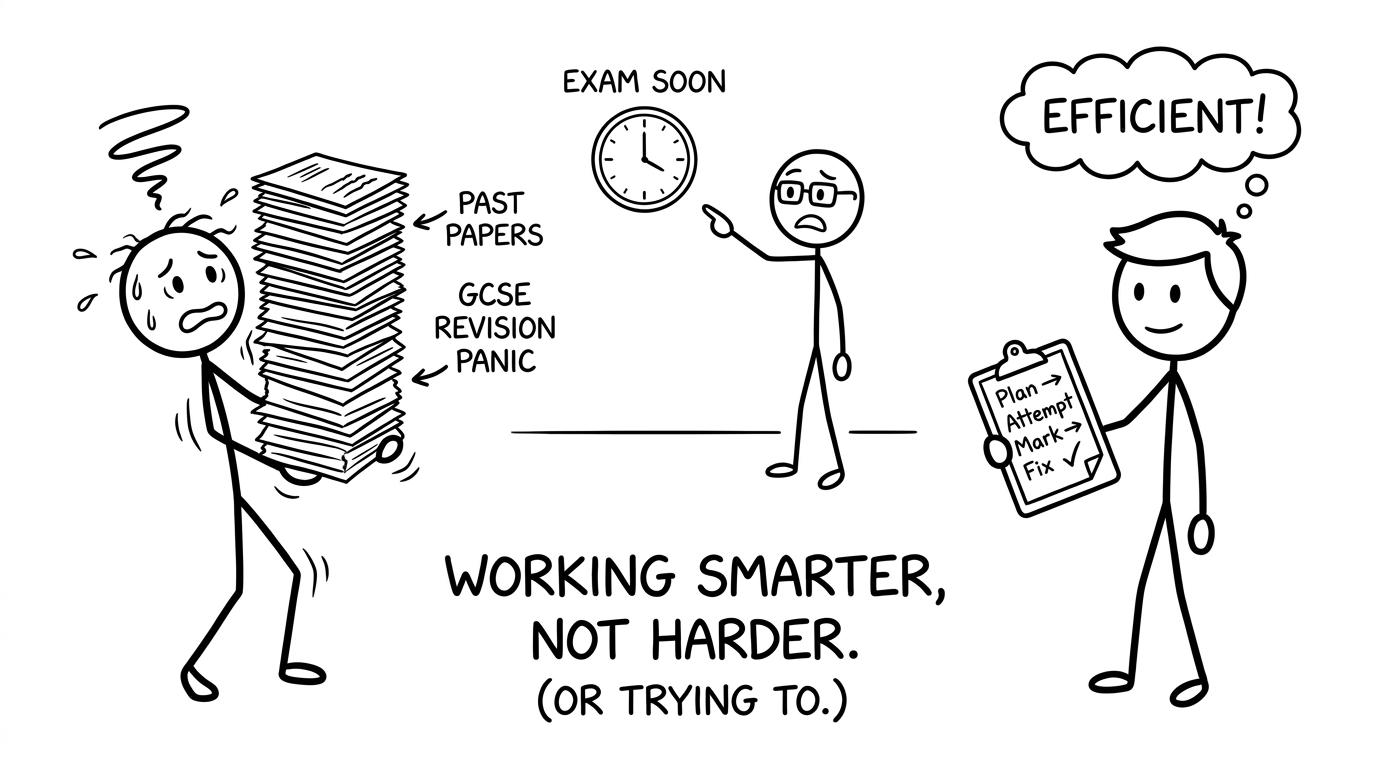 A calm checklist beats a panicked stack of past papers
The proper way to use OCR GCSE Chemistry past papers (quick checklist)
Use this as your default routine whenever you open an OCR GCSE Chemistry past paper.
- Pick the right paper for your stage (older papers for skill-building, newest papers for exam readiness).
- Do it timed with exam conditions at least some of the time.
- Mark it like an examiner, not like a friend.
- Build a mistake log that turns errors into targeted practice.
- Convert each mistake into a maths or method task (especially calculations, graphs, ratios and units).
- Repeat the same topic in a different format (topic questions, mini tests, then another paper).
For your maths side of revision, you can run the same process using GCSE Past papers and board-specific maths pages like GCSE Maths OCR.
Why OCR GCSE Chemistry past papers feel hard (even when you revised)
An OCR GCSE Chemistry paper is less about remembering facts under pressure and more about doing three things smoothly:
- Interpreting the question’s story (what is it really asking?).
- Selecting the correct method (which relationship, which graph skill, which calculation route?).
- Executing accurately (units, significant figures, rearranging, calculator entry).
That last bullet is where GCSE maths revision quietly pays off. If you’re strong at algebra, ratio, unit conversions and graphs, OCR Chemistry becomes less mysterious. It starts to feel like a structured puzzle.
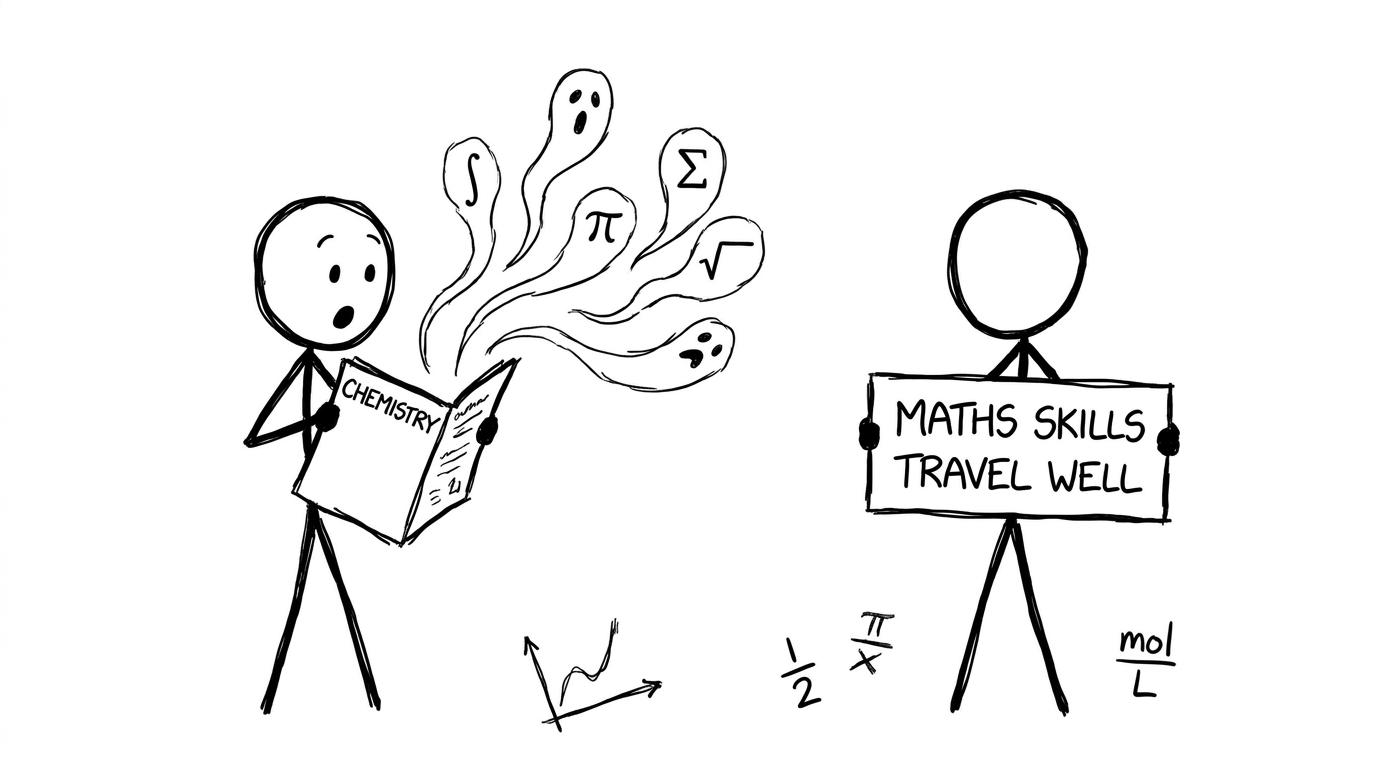 When “Chemistry” opens and maths floats out
Set up your OCR Chemistry past paper practice like a training block
Choose papers with a purpose
A good GCSE plan separates papers into roles:
- Learning papers (early): you stop often, annotate, and build understanding.
- Performance papers (late): fully timed, no pausing, then honest marking.
If you’re mixing this with maths revision, keep your practice ecosystem simple: use past papers for performance, and topic practice for fixing.
On YesGenie, students often pair paper practice with:
- Resources (including predicted papers, mini tests, and other revision tools)
- Other Resources (useful for self-checking and planning what to practise)
Simulate exam conditions (sometimes)
Not every session must be “full exam mode”. But if you never practise timed conditions, you’re leaving GCSE marks to chance.
Try:
- 1 full OCR Chemistry paper every 1-2 weeks (timed)
- 2 shorter “fix sessions” per week (targeted questions from your mistake log)
If your concentration dips, copy the idea behind shorter tests in maths such as mini tests and split papers (YesGenie has these styles within its revision resources). The point is to practise finishing.
Marking properly: the difference between practice and progress
Marking is where OCR GCSE Chemistry past papers turn into a score, or into improvement.
Mark for method, not just the final answer
In calculation questions, the mark scheme often rewards:
- correct substitution
- correct rearrangement
- correct units
- sensible rounding
So when you mark, don’t just circle a wrong answer. Write what went wrong.
A simple marking code helps:
- A = algebra/rearranging error
- U = units/conversion error
- R = ratio/proportion error
- G = graph/reading scales error
- S = significant figures/standard form error
- M = misread the question
Then your revision becomes a set of patterns, not a pile of regrets.
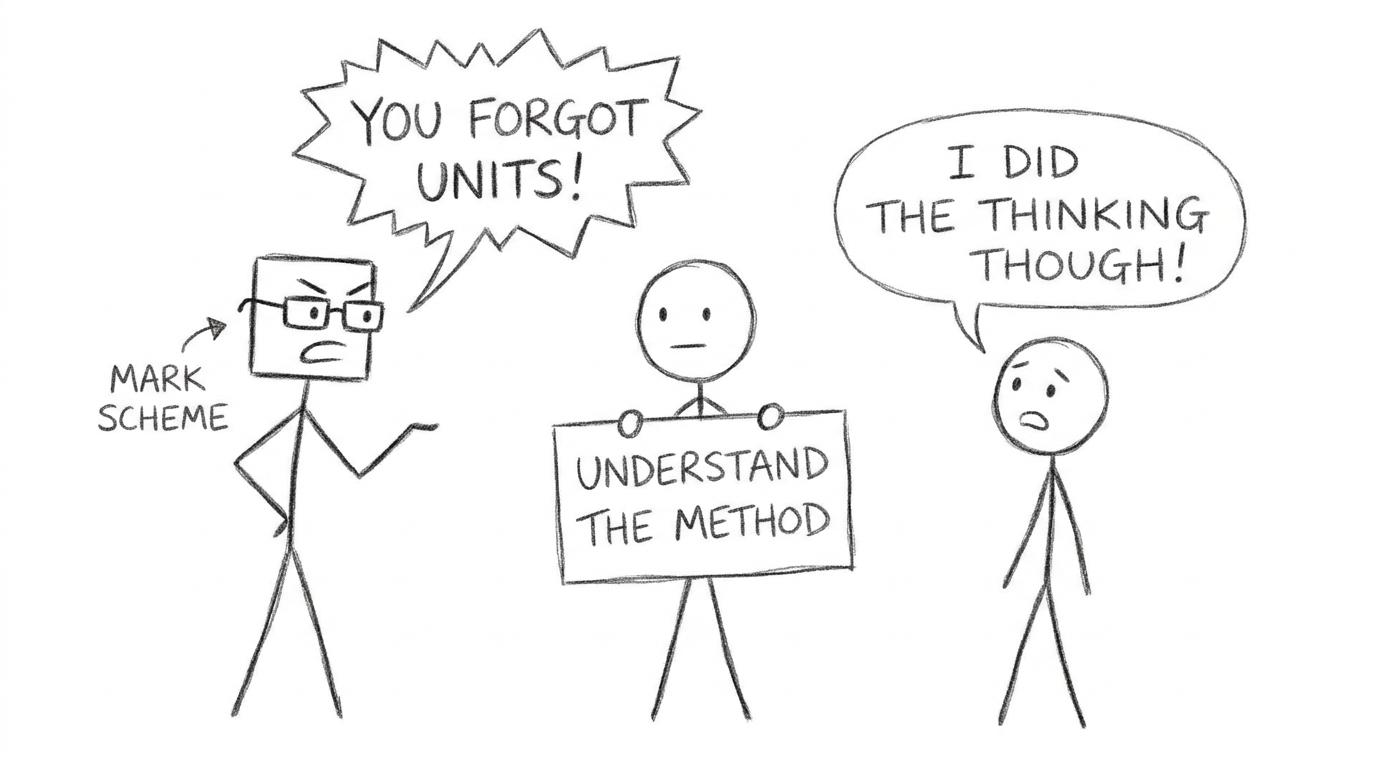 A student negotiates with the mark scheme
Worked examples: the maths skills OCR Chemistry keeps testing
These examples are Chemistry-flavoured, but the skill is pure GCSE maths. If you want to sharpen the maths behind them, practising GCSE maths topics on YesGenie alongside papers is a high-return move.
Rearranging a formula (and not losing the units)
Suppose a question uses the density relationship:
ρ=mV \rho = \frac{m}{V} ρ=VmIf ρ=1.25 g/cm3\rho = 1.25\,\text{g/cm}^3ρ=1.25g/cm3 and V=40 cm3V = 40\,\text{cm}^3V=40cm3, find mmm.
Rearrange:
m=ρV m = \rho V m=ρVSubstitute:
m=1.25×40=50 m = 1.25 \times 40 = 50 m=1.25×40=50So:
m=50 g m = 50\,\text{g} m=50gWhat GCSE students often miss is that the unit structure is doing the checking for you:
g/cm3×cm3=g \text{g/cm}^3 \times \text{cm}^3 = \text{g} g/cm3×cm3=gIf your units don’t simplify nicely, your rearrangement or conversion is probably off.
Ratio and proportion (limiting reagent style thinking)
Imagine a reaction where the ratio is effectively 2:12:12:1 between substances AAA and BBB. If you have 666 units of AAA, you need:
12×6=3 \frac{1}{2} \times 6 = 3 21×6=3units of BBB.
That calculation is simple, but OCR papers hide it inside words. The maths is still GCSE ratio. If ratio questions in maths are shaky, that weakness will leak marks in Chemistry too.
To build the habit of setting up proportions cleanly, doing structured ratio practice in maths helps. For example, topics like “best buy” and unit rates build the same thinking. See the maths approach in Best Buy Questions (OCR) Revision Guides.
Graph skills: gradient as rate of change
OCR GCSE Chemistry often uses graphs for rates, heating curves, or changes over time. The core GCSE maths move is gradient:
gradient=ΔyΔx \text{gradient} = \frac{\Delta y}{\Delta x} gradient=ΔxΔySuppose a graph shows mass decreases from 80 g80\,\text{g}80g to 50 g50\,\text{g}50g over 6 min6\,\text{min}6min.
Δy=50−80=−30 \Delta y = 50 - 80 = -30 Δy=50−80=−30 Δx=6 \Delta x = 6 Δx=6 gradient=−306=−5 \text{gradient} = \frac{-30}{6} = -5 gradient=6−30=−5So the rate is −5 g/min-5\,\text{g/min}−5g/min. In context you might report the magnitude as 5 g/min5\,\text{g/min}5g/min and explain it is decreasing. In a mark scheme, that explanation matters.
Turning an OCR Chemistry past paper into a revision plan (the mistake log loop)
A good GCSE mistake log is small, specific, and used daily.
After each OCR GCSE Chemistry past paper, write:
- the question number
- your marking code (A/U/R/G/S/M)
- the minimum fix (one sentence)
- the next action (what you will practise)
Example:
- Q4(c), U: converted cm3\text{cm}^3cm3 to m3\text{m}^3m3 wrongly.
- Fix: write the conversion and check powers of 101010.
- Next action: practise standard form and unit conversions for 20 minutes.
Then actually do the action. On YesGenie, that often means switching from paper mode to topic mode, then returning to another paper once the weakness is smaller.
If you’re revising maths alongside science, it’s efficient to use the maths equivalents:
- practise topics within your board page like GCSE Maths OCR
- use general exam practice via GCSE Past papers
Common mistakes students make with OCR GCSE Chemistry past papers
- Doing papers too early, too fast: you’re collecting wrong answers before you’ve built the methods.
- Never doing a timed paper: you get a false sense of security because you always “eventually” solve it.
- Marking leniently: giving yourself credit for an idea that the mark scheme won’t reward.
- Skipping units and significant figures: in GCSE science, these are not decoration; they are marks.
- Not categorising mistakes: without patterns, you can’t prioritise.
- Fixing with rereading, not practising: reading notes feels productive, but practice changes behaviour.
- Ignoring maths foundations: a shaky grip on ab\frac{a}{b}ba, standard form, gradient, and rearranging formulas quietly costs a lot over a whole paper.
How this helps your maths GCSE (and even A Level confidence)
Here’s the surprising part: using OCR GCSE Chemistry past papers properly can improve your GCSE maths performance because it forces you to do maths under story-based pressure. That’s exactly how GCSE maths exam questions are written: words first, method second.
When you find your Chemistry mistakes are mostly algebra, graphs, ratio and units, you’ve discovered your real revision priority. At that point, jumping into structured maths revision is not “switching subjects”; it’s reinforcing the same skill from a clearer angle.
If you’re moving towards A Level maths later, these habits matter even more. A Level rewards students who can do basic algebra and graph interpretation automatically, because the questions move too quickly for you to be re-learning GCSE foundations mid-solution.
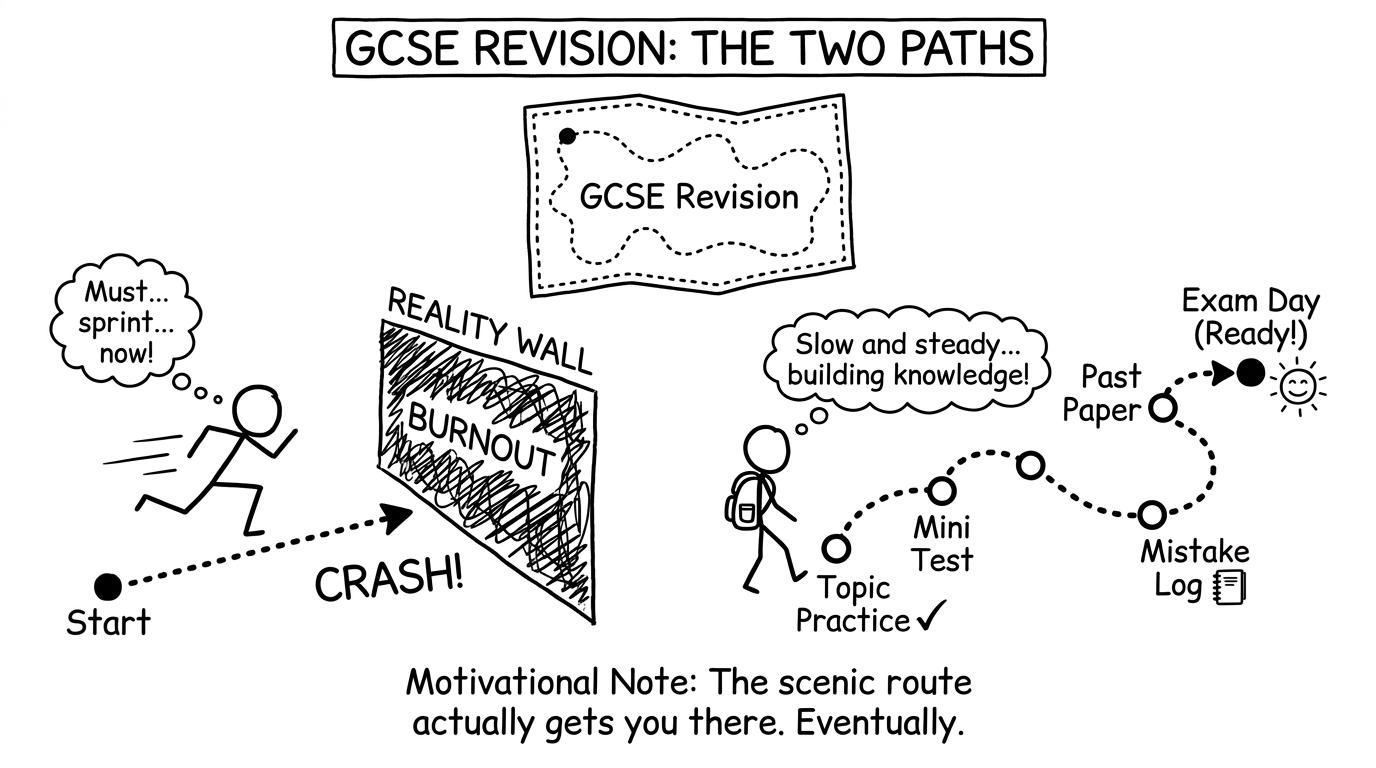 The revision map with checkpoints, not a sprint into a wall
Final thought: make GCSE past papers earn their place
OCR GCSE Chemistry past papers are not just something to “get through”. They’re a mirror. If you use them properly, they tell you exactly where your GCSE marks are hiding: in small, repeatable skills like rearranging formulas, handling units, interpreting graphs, and writing what the mark scheme rewards.
If you want that process to feel simpler, anchor it to a system. Use YesGenie’s free revision lessons, topic practice, and exam resources to move from diagnosis to improvement: start with GCSE Past papers, strengthen your foundations with GCSE Maths OCR, and explore more tools via Resources and Other Resources. Then return to the next OCR GCSE Chemistry past paper with one quiet aim: make one mistake impossible to repeat.