

GCSE: Use OCR Biology Past Papers Properly (Maths)
GCSE revision: learn how to use OCR Biology past papers properly, without wasting time. A maths-first method to plan, mark, analyse and improve.
GCSE season has a particular kind of silence. You sit down with an OCR Biology past paper, open the first page, and suddenly you can hear your own doubts thinking out loud: What if I’m doing this wrong? What if I’m just burning time? The truth is, most students don’t need more past papers; they need a better method.
This post shows you how to use OCR GCSE Biology past papers properly in a way that helps your maths too. Not because you’re sitting a biology calculator paper (you’re not), but because the discipline that lifts your GCSE maths marks, timing, method marks, error analysis, and targeted practice, is exactly the discipline that turns any past paper into progress.
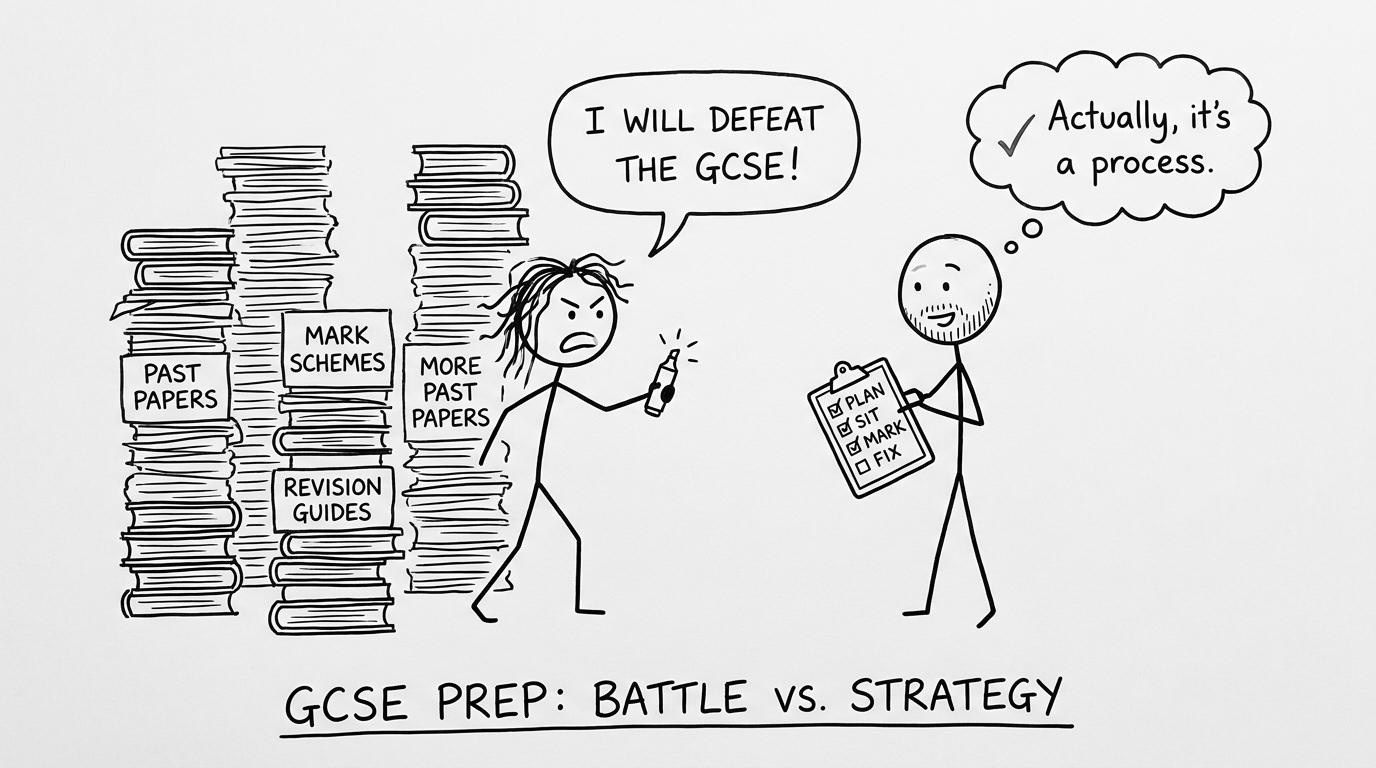 Student vs past papers checklist
The GCSE past paper method (a quick checklist)
If you only remember one structure for GCSE past papers, make it this:
- Plan: pick the paper, pick the time, pick the topics you’ll review afterwards.
- Sit: do it like the real thing (quiet, timed, no mark scheme).
- Mark: use the mark scheme like a microscope, not a judge.
- Fix: turn every lost mark into one clear action.
- Repeat: reattempt the same questions a week later.
On YesGenie, you can mirror this approach with maths resources too: start with GCSE Past papers, then follow up with topic practice and short recall using GCSE Mini Tests.
Why OCR Biology past papers can improve your GCSE maths mindset
OCR Biology past papers reward the same hidden skills that drive GCSE maths grades 9-1:
- Interpreting command words (describe, explain, calculate) is like spotting whether a maths question wants a proof, a method, or a final value.
- Method marks exist in both subjects, even if they look different. In maths, you often gain marks for setting up an equation correctly even if arithmetic slips.
- Data handling shows up everywhere: rates, percentages, averages, and graphs are GCSE crossovers.
If you’re revising maths alongside science, keep your maths revision anchored to one board so practice is consistent. If you’re OCR for maths, begin at GCSE Maths OCR and use the question bank and lessons to fix weaknesses you uncover.
 Calculator and biology book arguing
How to choose the right OCR Biology paper (so GCSE revision stays targeted)
A common trap is doing “a paper” because it feels productive. Better is doing the right paper for the right reason.
Match your paper to your goal
- If you want confidence: do an older OCR Biology paper first, open-book for the first 10 minutes only, then close notes and finish normally.
- If you want accuracy: do a recent paper untimed, but annotate every question with what it’s really testing.
- If you want exam readiness: do a recent paper fully timed, no interruptions.
Borrow the GCSE maths approach to tier and difficulty
In maths, you’re used to Foundation vs Higher tier and predictable topic weighting. Biology isn’t tiered the same way across all specs, but the principle still applies: pick papers that match your current level and then stretch gradually.
For maths, you can keep a steady pipeline of exam-style practice by board, for example:
Sit OCR Biology past papers like a real GCSE (without fooling yourself)
The biggest jump in GCSE scores often comes from removing tiny comforts: pausing, checking, re-reading notes, “just quickly looking up” a definition. Those comforts feel harmless. They also make your results meaningless.
The non-negotiables
- Timer on from the first question.
- No mark scheme until the end.
- No phone (even face down).
- Write in full where the paper expects it.
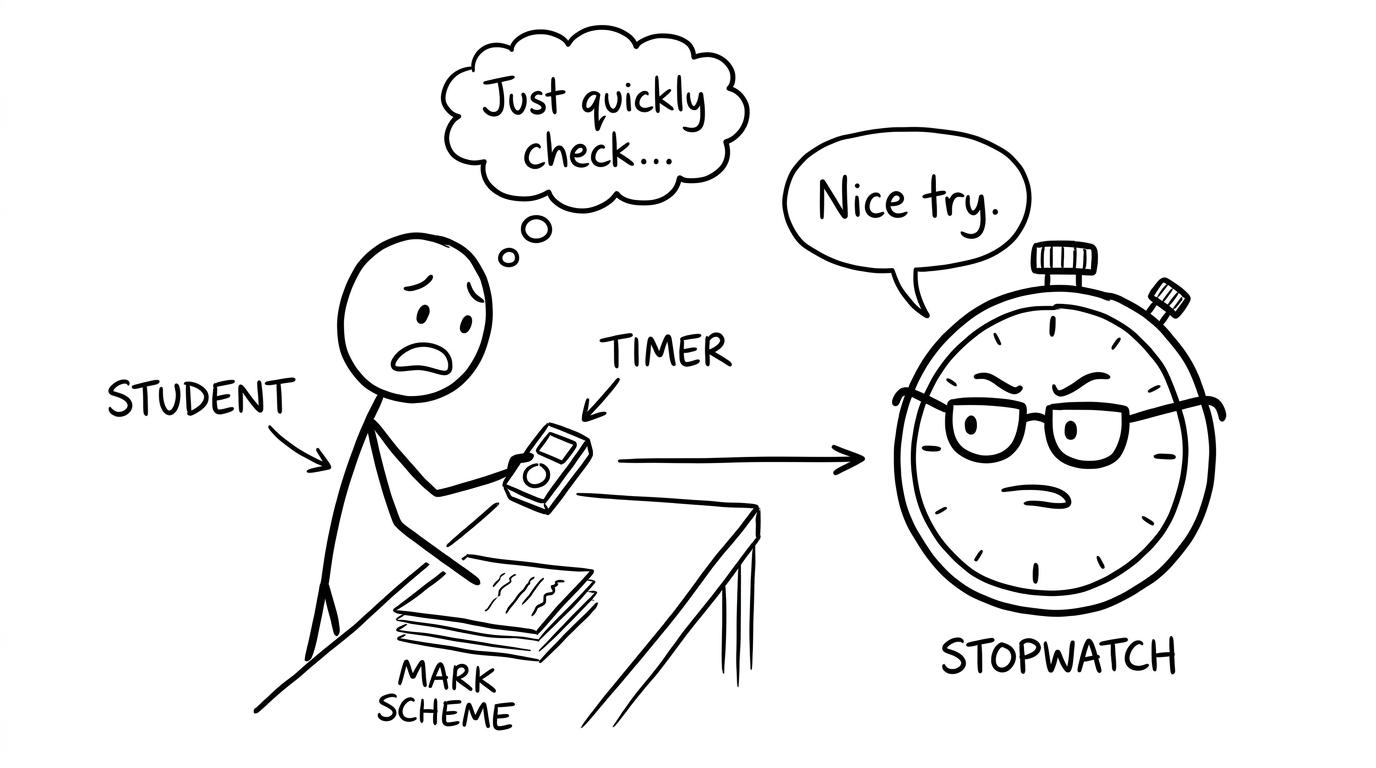 Stopwatch catching mark scheme cheating
A maths-style timing rule that works in biology
In GCSE maths, you often estimate time per mark. Use the same rule here.
If a paper is TTT minutes and worth MMM marks, your average time per mark is:
minutes per mark=TM \text{minutes per mark} = \frac{T}{M} minutes per mark=MTExample: Suppose your paper is 909090 minutes and 100100100 marks.
90100=0.9 \frac{90}{100} = 0.9 10090=0.9That’s about 0.90.90.9 minutes per mark (roughly 545454 seconds). If a 2-mark question is dragging past 222 minutes, you’re probably stuck; move on and return.
This simple GCSE habit also improves maths papers, especially on Higher tier where the last five questions can steal time if you let them.
Mark OCR Biology past papers properly (the part most students rush)
Marking is where improvement lives. Doing papers is just collecting evidence.
Use the mark scheme like a method checklist
In GCSE maths mark schemes, you’ll often see method marks (M), accuracy marks (A), and independent marks (B). Biology mark schemes are different, but the same mindset works: the examiner is looking for specific points, not a general vibe.
When you mark:
- Highlight the exact words the mark scheme wanted.
- Circle any “almost” answer, then write what was missing.
- Keep a log of mistakes by type, not by topic.
Build a “lost marks ledger” (and treat it like maths)
Create three columns:
- Type: knowledge gap, misread, weak explanation, data handling.
- Trigger: what caused the slip (panic, unfamiliar wording, rushed graph reading).
- Fix: one action you can do this week.
A strong GCSE student is not someone who never gets it wrong. It’s someone who can say, “I know exactly why I dropped those 6 marks, and I know what I’ll do next.”
The maths crossover: worked examples you’ll see in OCR Biology papers
OCR Biology past papers often include calculations. If you’re revising GCSE maths, treat these as free practice in ratio, percentage change, and unit conversion.
Worked example: percentage decrease (common in practical/data questions)
A student’s heart rate drops from 848484 bpm to 727272 bpm.
-
Find the decrease: 84−72=1284 - 72 = 1284−72=12.
-
Divide by the original: 1284=17\frac{12}{84} = \frac{1}{7}8412=71.
-
Convert to a percentage:
So the heart rate decreased by approximately 14.3%14.3\%14.3%.
If this kind of calculation feels shaky, revisit percentages practice on YesGenie via your OCR maths topic routes (start at GCSE Maths OCR and use lessons plus question bank).
Worked example: rearranging a formula (where GCSE maths marks are won)
Suppose a biology question gives a relationship like:
D=MV D = \frac{M}{V} D=VMand asks you to make VVV the subject.
Multiply both sides by VVV:
DV=M DV = M DV=MNow divide both sides by DDD:
V=MD V = \frac{M}{D} V=DMThis is pure GCSE algebra. If rearranging is a weak spot, build confidence with structured practice questions and worked solutions.
Worked example: mean rate from data
A plant grows from 12 cm12\text{ cm}12 cm to 18 cm18\text{ cm}18 cm in 888 days.
Change in height: 18−12=6 cm18 - 12 = 6\text{ cm}18−12=6 cm.
Mean rate:
rate=68=0.75 cm/day \text{rate} = \frac{6}{8} = 0.75\text{ cm/day} rate=86=0.75 cm/dayAgain, very GCSE: difference, divide, units.
Turn one OCR Biology past paper into a week of GCSE progress
A past paper should create a chain reaction.
Day 1: Sit the paper
Do it timed. Stop when time stops.
Day 2: Mark and classify
Don’t just total the score. Identify patterns.
Day 3: Patch the maths crossover skills
If you lost marks on graphs, proportion, or rearranging, switch into maths repair mode:
- Use topic notes and examples in Edexcel GCSE Maths Revision Guides (even if you’re not Edexcel, the skills transfer well).
- Then practise questions by topic on your board page, like GCSE Maths OCR.
Day 4: Do short recall
Use quick tests to make the fix stick. In maths, the fastest way is short focused papers like Edexcel GCSE Maths Mini Tests.
Day 7: Reattempt the exact questions you missed
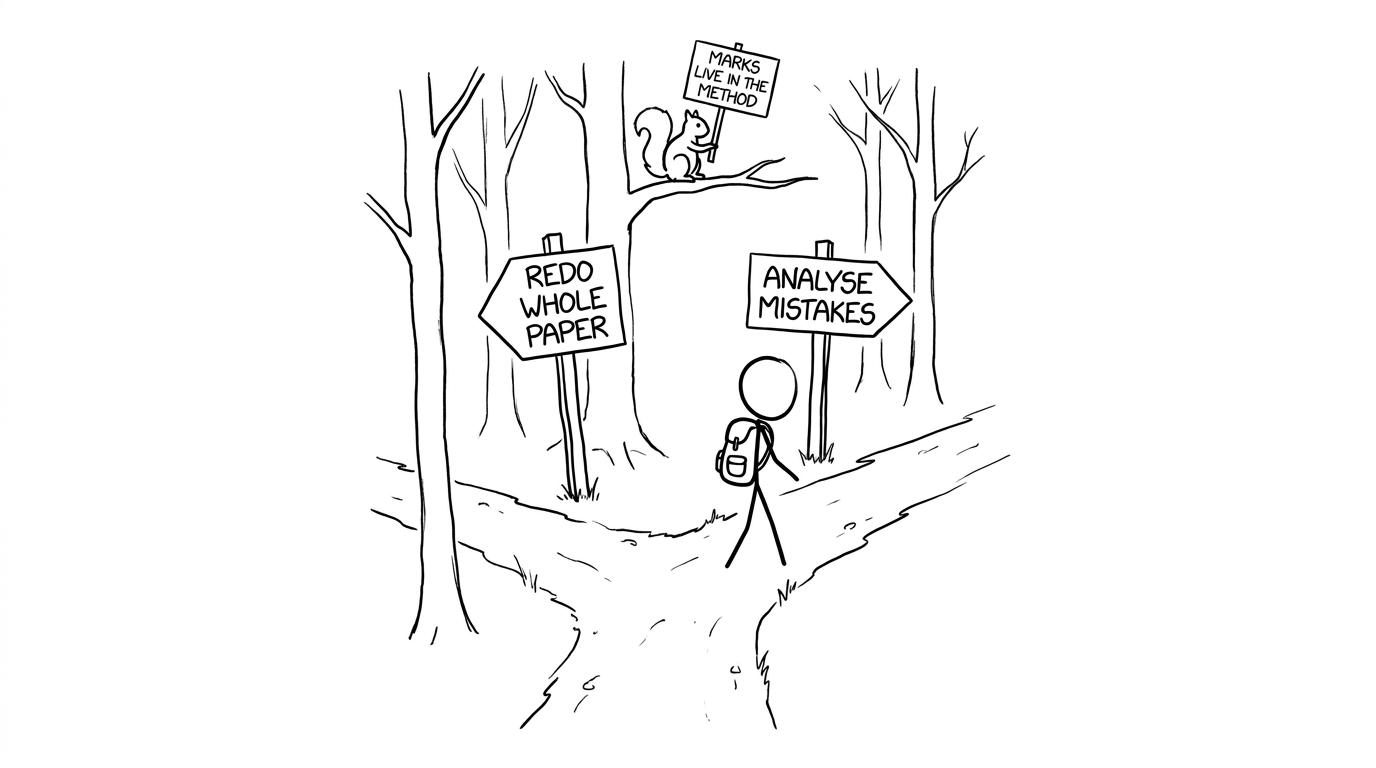
This is the bit most students skip. It’s also the bit that actually changes your GCSE grade.
 Choosing analyse mistakes over redo paper
Common mistakes when using OCR Biology past papers
- Marking for comfort, not accuracy: giving yourself the mark because you “basically meant that”. In GCSE marking, “basically” scores 000.
- Using the mark scheme too early: it turns the paper into guided revision, not assessment.
- Chasing total marks only: two students can both score 60%60\%60%, but one has fixable timing issues and the other has core knowledge gaps. Same score, different next step.
- Never redoing errors: if you don’t reattempt missed questions, you’re collecting mistakes instead of converting them.
- Ignoring maths-y slips: dropping easy calculation marks because of units, rounding, or rearranging is like losing GCSE maths marks on the last line.
Bringing it back to YesGenie (and your next GCSE step)
Using OCR Biology past papers properly is less about biology and more about habits: sitting papers honestly, marking with care, and turning mistakes into a plan. That mindset is what raises GCSE grades fastest, and it’s exactly what YesGenie is built to support.
If you want the maths side of your GCSE revision to feel simpler and more structured, use YesGenie as your home base: start with GCSE Past papers, then patch gaps using your board page like GCSE Maths OCR, reinforce with short recall via GCSE Mini Tests, and keep explanations tight with Edexcel GCSE Maths Revision Guides. Do that consistently, and past papers stop being something you survive, and become something that steadily, quietly, lifts your marks.










