GCSE: How to stop forgetting Chemistry content
GCSE revision tips to stop forgetting Chemistry content: spaced repetition, active recall, maths methods, and a plan using YesGenie practice papers.
The moment you realise you’ve “revised”, and remembered nothing
If you’ve ever opened your notes the night before a GCSE paper and felt that cold, hollow feeling, I definitely covered this… so why can’t I say it out loud?, you’re not lazy. You’re human. Memory doesn’t work like a highlighter pen. It’s more like a path through long grass: you don’t build it by staring at it. You build it by walking it.
And here’s the twist for GCSE and A Level maths students: the best way to stop forgetting Chemistry is to steal the revision behaviours you already use in maths. Maths forces you into retrieval, spacing, and feedback. Chemistry often tempts you into rereading and copying. This post shows you how to revise Chemistry so it sticks, while keeping your maths strong using YesGenie.
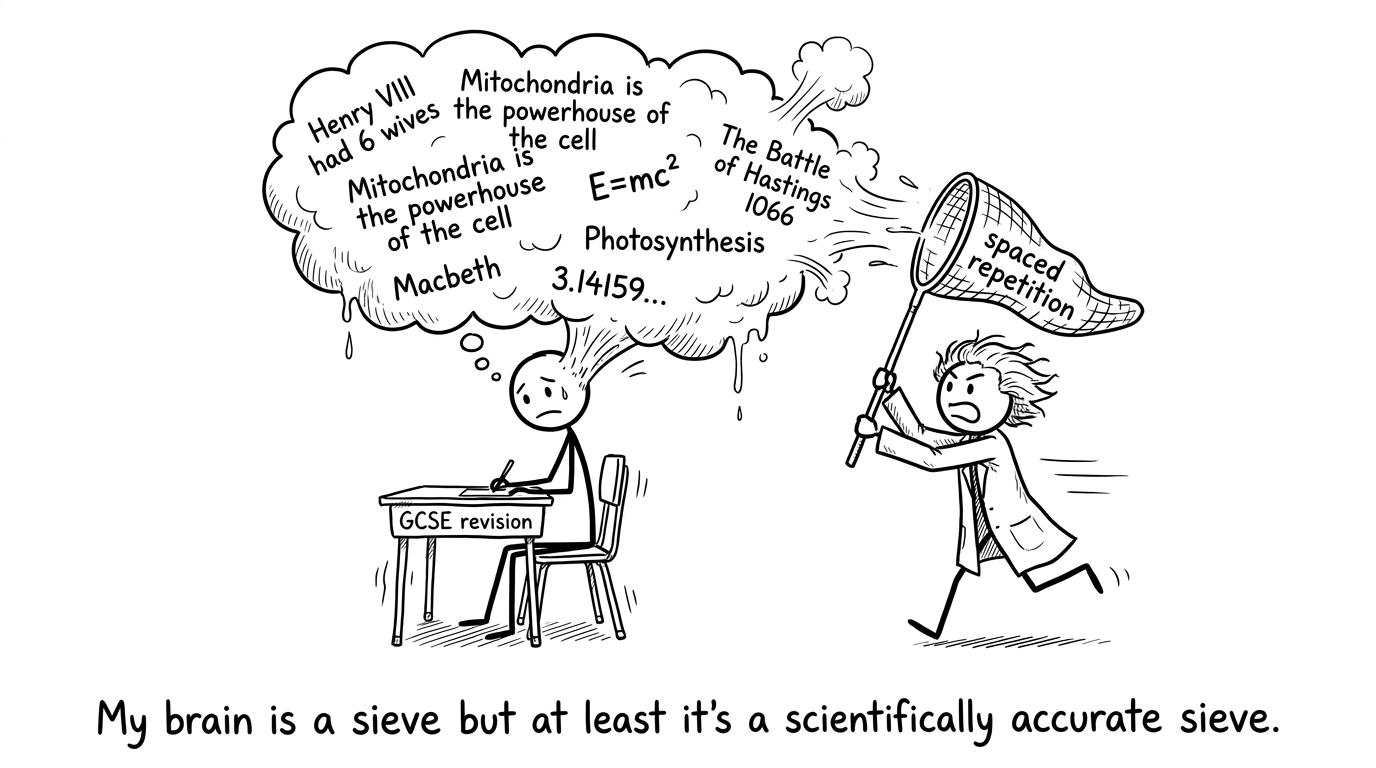 A student catching escaping facts with spaced repetition
A simple checklist to stop forgetting (save this)
Use this checklist for GCSE Chemistry content you keep forgetting:
- Retrieve first: try to write or say what you know before looking.
- Space it: revisit after 111 day, 333 days, 777 days, then weekly.
- Interleave: mix topics (bonding + calculations + rates) instead of blocks.
- Mark ruthlessly: use mark schemes to learn phrasing and precision.
- Convert facts into questions: every bullet point becomes a test.
- Do a little maths daily: it keeps your problem-solving sharp and reduces overall exam stress.
For the maths side of your GCSE routine, you can keep momentum with YesGenie’s topic lessons and exam practice: Edexcel GCSE Maths Revision and GCSE Past Papers (all boards).
Why you forget GCSE Chemistry (and why it feels personal)
Most forgetting happens for three quiet reasons.
First, recognition masquerades as knowing. You read a page on electrolysis and your brain nods along. It feels familiar, so it feels learned. But in a GCSE exam you don’t get marks for familiarity. You get marks for recall under time pressure.
Second, you’re often revising Chemistry in “one long sitting”. That creates short-term performance but weak long-term storage. The brain loves to throw away information it thinks you won’t need again.
Third, Chemistry is packed with similar-looking ideas: ionic vs covalent, exothermic vs endothermic, displacement vs neutralisation. Without deliberate practice at telling them apart, your memory files them in the same drawer.
Maths students are used to this problem. A question on fractions can look like a question on ratio until you read carefully. That’s why maths revision naturally uses practice questions and mark schemes. We’re going to make Chemistry revision behave the same way.
The “maths method” for Chemistry memory: active recall + spacing
Turn notes into retrieval prompts
Take a Chemistry page and force it into questions. For example:
- “What is an isotope?”
- “Why does increasing concentration increase rate?”
- “What must you include to get full marks on ‘explain’ questions?”
Then answer without looking. Only afterwards do you check and correct. This is active recall.
If you want a familiar model, think of how you revise algebra. You don’t reread the rules. You try a question, get it wrong, then fix it. YesGenie is built around that loop: lesson, practice, solutions, repeat.
Useful maths pages to keep your daily retrieval habit consistent:
Use a spacing schedule that actually fits school life
A practical spacing pattern for GCSE Chemistry:
- Day 000 (today): learn + retrieve immediately.
- Day 111: 101010 minutes retrieval.
- Day 333: 101010 minutes retrieval.
- Day 777: 151515 minutes mixed retrieval.
- Weekly: 151515 a few 252525 minutes, exam-style.
Keep each session short. The power comes from returning when it’s slightly uncomfortable. That mild struggle is the signal your brain uses to strengthen memory.
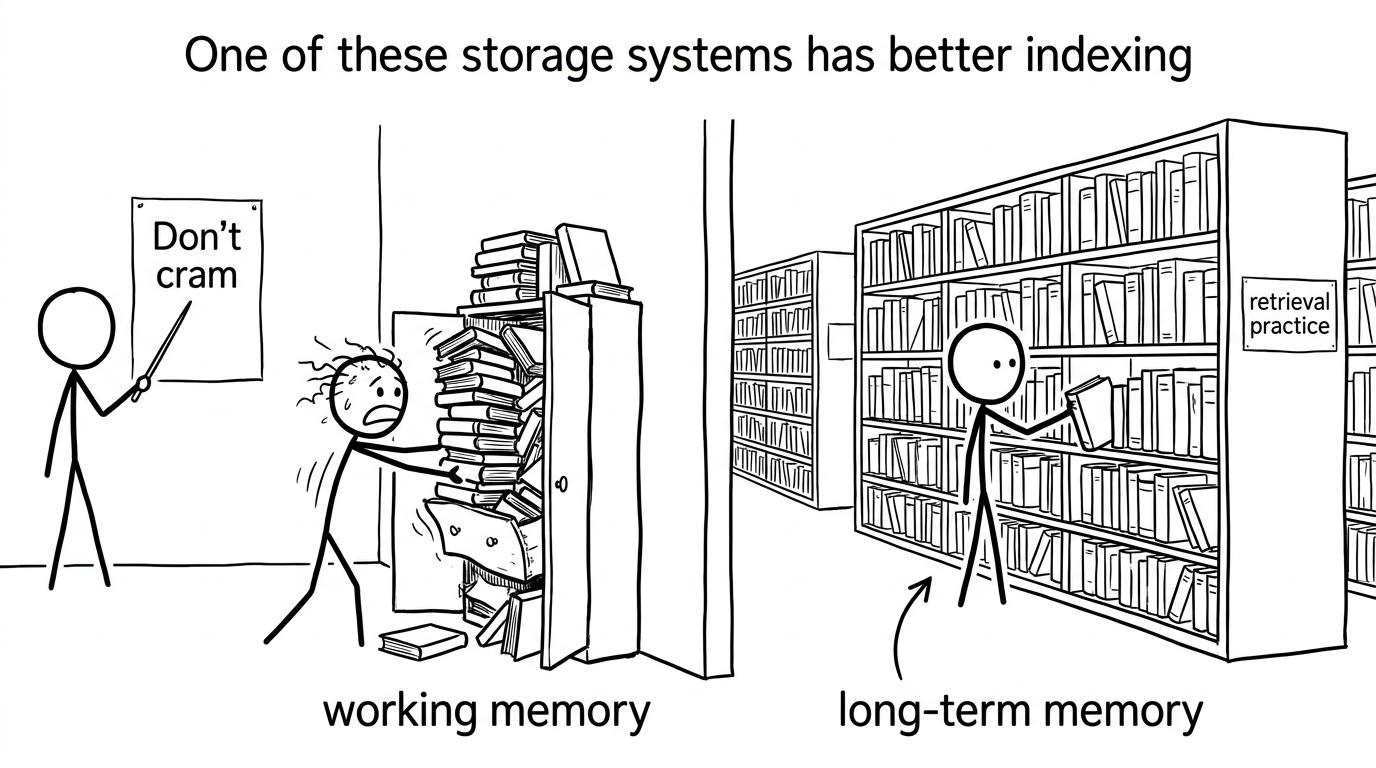 Don’t cram books into working memory
Make Chemistry stick by borrowing GCSE maths exam habits
Mark schemes teach you what “a mark” really is
In Chemistry, marks are often for specific keywords or logical links. In maths, marks are often for method even if the final answer is wrong. Either way, the mark scheme is a map of what the examiner rewards.
So revise Chemistry like you revise maths:
- Do a short set of exam questions.
- Mark strictly.
- Rewrite the best answer in your own words.
- Re-test 484848 hours later.
To practise that discipline on the maths side (which helps your overall GCSE exam stamina), use:
Interleaving: stop revising in “pretty” chapters
Chemistry revision often goes: “I’ll do all of bonding this weekend.” It feels tidy. It’s also a trap.
Instead, mix:
- a recall task (definitions)
- a calculation task (moles, concentration)
- an explanation task (rates, equilibrium)
Maths revision naturally interleaves because exam papers mix topics. You can mirror that feeling with YesGenie: do a mini test, then a couple of revision guide sections, then a past paper.
Worked examples: the Chemistry memory boost hiding in GCSE maths skills
Chemistry is full of maths. When students “forget Chemistry”, what they often mean is: I panic on the calculations and then I can’t remember the words either. Fixing the calculations reduces anxiety, which frees memory.
Worked example 1: concentration
A student makes 250 cm3250\text{ cm}^3250 cm3 of solution using 5 g5\text{ g}5 g of sodium chloride (relative formula mass =58.5=58.5=58.5). Find the concentration in mol dm−3\text{mol dm}^{-3}mol dm−3.
Step 1: Convert volume
1000 cm3=1 dm31000\text{ cm}^3 = 1\text{ dm}^31000 cm3=1 dm3, so
250 cm3=2501000 dm3=0.25 dm3. 250\text{ cm}^3 = \frac{250}{1000}\text{ dm}^3 = 0.25\text{ dm}^3. 250 cm3=1000250 dm3=0.25 dm3.Step 2: Find moles
n=mMr=558.5≈0.08547 mol. n = \frac{m}{M_r} = \frac{5}{58.5} \approx 0.08547\text{ mol}. n=Mrm=58.55≈0.08547 mol.Step 3: Concentration
c=nV=0.085470.25≈0.34188 mol dm−3. c = \frac{n}{V} = \frac{0.08547}{0.25} \approx 0.34188\text{ mol dm}^{-3}. c=Vn=0.250.08547≈0.34188 mol dm−3.So c≈0.342 mol dm−3c \approx 0.342\text{ mol dm}^{-3}c≈0.342 mol dm−3 (to 333 s.f.).
Notice the structure: convert units, substitute, calculate, present to appropriate accuracy. That is pure GCSE maths behaviour.
To keep these skills automatic, practise substitution and rearranging on YesGenie:
Worked example 2: percentage yield
A reaction should produce 12 g12\text{ g}12 g of product, but actually produces 9 g9\text{ g}9 g. Find the percentage yield.
Percentage yield=actualtheoretical×100=912×100=75%. \text{Percentage yield} = \frac{\text{actual}}{\text{theoretical}} \times 100 = \frac{9}{12} \times 100 = 75\%. Percentage yield=theoreticalactual×100=129×100=75%.Again, this is fractions and percentages. If you make the maths fluent, you reduce the cognitive load in Chemistry.
A quick maths refresher that supports this:
Common mistakes that keep GCSE Chemistry slipping away
- Rereading instead of retrieving: if your revision doesn’t include testing yourself, forgetting is guaranteed.
- Making flashcards that are too vague: “Electrolysis” on the front is not a prompt. A better front is “Why must an ionic compound be molten for electrolysis?”
- No spacing: revising a topic once and calling it “done” is not how memory works.
- Ignoring mark scheme language: in GCSE Chemistry, precision matters. “Atoms swap electrons” is not the same as “electrons are transferred”.
- Doing calculations only when you feel confident: that delays the discomfort that actually creates learning.
- Letting maths drift: if you stop practising maths, you’ll spend more working memory on calculations in Science, and you’ll forget more content under pressure.
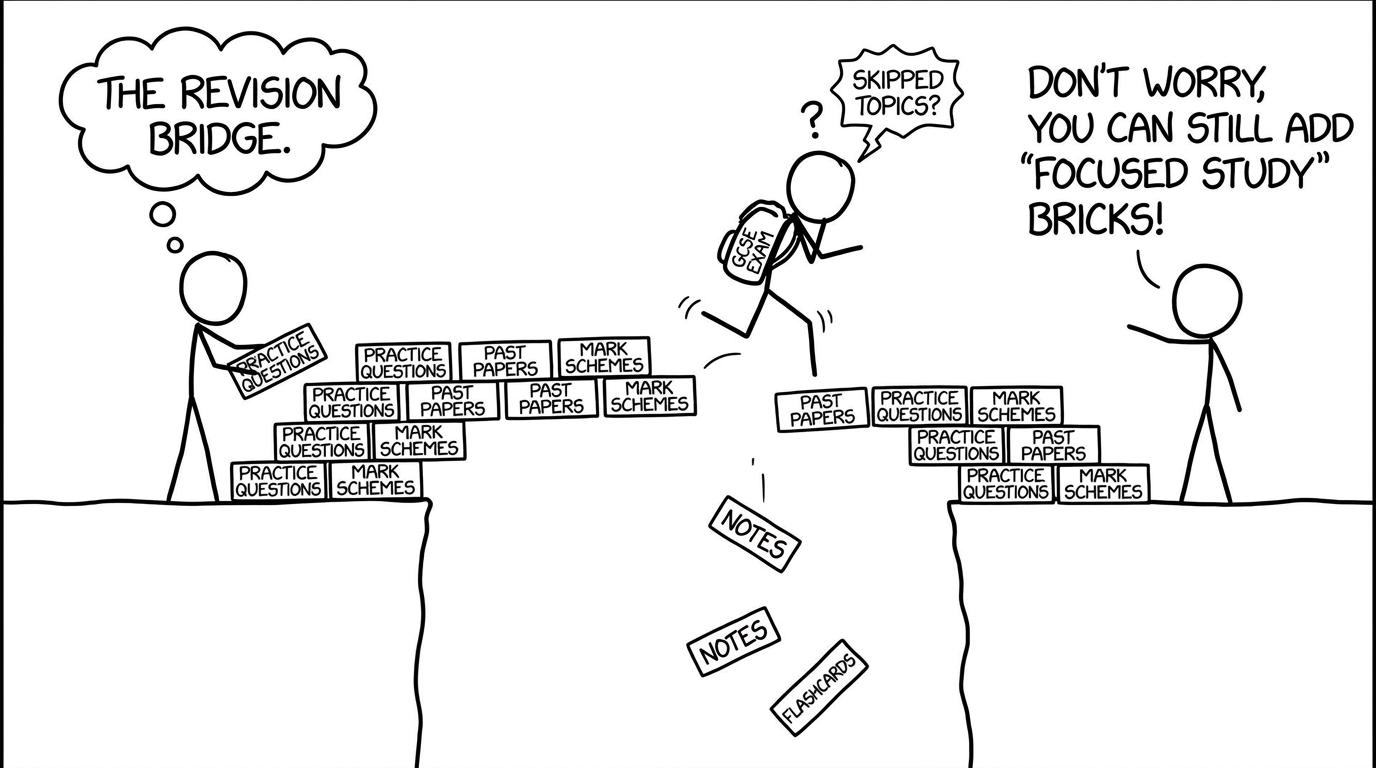 A revision plan built like a bridge
Bringing it together: a calm plan that stops forgetting
Forgetting GCSE Chemistry content isn’t a character flaw. It’s what happens when revision is built around exposure instead of retrieval. The fix is refreshingly unglamorous: test yourself, leave gaps, come back, and let the mark scheme teach you what matters.
If you’re a GCSE or A Level maths student, you already have the blueprint. You know how it feels to improve by doing questions, checking solutions, and trying again. Use that same rhythm for Chemistry, and keep your maths strong with YesGenie at the same time.
Your next step:
- Pick one Chemistry topic you keep forgetting and turn it into 151515 retrieval questions.
- Schedule it on a simple spacing plan for the next two weeks.
- Keep a short daily maths routine using YesGenie lessons, revision guides, and past papers.
Start here on YesGenie:
- Resources hub (mini tests, predicted papers, and more)
- Edexcel GCSE Maths Revision
- GCSE Past Papers (all boards)
- Edexcel GCSE Maths Past Papers
Keep showing up. Memory is built the same way grades are built: a small, repeated vote for the student you’re becoming, one retrieval at a time, until the GCSE paper feels familiar for the right reasons.