

GCSE Revision: Stop Forgetting Content (Even Biology)
GCSE revision that sticks: learn how to stop forgetting Biology content using spaced practice, active recall and maths-style exam routines with YesGenie.
GCSE revision has a strange rhythm. You can spend an hour rereading a page of Biology, feel like you “know it”, then open a past paper and realise your brain has quietly moved out overnight.
If that’s you, you’re not lazy. You’re normal. Forgetting is what brains do when revision stays comfortable, tidy, and a little too gentle. The trick is to revise like your exam will test you: under pressure, from memory, with mistakes turned into a plan.
This post is about how to stop forgetting GCSE Biology content, but it’s written for UK GCSE and A Level maths students, because the habits that make you reliable in maths are the same habits that make Biology stick.
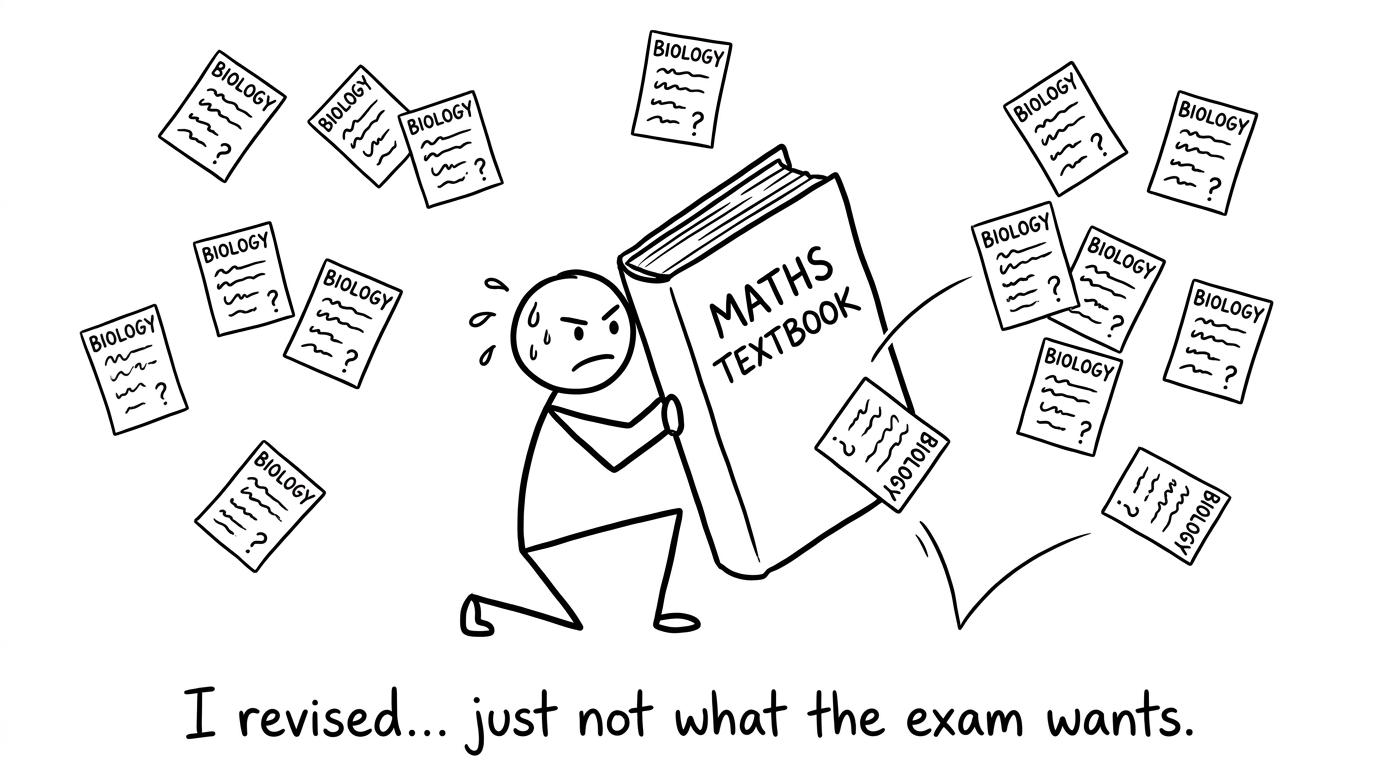 A stressed student with Biology flashcards and a maths textbook shield
The quick checklist (use this tonight)
If you only do one thing, do this:
- Replace rereading with active recall (no notes, just your brain).
- Space your GCSE revision: revisit after 1 day, 3 days, 7 days, 14 days.
- Interleave topics (don’t revise “all of cells” in one block).
- Turn mistakes into a “mark scheme list” of what you missed.
- Do timed exam practice, then fix the exact gaps.
For maths students, this is already familiar: you don’t “read about algebra” and hope for the best. You practise, you check, you redo.
Why you keep forgetting GCSE Biology (and why it feels unfair)
Most forgetting comes from two traps:
You’re confusing recognition with recall
Rereading is like looking at a solution and thinking “I would have done that.” It feels fluent because the answer is right in front of you. But GCSE exams don’t reward recognition. They reward recall, and, in Biology, recall in the phrasing the mark scheme expects.
Your revision is too “blocked”
If you revise infection, then infection, then infection, you get better at infection in that moment. But GCSE Biology papers ask you to switch: cells to enzymes to ecology to required practicals. Blocking makes revision feel productive; interleaving makes you exam-ready.
The maths parallel is obvious: doing 20 identical factorising questions builds confidence, but mixing factorising with rearranging and angles builds marks.
GCSE revision that sticks: steal the maths method
Maths revision works because it has three built-in behaviours:
- You attempt without notes.
- You get immediate feedback.
- You repeat what you got wrong.
That’s the whole system. So let’s transplant it into GCSE Biology.
The “no-notes first” rule (active recall)
Pick one GCSE Biology subtopic, set a timer for 6 minutes, and write everything you can remember on a blank page. Then check notes and correct in a different colour.
Your goal isn’t neat notes. Your goal is to generate “desirable difficulty”: the effort that creates memory.
A maths student already does this instinctively with exam questions. On YesGenie, you can keep your maths habits sharp with:
Even if you’re revising Biology, keeping a daily maths “active recall” loop makes your whole revision more disciplined.
Spaced practice (build a timetable your future self will thank you for)
Spacing is not a productivity hack. It’s how memory consolidates. The pattern below is simple enough to follow during GCSE season:
- Day 0: learn + active recall
- Day 1: quick test
- Day 3: quick test
- Day 7: exam question
- Day 14: exam question again
If you want a maths-flavoured way to keep yourself honest, use timed papers as anchor points. YesGenie’s predicted and past papers give you deadlines that aren’t imaginary:
- Edexcel GCSE Maths Predicted Papers
- Edexcel GCSE Maths Revision
- Resources (including predicted papers and mini tests)
Worked example: planning spaced GCSE revision with a simple model
Let’s make spacing concrete using a tiny maths model you can actually apply.
Imagine you rate your recall of a GCSE Biology topic out of 10 after a session.
- Right after revising: 10/1010/1010/10
- After 1 day: maybe 7/107/107/10
- After 7 days: maybe 4/104/104/10
Suppose your recall drops by about 30%30\%30% each day you don’t revisit (not a perfect science model, but useful for planning). If you start at 101010, then after nnn days your recall is:
R=10×0.7n R = 10 \times 0.7^n R=10×0.7nAfter 333 days:
R=10×0.73=10×0.343=3.43 R = 10 \times 0.7^3 = 10 \times 0.343 = 3.43 R=10×0.73=10×0.343=3.43That’s the point: even if you felt great on Day 0, your brain may be sitting at about 3.43/103.43/103.43/10 by Day 3 unless you interrupt the forgetting curve.
Now see why spaced practice works: you revisit just as you’re about to forget, which forces retrieval and strengthens the memory.
This is GCSE revision thinking like a mathematician: not vibes, but a system.
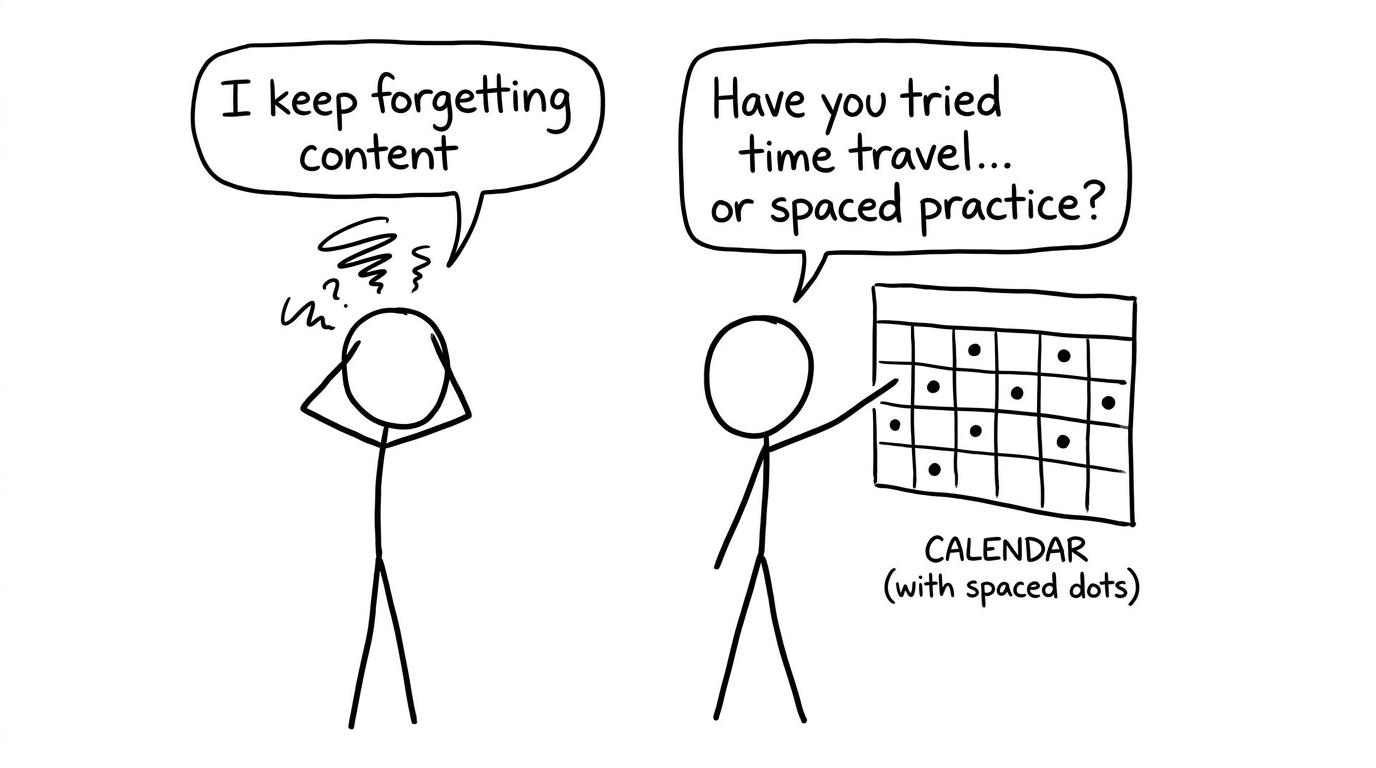 Two students arguing about forgetting and a calendar of spaced repetition
Interleaving: the secret that makes recall exam-proof
Interleaving means mixing topics so your brain has to choose the method, not just repeat it.
A simple GCSE Biology interleave set might look like:
- 10 minutes: cell structure recall
- 10 minutes: enzymes recall
- 10 minutes: required practical method + variables
- 10 minutes: ecology definitions
For maths students, you can mirror this with a mixed set from your weaker areas (for example, ratio, equations, and graphs). If you’re doing Edexcel, build the habit with:
The point isn’t the board. The point is training your brain to switch.
Turn mark schemes into memory: the “exam language bank”
GCSE Biology rewards specific phrasing: “diffusion is the net movement of particles from a region of higher concentration to a region of lower concentration” is not the same as “stuff spreads out”.
Here’s the maths-student approach: treat every missing mark like a missing method mark.
Make a two-column corrections log
On the left, write the question prompt. On the right, write the exact mark scheme phrase you needed.
Then revise that log using active recall. Cover the right column and force yourself to produce the wording.
This is exactly how you improve in maths: you learn the structure of what gets marks.
To practise that in maths, use videos and mark schemes side-by-side. For example:
Worked example: use maths to reduce Biology forgetting
Say you have 8 GCSE Biology topics you keep forgetting and you want to fit them into a week alongside maths.
You have 6 revision days, and you can do 3 focused slots per day. That’s 6×3=186 \times 3 = 186×3=18 slots.
If each topic needs 2 spaced revisits in the week (first recall + one spaced recall), you need 8×2=168 \times 2 = 168×2=16 slots.
That leaves 18−16=218 - 16 = 218−16=2 slots for exam practice or “panic gaps”.
The method is calm because it’s counted. You’re not guessing. You’re allocating.
If you also need maths practice, make one of the daily slots a timed set from YesGenie (mini test, topic questions, or a half paper). The consistency keeps GCSE revision from turning into a last-minute sprint.
Common mistakes (that quietly sabotage GCSE revision)
- Rereading instead of recalling. You feel productive, but you’re not testing memory.
- No spacing. You “finish” a topic once and never return, which guarantees forgetting.
- Only doing easy questions. In Biology, that means definitions but not application. In maths, it’s repeating the same format.
- Not learning from mark schemes. GCSE marks are awarded for specific ideas and phrasing.
- Revision sessions that are too long. After 40-60 minutes, your output often drops. Short, repeated sessions win.
- Ignoring maths because you’re stressed about Biology. Then maths becomes the new stress. Keep maths ticking over with short YesGenie practice.
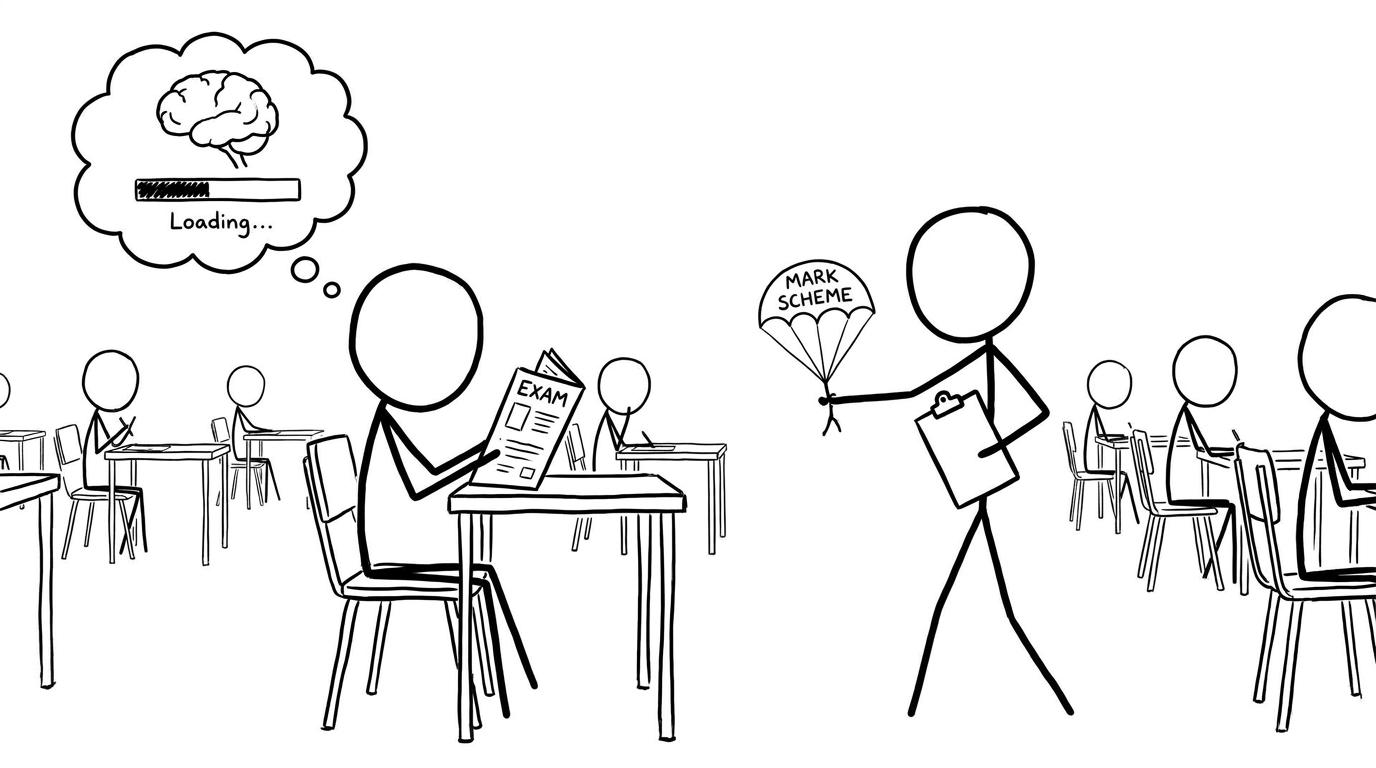 Exam hall brain loading bar joke
Bring it home: make GCSE revision feel reliable
Stopping forgetting isn’t about being “naturally good” at memory. It’s about building a loop that keeps returning: recall, check, correct, space, repeat. That’s what strong maths students already do, which means you’re closer than you think.
If you want a revision routine that actually feeds back into marks, use YesGenie as your daily structure: revision lessons when you need clarity, practice questions when you need repetition, and past papers and predicted papers when you need realism. Start with GCSE Past papers, add a weekly paper from Edexcel GCSE Maths Predicted Papers, and keep your fundamentals sharp with Edexcel GCSE Maths Revision Guides.
GCSE exams reward the student who shows up with memory that works on command. Build that, and forgetting stops being a personality trait and becomes just another problem you’ve already solved.










