GCSE Statistics Exam Paper Guide | MathsGenie
GCSE statistics exam paper guide covering AQA and Edexcel formats, timings, tiers, question styles, calculators and a practical revision plan for exams.
The unsettling part of an exam is often not the hardest calculation. It is uncertainty. How long is the paper? Can any topic appear? Will there be an extended statistical enquiry question? Is the calculator allowed?
This GCSE statistics exam paper guide answers those questions for the current AQA and Pearson Edexcel GCSE Statistics qualifications. Both boards use two equally weighted papers, and both can assess content from across the specification on either paper. The important lesson is simple: Paper 1 and Paper 2 are not separate topic lists. You need broad preparation for both.
Use the GCSE Statistics revision hub to confirm your board and find free lessons, questions, worksheets, past papers and mark schemes.
GCSE Statistics paper checklist
Before beginning revision, confirm these details with your teacher or from the front of a recent paper:
- your exam board and specification code;
- whether you are entered for Foundation or Higher tier;
- the duration and total marks for each paper;
- which equipment is permitted;
- the full specification content for your tier;
- the command words used in longer questions;
- the official assessment arrangements for your examination series.
AQA GCSE Statistics uses specification code 8382. Pearson Edexcel uses 1ST0. OCR and Eduqas include statistics within their GCSE Mathematics specifications, but they do not use the two-paper standalone GCSE Statistics structure described below. If your timetable says GCSE Mathematics rather than GCSE Statistics, check your board's maths paper arrangements instead.
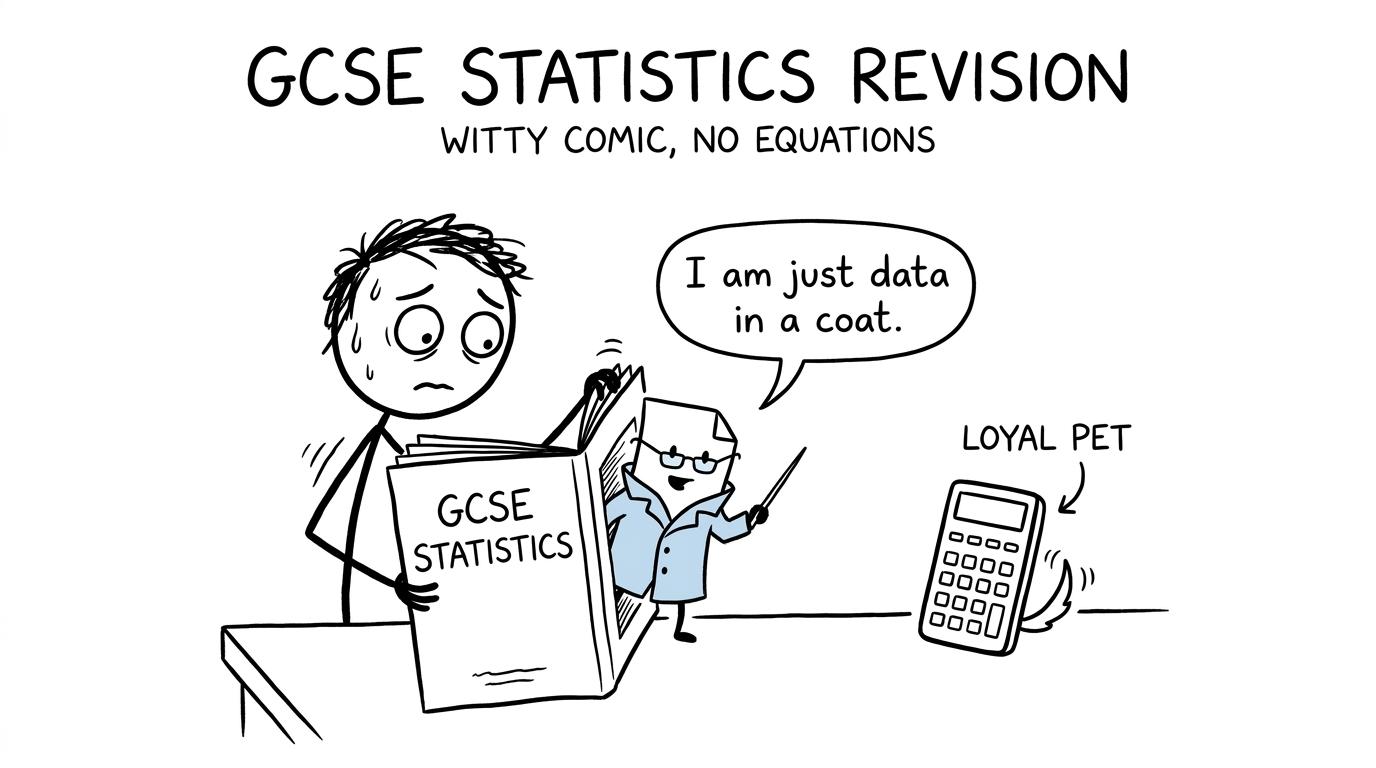 A student discovers that the statistics paper monster is only data in a coat
GCSE Statistics exam paper structure at a glance
| Exam board | Paper | Duration | Marks | Weighting | Calculator |
|---|---|---|---|---|---|
| Pearson Edexcel | Paper 1 | 1 hour 30 minutes | 808080 | 50%50\%50% | Permitted |
| Pearson Edexcel | Paper 2 | 1 hour 30 minutes | 808080 | 50%50\%50% | Permitted |
| AQA | Paper 1 | 1 hour 45 minutes | 808080 | 50%50\%50% | Permitted |
| AQA | Paper 2 | 1 hour 45 minutes | 808080 | 50%50\%50% | Permitted |
For both boards, students take two papers at the same tier in the same examination series. Foundation tier targets grades 1-5, while Higher tier targets grades 4-9. Your two raw marks are combined to produce a total out of 160160160.
Grade boundaries are set for each examination series, so do not assume that a raw mark from an older paper will always represent the same grade. Use raw marks to monitor improvement, then consult the relevant official boundaries when results are available.
Pearson Edexcel GCSE Statistics papers
The Edexcel GCSE Statistics revision area organises board-specific practice for Foundation and Higher tier. The official specification describes two papers of equal size and weighting.
Edexcel Paper 1
Paper 1 lasts 1 hour 30 minutes and is worth 808080 marks. Students must answer all questions, and calculators are permitted.
Questions may assess any content from the specification, including:
- planning and collecting data;
- populations, samples and sampling methods;
- processing, representing and analysing data;
- averages and measures of spread;
- charts, diagrams and statistical comparisons;
- probability;
- interpretation and evaluation within the statistical enquiry cycle.
The paper contains short-response, medium-response and extended-response questions. Some tasks test a recognisable technique, while others place familiar statistics inside an unfamiliar context. The context matters because a numerical answer alone may not complete an instruction such as “interpret”, “compare” or “evaluate”.
You can inspect the layout using the Edexcel Higher specimen Paper 1. Treat it as evidence of style, not a prediction of the next topic order.
Edexcel Paper 2
Paper 2 also lasts 1 hour 30 minutes, carries 808080 marks and permits a calculator. It assesses the same overall specification content as Paper 1.
That last point prevents a common revision error. There is no dependable rule saying that one Edexcel paper is “data collection” and the other is “probability”. A topic appearing on Paper 1 does not automatically remove it from Paper 2. Questions can also connect several stages of an investigation, such as choosing data, representing it and judging whether a conclusion is justified.
The Edexcel Higher specimen Paper 2 is useful for seeing how calculations, interpretation and extended reasoning can share one paper.
AQA GCSE Statistics papers
The AQA GCSE Statistics revision area contains aligned questions and past-paper resources for specification 8382.
AQA Paper 1
AQA Paper 1 lasts 1 hour 45 minutes and is worth 808080 marks, or 50%50\%50% of the qualification. It is available at Foundation and Higher tier, and a calculator is permitted.
Official AQA assessment information states that all specification content may be assessed. The question paper includes multiple-choice questions, short answers and a Statistical Enquiry Cycle question. The enquiry-cycle task may require you to move beyond calculation by considering how an investigation was planned, how data was obtained, what the evidence shows and whether the conclusion is reliable.
Multiple-choice questions still deserve written thought. Eliminate impossible options, estimate before calculating where appropriate and check that the selected answer addresses the stated population or context.
AQA Paper 2
AQA Paper 2 has the same duration, mark total and weighting: 1 hour 45 minutes, 808080 marks and 50%50\%50%. It also permits a calculator and can assess all specification content.
Its published question structure is the same broad mixture of multiple choice, short answer and a Statistical Enquiry Cycle question. You should therefore prepare for both papers in the same way: complete specification coverage, secure calculator technique and repeated practice in interpreting results.
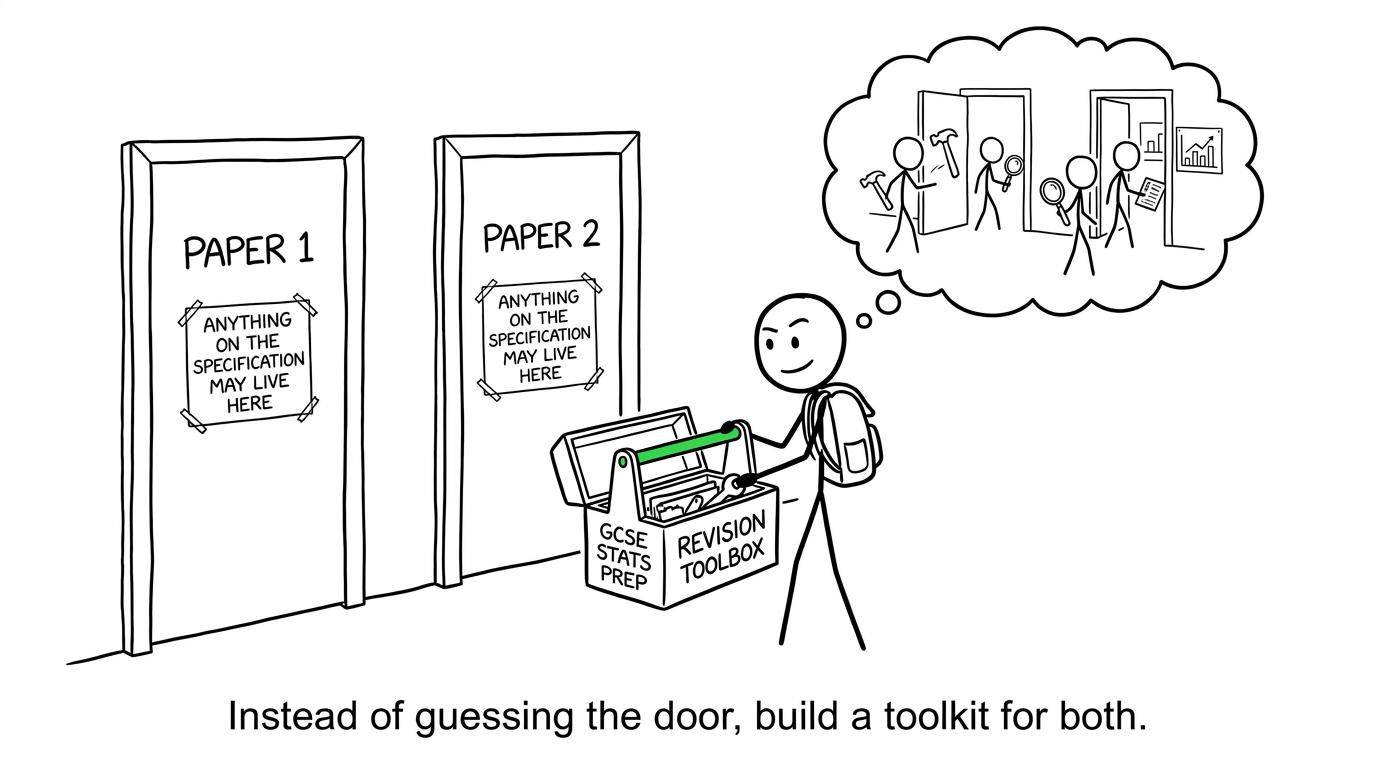 Two papers explain that anything from the specification may be behind either door
What the papers are really testing
GCSE Statistics is not simply a collection of formulae. Across the qualification, assessment gives substantial weight to three connected abilities:
- using statistical techniques accurately;
- interpreting information and reasoning in context;
- assessing methods and evaluating conclusions through the statistical enquiry cycle.
This explains why a student can calculate a correct average yet lose a later mark. The calculation answers “what is the value?” The next instruction may ask “what does it suggest?” or “is this comparison valid?” Those are different tasks.
Higher-tier students should also expect more demanding methods and reasoning. For example, Edexcel standard deviation questions help you practise both calculation and interpretation. AQA students can use the corresponding AQA standard deviation practice.
How to approach each paper on exam day
Read the command word first
“Calculate” usually requires a numerical method. “Compare” needs statements about both distributions, normally involving an appropriate measure of location and spread. “Evaluate” asks you to judge quality, validity or usefulness using the information given.
For conclusions, return to the original context. A statement about association should not quietly become a claim of causation. Evidence from a sample should not automatically be presented as certainty about an entire population.
Use the marks and time together
Edexcel gives 90 minutes for 808080 marks, while AQA gives 105 minutes for 808080 marks. This offers a rough pacing guide, not a command to spend exactly the same time on every mark.
Move on if one short question begins consuming the time needed for a longer response. Leave enough space to return. In the final minutes, check unanswered questions, units, labels, rounding and whether your conclusions refer to the context.
Show enough working
A calculator can produce an answer without showing why that answer is sensible. Write down substitutions, intermediate values and the statistical measure you are using. Clear working may earn method marks when a final value is inaccurate, and it makes checking much easier.
Treat diagrams as evidence
Check scales, axis labels, keys and class intervals before interpreting a graph. When drawing, use accurate plotting and appropriate labels. When comparing distributions, select statistics that address both typical value and variation rather than listing everything you can see.
How to revise for both papers
Begin with one timed paper to identify what actually costs you marks. Then classify each error as missing knowledge, incorrect method, weak interpretation or an avoidable examination mistake.
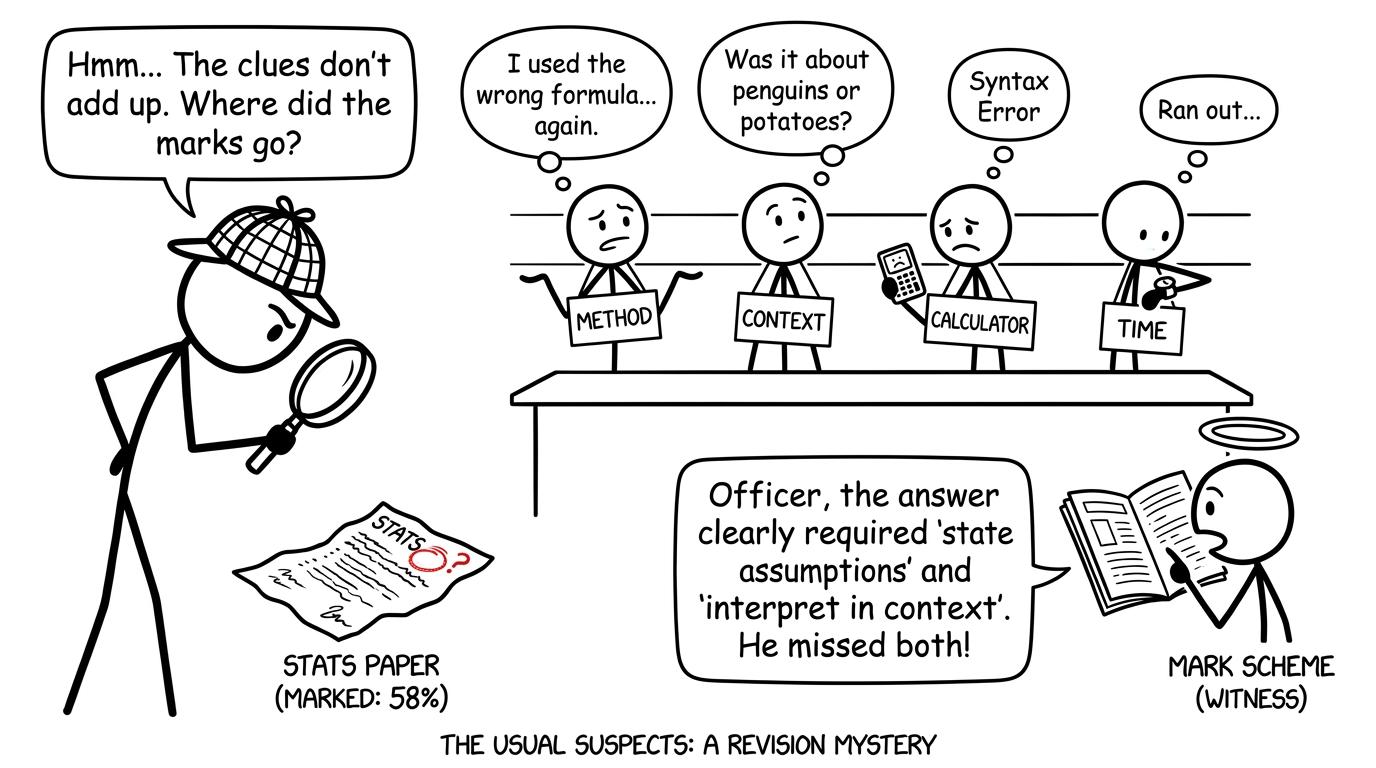 A student detective interviews the suspects behind lost statistics marks
Use a four-stage cycle:
- revisit the relevant revision lesson;
- answer focused practice questions without notes;
- mark them using the mark scheme or solution;
- return to a different question on the same skill several days later.
Once individual topics are secure, move into mixed and timed practice. Past papers teach board-specific wording and stamina. Predicted papers and mini tests can provide further practice, but they should never replace full specification revision because either paper can assess any eligible topic.
The GCSE Statistics resit revision plan explains how to turn paper results into targeted revision. You can also place lessons, short tests and full papers into the free MathsGenie revision planner so that weak topics are revisited rather than forgotten.
Common GCSE Statistics paper mistakes
- Revising Paper 1 and Paper 2 as separate topic lists. Both AQA and Edexcel can assess content from across their specifications on either paper.
- Using the wrong tier. Practise papers and mark schemes that match your Foundation or Higher entry.
- Giving a calculation when interpretation is required. Translate the result into a clear statement about the data and context.
- Claiming causation from correlation. Association alone does not prove that one variable causes the other.
- Ignoring sampling limitations. Consider the population, sampling method, sample size, non-response and possible bias.
- Comparing only averages. A sound comparison often needs both location and spread.
- Rounding too early. Keep sufficient calculator accuracy until the final answer, then follow the requested degree of accuracy.
- Trusting calculator output without checking it. An incorrect mode, bracket or data entry can still produce a convincing-looking result.
- Using old grade boundaries as permanent targets. Boundaries can change between examination series.
- Leaving long questions until the final seconds. Extended reasoning needs time for a conclusion that is supported by evidence.
Make the paper feel familiar before it matters
An exam paper becomes less intimidating when its structure is no longer new. For AQA, expect two 1 hour 45 minute papers. For Edexcel, expect two 1 hour 30 minute papers. Each paper is worth 808080 marks, each contributes 50%50\%50%, calculators are permitted and all specification content may be assessed.
Now turn that knowledge into practice. Choose your board in the MathsGenie GCSE Statistics hub, rebuild weak areas through revision lessons and practice questions, then complete past papers under the correct time limit. Use mark schemes and video solutions to understand lost marks, and add predicted papers or mini tests when you need fresh mixed practice.
The goal is not to guess what will appear. It is to make the format so familiar that, when the paper opens, your attention can go where it belongs, onto the statistics.