

GCSE Psychology Grade 9 Meaning Explained
GCSE psychology grade 9 meaning explained: learn what the grade represents, how it compares with A*, and how boundaries and exam skills shape results.
A grade can look wonderfully simple on results day. One digit. One line on a statement. Yet the work behind it is rarely simple at all.
The GCSE psychology grade 9 meaning is that a student has demonstrated the highest level of performance available in the qualification. It reflects excellent knowledge of psychology, accurate application to unfamiliar situations, strong analysis and evaluation, and confident handling of research methods. It does not mean the student achieved full marks, and it is not tied to one permanent percentage.
A grade 999 is broadly above the old grade A*, but there is no exact one-to-one conversion. It was introduced partly to distinguish the very strongest performances within the range previously covered by A and A*.
Before looking deeper, keep this short checklist in mind:
- Grade 999 is the highest GCSE grade in England.
- It represents exceptional overall performance, not perfection.
- The required mark changes between exam series and exam boards.
- Grades 777, 888 and 999 collectively cover the upper range previously associated with A and A*.
- Psychology rewards knowledge, application, analysis and evaluation.
- GCSE Psychology is not divided into foundation and higher tiers on the main AQA and Edexcel specifications.
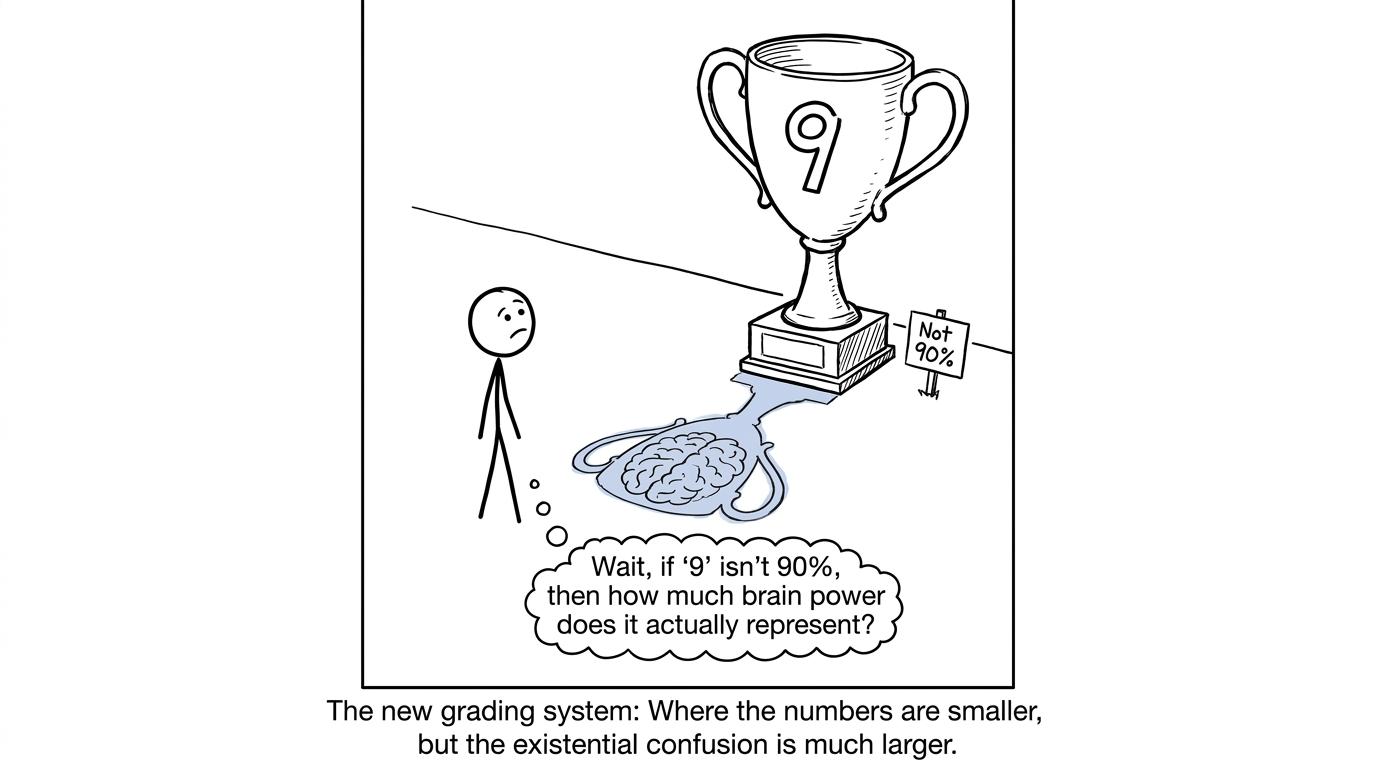 A student discovering that a grade 9 is not simply 90 per cent
What does a grade 9 in GCSE Psychology represent?
A grade 999 shows that your total performance crossed the highest boundary set for your examination series. The grade is awarded for the qualification as a whole, rather than for being flawless on every topic or receiving a separate grade on each paper.
In a linear qualification, the basic idea is:
overall mark=Paper 1 mark+Paper 2 mark\text{overall mark} = \text{Paper 1 mark} + \text{Paper 2 mark}overall mark=Paper 1 mark+Paper 2 markThe exam board then compares the overall mark with the qualification boundaries for that year. You can explore historical figures through the MathsGenie GCSE and A Level grade boundaries hub.
This distinction matters. A student may write an outstanding response on memory but lose marks on research methods. Another may have less detailed recall but apply ideas accurately throughout the papers. If both totals reach the grade 999 boundary, both receive grade 999.
The number reports an overall standard. It does not provide a complete profile of every strength and weakness.
The ability behind the number
Across GCSE Psychology specifications, assessment is organised around three objectives:
- AO1: knowledge and understanding of psychological ideas, processes and procedures
- AO2: application of that knowledge and understanding
- AO3: analysis and evaluation used to form judgements and conclusions
For current AQA and Pearson Edexcel GCSE Psychology specifications, the overall weightings are approximately 35%35\%35% for AO1, 35%35\%35% for AO2 and 30%30\%30% for AO3.
That balance reveals why memorising a revision guide is not enough for the highest grade. Recall matters, but almost two-thirds of the assessment concerns applying, analysing or evaluating what you know.
Secure psychological knowledge
A grade 999 student is normally able to recall theories, studies, processes, terminology and research methods precisely. Their answers distinguish between related ideas rather than relying on vague descriptions.
Accuracy is especially important when discussing variables, sampling, experimental design, reliability, validity and ethical issues. Small differences in terminology can change the meaning of an answer.
Application to unfamiliar contexts
AO2 questions often place familiar psychology inside a new scenario. High-level performance means recognising which idea is relevant and connecting it directly to the details provided.
Repeating a memorised definition beside a scenario is not genuine application. The answer must show how the psychological concept explains the particular behaviour, investigation or evidence in the question.
Analysis and balanced evaluation
At the top level, evaluation is more than listing one strength and one weakness. Strong responses explain why a feature affects the usefulness, credibility or interpretation of evidence. They make supported judgements and maintain a clear line of reasoning.
This is where grade 999 answers often become distinctive. They do not merely contain more information. They use information more deliberately.
Confidence with research methods and data
Psychology is a scientific subject, so students must interpret evidence and work with quantitative information. Depending on the specification, this can include averages, ranges, percentages, graphs, tables, sampling and correlations.
If you are preparing for maths exams alongside Psychology, this overlap is useful. The MathsGenie GCSE Maths revision hub can strengthen the numerical fluency needed when psychological data appears in an unfamiliar format.
How does grade 9 compare with the old letter grades?
The numbered scale is not a simple relabelling of A* to G. Only certain comparison points were deliberately aligned when grades 999 to 111 replaced the old system in England.
| Current GCSE grade | Broad comparison with the old scale |
|---|---|
| 999 | Higher than the old A* threshold and intended to identify exceptional performance |
| 888 | Within the old A/A* range |
| 777 | The bottom of grade 777 aligns with the bottom of the old grade A |
| 444 | The bottom of grade 444 aligns with the bottom of the old grade C |
| 111 | The bottom of grade 111 aligns with the bottom of the old grade G |
The safest conclusion is not that grade 999 simply equals A*. Grades 777, 888 and 999 span the range formerly occupied by A and A*, with grade 999 identifying performance at the very top.
This also means an older relative or employer might describe a grade 999 as an A*, but that shorthand loses some precision. A grade 999 represents a narrower and more demanding part of the former top-grade range.
Why grade 9 is not a fixed percentage
Students often search for a single target such as 80%80\%80% or 90%90\%90%. It feels reassuring because it turns uncertainty into a number. Unfortunately, it is not how GCSE boundaries work.
Grade boundaries are set for each examination series after the papers have been taken and marked. Awarding organisations use evidence and expert judgement to maintain a comparable standard when papers differ in difficulty.
The latest completed summer series currently available is June 2025. It provides useful historical context, but its boundaries are not predictions for a future examination.
| Specification | Reported maximum mark | June 2025 grade 999 boundary |
|---|---|---|
| AQA GCSE Psychology 818281828182 | 200200200 | 170170170 |
| Pearson Edexcel GCSE Psychology 1PS01PS01PS0 | 180180180 | 124124124 |
The totals cannot be compared mark for mark because the specifications, assessments and reported mark scales differ. Use the AQA GCSE Psychology grade boundaries or Edexcel GCSE Psychology grade boundaries for your exact board and examination series.
The broader lesson is simple: a grade 999 is a standard of performance, not a permanent percentage. MathsGenie's guide to how GCSE grade boundaries work explains why boundaries can move without the qualification becoming easier or harder in any simple sense.
What grade 9 performance looks like in revision
The best preparation does not begin by trying to sound like a grade 999 student. It begins by finding out where marks are actually being lost.
A practical revision cycle is:
- retrieve a topic without notes;
- answer specification-matched questions;
- mark the response carefully;
- identify whether the lost marks came from AO1, AO2 or AO3;
- rewrite or improve the weak part;
- revisit it after a gap.
This creates a useful distinction between knowing and performing. You may understand conformity perfectly in conversation but fail to connect it to a scenario. You may remember a study but omit the detail needed for the mark scheme. Revision becomes more effective when it repairs the exact failure rather than reviewing the entire chapter again.
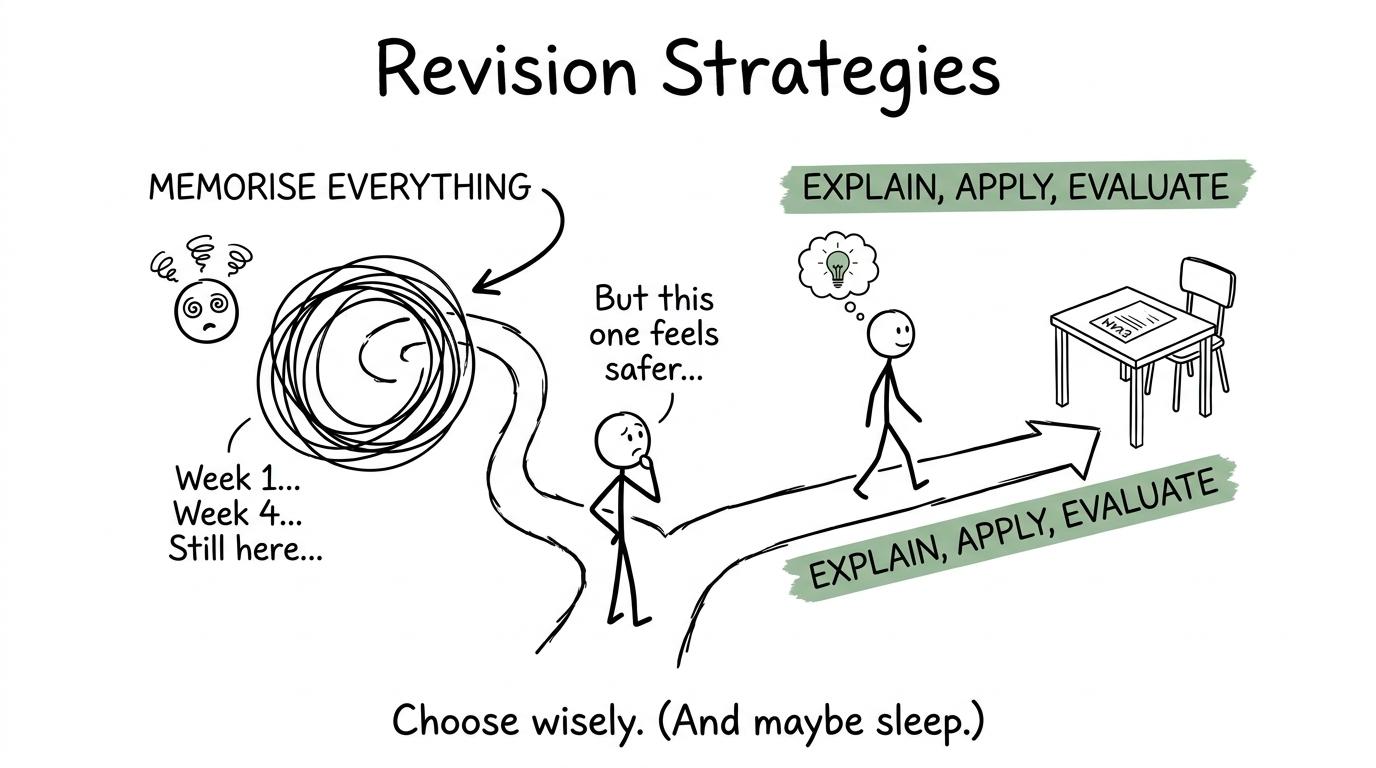 Two revision paths showing why explanation, application and evaluation matter
Use past papers as evidence
Past papers reveal how command words, scenarios and mark tariffs change what an answer requires. The Edexcel GCSE Psychology past papers include official mark schemes and organised paper practice.
Complete papers under timed conditions once your topic knowledge is reasonably secure. MathsGenie's past-paper tools help you compare your response with the mark scheme rather than relying on how confident the paper felt.
Confidence is useful. Marked evidence is better.
Build a marks-leak record
After each paper, classify mistakes under a few headings:
- missing knowledge;
- inaccurate terminology;
- weak application;
- undeveloped evaluation;
- misunderstood command word;
- data or calculation error;
- unfinished response.
Patterns become visible after several attempts. That is valuable because a grade boundary tells you how many marks were required, while your error record tells you where your next marks may come from.
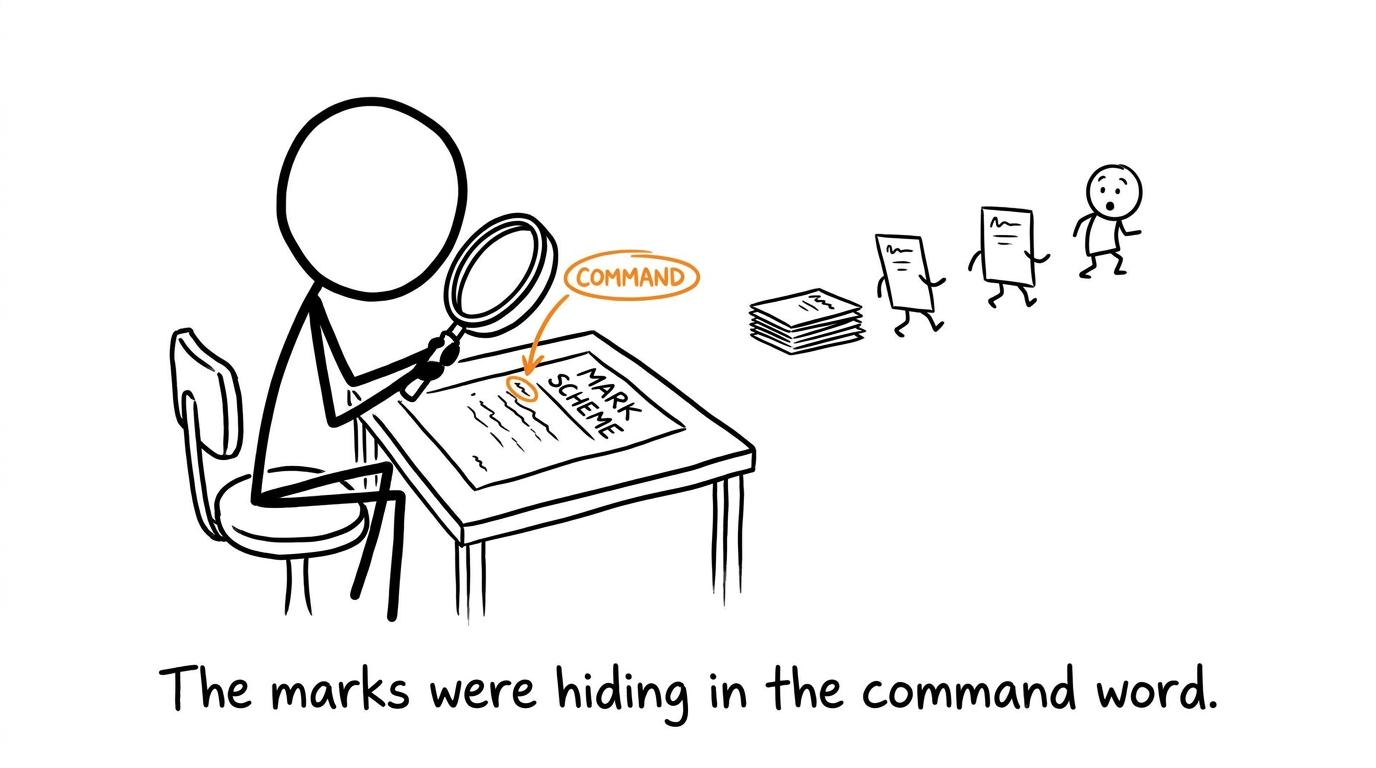 A student discovering marks hidden inside a command word
Common mistakes when interpreting a psychology grade 9
Assuming grade 9 means full marks
It does not. The boundary is below the maximum mark, and students can lose marks while still demonstrating the highest overall standard.
Treating grade 9 as exactly the same as A*
A* is the closest familiar description, but the scales are not directly equivalent. Grade 999 identifies the top part of the former A/A* range more precisely.
Using last year's boundary as a guaranteed target
Historical boundaries are useful for judging past-paper performance, not forecasting the exact mark required in a future series. Check the correct year, board and specification on results day. The GCSE Psychology grade boundaries results-day guide explains what to verify.
Comparing AQA and Edexcel raw marks directly
The papers, totals and specification structures differ. A lower raw boundary on one board does not prove that its qualification is easier.
Revising only AO1 content
Knowing every definition may feel productive, but application and evaluation carry substantial weight. High-grade preparation must include scenarios, evidence, methodological reasoning and extended responses.
A grade is a signal, not an identity
A grade 999 in GCSE Psychology signals exceptional performance across the qualification. It shows that a student can do more than remember content: they can select relevant knowledge, apply it accurately, interpret evidence and build reasoned evaluations under examination conditions.
But the number is not a judgement on intelligence, potential or personal worth. It is the outcome of particular papers taken on particular days. That is why the healthiest target is not to chase a symbol in the abstract, but to build the abilities the symbol represents.
Start with one paper. Mark it honestly. Find the marks that slipped away, then repair the underlying skill. MathsGenie brings together free revision lessons, practice questions, past papers, predicted papers, mini tests, mark schemes and video solutions so that revision leads to a clear next action. The grade comes later. The improvement begins now.










