GCSE Physics Revision: How Parents Can Help Without Nagging
GCSE physics revision without nagging: practical, calm ways parents can help build routines, confidence and exam technique with YesGenie maths support.
The moment nagging stops working
Somewhere around March, a lot of homes discover the same uncomfortable truth: the more you say “Have you revised?”, the less revision actually happens. It’s not because your teenager doesn’t care about their GCSE. It’s because nagging turns revision into a power struggle, and power struggles drain the exact energy they need for learning.
If you’re a parent, you’re trying to help. If you’re a student reading this, you probably want help too but just not in the form of hourly reminders. The best support for GCSE Physics revision is usually quiet: better routines, smaller steps, clearer feedback loops, and a calm sense that someone is on your side.
And because Physics is full of equations and rearranging, good maths habits often decide whether those marks arrive on the page. That’s where YesGenie (Maths Genie) quietly becomes a secret weapon for GCSE success.
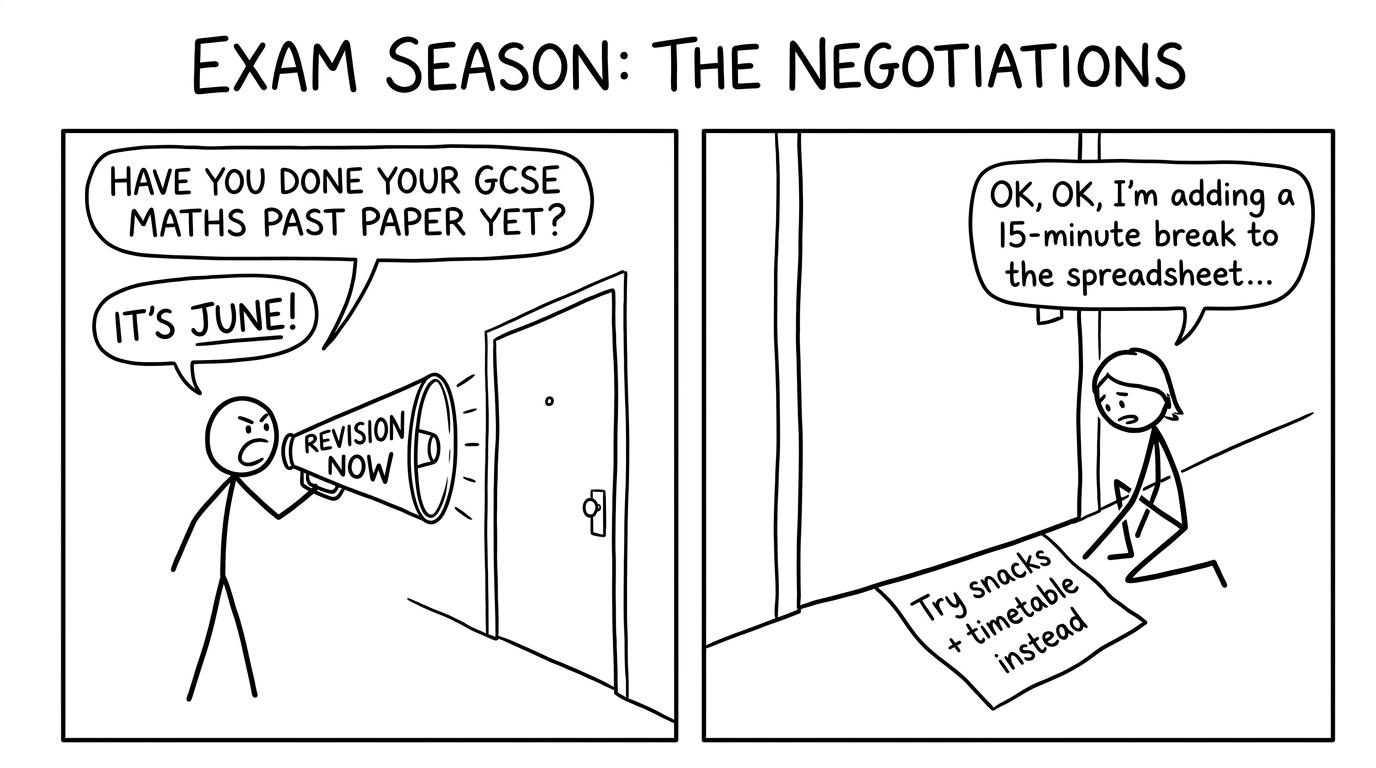 Parent with megaphone vs snacks+timetable
A quick checklist for parents (support, not pressure)
Keep this simple. The goal is momentum, not perfection.
- Agree a revision time window (not a “revise all evening” command).
- Ask “What’s the plan?” instead of “Have you revised?”
- Make the environment easier: desk space, charger, water, fewer interruptions.
- Use short cycles: 252525 minutes work, 555 minutes break.
- Encourage past-paper practice early, not just at the end.
- Help them mark, but don’t take over.
- When Physics equations feel hard, plug the maths gap quickly with YesGenie.
Useful YesGenie pages to keep open in a browser tab:
- GCSE Past Papers
- Edexcel GCSE Maths Revision
- Edexcel GCSE Maths Past Papers
- Edexcel GCSE Maths Predicted Papers
- Resources Hub
- Edexcel GCSE Maths Revision Guides
- Eduqas GCSE Maths Question Bank
Why nagging fails (and what works instead)
Nagging is usually an attempt to manage uncertainty. You can’t sit the GCSE for them, so you try to control what you can: time, behaviour, routines. The problem is that revision is internal. The student has to choose it.
What works better is shifting from control to structure.
Replace reminders with rituals
A ritual is a predictable cue that makes revision more automatic. For example:
- Tea at 6:006{:}006:00 pm.
- Phone on charge outside the room.
- 252525 minutes of focused work.
- One small check-in after.
The parent’s job is the cue and the consistency. The student’s job is the thinking.
Make the goal “start”, not “finish”
A lot of students avoid revision because they don’t know where to begin. So parents can support the most underrated skill in GCSE preparation: starting.
Try: “Do you want to begin with one six-mark question or a quick formula recap?”
That choice matters. It gives agency. It reduces friction.
Build a revision routine that actually survives real life
Students often plan revision like a perfect robot, then feel guilty when life happens. Parents can help by planning like a human.
Use the three-lane plan
- Lane 1 (minimum): 202020 minutes. Something every day.
- Lane 2 (solid): 454545 to 606060 minutes.
- Lane 3 (stretch): past paper + marking.
If you hit Lane 1 on a messy day, you’re still building consistency. Consistency is what lifts GCSE grades over time.
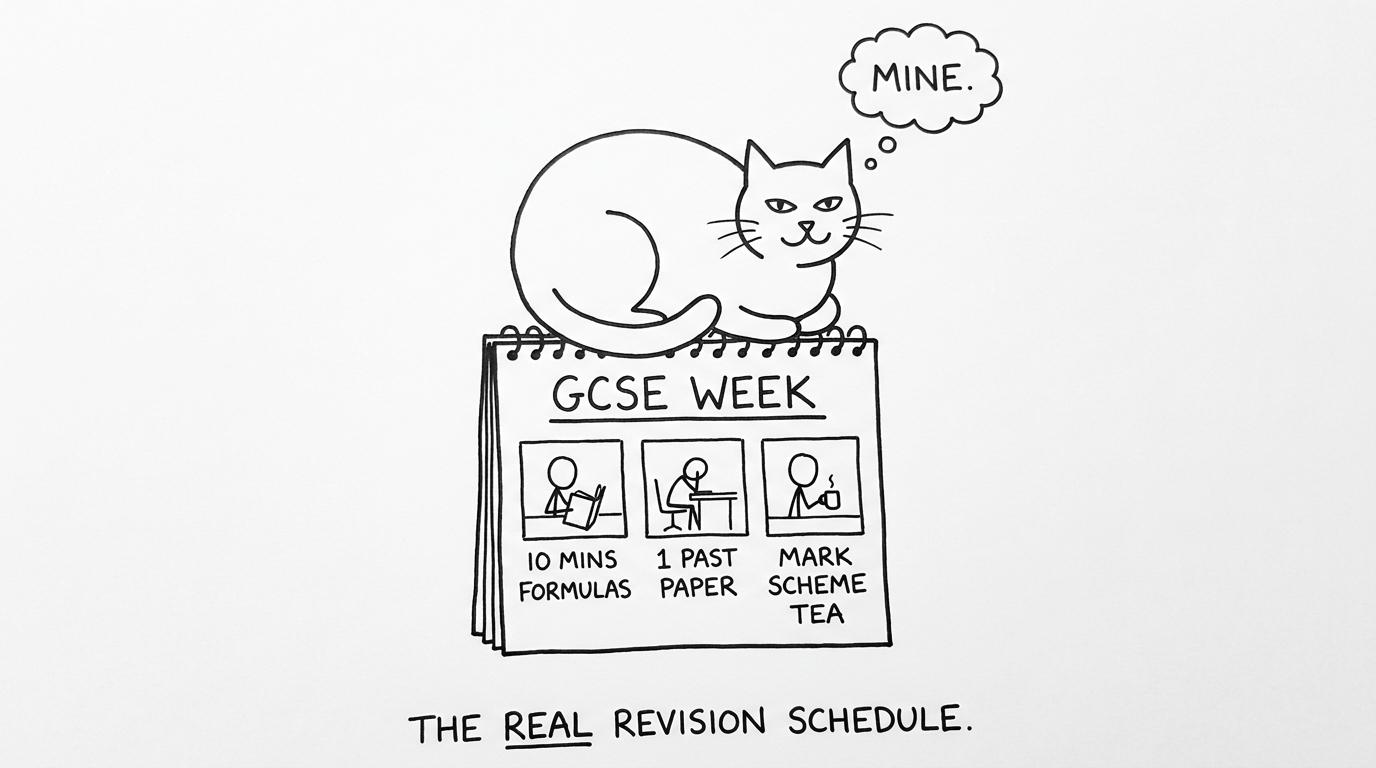 GCSE week calendar with cat on planner
Pair Physics with the maths that unlocks it
Physics revision often stalls on the same maths pressure points:
- rearranging equations
- standard form
- gradients and graphs
- ratios and proportionality
Parents don’t need to teach these. They just need to help students find targeted practice quickly. YesGenie is ideal here: revision guides, question banks, video solutions, mini tests, and past papers in one place.
If your child is on Edexcel, keep Edexcel GCSE Maths Revision handy. If they’re unsure what to practise, the Edexcel GCSE Maths Revision Guides make it easy to choose a topic and go.
Worked examples parents can use to support (without teaching)
The best kind of help is not “Let me explain it” but “Let’s make the next step obvious.” These examples are written so a parent can ask good questions without needing a physics degree.
Example 1: Rearranging a Physics-style formula
A classic GCSE Physics situation: rearrange an equation to make a different variable the subject.
Suppose the formula is:
V=IR V = IR V=IRIf a question asks for RRR, rearrange:
V=IR V = IR V=IR ÷I:VI=R \div I: \quad \frac{V}{I} = R ÷I:IV=RSo:
R=VI R = \frac{V}{I} R=IVIf V=12V = 12V=12 and I=3I = 3I=3, then:
R=123=4 R = \frac{12}{3} = 4 R=312=4Parent support line that helps without nagging: “What are you trying to make the subject? What operation is attached to it?”
For students who find rearranging hard, a short burst of algebra practice on YesGenie usually pays off quickly.
Example 2: Standard form (Physics loves it)
Physics questions often use very large or very small numbers. Standard form is a common GCSE marks-earner.
Write 0.000560.000560.00056 in standard form:
Move the decimal 444 places to make 5.65.65.6:
0.00056=5.6×10⁻⁴ 0.00056 = 5.6 \times 10^{-4} 0.00056=5.6×10⁻⁴Multiply (3×10⁵)(2×10³)(3 \times 10^5)(2 \times 10^3)(3×10⁵)(2×10³):
3×2=6 3 \times 2 = 6 3×2=6 105×103=105+3=108 10^5 \times 10^3 = 10^{5+3} = 10^8 105×103=105+3=108So:
(3×10⁵)(2×10³)=6×10⁸ (3 \times 10^5)(2 \times 10^3) = 6 \times 10^8 (3×10⁵)(2×10³)=6×10⁸Parent support line: “Can you separate the numbers and the powers of 101010?”
Example 3: Gradient from a graph (rate questions)
Rates appear everywhere in GCSE Physics. Gradient is rate of change.
If a straight line goes through (2,5)(2, 5)(2,5) and (8,17)(8, 17)(8,17), the gradient is:
m=ΔyΔx=17−58−2=126=2 m = \frac{\Delta y}{\Delta x} = \frac{17 - 5}{8 - 2} = \frac{12}{6} = 2 m=ΔxΔy=8−217−5=612=2Parent support line: “Which two clear points can you read, and are you doing change in yyy over change in xxx?”
YesGenie has lots of practice on graphs and gradient through exam-style questions, and it’s the kind of skill that supports both maths and Physics marks.
Make past papers a family system (not a solo battle)
Past papers are where GCSE revision becomes real. But they can feel lonely and exposing: you see what you don’t know.
Parents can help by turning past papers into a routine:
- Student does a timed section.
- Parent provides the “marking window” (quiet time, no judgement).
- Student uses the mark scheme to correct in a different colour.
- Together, you write a short “next steps” list: 333 targets max.
Use GCSE Past Papers to make this simple, and if your student takes Edexcel maths alongside Physics, Edexcel GCSE Maths Past Papers is an easy place to start.
When exam season gets close, predicted papers can reduce overwhelm by focusing revision. YesGenie’s Edexcel GCSE Maths Predicted Papers are built to match the latest specification style.
Common mistakes (that look like “laziness” but aren’t)
Treating revision as reading
Many students “revise” by re-reading notes. It feels safe, but it rarely builds exam performance. GCSE Physics needs retrieval practice and questions.
Doing questions without feedback
A worksheet completed and never marked is just time spent. Encourage marking with a mark scheme and writing corrections.
Fixing everything at once
Students often try to overhaul their whole routine in one weekend. That usually collapses by Tuesday. Build habits using small daily wins.
Parents teaching instead of prompting
When a parent starts explaining, the student can feel watched, judged, or infantilised. It also removes the student’s chance to wrestle with the problem, which is where learning happens.
Ignoring the maths behind the Physics
A lot of GCSE Physics marks are lost to rearranging, units, standard form, and graphs. Plugging those maths gaps through YesGenie can lift confidence quickly across subjects.
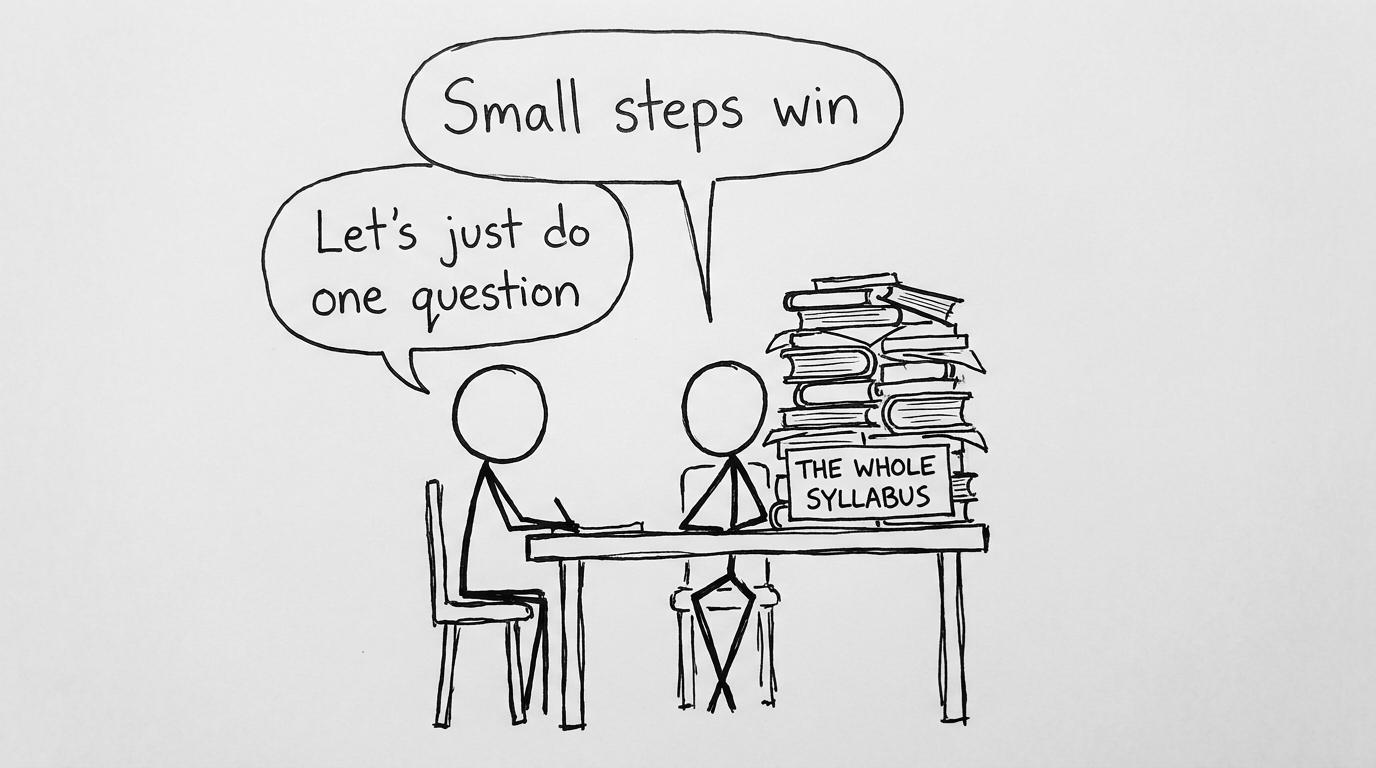 Two stick figures: one question vs whole syllabus
Bringing it back to calm, consistent GCSE progress
The best revision support rarely sounds like “revise more.” It sounds like, “Let’s make this easier to start,” and “Let’s see what the mark scheme wanted,” and “Pick one thing to improve this week.” That’s how GCSE progress is usually made: quietly, through small repetitions that build exam confidence.
If you’re a student, you don’t need perfect motivation. You need a plan you can actually follow, plus practice that looks like the exam. If you’re a parent, you don’t need to become a teacher. You need to create the conditions where revision happens without a daily argument.
Use YesGenie as the backbone: revision lessons, revision guides, practice questions, mini tests, past papers, and predicted papers. Start with GCSE Past Papers, add targeted skill-building through Edexcel GCSE Maths Revision Guides, and build confidence through regular exam practice. Do that, and the conversation at home shifts from nagging to progress, which is exactly what you want in the run-up to GCSE exams.