GCSE Physics Revision for CCEA: From Pass to Progress
GCSE revision for CCEA Physics when you’re stuck at a pass: build maths skills, master equations, and use past papers with mark schemes to improve.
You know the feeling. You’ve revised enough to scrape a pass, but every time you open a GCSE paper it’s the same story: you can almost do it, then the numbers arrive and your confidence disappears. For CCEA students, GCSE Physics can feel like that kind of subject, not because you’re “bad at science”, but because Physics quietly relies on maths skills you might not have practised recently. The good news is that a pass grade is not a ceiling. It’s a starting line.
This post is written for CCEA GCSE Physics students who feel stuck, but it’s hosted on YesGenie because the fastest way to lift a GCSE Physics grade is often to strengthen the maths underneath it. Once you do that, the mark scheme starts to feel less like a mystery and more like a map.
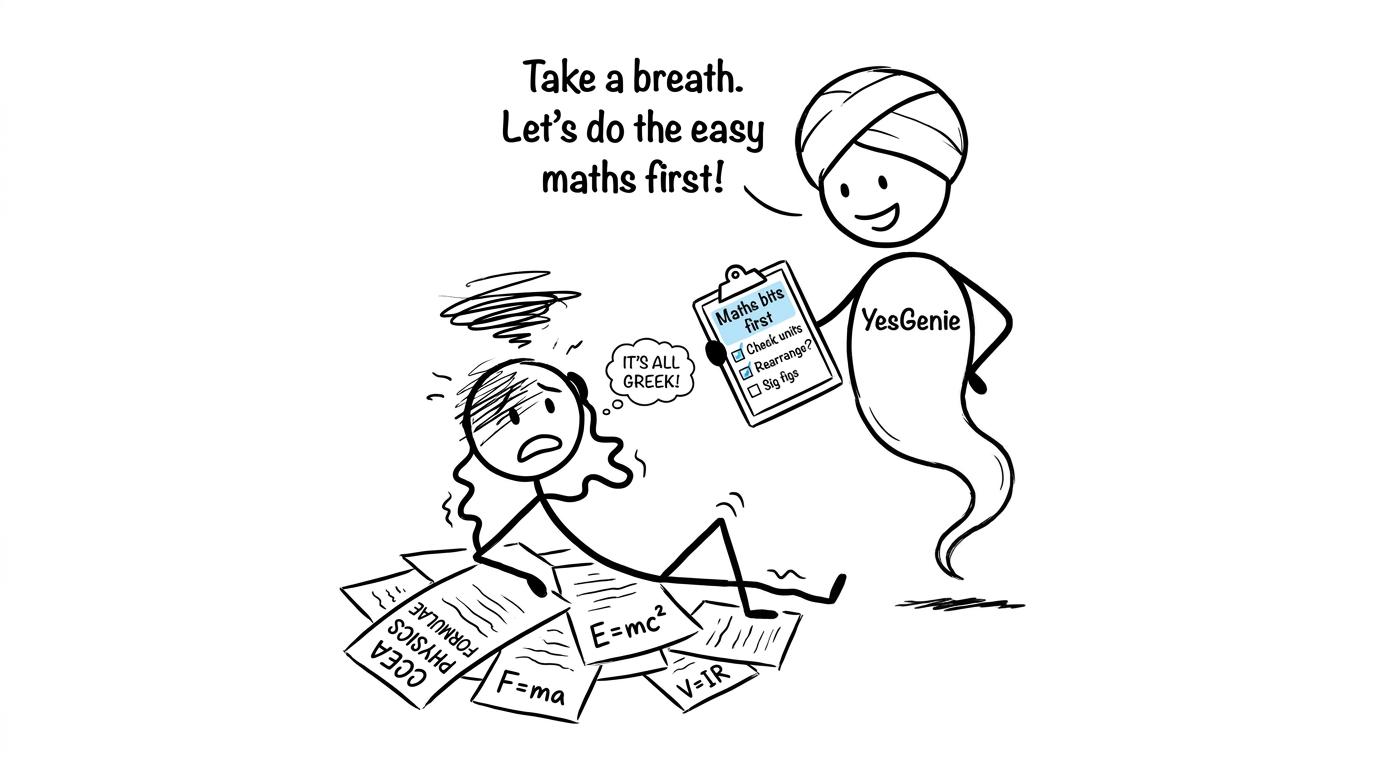 A stressed student gets a calm checklist from YesGenie
The “pass plateau” checklist (save this)
If you’re hovering around a pass, your revision should be boringly specific. Here’s the checklist that moves most students quickest:
- Learn the core equations and what each symbol means (not just the words).
- Practise rearranging formulae until it’s automatic.
- Get fluent with units and standard form, because half of “hard Physics” is actually conversions.
- Use mark schemes to collect method marks even when the final answer goes wrong.
- Do short cycles: topic practice, then exam questions, then past paper sections.
On YesGenie, that looks like: revision lessons + practice questions + mark schemes + past papers. Start with the GCSE hubs, then zoom in.
Useful starting points:
Why GCSE Physics feels like maths (and why that helps)
Physics rewards students who can do three quiet things under pressure:
- Translate words into an equation.
- Rearrange the equation for the thing the question asks.
- Substitute values with correct units and sensible rounding.
If you’re stuck at a pass, it’s usually because one of those three steps breaks. So we’re going to rebuild them, with simple routines you can repeat.
Even if your target is “just a better pass”, these routines often unlock the jump from borderline to comfortable, because they create reliable marks.
The equation triangle is not enough: learn rearranging properly
CCEA GCSE Physics uses familiar equations (speed, density, pressure, power). Students often memorise a triangle and hope for the best. But triangles don’t help when the equation is more complex, or when the unknown is in a denominator, or squared.
You want the real skill: making a letter the subject.
If rearranging is a weakness, do one focused session on it:
Worked example: rearranging for acceleration
Suppose a CCEA-style question gives:
F=m×a F = m \times a F=m×aand asks for aaa when F=18 NF=18\text{ N}F=18 N and m=6 kgm=6\text{ kg}m=6 kg.
Rearrange first:
a=Fm a = \frac{F}{m} a=mFNow substitute:
a=186=3 a = \frac{18}{6} = 3 a=618=3So a=3 m/s2a=3\text{ m/s}^2a=3 m/s2.
Notice the habit: rearrange first, substitute second. This reduces errors and earns method marks.
Worked example: rearranging with a fraction (density)
Density is
ρ=mV \rho = \frac{m}{V} ρ=VmMake VVV the subject:
ρV=m \rho V = m ρV=m V=mρ V = \frac{m}{\rho} V=ρmIf m=0.54 kgm=0.54\text{ kg}m=0.54 kg and ρ=2700 kg/m3\rho=2700\text{ kg/m}^3ρ=2700 kg/m3:
V=0.542700=0.0002 V = \frac{0.54}{2700} = 0.0002 V=27000.54=0.0002So
V=2×10⁻⁴ m3 V = 2 \times 10^{-4}\text{ m}^3 V=2×10⁻⁴ m3That last step is exactly where many pass-grade scripts fall apart: standard form and sensible presentation.
Units and standard form: the hidden marks in every GCSE paper
In many GCSE Physics mark schemes, the marks are not “for being clever”. They’re for being careful. Units are careful.
Two key rules:
- Convert everything into the units the equation expects.
- If the number is tiny or huge, use standard form confidently.
If you need to rebuild standard form quickly:
Worked example: converting cm3\text{cm}^3cm3 to m3\text{m}^3m3
A common CCEA-style density question mixes units.
If V=250 cm3V=250\text{ cm}^3V=250 cm3, convert to m3\text{m}^3m3.
Since 1 cm=0.01 m1\text{ cm}=0.01\text{ m}1 cm=0.01 m,
1 cm3=(0.01)3 m3=10−6 m3 1\text{ cm}^3 = (0.01)^3\text{ m}^3 = 10^{-6}\text{ m}^3 1 cm3=(0.01)3 m3=10−6 m3So:
250 cm3=250×10−6 m3=2.5×10⁻⁴ m3 250\text{ cm}^3 = 250 \times 10^{-6}\text{ m}^3 = 2.5 \times 10^{-4}\text{ m}^3 250 cm3=250×10−6 m3=2.5×10⁻⁴ m3That conversion alone can be the difference between a pass and a strong pass, because the physics is often straightforward once the units behave.
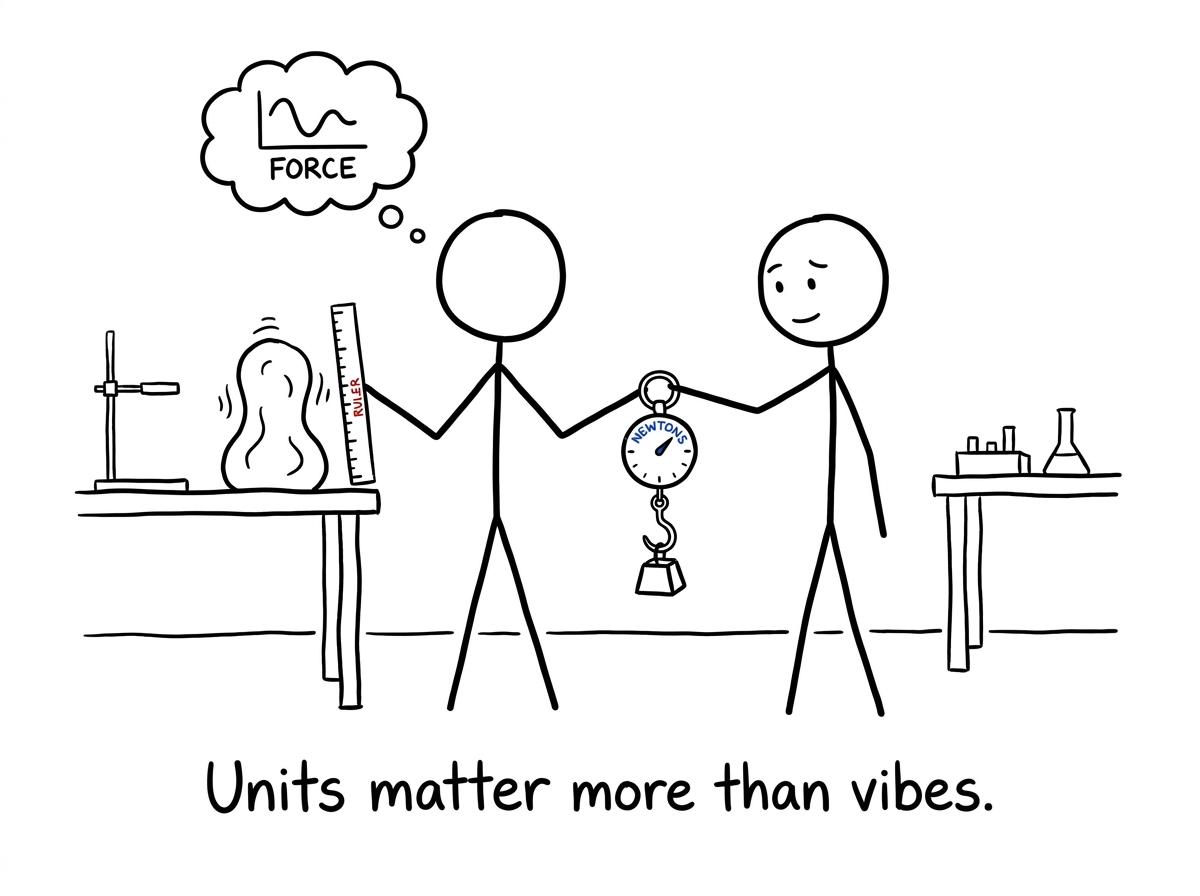 Two students argue about measuring force with a ruler
Learn to “read” mark schemes: method marks are your lifeline
When students say “I knew it but I got zero”, what they often mean is: they did some thinking, but the mark scheme couldn’t see it.
Your job is to make your method visible.
Practical routines:
- Write the equation you’re using before you substitute.
- Show one clear rearrangement line.
- Substitute with units.
- Round at the end unless told otherwise.
To practise this properly, use real papers with mark schemes:
- GCSE Past papers
- If you also take GCSE Maths and want more exam practice: Edexcel GCSE Maths Past Papers
Even if your exam board for maths is not Edexcel, the skills transfer perfectly: rearranging, units, standard form, proportional reasoning.
The “two-layer” revision method for CCEA GCSE Physics
When you’re stuck at a pass, you can’t revise everything at once. You need layers.
Layer 1: the maths layer (daily, short)
Spend 151515 202020 minutes on one of these:
- rearranging formulae
- standard form
- fractions, decimals and percentages
Good refreshers on YesGenie:
- Fractions, Decimals and Percentages
- Reverse Percentages
- Bounds (useful for “rounding and accuracy” questions)
Layer 2: the physics layer (every other day)
Pick one physics area and do:
- a short revision lesson
- 666 101010 exam-style questions
- check the mark scheme and fix one mistake pattern
YesGenie has GCSE Physics revision guides you can use as a clean explanation base. For example:
You’re not “switching boards” by reading AQA-style content. You’re building understanding, equations, and exam language that CCEA also rewards.
A pass-grade student’s best topics (because they repeat)
You don’t need to master every corner of the specification first. Start with the high-return areas where marks are predictable:
- Forces: F=maF=maF=ma, weight W=mgW=mgW=mg, momentum basics.
- Electricity: V=IRV=IRV=IR, P=IVP=IVP=IV, energy E=IVtE=IVtE=IVt.
- Waves: v=fλv=f\lambdav=fλ.
- Density and pressure: ρ=mV\rho=\frac{m}{V}ρ=Vm, p=FAp=\frac{F}{A}p=AF.
If you can reliably do equation selection + rearranging + units in those topics, your GCSE outcome improves even before you learn the harder explanations.
Common mistakes (and how to stop making them)
Pass-grade errors are usually repeat errors. Here are the big ones.
Mixing up mass and weight
Students write W=mgW=mgW=mg but then give the answer in kg, or they use mmm when the question asked for weight. Train yourself to underline the required unit in the question. If the unit is newtons, it’s a force.
Rearranging after substituting
Substituting first makes the algebra messier and increases calculator slips. Rearrange while it’s still letters, then substitute cleanly. This also mirrors how mark schemes award method marks.
Not converting units before using an equation
Using V=IRV=IRV=IR with RRR in kΩ\text{k}\OmegakΩ while III is in amperes is a classic trap. Convert kΩ\text{k}\OmegakΩ to Ω\OmegaΩ by multiplying by 100010001000 first. In density questions, convert cm3\text{cm}^3cm3 to m3\text{m}^3m3 before you begin.
Rounding too early
If you round mid-way, you can lose accuracy marks. Keep full calculator values and round at the end to the required significant figures or decimal places. If the question doesn’t specify, use a sensible level (often 222 or 333 s.f.) and include units.
Forgetting what the symbols mean
In v=fλv=f\lambdav=fλ, students confuse vvv for volts. This is why you should write a short label once: vvv is wave speed, fff is frequency, λ\lambdaλ is wavelength. In a pressured GCSE exam, that tiny note keeps you steady.
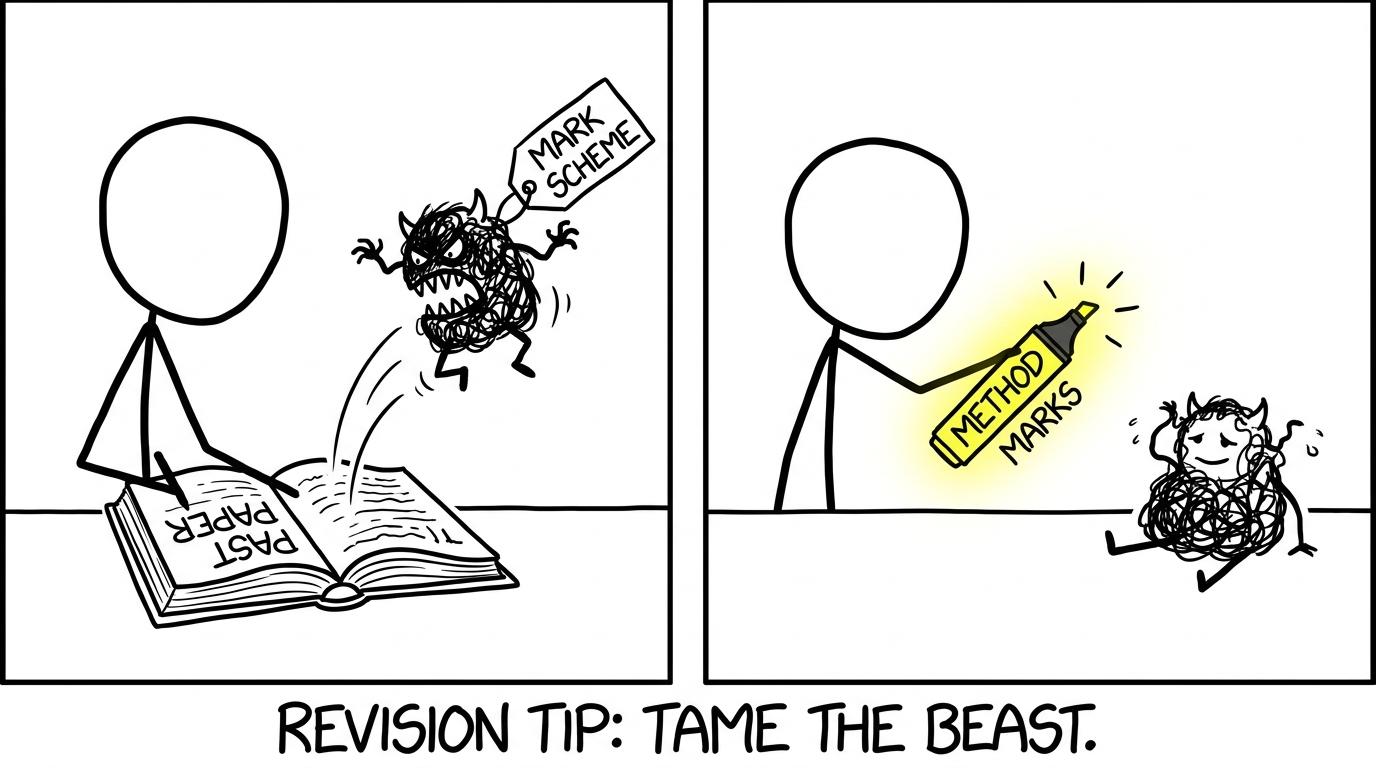 Taming the mark scheme monster with a highlighter
The final nudge: your GCSE grade can move faster than you think
A pass grade can feel like a judgement, but it’s often just a sign that you’re doing the hard part (turning up) without yet having a system. Make Physics predictable: master the maths that sits underneath it, practise with real questions, and use mark schemes as feedback rather than a verdict.
If you want a simple place to run that plan, use YesGenie as your revision base: start with revision lessons, then build confidence through practice questions, then prove it with GCSE Past papers. If you’re doing CCEA GCSE Maths alongside Physics, the CCEA GCSE Maths pages are a straightforward way to sharpen the exact rearranging and unit skills that lift Physics marks too.
Your next GCSE paper doesn’t need a new you. It needs a clearer method, and the confidence that comes from practising it the same way every time.