

Can You Take Old GCSE Maths and an Alternative?
GCSE old maths and GCSE the alternative option together: discover whether dual entry is possible and how much overlap you should expect between courses.
A qualification name can change faster than the language people use for it. Teachers may say “old Maths”, relatives remember letter grades, and an options sheet may describe an “alternative” without making clear whether it is another GCSE, a Level 2 certificate or simply a different tier.
If you are wondering whether you can take GCSE old maths and GCSE the alternative option together, the short answer is this: you cannot normally enter a withdrawn legacy GCSE alongside its current replacement. You may, however, be able to take current GCSE Mathematics alongside a separate qualification such as GCSE Statistics or a Level 2 Further Mathematics course. Your school, exam board and entry arrangements determine what is actually available.
The most important first step is therefore not extra revision. It is finding the exact qualification titles and specification codes on your school’s entry information.
The quick checklist
Before deciding whether two maths qualifications can be taken together, check:
- the full qualification title for each course;
- whether each qualification is currently available for examination;
- the awarding organisation, such as Edexcel, AQA, OCR or Eduqas;
- the specification code shown by your school;
- whether the second course is a GCSE, an International GCSE or another Level 2 qualification;
- whether you will receive two separate results;
- whether the examination dates clash;
- how your school or college will treat both results;
- how much additional content you must learn.
Do not rely on an informal label such as “old Maths”. Ask your maths teacher or exams officer to confirm the registered qualification names in writing.
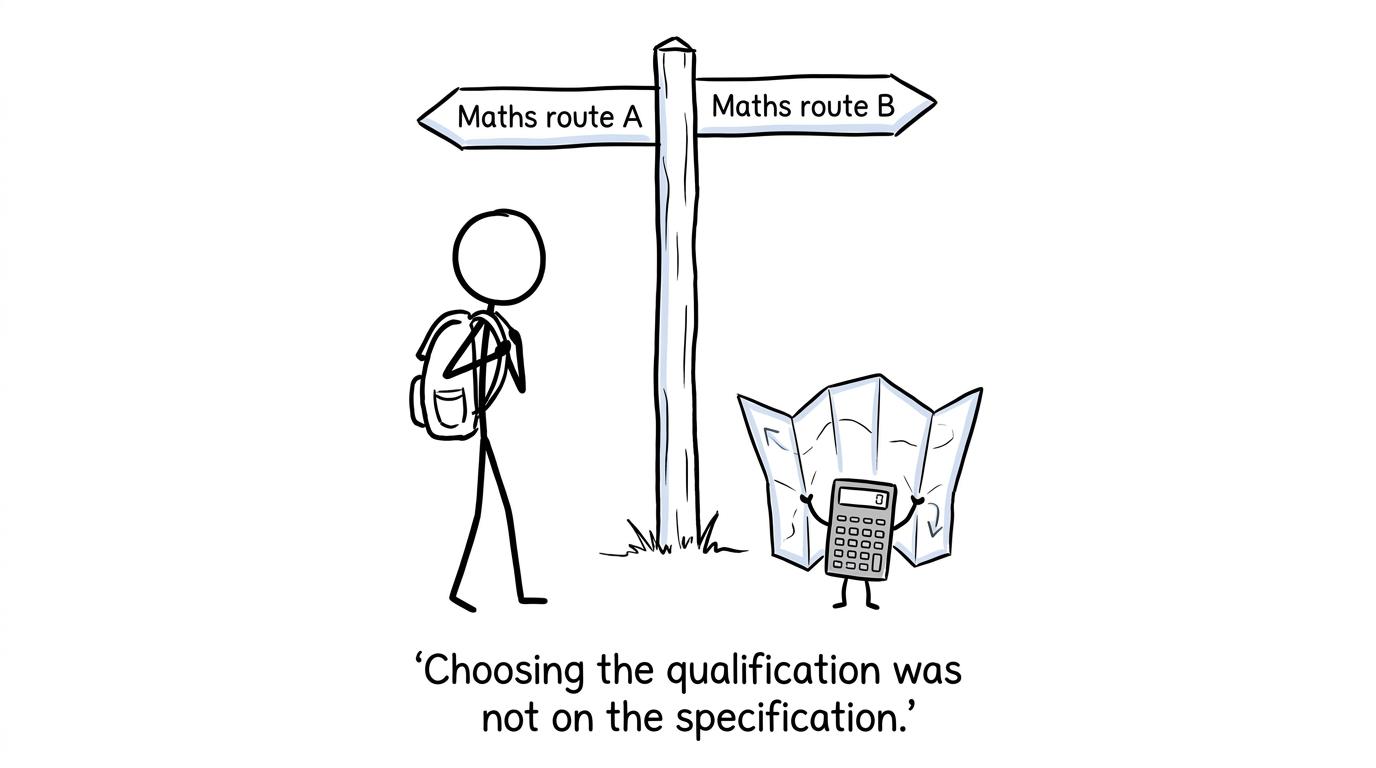 A student choosing between two confusing maths routes
What does “GCSE old Maths” mean?
There is no current qualification officially titled “GCSE Old Maths”. The phrase usually refers to a legacy specification that has been replaced, although its meaning depends on who is using it.
In England, current GCSE Mathematics uses the grades 999 to 111. Older GCSE specifications used grades A* to G and assessed a different curriculum. Those legacy specifications are not an alternative route that a new candidate can ordinarily choose instead of the current GCSE.
The position is different across the UK. Wales and Northern Ireland have their own qualification systems and specifications, so advice about English grades 999 to 111 should not automatically be applied elsewhere. An International GCSE is different again: it is a live qualification offered by particular awarding organisations, not simply the “old GCSE”.
Sometimes “old Maths” is merely a school’s informal name for a resit class, an older textbook or a previous set of past papers. None of those descriptions proves that a student is being entered for a legacy examination.
This distinction matters because old papers can still be useful for practising stable skills such as fractions or algebra. They are not, however, a reliable guide to the exact content, structure or mark allocation of a current specification. For exam-focused practice, use the current GCSE Maths revision resources and papers for your actual exam board.
What might “the alternative option” refer to?
Schools use “alternative” in several ways. Until you know which one applies, it is impossible to give a dependable yes-or-no answer.
Another tier of GCSE Mathematics
Foundation and higher are tiers within the same GCSE Mathematics qualification. They are not two separate GCSEs that students normally collect together.
A candidate is entered for one tier. Foundation tier assesses grades 111 to 555, while higher tier assesses grades 444 to 999, with an allowed grade 333 in limited circumstances under awarding arrangements. The precise entry decision belongs with your school, which should consider your current performance and the papers you are likely to handle confidently.
Taking foundation and higher papers is therefore not the usual meaning of taking two maths qualifications. Students can compare the demands through GCSE Maths past papers, but should practise the tier for which they are entered.
GCSE Statistics
GCSE Statistics is a separate GCSE where a school offers it. It develops work on data collection, sampling, probability, interpretation and statistical reasoning.
There is meaningful overlap with the statistics and probability content in GCSE Mathematics, but it is not a duplicate course. Statistics contains additional depth, terminology and assessment demands. A student may be able to take both qualifications and receive separate results, subject to the school’s curriculum and entry policy.
Level 2 Further Mathematics
A Further Mathematics course may also be described informally as the alternative or additional maths option. Its exact title matters: some courses are Level 2 certificates rather than GCSEs.
These qualifications generally build beyond higher-tier GCSE Mathematics, often extending algebra, functions, graphs and geometry while introducing ideas that support progression towards A Level. They are usually intended for confident higher-tier students and are taught alongside, or after substantial progress through, the ordinary GCSE course.
Being able to attempt more advanced material does not remove the need to prepare carefully for GCSE Mathematics. The core GCSE result remains important for progression, and Further Mathematics has its own specification and assessment style.
International GCSE Mathematics
An International GCSE is a distinct, current qualification. Some independent schools and international centres offer it instead of the standard GCSE used in England.
In principle, a centre could make entries for more than one live qualification, but availability does not make double entry automatically useful. There may be examination clashes, duplicated preparation and school reporting considerations. You would also need to follow the correct specification rather than treating the courses as interchangeable.
Is taking both realistic?
Taking current GCSE Mathematics and a genuinely separate qualification can be realistic. Taking a withdrawn “old” GCSE alongside the current version generally is not.
The practical question is whether the second qualification improves your education enough to justify its workload. A sensible decision depends on four factors.
Your school must offer and enter you for it
Students do not normally arrange GCSE entries independently when attending a school. The centre decides which specifications it teaches, whether it has suitable staff and whether it will make the examination entry.
Even where an awarding organisation offers a qualification, your school is not obliged to provide it. Ask the exams officer to confirm your entries rather than assuming that attending lessons guarantees an examination entry.
The examinations must fit your timetable
Separate qualifications can have papers close together or, occasionally, at the same time. Examination centres have procedures for timetable clashes, but these can make an already demanding exam period more tiring.
Your personal timetable is more reliable than a generic online list because it reflects your board, tier and centre entries.
You need time for the non-overlapping content
Overlap saves some learning time, but it rarely removes the need for separate revision. Each specification can use different terminology, question styles and mark schemes. Even a familiar topic may be assessed in greater depth or in a less familiar context.
A student who is still repairing gaps in core GCSE topics will often gain more from mastering one course than from dividing attention between two. Begin by identifying weak areas through the MathsGenie GCSE revision programme, then judge honestly whether there is room for another specification.
The second qualification should serve a purpose
A second maths qualification may offer valuable challenge, support a planned A Level pathway or develop stronger statistical reasoning. It should not be chosen merely because some topics look familiar.
If you are considering Mathematics at sixth form, look ahead at the MathsGenie A Level Maths resources. That helps you see whether an additional course develops useful foundations without pretending that it is required by every sixth form. Entry requirements vary, so check directly with the institutions you may apply to.
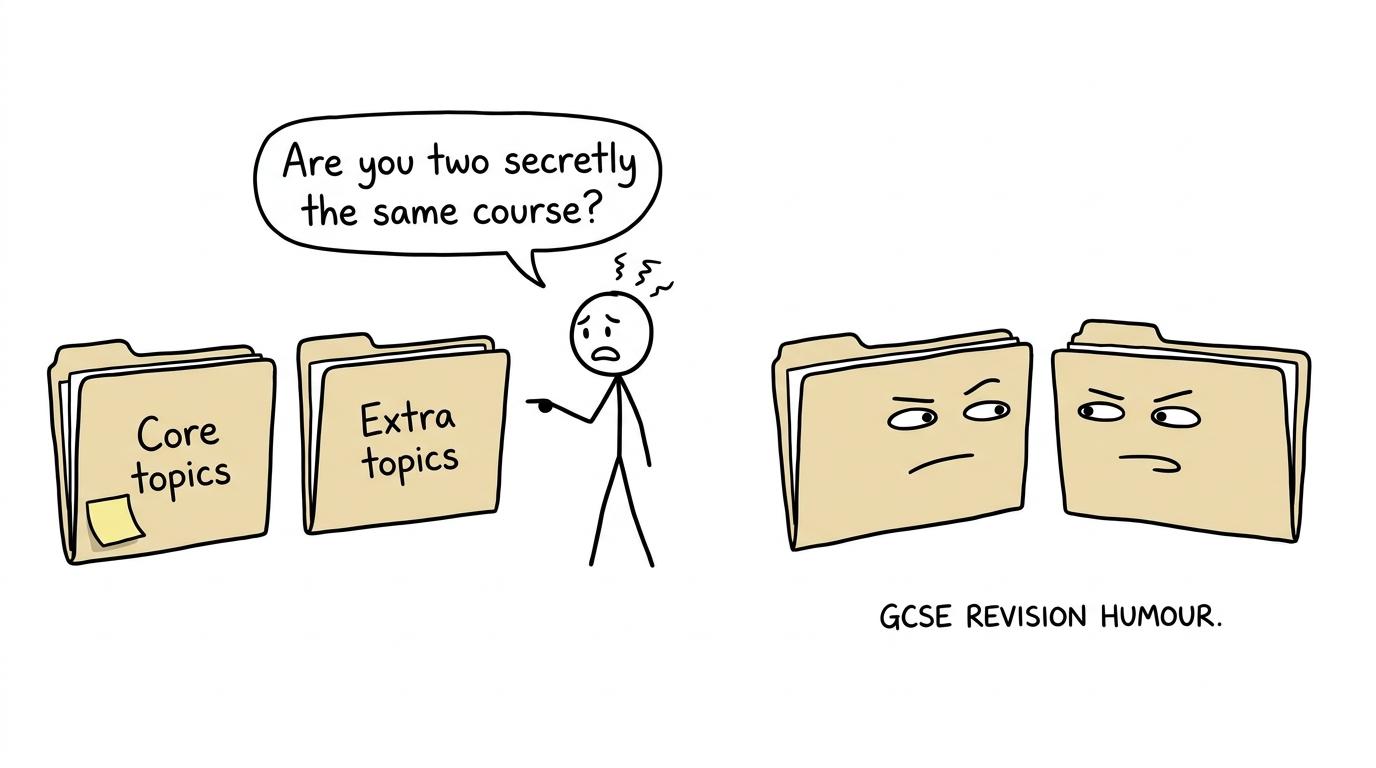 Two revision folders wondering whether they are secretly the same course
How much syllabus overlap is there?
There is no honest universal percentage. The answer changes with the two exact specifications, their tiers and the versions being compared.
Current GCSE Mathematics includes number, algebra, ratio and proportion, geometry and measures, probability, and statistics. Another maths-related qualification may revisit some of these areas, but with different breadth or depth.
The likely pattern is:
- GCSE Mathematics and GCSE Statistics: concentrated overlap in probability, data representation and interpretation, with substantial additional statistics content;
- higher GCSE Mathematics and Level 2 Further Mathematics: strong dependence on core algebra and geometry, followed by more advanced material;
- GCSE Mathematics and International GCSE Mathematics: potentially broad topic overlap, but differences in specification detail, paper structure and permitted techniques;
- foundation and higher tier: considerable shared curriculum, but these are alternative tiers of one qualification rather than two complementary awards;
- legacy and current GCSE papers: many enduring mathematical skills, but potentially important differences in content, grading and assessment emphasis.
The best comparison is a specification audit. Place the official topic lists side by side and label every area as:
- already secure;
- familiar but assessed differently;
- new content;
- not included in the other course.
Then compare assessment details: calculator rules, paper length, formula information, command words and the balance between routine and problem-solving questions. Topic overlap alone does not prove that revision overlap will be equally large.
A practical revision approach for two qualifications
If your entries are confirmed, keep one revision plan with two clearly marked strands. Shared topics should be learned thoroughly once, then practised in the style of each qualification. Unique topics need protected revision time rather than being left until the end.
Use Edexcel GCSE Maths papers, AQA GCSE Maths papers or OCR GCSE Maths papers according to your entry. Switching casually between boards can hide gaps because specifications and paper conventions are not identical.
A useful routine is to:
- revise the underlying skill through a lesson and video;
- answer focused practice questions;
- complete a mini test without notes;
- mark it carefully using the mark scheme;
- record errors by topic rather than only recording the total mark;
- complete full papers under timed conditions later in the process.
MathsGenie predicted papers can provide further exam-style practice when available, but they should complement rather than replace official past papers. No predicted paper can guarantee the questions that will appear.
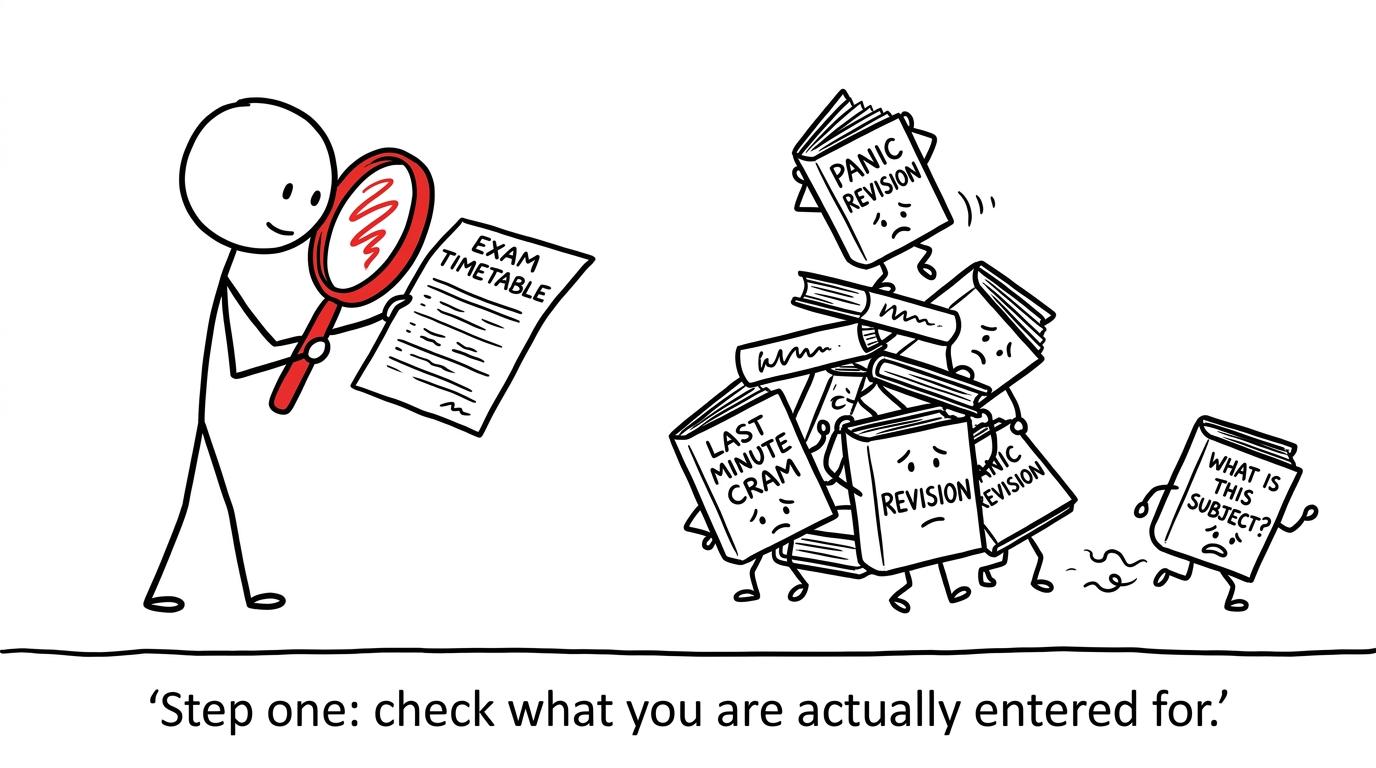 A student carefully checking the qualification on an exam timetable
Common mistakes when considering both options
Treating an informal nickname as a qualification title
“Old Maths”, “extra Maths” and “alternative Maths” are not precise enough. Always obtain the awarding organisation, full title and specification code.
Assuming overlap means no extra revision
Two courses can share topics while assessing them differently. Separate past-paper practice and mark-scheme review remain necessary.
Revising from obsolete papers alone
Legacy questions can build fluency, but they may omit current content or create a misleading impression of today’s paper. Prioritise materials matched to your live specification.
Confusing a tier with a second GCSE
Foundation and higher are entry routes within GCSE Mathematics. They are not normally two separate qualifications taken together.
Neglecting the main GCSE to chase an additional award
More qualifications do not automatically mean better preparation. Secure understanding, accurate working and calm exam technique in your principal GCSE should come first.
Assuming every sixth form treats qualifications identically
Admissions policies vary. If the second course is intended to support an application, ask the sixth form or college how it views that exact qualification.
Make the qualification name your starting point
The phrase GCSE old maths and GCSE the alternative option together sounds like a question about workload, but it begins as a question about definitions. A withdrawn legacy GCSE cannot normally be selected as a parallel alternative. A separate live course, such as GCSE Statistics or Level 2 Further Mathematics, may be taken alongside current GCSE Mathematics when your school offers it and the entry is worthwhile.
Ask for the exact qualification names. Compare the specifications. Check your timetable. Then decide whether the additional content supports your goals without weakening your preparation for the core GCSE.
Once your route is confirmed, MathsGenie gives you a clear place to begin. Use the free revision lessons, video solutions, practice questions and mini tests to strengthen individual topics, then move to mark schemes, past papers and predicted papers when you are ready to practise complete examinations. Start with the MathsGenie GCSE revision hub and build a plan around the examination you are actually taking.










