

GCSE OCR vs Edexcel Maths: What Actually Changes?
GCSE OCR vs Edexcel Maths explained: what’s different, what’s the same, and how to revise smarter using Maths Genie topics, papers and mark schemes.
If you’ve ever opened a paper and thought, “This doesn’t look like the GCSE I revised for”, you’re not being dramatic. You’re noticing something real: each exam board has its own style. But here’s the quiet truth most students only learn late on, OCR vs Edexcel Maths isn’t a different mountain. It’s the same mountain with slightly different signposts.
The danger is spending revision time comparing signposts instead of climbing. The opportunity is using those differences to practise with intent: the right topics, the right paper format, the right habits under timed conditions. That’s where Maths Genie helps, because it lets you revise the maths, then sharpen your exam technique with board-specific papers, mark schemes and video solutions.
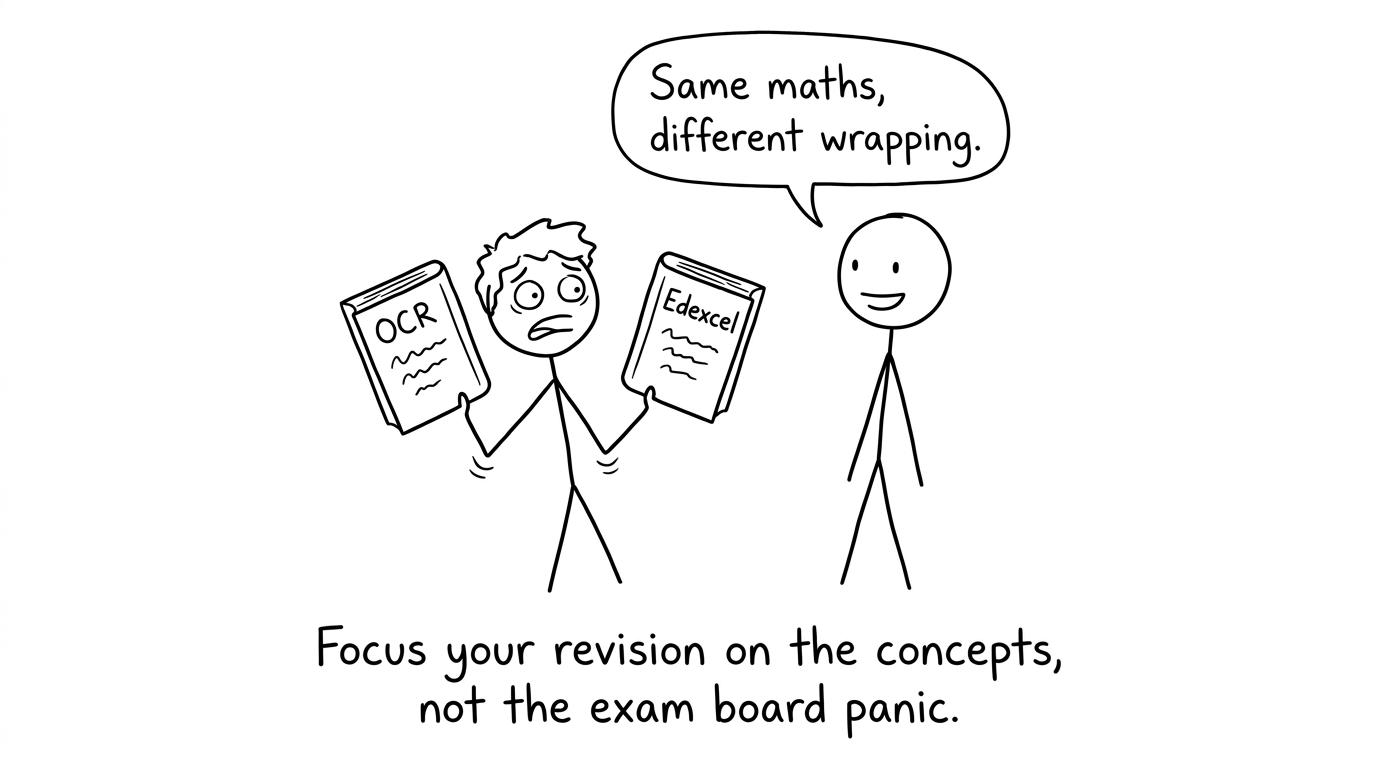 Two textbooks labelled OCR and Edexcel
OCR vs Edexcel Maths in one sentence
OCR vs Edexcel Maths is mostly about presentation (how questions are written and structured), not content (the maths you need to know for GCSE).
Both boards assess the same core areas: number, algebra, ratio and proportion, geometry and measures, probability and statistics, plus problem-solving. In other words: your grade still comes from the same fundamentals.
To see how Maths Genie organises those fundamentals into a steady path, use the Edexcel GCSE Maths learning journey. Even if you’re OCR, the topic sequencing is still excellent GCSE revision.
A quick checklist before you choose how to revise
Use this checklist to stop “exam board anxiety” turning into wasted revision:
- Confirm your board and tier (foundation or higher) with your teacher.
- Learn topics first, then do exam questions second.
- Practise on the correct paper format (especially non-calculator papers).
- Mark with the mark scheme and write down what the examiner wanted.
- Repeat weak topics using short tests and mini tests.
Maths Genie has the building blocks for this approach: revision lessons, practice questions, mini tests and full papers.
Helpful starting points:
- OCR GCSE Maths exam papers
- GCSE predicted papers (Edexcel)
- Target Tests (GCSE mini tests)
- Maths Genie resources hub
What’s the same in OCR vs Edexcel Maths
The same things decide your GCSE grade, regardless of OCR or Edexcel.
The maths content overlaps heavily
For both OCR and Edexcel, you’ll repeatedly meet:
- rearranging and solving equations
- graphs (straight lines, quadratics, real-life graphs)
- angle rules and bearings
- ratio and percentages
- probability trees and Venn diagrams
- cumulative frequency and histograms
The boards may dress these up differently, but the method is the method.
The marks still reward method
This matters because it changes how you revise: you’re not revising “a question”, you’re revising a method that earns marks. That’s why it’s powerful to practise with mark schemes and video solutions. Maths Genie keeps those close to the questions, so you can quickly see how method marks are awarded.
If you want a broad bank of papers to practise from (useful even if you’re OCR), the Resources page links to multiple boards.
What changes between OCR vs Edexcel Maths
This is where students feel the difference.
Question style and wording
Edexcel often uses very structured phrasing, sometimes leading you step-by-step through a scenario. OCR can feel slightly more direct, and sometimes the “what are you meant to do?” part is shorter, meaning you must choose the method sooner.
In practice, this means:
- OCR can reward confidence with technique selection.
- Edexcel can reward careful reading across multi-part questions.
Paper naming and layout
Both boards typically use three papers, including at least one non-calculator. But the numbering conventions and layout can look unfamiliar if you only practised one board.
So a simple rule for GCSE revision is: once per week, sit a paper that looks exactly like your board’s papers. For OCR students, that’s straightforward with the OCR GCSE Maths exam papers.
Topic emphasis (small differences)
No board has “secret topics”, but emphasis can drift slightly year to year. That’s why a topic-based revision journey plus board papers is a better long-term bet than trying to guess what will come up.
Maths Genie’s predicted papers are useful as an extra layer of practice (not a crystal ball). Try the GCSE predicted papers (Edexcel) after you’ve built confidence with topics.
A worked example that shows the “same maths, different wrapping” idea
A lot of OCR vs Edexcel Maths differences disappear once you translate the words into algebra.
Example: forming and solving a linear equation
Problem: A phone contract costs a fixed fee of £12 plus £0.08 per text. The total cost is £18.40. How many texts were sent?
Method:
Let the number of texts be ttt.
Cost equation:
12+0.08t=18.40 12 + 0.08t = 18.40 12+0.08t=18.40Subtract 121212 from both sides:
0.08t=6.40 0.08t = 6.40 0.08t=6.40Divide by 0.080.080.08:
t=6.400.08 t = \frac{6.40}{0.08} t=0.086.40Because 0.08=81000.08 = \frac{8}{100}0.08=1008 and 6.40=6401006.40 = \frac{640}{100}6.40=100640,
t=6401008100=6408=80 t = \frac{\frac{640}{100}}{\frac{8}{100}} = \frac{640}{8} = 80 t=1008100640=8640=80So, 808080 texts were sent.
Why this matters for OCR vs Edexcel Maths: One board might give you a table to fill in first. Another might ask you to “form an equation” immediately. But the scoring engine underneath is the same: define a variable, create an equation, solve cleanly.
To reinforce the skill, use topic practice and then exam-style questions. Maths Genie’s Target Tests are great for quick, focused GCSE method practice.
A second worked example: higher-tier algebra that appears everywhere
For higher tier GCSE, rearranging and solving is a frequent differentiator.
Example: solving a quadratic by factorising
Solve x2−5x+6=0x^2 - 5x + 6 = 0x2−5x+6=0.
We need two numbers that multiply to 666 and add to −5-5−5. These are −2-2−2 and −3-3−3.
Factorise:
x2−5x+6=(x−2)(x−3) x^2 - 5x + 6 = (x-2)(x-3) x2−5x+6=(x−2)(x−3)Set each bracket to zero:
x−2=0orx−3=0 x - 2 = 0 \quad \text{or} \quad x - 3 = 0 x−2=0orx−3=0So:
x=2orx=3 x = 2 \quad \text{or} \quad x = 3 x=2orx=3Exam-board angle: OCR might wrap this inside a geometry or sequence context. Edexcel might ask for factorisation as part (a) and solutions as part (b). Either way, the method is stable. Your revision should be stable too.
If you’re building a reliable topic order, follow the Edexcel GCSE Maths learning journey and then switch to your board’s papers for timing and familiarity.
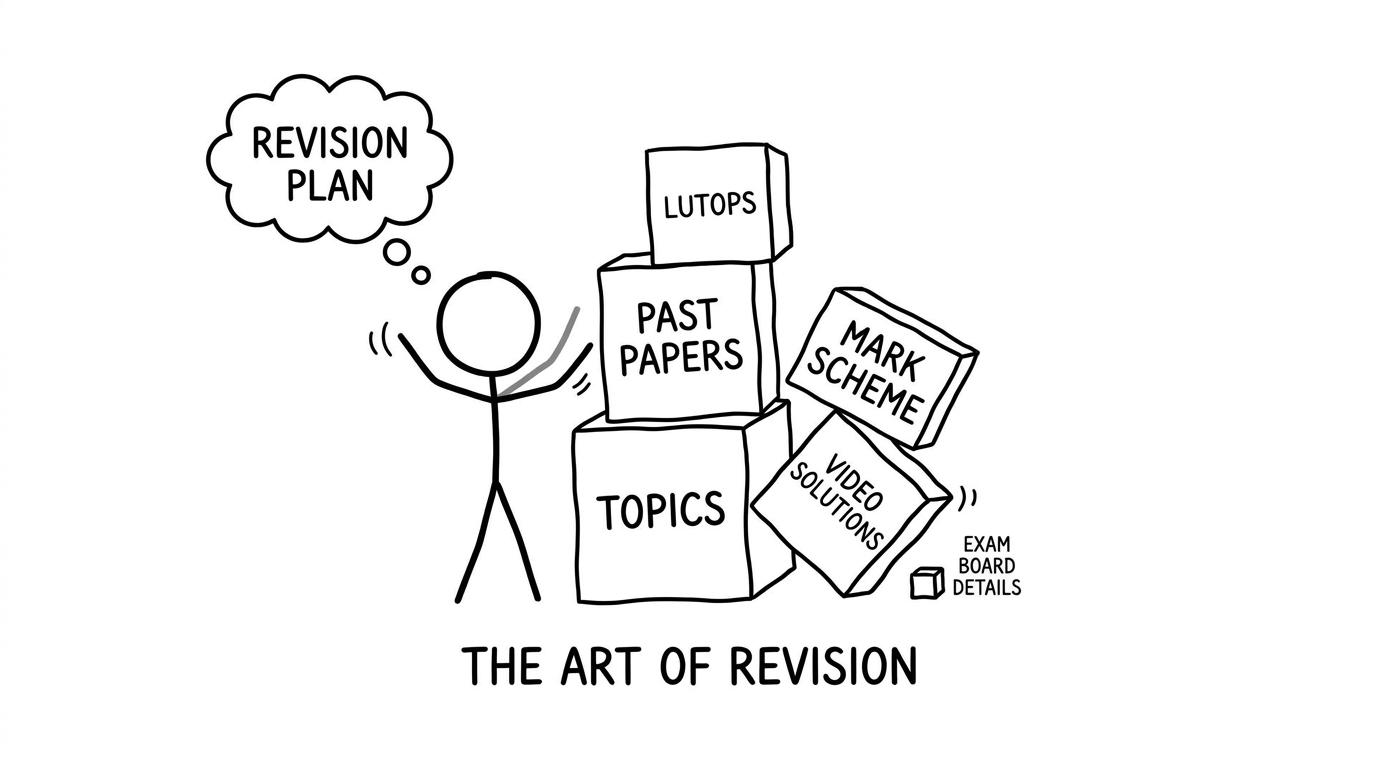 Revision plan tower of blocks
How to revise smartly for OCR vs Edexcel Maths (without overthinking it)
The best GCSE revision strategy is boring in the way that strong foundations are boring.
Build topic security first
If you’re constantly surprised by questions, it usually means the topic isn’t secure yet. Use Maths Genie revision lessons and practise until you can do a method without hesitation.
A simple rhythm:
- 20 minutes topic learning
- 20 minutes practice questions
- 10 minutes marking and corrections
Then practise board-specific papers
This is where OCR vs Edexcel Maths becomes useful rather than stressful. Do papers to learn:
- the look and feel of the paper
- how questions are sequenced
- how much working the mark scheme expects
Go straight to:
- OCR GCSE Maths exam papers
- If you’re Edexcel, use GCSE predicted papers alongside full past papers
Use short tests when motivation is low
On days when a full paper feels impossible, do something smaller, but still real. That’s what keeps revision consistent.
Try:
Consistency beats intensity, especially in the last 6-8 weeks before GCSE exams.
Common mistakes students make with OCR vs Edexcel Maths
These mistakes cost more marks than any exam board difference.
Revising the board instead of the maths
Students sometimes spend hours reading about OCR vs Edexcel Maths, then do zero algebra. Knowing the difference between boards won’t help if you can’t solve 12+0.08t=18.412 + 0.08t = 18.412+0.08t=18.4. Use board knowledge to choose practice papers, not to replace practice.
Not practising non-calculator skills
Non-calculator papers reward fluency: fractions, percentages, estimation, and exact values. If you always reach for a calculator in revision, the non-calculator paper feels like a different subject on the day.
Ignoring method marks
A correct answer with no working can lose marks if the answer is wrong due to one slip. A wrong final answer with strong working can still earn method marks. Mark schemes show this clearly, and Maths Genie makes it easy to practise that habit.
Not analysing mistakes
Doing a paper and moving on is comforting but shallow. The real gains come from writing a correction and redoing the question a few days later. That’s how you turn a mistake into a method.
If you’re also doing A Level maths
If you’re sitting GCSE now but thinking ahead (or you’re already in sixth form), the OCR vs Edexcel habit of over-comparing can follow you into A Level too.
At A Level, the content becomes more connected: algebra feeds calculus, graphs feed mechanics, trig identities show up everywhere. The simplest preparation is to strengthen your algebra and graph fluency now, because those are the skills A Level assumes.
Maths Genie’s A Level section is here:
Even a small amount of A Level-style thinking can make higher tier GCSE feel calmer.
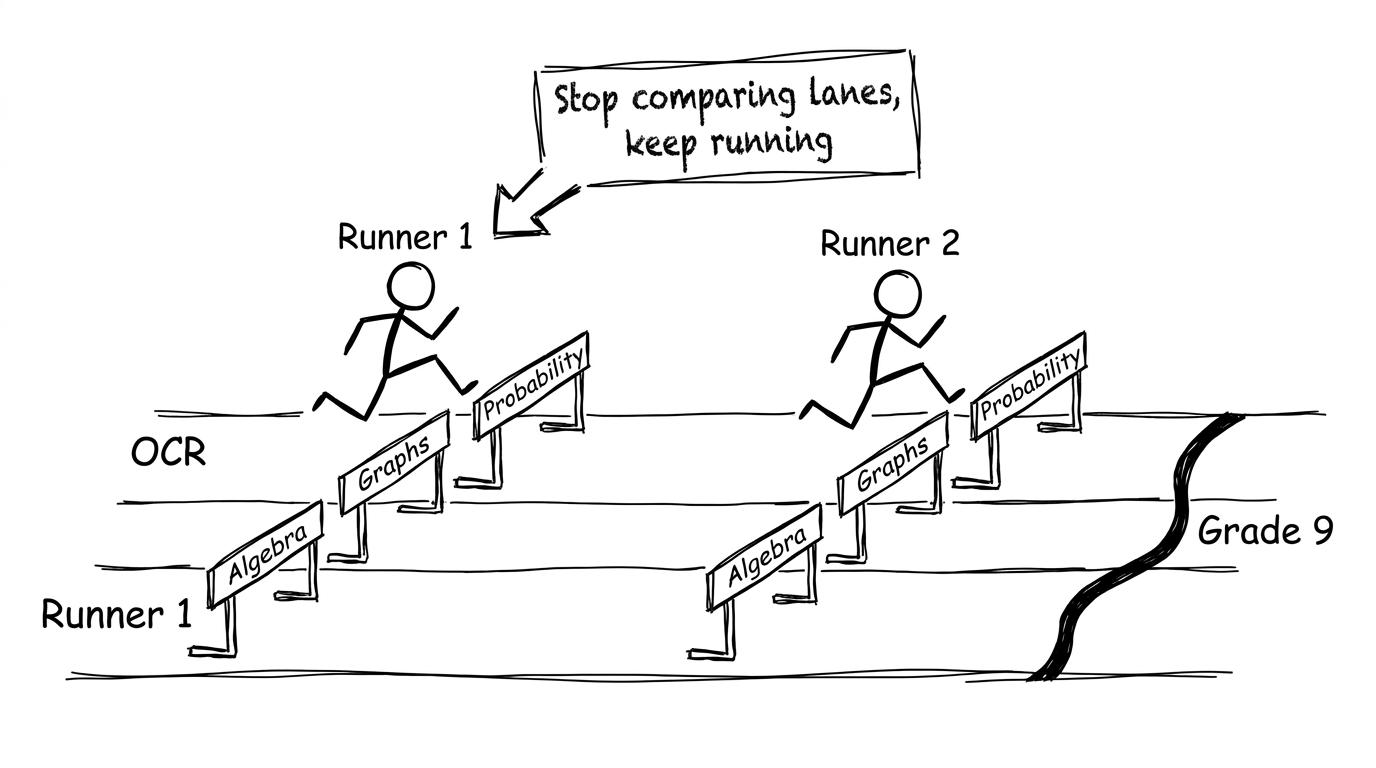 Two runners labelled OCR and Edexcel
The real conclusion on OCR vs Edexcel Maths
OCR vs Edexcel Maths matters less than students think, and more than they practise. Less, because the GCSE maths content is fundamentally the same. More, because familiarity with your paper style can be the difference between “I knew this” and “I panicked”.
So don’t build your revision around the exam board. Build it around methods, then use the exam board papers to sharpen timing and confidence.
Your next steps on Maths Genie:
- Learn and practise topics systematically with the Edexcel GCSE Maths learning journey (useful for any GCSE student).
- Sit board-style papers using OCR GCSE Maths exam papers.
- Add extra exam practice with GCSE predicted papers.
- Boost consistency with Target Tests (mini tests).
Keep it simple: revise the maths, practise the papers, use the mark schemes, and let your confidence compound, one GCSE method at a time.










