GCSE: Stop Forgetting OCR Maths Content (Simple System)
GCSE OCR maths revision tips to stop forgetting content. Use retrieval practice, spaced repetition, past papers and YesGenie resources to improve grades.
GCSE revision can feel like pouring water into a leaky bucket.
You sit down, you understand the topic, you do a few questions… and then a week later it’s gone. If you’re an OCR student, that panic can hit hardest when you open a mixed-topic paper and realise your brain remembers the feeling of a method, but not the method itself. The good news is that forgetting GCSE maths content is normal. The better news is that you can build a system that makes forgetting slower, and remembering faster.
This post gives you a practical, OCR-friendly routine to stop forgetting GCSE maths content using the exact tools that work best: spaced practice, retrieval, interleaving, and exam-style questions. We’ll keep it grounded, with worked examples, common mistakes, and a simple plan you can run on YesGenie.
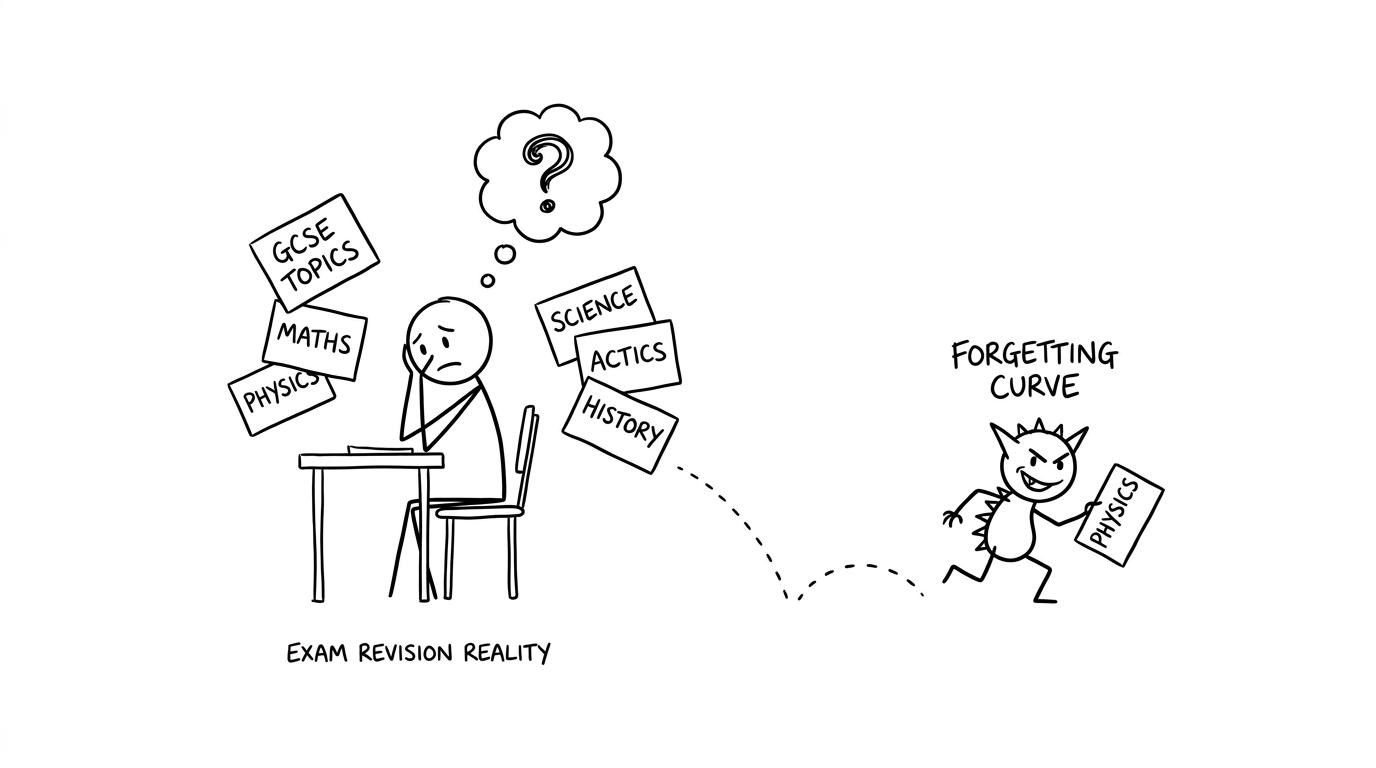 A forgetting curve gremlin stealing flashcards
The quick checklist (print this mentally)
If you want to stop forgetting GCSE maths content for OCR, you need four habits:
- Learn once (clear method, one page of notes max)
- Retrieve often (from memory, not from reading)
- Space it out (same topic returns after days and weeks)
- Mix it up (OCR papers mix topics, so your revision must too)
On YesGenie, that usually looks like:
- Use GCSE Maths Revision to pick topics.
- Use GCSE - Maths - OCR for OCR topic lists, question banks, booklets, and solutions.
- Use GCSE Past papers to build exam stamina.
- Use Resources when you want predicted papers and timed practice formats.
Why you forget GCSE maths (and why it’s not a “you” problem)
Most GCSE forgetting happens for a boring reason: recognition disguises itself as knowledge.
Reading a revision guide or watching a video makes the method feel familiar. Familiarity is comforting. But OCR exam questions don’t ask, “Do you recognise this?” They ask, “Can you produce the method under time pressure, with unfamiliar numbers, and with three other topics on the page?”
That’s why the fix is not “more notes”. The fix is more retrieval.
Retrieval practice means you try to bring the method to mind before you look at help. It feels harder. That difficulty is exactly what makes the memory stronger.
Build an OCR-friendly GCSE revision loop on YesGenie
Here’s a loop you can repeat all year, and then tighten before exams.
Step one: pick a small slice of GCSE content
Choose one topic you can finish in 252525 minutes. For example:
- simplifying algebra
- substitution
- expanding and factorising
- ratio and proportion
- sine rule (higher tier)
On YesGenie, a clean starting point is the OCR board hub: GCSE - Maths - OCR. If you’re not sure which tier you’re aiming for, use the topic list and be honest: foundation topics should feel automatic; higher topics should feel achievable with practise.
For a concrete example topic page, you can use something like Simplifying Algebra (the skill is the same across exam boards, even if you’re OCR).
Step two: learn the method, then close it
Use a revision guide page, a short lesson, or a video solution. But keep the input phase short. Your goal is a method you can say out loud.
Then close the tab and write the method from memory.
Step three: do “one from memory” before you do “ten with help”
This is the turning point. Do one exam-style question with no notes. If you get stuck, then look at the steps, and immediately try a second one.
YesGenie makes this easy because you can move from guides to question banks and then to full papers without changing websites.
Step four: schedule the return (spaced practice)
If you practise a topic once, you’re basically training short-term confidence.
Instead, return to it:
- after 111 day
- after 333 days
- after 777 days
- after 141414 days
Each return only needs 101010 minutes. Two questions. One flashcard. A mini test. The point is to keep the memory alive.
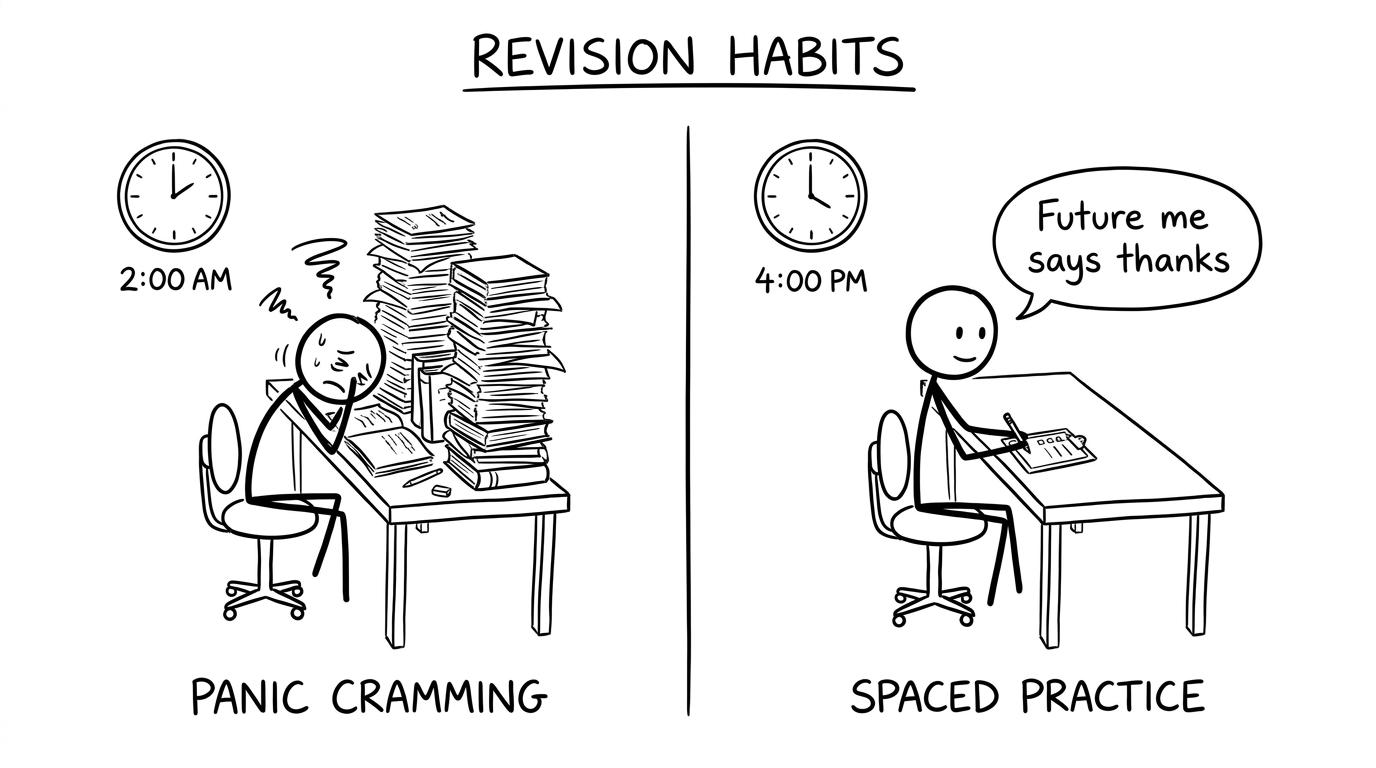 Cramming vs spaced practice
Worked examples that train memory (not just understanding)
The OCR GCSE papers reward methods you can execute cleanly. Here are two examples you can use as templates for retrieval.
Worked example: substitution with negatives
Evaluate 3a2−2b3a^2 - 2b3a2−2b when a=−4a=-4a=−4 and b=7b=7b=7.
Method: substitute using brackets, then follow BIDMAS.
3a2−2b=3(−4)2−2(7)3a^2 - 2b = 3(-4)^2 - 2(7)3a2−2b=3(−4)2−2(7)Compute the power first:
(−4)2=16(-4)^2 = 16(−4)2=16So:
3(−4)2−2(7)=3(16)−14=48−14=343(-4)^2 - 2(7) = 3(16) - 14 = 48 - 14 = 343(−4)2−2(7)=3(16)−14=48−14=34Answer: 343434.
If substitution is a weak spot, revise the approach using a substitution guide like Substitution - GCSE Maths Revision Guide and then immediately do two questions from the OCR question bank on YesGenie.
Worked example: factorising then simplifying (the “don’t cancel terms” trap)
Simplify:
x2−9x+3\frac{x^2-9}{x+3}x+3x2−9Factorise the numerator:
x2−9=(x−3)(x+3) x^2 - 9 = (x-3)(x+3)x2−9=(x−3)(x+3)So:
x2−9x+3=(x−3)(x+3)x+3\frac{x^2-9}{x+3} = \frac{(x-3)(x+3)}{x+3}x+3x2−9=x+3(x−3)(x+3)Cancel the common factor (x+3)(x+3)(x+3):
(x−3)(x+3)x+3=x−3\frac{(x-3)(x+3)}{x+3} = x-3x+3(x−3)(x+3)=x−3Answer: x−3x-3x−3.
This style of algebra shows up everywhere in GCSE, and it’s a classic “I knew this last month” topic. For structured practice, use an exam booklet like Expanding and Factorising Exam Booklet and do it in spaced chunks.
Make OCR GCSE revision feel like OCR GCSE papers
OCR papers are not topic-by-topic in the real exam. They’re mixed.
So once you’ve got basic recall, you need interleaving: mixing topics so your brain practises choosing the right method.
A simple routine:
- 151515 minutes: one topic (tight focus)
- 151515 minutes: mixed questions (force method choice)
- 151515 minutes: timed mini-paper or half paper
For the timed phase, use:
- GCSE Past papers to practise real paper structure.
- The OCR board hub GCSE - Maths - OCR to find OCR-specific papers, mark schemes, and solutions.
And when you want something slightly unfamiliar (which is good for memory), try a higher-tier topic such as The Sine Rule and then return to it weekly.
How to mark so you actually stop forgetting
Marking is not punishment. It’s feedback.
When you use mark schemes or video solutions, don’t just tick and move on. Write a short “cause of error” note:
- “I forgot to square the bracket.”
- “I cancelled terms not factors.”
- “I used cosine rule when it was sine rule.”
Then turn that error into a retrieval prompt you revisit:
- “When can I cancel in a fraction?”
- “What’s the first line for substitution with negatives?”
YesGenie’s structure (topic questions, solutions, and past papers) makes this cycle quick: question, mark, diagnose, redo.
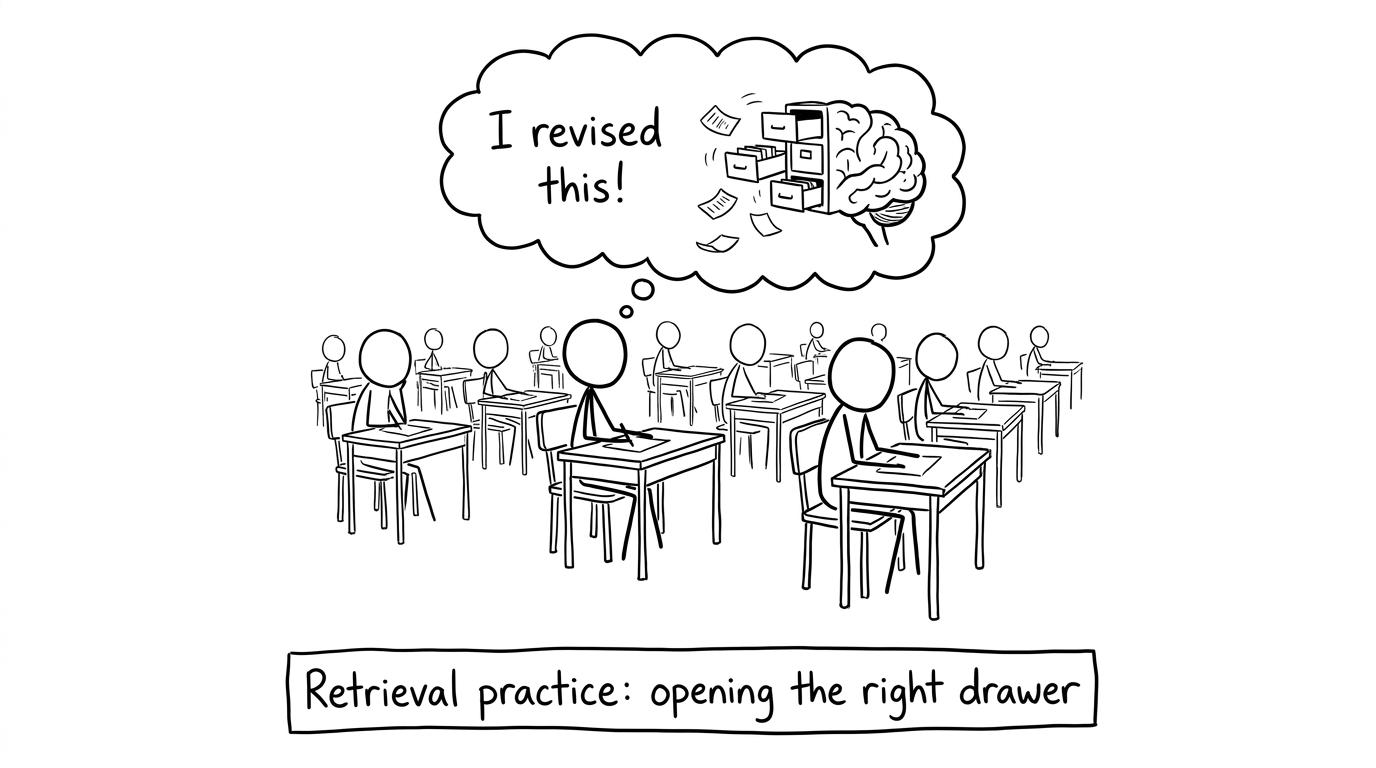 Brain filing cabinet during an exam
Common mistakes that keep OCR GCSE students forgetting
- Re-reading instead of retrieving. If your revision session is mostly highlighting, your GCSE memory won’t change much.
- Doing ten of the same question in a row. It builds momentum, not flexibility. OCR will mix topics, so you must mix your practice too.
- Not returning to topics. A topic you “finished” in September can still cost you marks in June.
- Marking without reflection. If you don’t name the mistake, you can’t fix the habit.
- Avoiding weak topics. Your grade is usually capped by the topics you keep dodging.
A simple 7-day OCR GCSE anti-forgetting plan
Use this as a repeatable week.
- Day 1: learn one topic + 666 questions (finish with one from memory)
- Day 2: 101010 minutes retrieval on Day 1 topic + mixed practice
- Day 3: new topic + 666 questions
- Day 4: return to Day 1 topic (two questions) + return to Day 3 topic (two questions)
- Day 5: mixed set from OCR question bank
- Day 6: one timed half paper, mark, write error prompts
- Day 7: rest or light flashcards
Everything in that plan is GCSE-friendly, and it’s built around the reality that memory needs revisiting.
Closing: make GCSE memory a system, not a mood
The students who stop forgetting GCSE maths content aren’t the ones who never forget. They’re the ones who notice forgetting early, and treat it like a signal to retrieve again.
If you’re studying OCR, keep it simple: learn the method clearly, retrieve it often, space it out, and practise in the same mixed style you’ll see on the day. Use YesGenie as your home base: start with GCSE - Maths - OCR, practise through GCSE Maths Revision, and build confidence with GCSE Past papers. When you’re ready to sharpen your timing and focus, use the tools in Resources.
Keep the loop running, and GCSE content stops slipping away, not because you tried harder once, but because you built something you can repeat.