

GCSE OCR Maths: Turn Notes Into Active Recall
GCSE OCR maths students: learn how to turn notes into active recall using past papers, mini tests and mark schemes on YesGenie for higher grades.
If you’re an OCR student, you’ve probably had this moment: you open your GCSE maths notebook and it looks… impressive. Colour. Headings. Worked examples copied neatly. And yet, when a real exam question arrives, your mind goes oddly quiet.
That’s not laziness. It’s the difference between recognising maths and recalling it.
This post shows OCR GCSE students how to turn GCSE notes into active recall, so your revision creates marks, not just pages. We’ll keep it practical, exam-focused, and built around the exact tools that make the biggest difference: self-testing, spacing, and past paper feedback, all of which you can do for free on YesGenie.
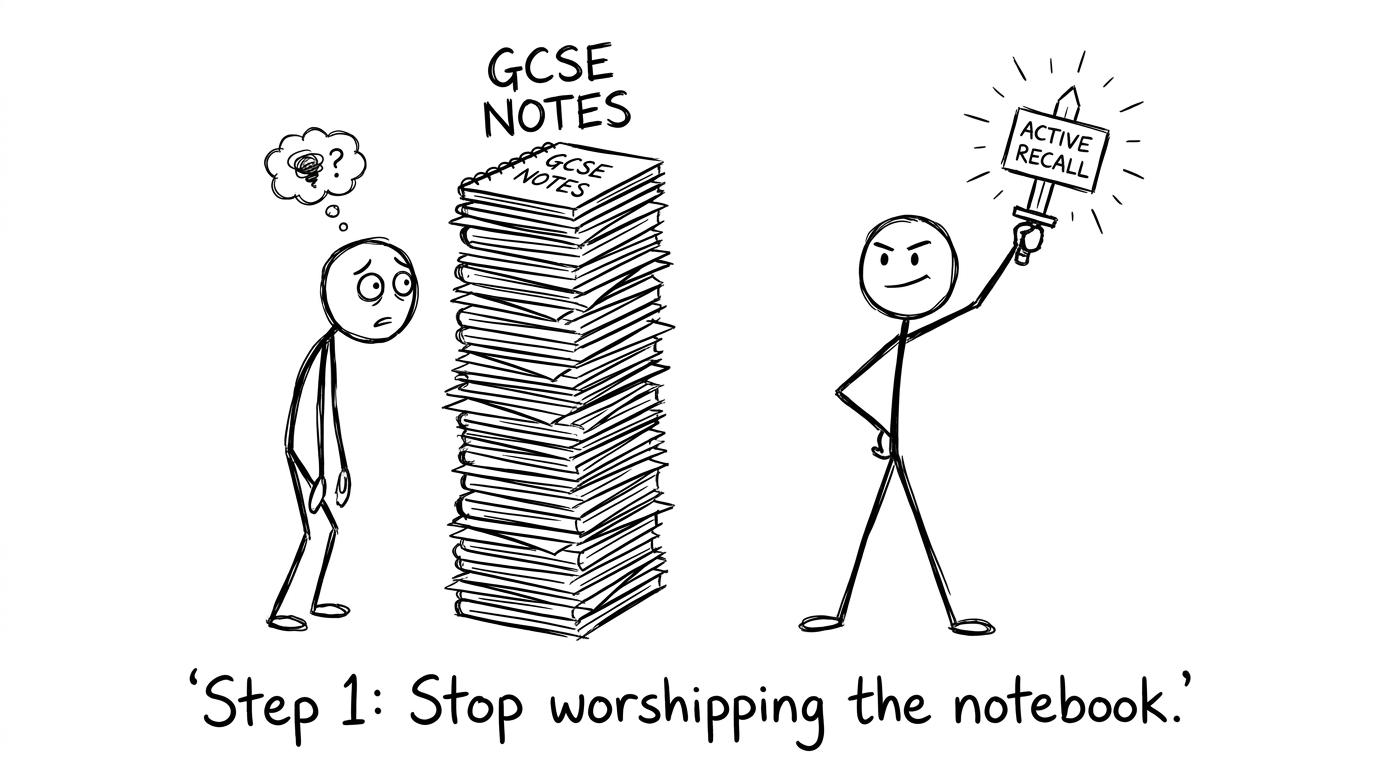 A student chooses active recall over worshipping notes
The quick checklist: notes to active recall in 20 minutes
When you sit down to revise, use this loop:
- Pick one topic from your GCSE notes.
- Write a one-page “memory version” (no looking): definitions, method steps, common forms.
- Do 4-8 exam-style questions on that same topic.
- Mark using a mark scheme and fix gaps.
- Return in 2 days for a shorter recall session.
This is active recall: bringing information to mind under mild pressure. It’s what GCSE exams reward.
To find OCR-specific practice fast, start here: GCSE Maths OCR. For mixed exam practice across boards, use: GCSE past papers. And if you need smaller chunks, Resources links to mini tests and other revision formats.
Why GCSE notes feel helpful (but don’t always raise marks)
A notebook is comforting because it gives you proof of effort. But GCSE maths isn’t assessed by whether you once understood something. It’s assessed by whether you can retrieve a method quickly, choose it from several options, and apply it accurately.
Reading notes is mostly recognition. You see a worked example and think, “Yes, I remember that.” In the exam, you must produce the method from scratch. That’s recall.
So the goal isn’t to throw notes away. The goal is to use your GCSE notes like a launchpad:
- Notes tell you what matters.
- Active recall proves whether you can do it.
- Past papers train the timing and decision-making.
How OCR students should structure active recall for GCSE maths
OCR papers still reward the same core habits as AQA and Edexcel: accuracy, clear method, and resilient problem-solving. But OCR students often benefit from being extra deliberate about showing method marks and interpreting questions carefully.
Here’s a structure that fits OCR GCSE revision well.
Step one: convert notes into “prompt cards”
Take one section of notes (for example, simplifying algebra). Don’t rewrite it. Instead, turn each idea into a prompt that forces recall.
Examples of good prompts:
- “What are the rules for indices?”
- “How do you simplify 3x−2x+53x - 2x + 53x−2x+5?”
- “What’s the difference between cancelling terms and cancelling factors?”
Then answer without looking. Only after you’ve attempted, check your notes.
If you want a model of what good concise notes look like, use YesGenie revision guides and lessons as the reference point. For example:
Even if you’re OCR, the maths skill is the same; and you can still use the explanations and exam-style practice to drive active recall.
Step two: practise retrieval with timed micro-sessions
A powerful GCSE pattern is 6 minutes recall + 12 minutes questions + 2 minutes review.
In that first 6 minutes, write down what you can remember: key steps, common mistakes, and one example from memory. This is where the real learning happens; it feels slightly uncomfortable because your brain is building retrieval strength.
Step three: lock it in with exam questions and a mark scheme
Active recall becomes exam-ready when it meets marking. After your micro-session, do exam-style questions and mark them.
On YesGenie you can move naturally from learning to exam practice:
- Find the topic (OCR hub): GCSE Maths OCR
- For shorter self-tests: GCSE Maths mini tests
- For full exam conditions: GCSE past papers
Mark schemes teach you what OCR is actually paying marks for: method, accuracy, and communication.
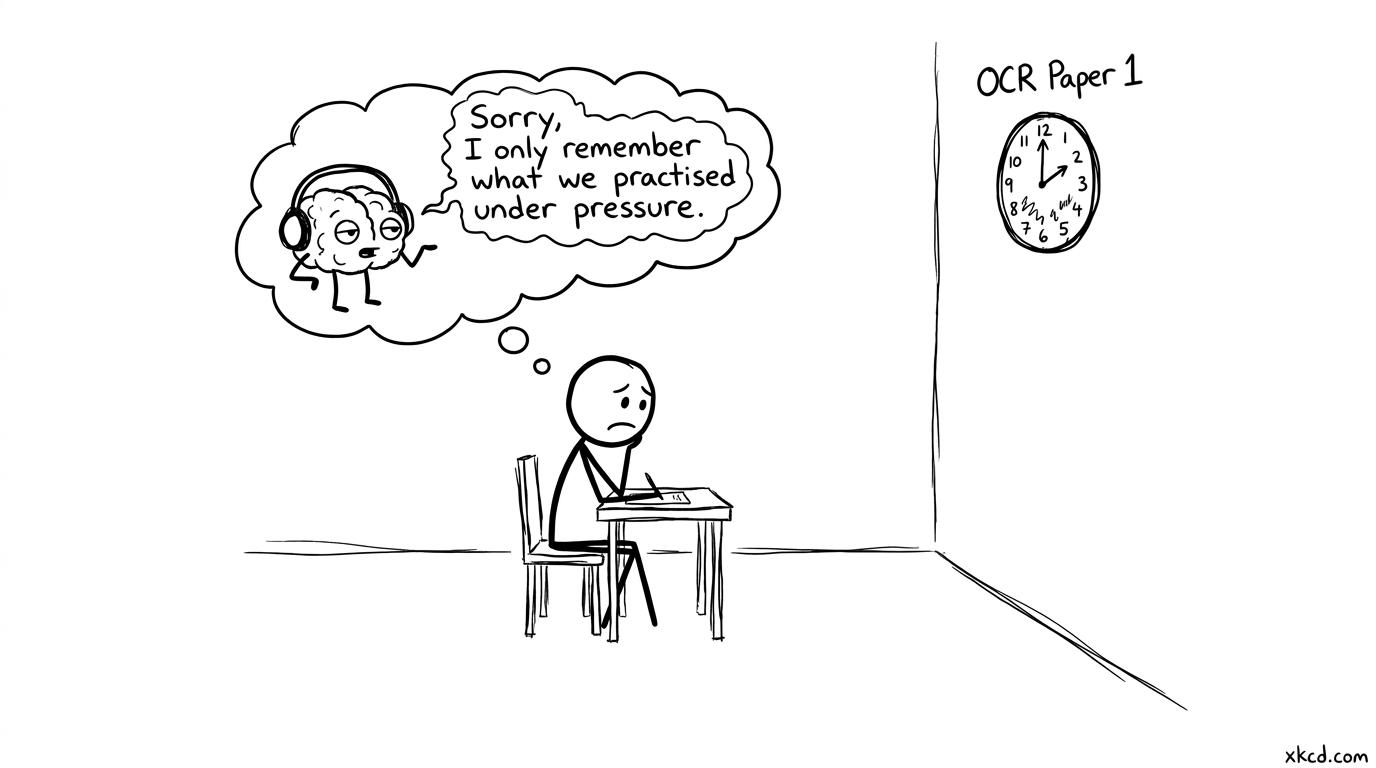 Exam brain only remembers what you practised
Worked examples: turn notes into active recall (proper GCSE style)
Below are three examples showing how to go from “I’ve got notes” to “I can recall and score marks”. Do the recall first (cover the solution), then check.
Example 1: algebra simplification from memory
Recall prompt: “Collect like terms and simplify.”
Simplify 4a−3+2a+74a - 3 + 2a + 74a−3+2a+7.
Attempt (from recall): group like terms: 4a+2a4a + 2a4a+2a and −3+7-3 + 7−3+7.
4a−3+2a+7=(4a+2a)+(−3+7)=6a+44a - 3 + 2a + 7 = (4a + 2a) + (-3 + 7) = 6a + 44a−3+2a+7=(4a+2a)+(−3+7)=6a+4Result: 6a+46a + 46a+4.
How this becomes active recall: your notes might show ten examples, but you need the one rule: collect like terms, then simplify constants.
Use this topic to reinforce your prompts: Simplifying Algebra.
Example 2: substitution with negatives (a common OCR mark-drop)
Recall prompt: “Substitute using brackets for negatives, then apply BIDMAS.”
Evaluate 3x2−2y3x^2 - 2y3x2−2y when x=−4x=-4x=−4 and y=5y=5y=5.
Attempt (from recall):
3x2−2y=3(−4)2−2(5)3x^2 - 2y = 3(-4)^2 - 2(5)3x2−2y=3(−4)2−2(5) (−4)2=16⇒3×16=48(-4)^2 = 16 \quad \Rightarrow \quad 3 \times 16 = 48(−4)2=16⇒3×16=48 2×5=10⇒48−10=382 \times 5 = 10 \quad \Rightarrow \quad 48 - 10 = 382×5=10⇒48−10=38Result: 383838.
If your GCSE notes don’t scream “BRACKETS FOR NEGATIVES”, make that your active recall card title. For a clean explanation, see: Substitution revision guide.
Example 3: ratios as fractions (turning words into structure)
Recall prompt: “Convert ratio parts into fractions of a total.”
The ratio of red to blue is 3:53:53:5. What fraction of the total is red?
Attempt (from recall): total parts =3+5=8=3+5=8=3+5=8, so red is 38\frac{3}{8}83.
Fraction red=33+5=38\text{Fraction red} = \frac{3}{3+5} = \frac{3}{8}Fraction red=3+53=83This style of prompt is powerful for OCR because it trains you to convert language into method quickly. Helpful notes and examples live here: Writing a ratio as a fraction revision guide.
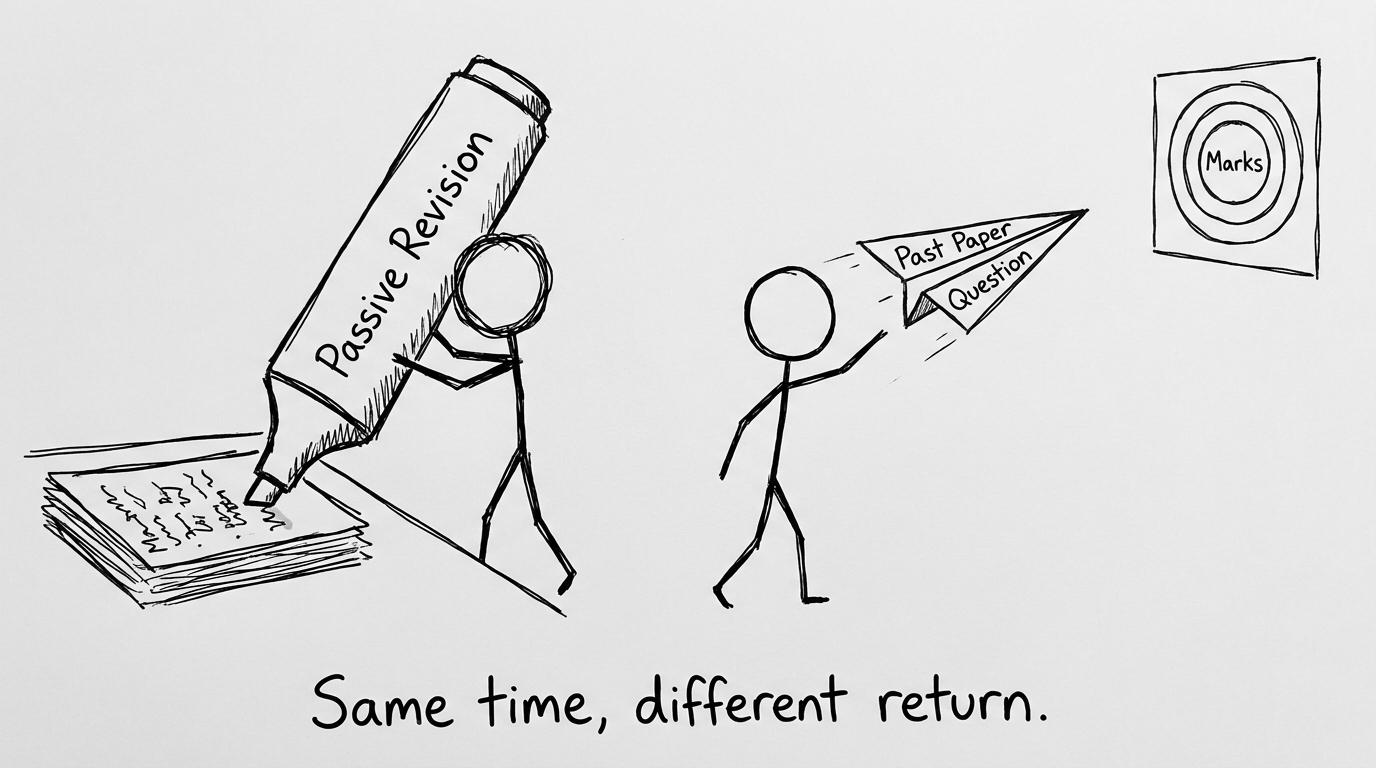 Passive highlighting vs exam questions for marks
Build a GCSE active recall routine that doesn’t collapse after two days
Most revision plans fail for boring reasons: they rely on motivation. A better approach is to build a simple system you can repeat even when you’re tired.
Use spaced return, not one-off “topic days”
If you do a topic once and move on, it feels productive but fades quickly. Instead:
- Day 1: learn + recall + questions
- Day 3: short recall + a few mixed questions
- Day 7: mini test or past paper section
This is how you turn GCSE notes into something you can retrieve on demand.
Mix topics once the basics are stable
OCR GCSE exams don’t label questions by topic. Once you’ve done a few focused recall sessions, start mixing.
A clean way to do that on YesGenie is:
- revise a topic using a lesson or revision guide
- do a mini test to create pressure
- finish with a past paper question set
Start browsing formats here: Resources. If you want full-paper practice, use: GCSE past papers.
Common mistakes when turning GCSE notes into active recall
- You keep rewriting notes because it feels safe. Active recall should look messier than your notebook because it’s produced from memory.
- You mark but don’t repair. After marking, you need a “fix step”: rewrite the method as a prompt, then redo a similar question.
- You only practise when it’s easy. GCSE marks often come from the second attempt, when you’re correcting a misconception.
- You never time yourself. OCR papers are generous to clear method, but you still need pace. Even 101010 minutes of timed practice builds exam stamina.
- You avoid mark schemes. Mark schemes aren’t just for checking answers; they teach you what counts as method marks and how to communicate your working.
Bringing it together: your GCSE notes are the start, not the finish
Your notebook isn’t useless. It’s just not the final product. For OCR GCSE maths, the win is being able to recall methods quickly, choose them confidently, and show working clearly enough to collect method marks even when the final answer slips.
So this week, pick one topic and do the simple loop: recall from memory, practise questions, mark honestly, and turn mistakes into new prompts. Repeat it with spacing. That’s how GCSE revision becomes reliable.
When you’re ready to make it concrete, build your routine on YesGenie: start with the GCSE Maths OCR hub, use Resources to find mini tests and other formats, and finish your cycle with GCSE past papers and mark schemes. Active recall is the engine; and the right practice questions are the fuel.










