GCSE OCR English Language Revision Without Wasting Time
GCSE OCR English Language revision tips that save time: smart practice, clear structure, and methods maths students will trust. Use YesGenie tools.
If you’re a maths student, you already know what wasted time feels like: pages of ‘revision’ that don’t move your marks. The same thing happens in GCSE OCR English Language when revision turns into endless highlighting, vague “reading more”, and practising without feedback. You don’t need more effort; you need a tighter method. The good news is that OCR English Language rewards the same mindset that helps in GCSE maths: clarity, evidence, and showing your working.
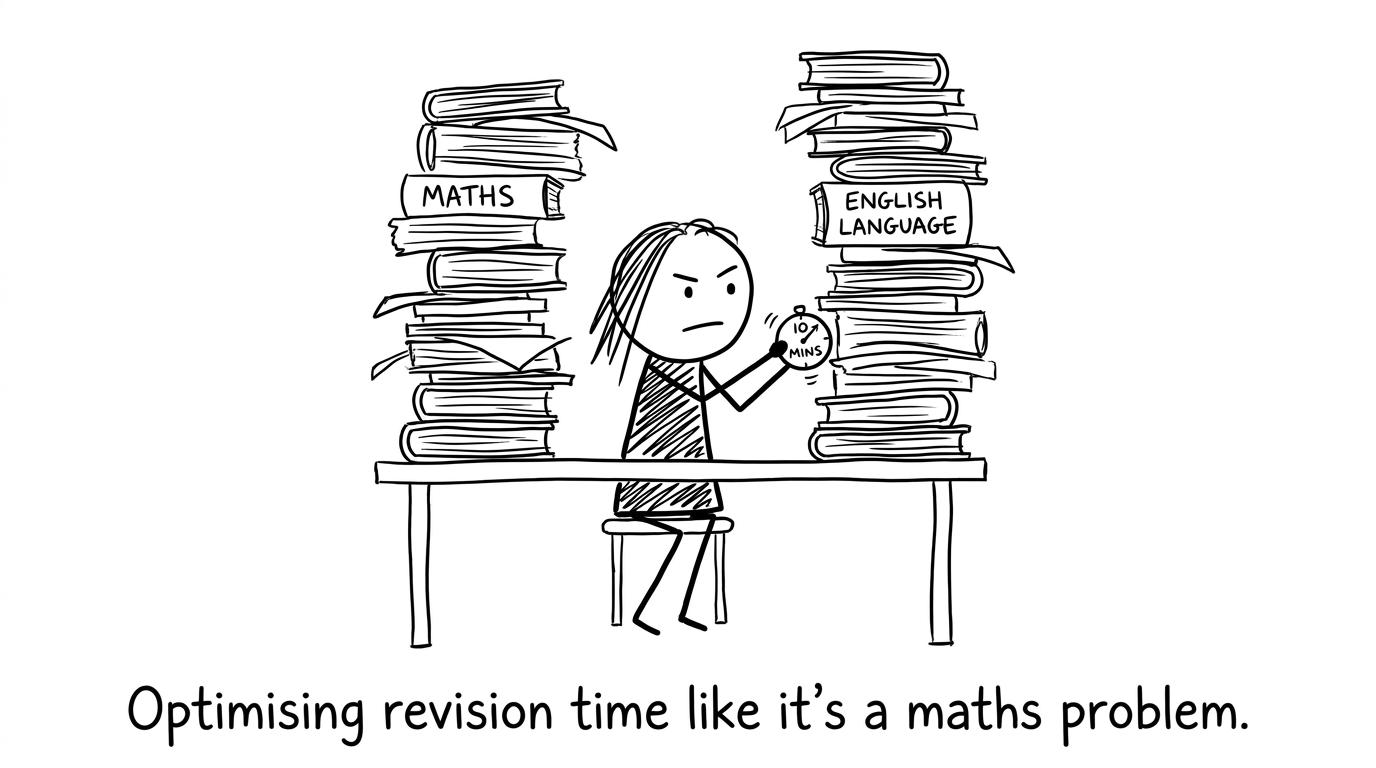 Optimising revision time like it’s a maths problem.
This guide is written for UK GCSE (and A Level) students who mainly revise maths, but want OCR English Language to stop stealing hours. We’ll build a revision routine that’s efficient, measurable, and realistic, and we’ll use YesGenie tools so your practice has structure, mark schemes, and progress you can actually see.
The no-waste GCSE checklist (OCR English Language)
If you only remember one thing, remember this: every GCSE English Language session should end with either (a) improved technique you can repeat or (b) a marked response you can learn from.
Use this checklist:
- Know what each OCR paper wants (question purpose, timings, and what earns marks).
- Practise in short blocks: one skill, one question type, one reflection.
- Mark against a mark scheme (or model) immediately.
- Build a “methods bank” of sentence stems and analysis habits.
- Track weaknesses like you would in maths: topic-by-topic, not mood-by-mood.
On YesGenie, the fastest way to keep revision disciplined is to combine subject pages with exam practice resources:
- OCR English Language exam practice: OCR GCSE English Language Past Papers
- Build your overall plan using: YesGenie Resources Hub
- Keep your maths momentum strong alongside English using: GCSE Maths OCR
- When you need calm, structured notes for maths (to protect your grade while you revise English): Edexcel GCSE Maths Revision Guides
Why maths students waste time on GCSE English Language
Most maths students revise what feels concrete. In maths, you practise questions, check the answer, and improve. In GCSE English Language, the answer isn’t a single number, so students fall into two traps:
They confuse activity with progress
Highlighting, copying quotes, rewriting notes; these can look like revision. But without a mark scheme lens, they don’t reliably increase marks.
They avoid the uncomfortable bit: evaluation
In maths, you’d never do 202020 questions without checking which ones you got wrong. In GCSE English Language, students often write a whole response and then move on, because marking feels fuzzy.
The fix is to treat English like maths: break it into small skills, use a repeatable structure, and mark ruthlessly.
OCR GCSE English Language: think “method marks”
A useful mental model for GCSE English Language is that marks come from method and evidence, not from sounding clever.
Maths analogy: if a student writes the correct final answer but shows no method, they often lose marks. In OCR English Language, it’s similar: you can have a good idea, but if you don’t prove it with quotation and effect, you don’t get full credit.
Here’s the structure you want to internalise:
- Point (what the writer suggests)
- Evidence (a short quote)
- Inference (what it implies)
- Effect (how it impacts the reader)
- Method (language/structure choice and why it matters)
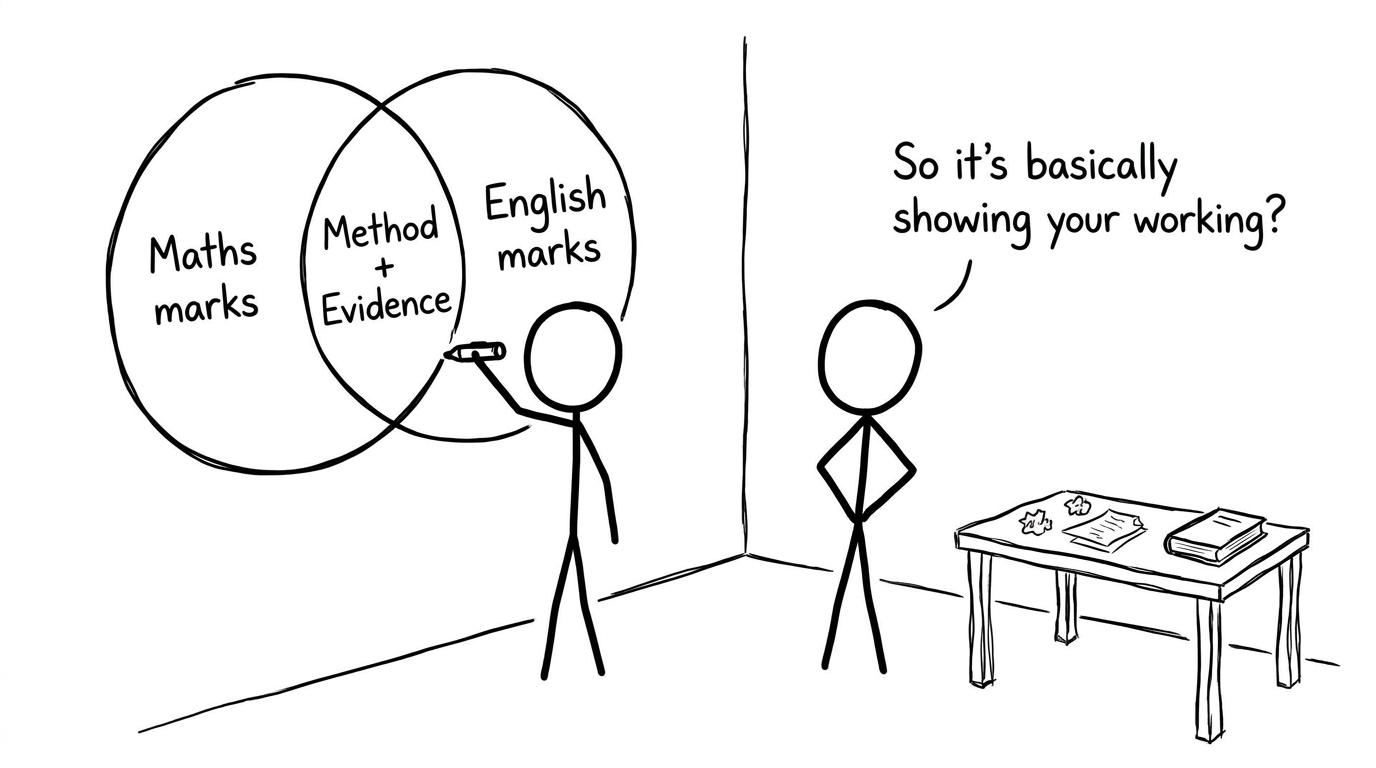 So it’s basically showing your working?
This doesn’t make your writing robotic. It makes it mark-scheme friendly. And that’s the entire job in GCSE exams.
A time-efficient OCR GCSE English Language routine (for busy maths revisers)
You’re not trying to become an English Literature scholar. You’re trying to bank reliable marks with minimal wasted time.
The 30-minute “one-question loop”
Do this 444 times a week, and you’ll build skill faster than one long weekly session.
- 5 minutes: read the question and underline exactly what it asks.
- 12 minutes: write one paragraph only (not a whole essay).
- 8 minutes: mark it using the mark scheme or model.
- 5 minutes: write a “next time” note (one sentence).
Use OCR-specific practice so your brain learns the right style: OCR GCSE English Language Past Papers.
The 60-minute “half-paper” (weekend)
Once a week, practise stamina:
- 10 minutes: plan timings.
- 40 minutes: answer a selection under timed conditions.
- 10 minutes: reflection and error log.
If you’re also juggling GCSE maths papers, YesGenie makes it easy to keep both subjects moving with exam practice pages like: GCSE Past Papers.
Worked example: turning a vague idea into marks (the maths way)
Let’s practise the single most important skill in GCSE English Language: turning an idea into evidence-based analysis.
Imagine a source text includes:
“The corridor narrowed, and the light seemed to hold its breath.”
A vague student response:
- “This makes it sound scary.”
That’s a start, but it’s low value because it lacks method and explanation. Now do it like maths: show your working.
A higher-mark paragraph (annotated method):
- Point: The writer creates tension by making the setting feel claustrophobic and alive.
- Evidence: The phrase “the corridor narrowed” suggests the space is closing in.
- Inference: This implies the character is being pressured or trapped, even before anything ‘happens’.
- Method: The personification in “the light seemed to hold its breath” gives the environment human behaviour.
- Effect: It makes the reader anticipate danger, because even the light appears fearful, building suspense.
Notice what we did: we took one quote and extracted multiple layers, like taking one diagram in maths and reading several facts from it.
To make this faster in your GCSE revision, create a mini template you can reuse:
- “The writer suggests ⟨\langle⟨idea⟩\rangle⟩ through ⟨\langle⟨method⟩\rangle⟩…”
- “This implies ⟨\langle⟨inference⟩\rangle⟩…”
- “As a result, the reader ⟨\langle⟨effect⟩\rangle⟩…”
What to practise first (highest return topics for OCR GCSE English Language)
Time-saving is about order. In GCSE English Language, these skills pay off fastest:
Quotation selection (short beats long)
Choose 333 to 666 word quotes that you can dissect. Long quotations waste time and often lead to retelling.
Method vocabulary (small, usable set)
You don’t need a thousand terms. You need a reliable 101010:
- metaphor, simile, personification
- contrast, repetition
- semantic field
- short sentence, list, rhetorical question
- shift in tone
Planning under pressure
Maths students sometimes skip planning because it feels like “not doing work”. In GCSE English Language, a 222 minute plan prevents a 101010 minute waffle.
Write a plan like a maths outline:
- Paragraph 1: main idea + best quote
- Paragraph 2: second idea + structural choice
- Paragraph 3: alternative interpretation + effect
Use YesGenie to protect your maths grades while revising English
If English revision starts eating the time you need for maths, you’ll feel it immediately in your confidence. A smart GCSE plan keeps maths ticking over with low-friction practice.
A simple split that works for many students:
- Mon/Wed/Fri: OCR English Language one-question loop (303030 mins)
- Tue/Thu: maths topic practice (303030 mins)
- Weekend: one timed English session + one timed maths session
On YesGenie you can keep maths revision efficient using targeted pages like:
- GCSE Maths OCR
- For quick active recall: Fractions, Decimals and Percentages Flashcards (GCSE Maths OCR)
- For focused lesson-style notes: Coordinates Revision Guide (GCSE Maths OCR)
- For exam-style topic practice: The Sine Rule (GCSE Maths OCR)
This matters because confidence is shared. When maths feels under control, English feels less like a threat.
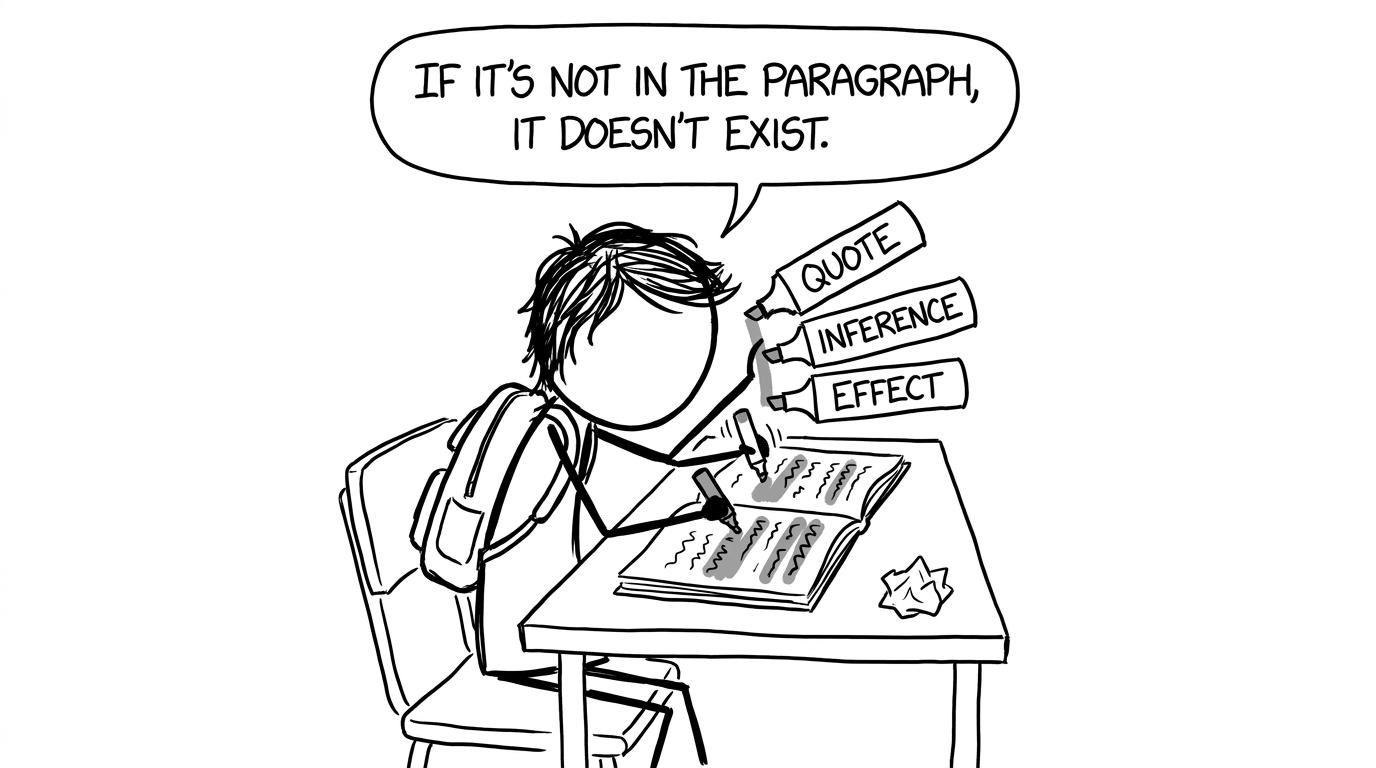 If it’s not in the paragraph, it doesn’t exist.
Common mistakes that waste time (and lose GCSE marks)
Writing too much before choosing a quote
If you write a long introduction, you’re usually avoiding analysis. In GCSE OCR English Language, quotes are your engine. Start with evidence early.
Retelling the story instead of analysing methods
If your paragraph could be written by someone who didn’t understand the language choices, it won’t score highly. Swap plot summary for method-and-effect.
Using fancy words without precision
“Creates imagery” is vague. Name the method (metaphor/personification), then explain the effect. Precision beats sophistication in GCSE.
Ignoring timing
A brilliant paragraph written too slowly is still a problem. You must practise under time limits so exam day doesn’t become a surprise.
Never learning from the mark scheme
You don’t have to become a teacher, but you must get comfortable checking what the exam rewards. Use real OCR practice and review it immediately: OCR GCSE English Language Past Papers.
Closing: make GCSE English revision as measurable as maths
The quiet secret of GCSE OCR English Language is that it’s not about having “a gift for words”. It’s about building repeatable habits: short evidence, clear method, precise effect, and honest marking. When you revise like a maths student, focused, timed, and feedback-led, English stops being the subject that steals your evening.
Use YesGenie to keep your revision tight:
- Practise OCR English using OCR GCSE English Language Past Papers.
- Keep maths strong with GCSE Maths OCR and targeted tools like flashcards and revision guides.
- When you’re ready to simulate exam weeks, pull from GCSE Past Papers and explore the wider YesGenie Resources Hub.
If you want your GCSE grades to rise without your workload exploding, build a plan, practise the right things, and let YesGenie handle the structure: revision lessons, practice questions, past papers, predicted papers, mark schemes, and video solutions, all in one place.