

GCSE Night-Before Plan (CCEA): Calm, Clear, Ready
GCSE night-before plan for CCEA that avoids panic: a calm checklist, time blocks, and maths mini-practice using YesGenie past and predicted papers.
The night before an exam has a particular kind of silence. Your notes are everywhere, your brain is loud, and your stomach acts like it has its own timetable. If you are sitting a GCSE tomorrow (and yes, even if it is Chemistry), the goal tonight is not to become a different person. It is to become a calmer version of you: organised, focused, and just rehearsed enough to pick up marks quickly.
This guide is written with a CCEA mindset (clear steps, steady pace, fewer surprises), but it is also for UK GCSE students who are revising maths alongside science. Because panic spreads fastest when you feel behind in more than one subject. The good news is that a sensible night-before plan can stabilise everything: your confidence, your sleep, and your marks.
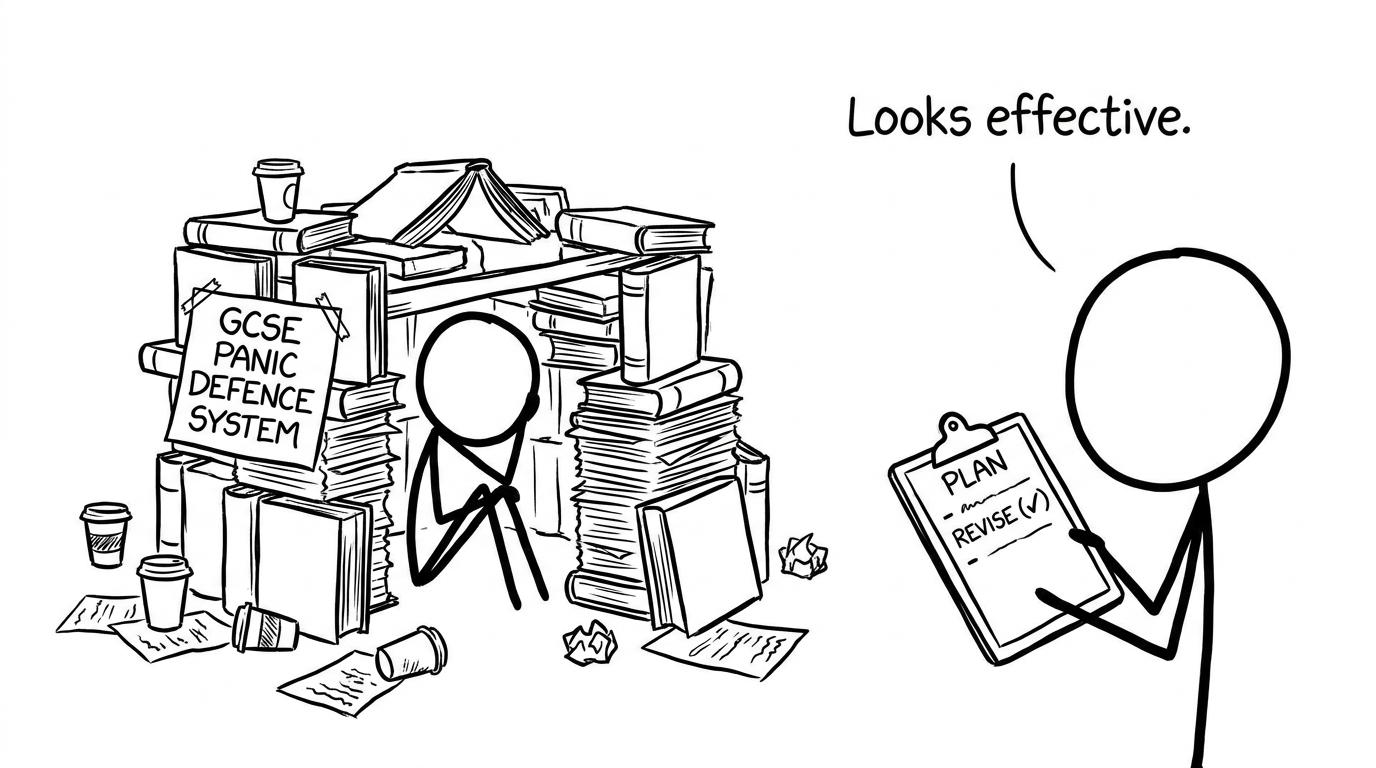 A stick-figure revision fort labelled GCSE Panic Defence System
The night-before checklist (do this before any revision)
Use this checklist as your “stop the spiral” routine. It matters more than another hour of frantic highlighting.
- Confirm the basics: exam time, location, seat, equipment.
- Pack now: calculator, spare batteries, ruler, pens, pencil, eraser.
- Decide your bedtime and protect it.
- Choose one maths target and one science target for tonight.
- Open the resources you will use so you do not waste time searching.
For maths, your best anchors on YesGenie are:
- GCSE Past papers
- Resources hub (including predicted papers)
- Edexcel GCSE Maths Predicted Papers
- Edexcel GCSE Maths Mini Tests
If you are on CCEA maths, start from the CCEA page and work topic-by-topic:
The CCEA-style night-before plan (simple time blocks)
You are going to use three blocks. The structure stops you “checking one thing quickly” for two hours.
Block 1: 35 minutes: high-yield recall (no new content)
Pick the topics most likely to score quickly in any GCSE maths paper: algebra basics, percentage change, probability, and graph skills. You are not trying to cover everything. You are trying to refresh methods.
A good route is a single revision guide page plus a few questions.
In Chemistry terms, this is like revising the “core practical logic” and the definitions that carry marks. In maths terms, it is remembering the shape of the method.
Block 2: 45 minutes: exam realism (mini test or half-paper)
Choose one timed piece. Keep it short enough that you can finish it without panic.
- Use a mini test, or
- Use a section from a paper via GCSE Past papers, or
- If it is close to exam season, use a predicted paper.
The win here is not the score. The win is practising what it feels like to start calmly, recover after a wobble, and keep moving.
Block 3: 20 minutes: mark scheme thinking (how marks are awarded)
This is where grades quietly improve. Open the mark scheme or video solution and look for patterns:
- What earns method marks?
- Where do you lose accuracy marks?
- Which lines of working are “cheap” but valuable?
On YesGenie, many papers include worked support and solutions. For example, the platform has video-solution views for papers, such as:
Even if your board is not Edexcel, the method-mark logic is similar across AQA, OCR, Edexcel and Eduqas: clear steps, correct maths, and sensible rounding.
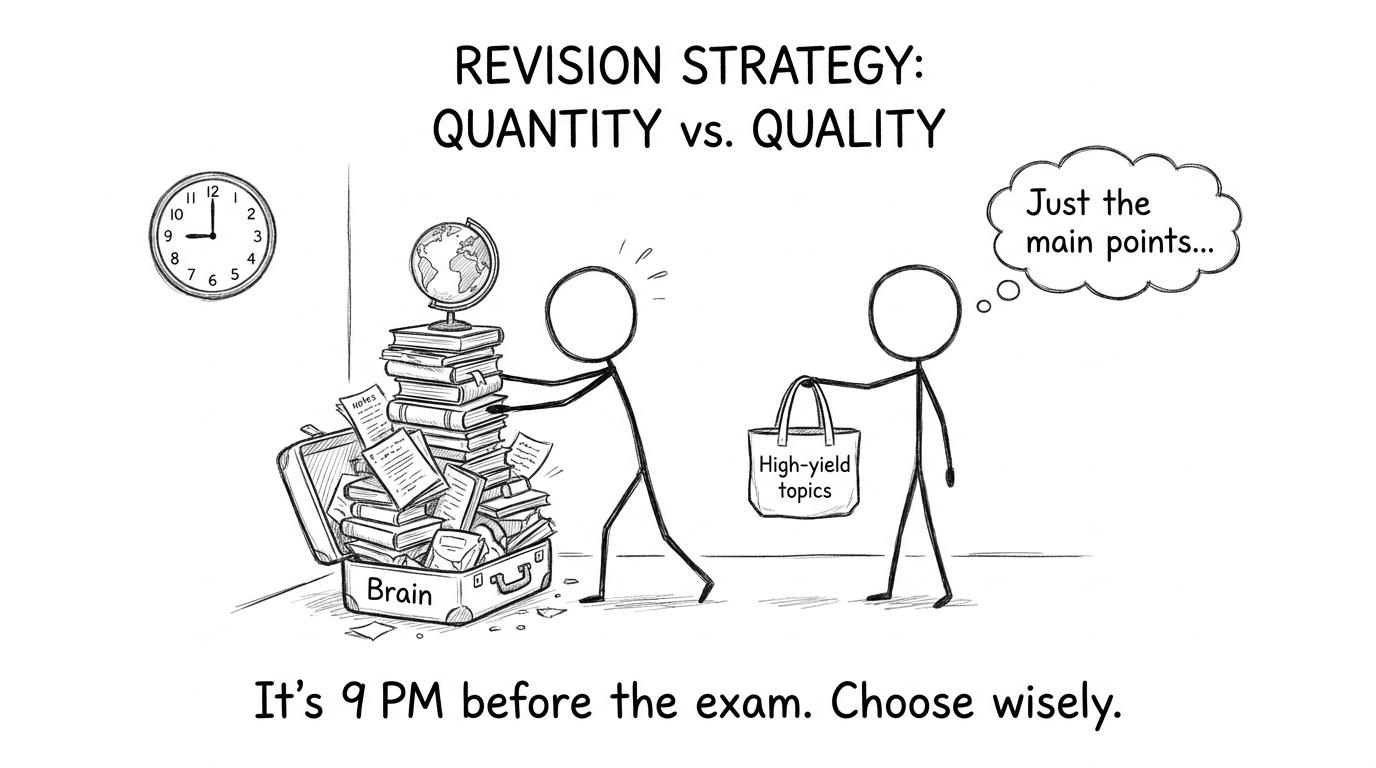 Stick figure squeezing books into a suitcase labelled Brain
Two worked maths examples (night-before friendly)
These are designed to be “muscle memory” questions: common, high yield, and quick to practise.
Worked example: percentage change (the calm method)
A chemical solution increases in concentration from 40%40\%40% to 52%52\%52%. Find the percentage increase.
Percentage increase is:
increaseoriginal×100 \frac{\text{increase}}{\text{original}}\times 100 originalincrease×100- Increase =52−40=12= 52 - 40 = 12=52−40=12 (percentage points)
- Original =40= 40=40
So:
1240×100=0.3×100=30 \frac{12}{40}\times 100 = 0.3\times 100 = 30 4012×100=0.3×100=30The percentage increase is 30%30\%30%.
Night-before note: students often write 12%12\%12% because it “looks like the answer”. But the question asks for relative change from the original.
If you want a few more percentage methods in one place, use the revision guide lists from your board’s GCSE maths page, for example:
Worked example: probability from counts (marks are predictable)
In a class, 181818 students take Chemistry, 121212 take Physics, and 777 take both. There are 303030 students in total. One student is chosen at random. Find the probability they take Chemistry only.
- Chemistry only =18−7=11= 18 - 7 = 11=18−7=11
- Total =30= 30=30
So the probability is:
1130 \frac{11}{30} 3011Night-before note: if you are tired, draw a quick two-circle sketch and fill the overlap first. This is exactly the habit described in Venn diagram methods.
Why this works when your exam tomorrow is Chemistry
You might be thinking: why is a GCSE Chemistry night-before plan talking about maths? Because panic is rarely subject-specific. It is usually logistical: too much content, too little time, and no plan.
A calm maths block does two things:
- It gives you a fast, objective sense of progress (you can see questions improving).
- It reminds your brain that marks come from method, not mood.
That matters for CCEA-style papers too: clear steps, credit for working, and a premium on careful reading.
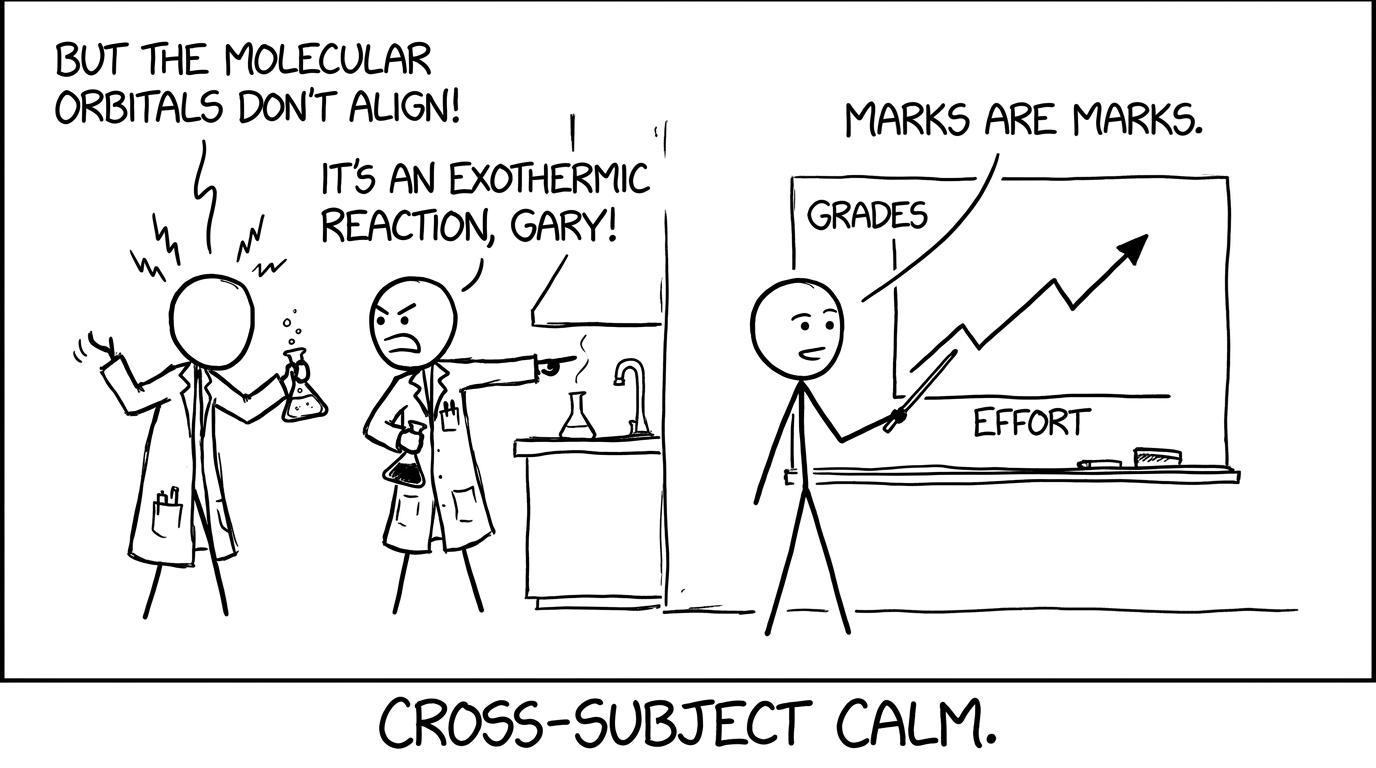 Stick figures in lab coats; one points to a graph saying “Marks are marks”
Common mistakes (the ones that create panic)
- Trying to learn new topics at 10pm. New content is sticky in the worst way: it feels familiar but collapses under exam pressure.
- Doing questions without checking answers. You end up practising mistakes. Use mark schemes and video solutions to close the loop.
- Overdoing full papers the night before. A full paper can be useful, but it often steals sleep. A mini test or half-paper is usually the smarter GCSE play.
- Not writing enough working. Even if you can do it in your head, the examiner cannot mark what you did not show.
- Calculator complacency. You still need estimation checks. If your answer to a simple proportion is wildly large, pause.
A calm finish: what to do in the last hour before sleep
- Stop revision at a fixed time.
- Pack your bag fully.
- Put your alarm across the room.
- Write a tiny “starting plan” note for the morning: first five minutes, first two questions, breathing steady.
If you want a single place to organise tomorrow’s next steps, open your board page and keep it bookmarked. For CCEA maths, start here:
Closing: your GCSE night-before win is calm, not cramming
A good night-before plan does not try to win the whole exam in one evening. It just makes sure you arrive with a steady mind and a few reliable methods ready to go. That is how panic gets replaced by process.
If you want your GCSE revision to feel simpler and more predictable, use YesGenie as your home base: revision lessons, revision guides, practice questions, mini tests, past papers, predicted papers, mark schemes, and video solutions. Choose one topic, do a short timed set, mark it properly, and go to bed knowing you did the right things in the right order.










