

GCSE night-before plan for Biology (no panic)
GCSE night-before plan for Biology that avoids panic: a calm evening routine, quick recall, exam technique, and a maths warm-up using YesGenie.
Your brain does a funny thing the night before an exam. It starts acting like tomorrow’s paper is a verdict on your whole life, rather than a two-hour snapshot of what you can do today. If you’re reading this the night before GCSE Biology, you probably have that familiar loop: open notes, feel behind, panic-scroll, promise yourself you’ll “start properly” in five minutes, then lose an hour.
This is a night-before plan that avoids panic by being honest about what tonight can (and can’t) do. It’s written for GCSE and A Level students who are revising maths too, because the best exam nights have one quiet secret: you protect your confidence in every subject, not just the one you sit first.
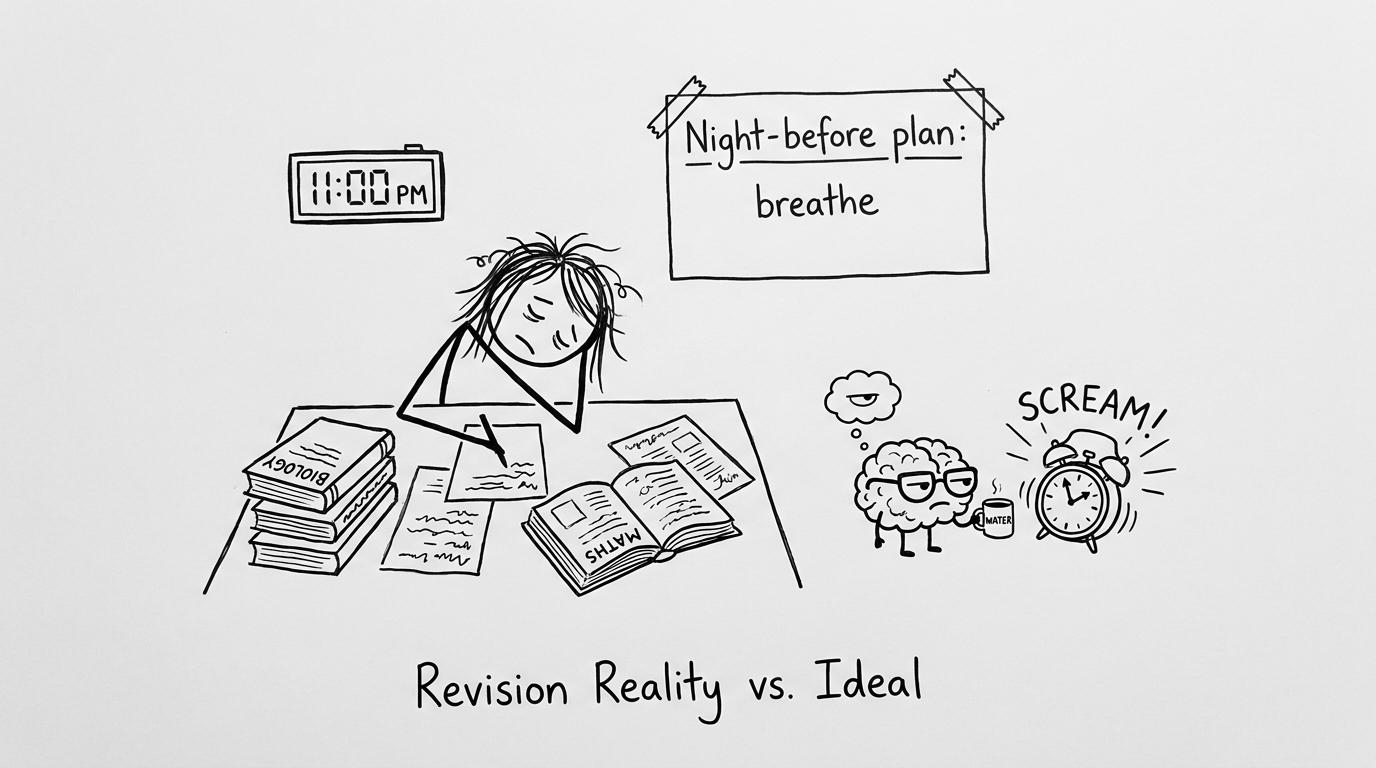 A late-night revision scene that chooses calm over panic
The night-before checklist (calm, not heroic)
Keep it simple. Tonight is about reducing cognitive noise and increasing “easy marks”.
- Choose your exam board focus (AQA, Edexcel, OCR, Eduqas) and stick to it.
- Do two short recall blocks for Biology (not a full topic rewrite).
- Do one exam-technique block using mark schemes.
- Do one tiny maths warm-up to settle your mind and keep routines stable.
- Pack your kit, plan your morning, and protect sleep.
If you want a familiar structure for the maths part, use YesGenie’s GCSE resources: Resources hub, plus past papers and mini tests.
Step 1: Decide what “enough” means (and write it down)
Panic is often just a lack of boundaries. The mind keeps scanning for danger because you haven’t told it when the work ends.
Write a one-line definition of success for tonight:
- “I will refresh the highest-yield Biology ideas, practise how answers are phrased, and go to sleep with my kit ready.”
That sentence matters because it stops you doing the worst night-before move: confusing motion with progress.
For your maths routine (even on a Biology night), “enough” might mean: one short set of questions to keep your methods sharp. YesGenie makes this easy with Edexcel GCSE Maths Mini Tests or the Edexcel GCSE Maths revision guides.
Step 2: The 90-minute Biology plan (two recall blocks + mark scheme)
A recall block that actually works
Do active recall, not re-reading. Choose two areas that score reliably across specifications (for Combined Science or Triple Biology):
- Key processes with sequences (e.g. infection response, ecology cycles, cell biology steps).
- Required practicals and the language examiners like.
Set a timer for 25 minutes:
- Write down everything you remember on one page.
- Then open notes and correct in a different colour.
- Circle the 5-8 facts you truly didn’t know.
Take a 5-minute break. Repeat for a second topic.
A mark scheme block (the anti-panic move)
Spend 30-35 minutes with real exam answers. Your goal is not “more content” but “more marks”.
- Pick 4-6 questions you’ve seen before (short structured questions and a couple of longer ones).
- Compare your answer to the mark scheme.
- Steal the phrasing.
Even though this post is about Biology, this is exactly how you get better at maths too: do questions, then mark carefully. On YesGenie you can do that with GCSE past papers and then tighten your technique using topic revision guides.
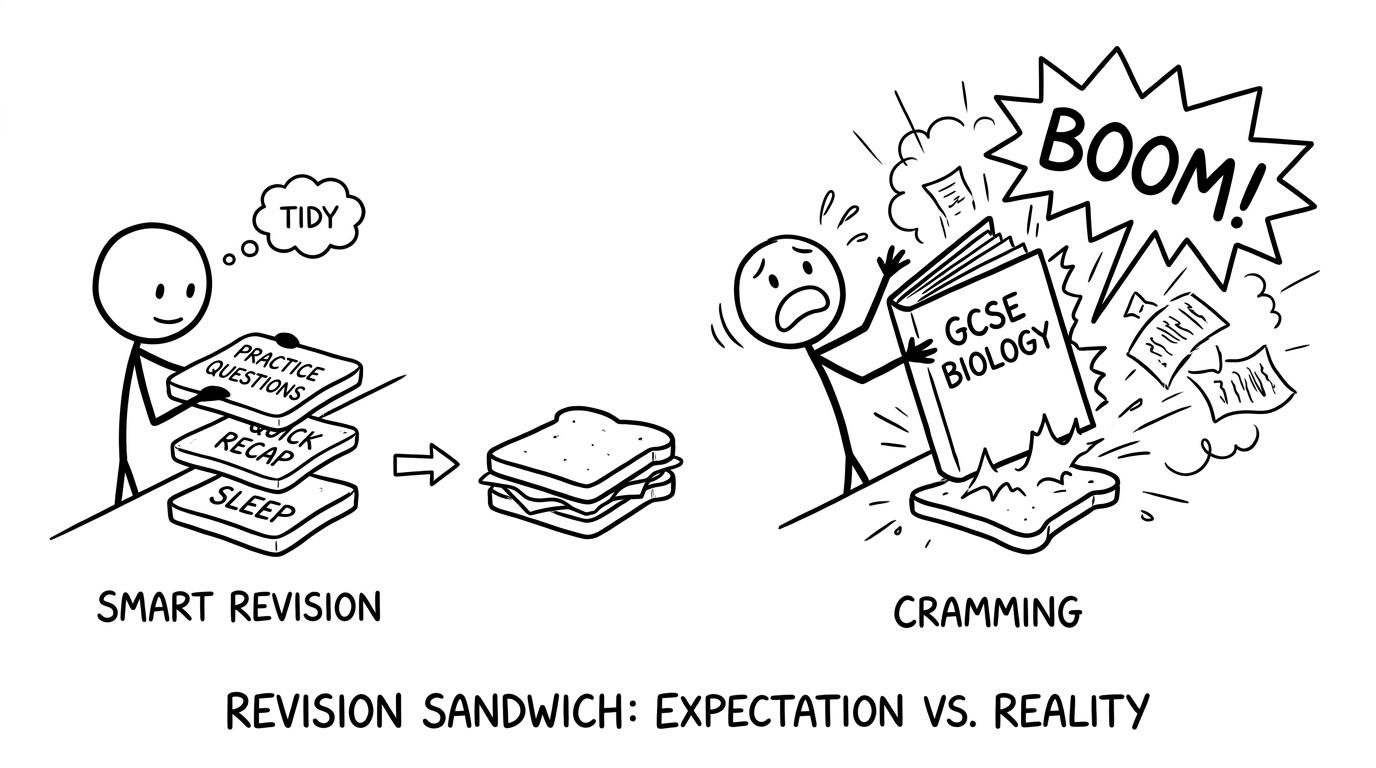 A revision sandwich beats cramming a whole textbook
Step 3: The 20-minute maths warm-up that calms your brain
This part is for GCSE and A Level students who feel their maths confidence dips when another subject takes over. A small maths routine keeps your identity steady: “I’m still the person who can do methods.”
Choose one micro-topic that gives quick wins (fractions, ratio, algebra, probability). If you want a structured list, start from the lessons pages like Edexcel GCSE Maths lessons or AQA GCSE Maths lessons.
Worked example: fraction and percentage method (high-yield GCSE maths)
A shop reduces a £80 jacket by 15%15\%15%, then reduces the new price by 10%10\%10%. Find the final price.
First reduction:
80×(1−0.15)=80×0.85=68 80 \times (1 - 0.15) = 80 \times 0.85 = 68 80×(1−0.15)=80×0.85=68Second reduction:
68×(1−0.10)=68×0.9=61.2 68 \times (1 - 0.10) = 68 \times 0.9 = 61.2 68×(1−0.10)=68×0.9=61.2So the final price is £61.20.
Night-before insight: this is why repeated percentage change is a calm topic to practise. It’s procedural, you can check it quickly, and it reminds you that marks come from method.
Worked example: ratio to fractions (another GCSE staple)
Sam and Tia share £45 in the ratio 4:54:54:5. How much does Sam get?
Total parts =4+5=9= 4 + 5 = 9=4+5=9.
Sam’s share is:
49×45=4×5=20 \frac{4}{9} \times 45 = 4 \times 5 = 20 94×45=4×5=20So Sam gets £20.
If ratio questions wobble for you, YesGenie’s revision guide on Writing a ratio as a fraction or linear function is exactly the sort of page you can skim tonight and then practise tomorrow.
Step 4: Pack your exam like a professional
This is boring, which is why it works.
- Check your start time, room, and candidate number if needed.
- Pack pens, spare pen, ruler, calculator (for maths exams), and any allowed equipment.
- Put a water bottle by the door.
The point is psychological: you reduce the number of decisions your morning self has to make. Less friction means less panic.
Step 5: Sleep with a plan for the first 10 minutes of the paper
Tell yourself what you will do when the paper lands.
For Biology:
- Read the question carefully.
- Underline command words (describe, explain, evaluate).
- For longer questions, write a tiny structure first (two or three bullet points).
For maths, it’s similar: you’re managing attention. If you’re revising maths as well this week, you can keep that routine consistent by doing a short paper segment from Edexcel GCSE Maths predicted papers or a real paper from GCSE past papers.
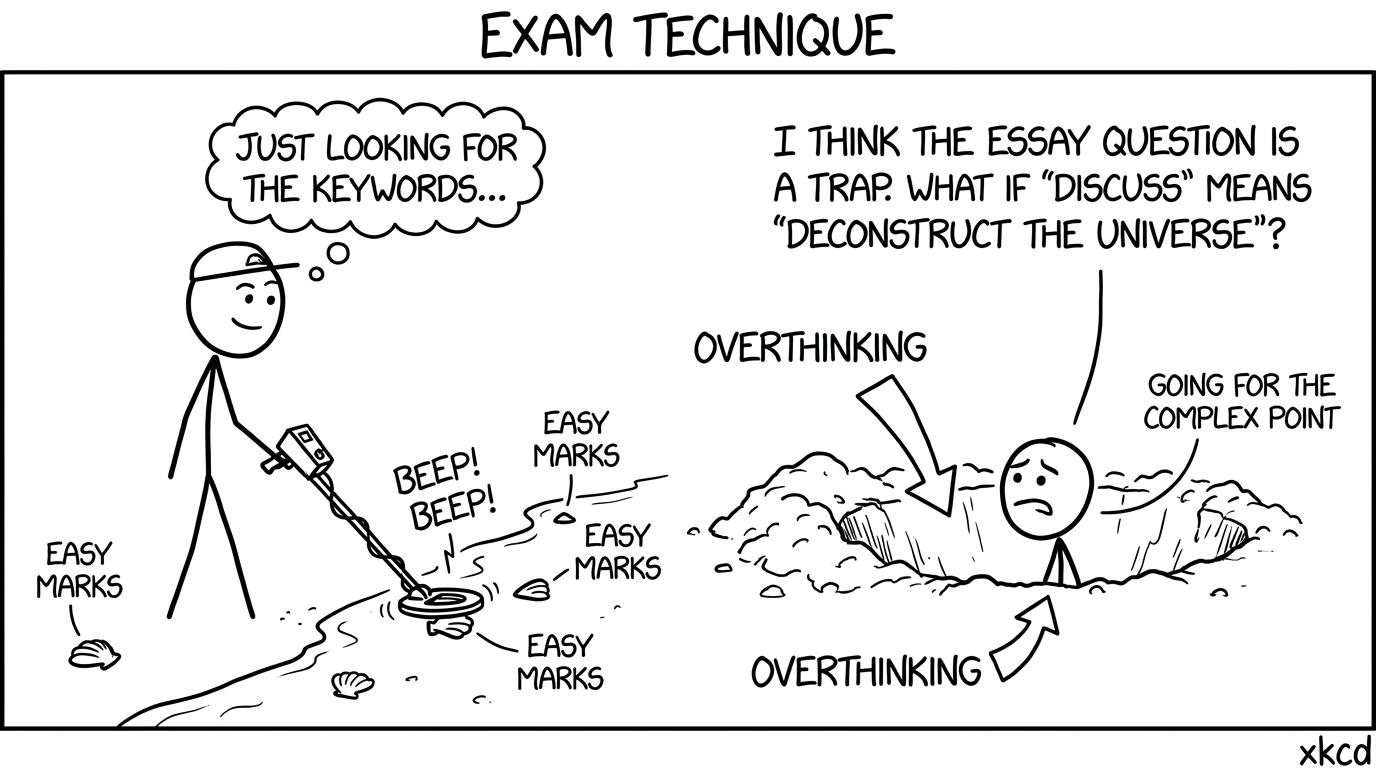 Hunting for easy marks instead of overthinking
Common mistakes the night before GCSE Biology (and how to avoid them)
- Rewriting notes for hours: it feels safe, but it’s low retrieval. Swap one hour of rewriting for one hour of recall plus mark scheme review.
- Trying to learn an entire topic from scratch: choose “patches” not “a rebuild”: fix 5-8 missing facts that unlock multiple questions.
- Ignoring command words: many marks are awarded for phrasing and structure, not extra detail.
- Going to bed with uncertainty: uncertainty fuels panic. Write a clear end time and a morning plan.
- Dropping maths revision completely: if you’re also sitting GCSE Maths (or doing A Level Maths), a 20-minute warm-up keeps your momentum. Use a mini test or a short topic session from revision guides.
A calm closing: tomorrow is about marks, not magic
The night before a GCSE exam isn’t a time machine. It’s a steering wheel. You can steer away from panic by doing three things well: recall what matters, learn the mark scheme language, and protect your sleep.
If you’re juggling Biology with maths revision, keep your routine stable. Use YesGenie to make the work feel lighter: revise a method using GCSE Maths revision guides, practise efficiently with mini tests, and build confidence under time pressure with GCSE past papers and predicted papers. Then stop. Pack your kit. Let your brain sleep.
Because the goal tonight is not to feel heroic. It’s to wake up calm and walk into your GCSE paper ready to collect the marks you’ve trained for.










