GCSE Maths WJEC: How to Get Past a Pass Grade
GCSE revision for WJEC students stuck on a pass grade. Use topic gaps, past papers, mark schemes and YesGenie practice to push to grade 5+.
If you’re a WJEC student stuck at a pass grade, you probably know the feeling: you do a bit of revision, you sit a paper, and the result comes back… almost the same as last time. Not terrible. Not great. Just stuck.
This is where GCSE maths revision quietly changes. To move from “I can usually scrape it” to “I can rely on my marks”, you don’t need a personality transplant or ten-hour days. You need a system that turns mistakes into predictable improvements.
In this post, you’ll get a practical plan for WJEC GCSE maths revision using YesGenie’s free lessons, revision guides, practice questions, mark schemes, mini tests and past papers. We’ll focus on what typically blocks progress at pass grade, and how to unlock the next set of marks.
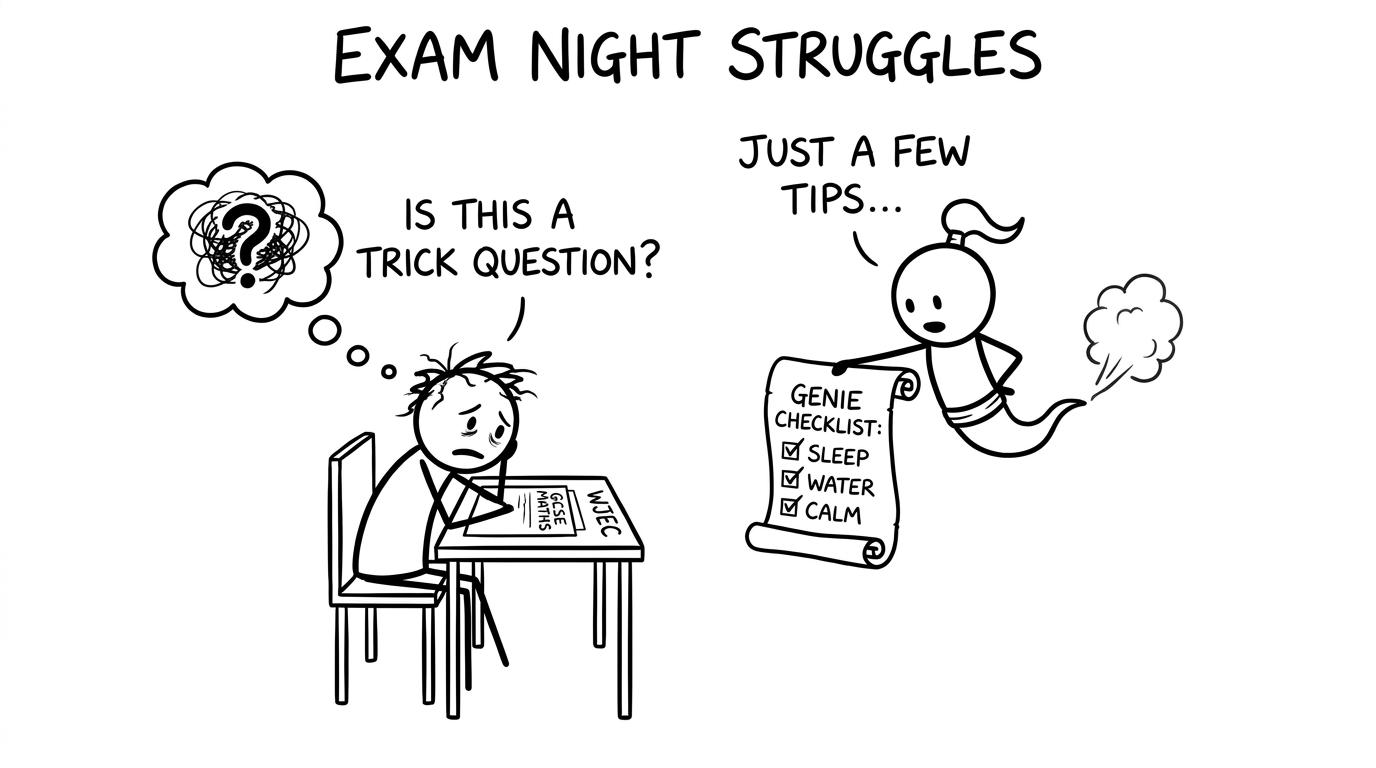 A student and a tiny genie with a checklist scroll
The pass-grade plateau (and why it happens in GCSE maths)
A pass grade in GCSE maths is often built from familiar routines: a bit of number, a bit of algebra, maybe some angles, and the confidence to attempt most questions. The plateau happens because the exam stops rewarding “having seen it before” and starts rewarding accuracy, method, and finishing.
At WJEC, just like AQA, Edexcel, OCR and Eduqas, the jump isn’t magical. It’s usually made of three small things:
- You drop marks on straightforward method questions because of slips.
- You avoid a cluster of topics that repeatedly appear.
- You don’t use the mark scheme like a tool, so your revision doesn’t sharpen.
So the goal isn’t to “learn everything again”. The goal is to earn the same easy marks more reliably, then add a thin layer of higher-value marks on top.
A simple checklist for WJEC GCSE revision (when you’re stuck)
Use this as your weekly loop:
- Diagnose using a paper and the mark scheme (not your memory).
- Target the top 3 topics costing you the most marks.
- Learn the method with a short lesson or revision guide.
- Practise with topic questions until you stop hesitating.
- Retest with a mini test or paper section under time.
You can build this loop entirely from YesGenie resources:
- Start with GCSE Past papers
- Use topic explanations from Eduqas GCSE Maths Revision Guides (many topics overlap well with WJEC)
- Use quick mastery checks like Edexcel GCSE Maths Mini Tests (again, skills transfer across boards)
- Pull extra practice from the topic pages (examples linked below)
How to revise WJEC GCSE maths when you keep making the same mistakes
The fastest way out of the pass-grade plateau is to stop treating mistakes as “bad days” and start treating them as data.
Build a “mistake map” from one paper
Pick one full paper (foundation or higher, whichever you’re sitting). Do it properly: quiet room, timer, no notes.
Then mark it using the mark scheme and write each lost mark into one of these categories:
- Method gap (you didn’t know what to do)
- Process gap (you knew the topic but couldn’t complete it)
- Careless error (sign, arithmetic, rounding, units)
- Exam technique (didn’t show steps, ignored “show that”, misread)
What you want is not a score. What you want is a pattern.
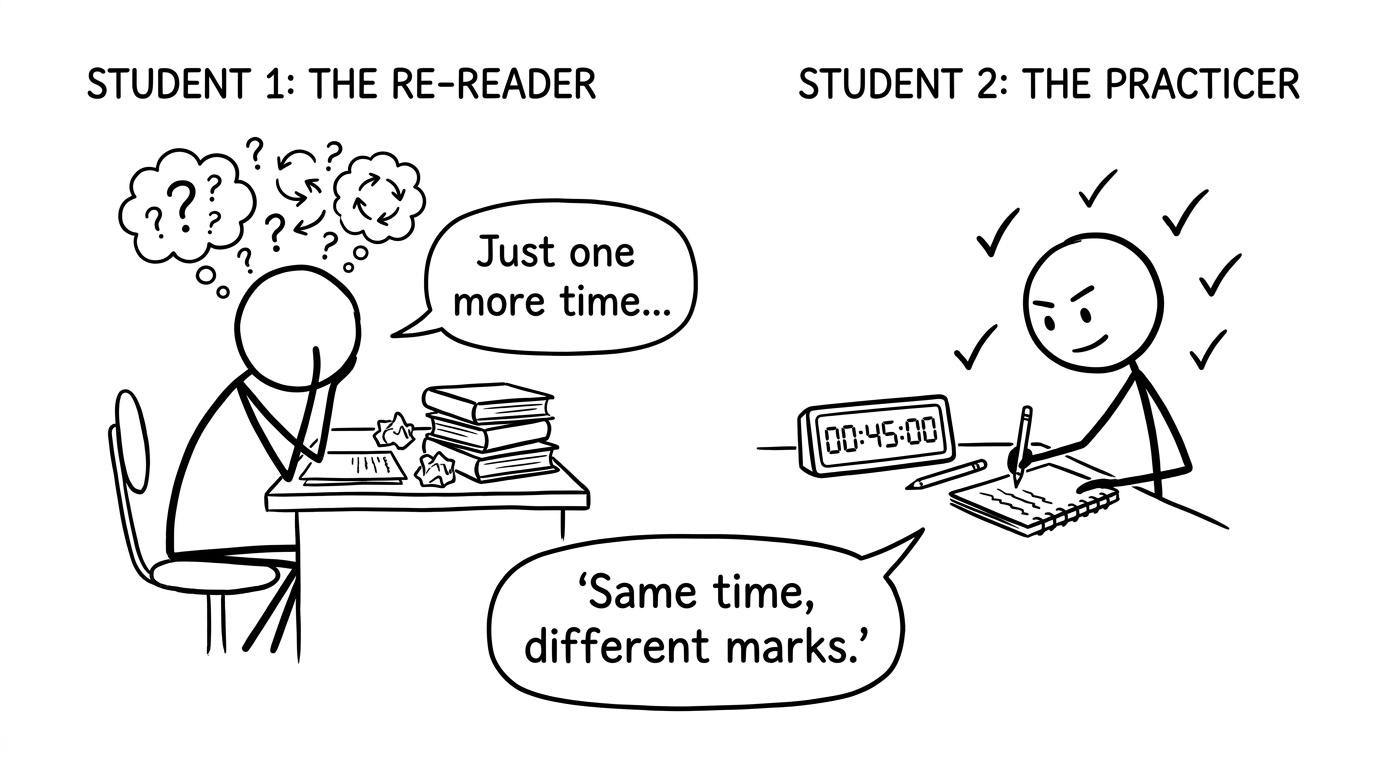 Two students: one rereading notes, one doing timed practice
Turn the mark scheme into a script
At pass grade, lots of marks are awarded for setting work out in a way an examiner can follow.
When you look at solutions, don’t just think “I get it now.” Copy the structure:
- What did they write first?
- What algebra line got the method mark?
- Where did they simplify?
- What did they round to?
This is why YesGenie’s video solutions and worked solutions matter: they model exam writing, not just answers.
The “grade 4 to grade 5” core: three topics that pay rent
WJEC GCSE maths papers (foundation and higher) repeatedly reward competence in these areas. If you’re stuck at a pass grade, improving these usually gives the biggest return.
Rearranging and substitution (algebra that unlocks other marks)
A lot of GCSE questions are really “substitute correctly and don’t panic.” If this is shaky, you lose marks everywhere: formulae, sequences, geometry, even probability.
Use a focused guide like Substitution - GCSE Maths Revision Guide.
Worked example (substitution with negatives)
Evaluate 3a−2b23a - 2b^23a−2b2 when a=−4a=-4a=−4 and b=−3b=-3b=−3.
Substitute carefully (put negatives in brackets):
3(−4)−2(−3)2 3(-4) - 2(-3)^2 3(−4)−2(−3)2Calculate powers first:
3(−4)−2(9) 3(-4) - 2(9) 3(−4)−2(9)Now multiply:
−12−18=−30 -12 - 18 = -30 −12−18=−30So the value is −30-30−30.
Probability basics (easy marks if you slow down)
Probability questions often feel “wordy”, but at foundation and lower higher-tier, they’re usually structured.
A strong starting point is Probability - GCSE Maths Revision Guide.
Worked example (missing probability)
A spinner has outcomes AAA, BBB, CCC. You’re told P(A)=0.25P(A)=0.25P(A)=0.25 and P(B)=0.5P(B)=0.5P(B)=0.5. Find P(C)P(C)P(C).
All probabilities add to 111:
P(C)=1−0.25−0.5=0.25 P(C)=1 - 0.25 - 0.5 = 0.25 P(C)=1−0.25−0.5=0.25So P(C)=0.25P(C)=0.25P(C)=0.25.
The pass-grade upgrade is often just this: you stop adding and “hoping”, and you always force the total back to 111.
Bounds and accuracy (where pass-grade students leak marks)
Bounds looks scary, but it’s mostly a reading skill: “nearest cm” means half a cm either side.
If you struggle with rounding language, revise bounds using a clear model like Bounds - GCSE Maths Revision Guide.
Worked example (simple bounds)
A length lll is 12.412.412.4 cm correct to 1 decimal place. Write the error interval.
Correct to 1 d.p. means the rounding step is 0.10.10.1, so half is 0.050.050.05.
Lower bound: 12.4−0.05=12.3512.4-0.05=12.3512.4−0.05=12.35
Upper bound: 12.4+0.05=12.4512.4+0.05=12.4512.4+0.05=12.45
So:
12.35≤l<12.45 12.35 \le l < 12.45 12.35≤l<12.45How to choose WJEC GCSE topics to revise (without guessing)
When you’re stuck at a pass grade, “revise everything” is basically the same as revising nothing. Instead, decide what to revise from evidence.
Use “marks per minute” as your filter
Pick 10 questions you got wrong and ask:
- Was it a 1-3 mark question you should get?
- Did it cost you time because you hesitated?
- Does it appear often across papers?
Prioritise:
- Easy method marks you missed
- Topics that show up repeatedly (algebra, graphs, ratio, probability, angles)
- Questions where one fixed method would give you consistent marks
Practise by topic, then return to papers
Once you identify the top three topics, do them in this order:
- A short lesson/revision guide to learn the method
- Topic practice until you can do it without looking
- A mini test or timed paper section to lock it in
For geometry-probability crossover skills, it can help to revise a topic like Venn Diagrams - GCSE Maths Revision Guide because it trains careful counting and clear regions, which reduces careless marks.
A realistic 14-day plan for WJEC GCSE maths (stuck at a pass)
This is built for students who have school, homework, and actual life.
Days 1-3: diagnose and patch the biggest leak
- Do one past paper under timed conditions.
- Mark it carefully and write a mistake map.
- Choose the top 3 topics costing marks.
Use GCSE Past papers to get started.
Days 4-10: topic practice with tight feedback
- Each day: one topic.
- 15 minutes: revision guide/lesson.
- 30-45 minutes: practice questions.
- 10 minutes: mark scheme reflection and rewrite one perfect solution.
Days 11-14: exam mode
- Do another paper (or two half-papers).
- Focus on finishing, not perfection.
- Compare your mistake map to the first one.
If you like the structure of predicted resources, you can also explore the Resources page for timed paper formats and revision planning.
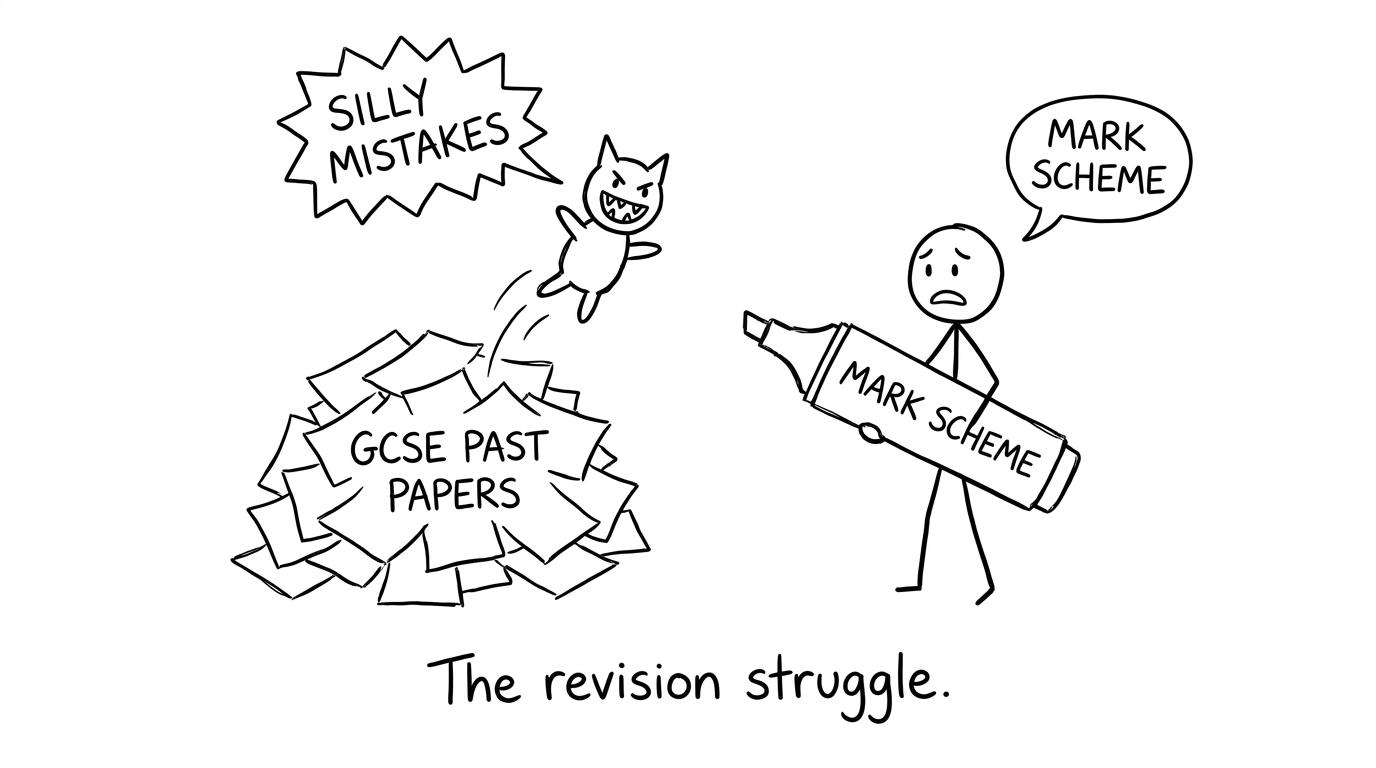 Past papers pile with a “Silly Mistakes” monster and a mark scheme highlighter
Common mistakes that keep WJEC GCSE students at a pass grade
- Treating revision as reading. If you only read notes, you can feel confident without gaining marks. GCSE maths rewards doing.
- Not writing enough working. Many WJEC questions award method marks; if you skip lines, you lose marks even when your thinking was right.
- Ignoring units and rounding. A correct method with the wrong unit, or rounding to the wrong accuracy, can drop a mark that you needed for a higher grade.
- Not using brackets with negatives. Mistakes like −32-3^2−32 vs (−3)2(-3)^2(−3)2 show up everywhere.
- Practising only your favourite topics. You can get very good at the same 60% of the course and still stay stuck.
Bringing it together: the WJEC GCSE plan that actually moves your grade
If you’re stuck at a pass grade, it’s not because you “can’t do maths”. It’s because your revision isn’t converting time into marks yet. The fix is calm and methodical: one paper, one mistake map, three priority topics, and enough practice that the mark scheme starts to feel familiar.
Make YesGenie your home base for that process: use the free revision lessons and revision guides to learn methods, then practise with topic questions, mini tests, and GCSE Past papers to build exam confidence. When you mark honestly and practise deliberately, your GCSE grade stops being a mystery and becomes the result of a routine.
Your next step: do one timed paper today, write down your top three weak topics, and use YesGenie to attack them one-by-one until you’re no longer stuck.