GCSE Maths: Revise Edexcel Without Wasting Time
GCSE revision for Edexcel Maths without wasting time: use lessons, predicted papers, past papers and mark schemes to boost grades 9-1 fast.
Every Edexcel student has had this moment: it’s 9pm, you open your book for GCSE Maths revision, and suddenly you’re three tabs deep into “helpful” videos, rewriting notes you already understand, and telling yourself it still counts as work.
It does count as effort. It just doesn’t always count as progress.
The difference between a student who does lots and a student who gets marks is usually not talent. It’s what they do with time. In GCSE Maths, time-wasting is often disguised as comfort: neat notes, long checklists, and “I’ll do papers later”. This guide is about revising Edexcel GCSE Maths with a calm, repeatable system that turns revision time into exam marks.
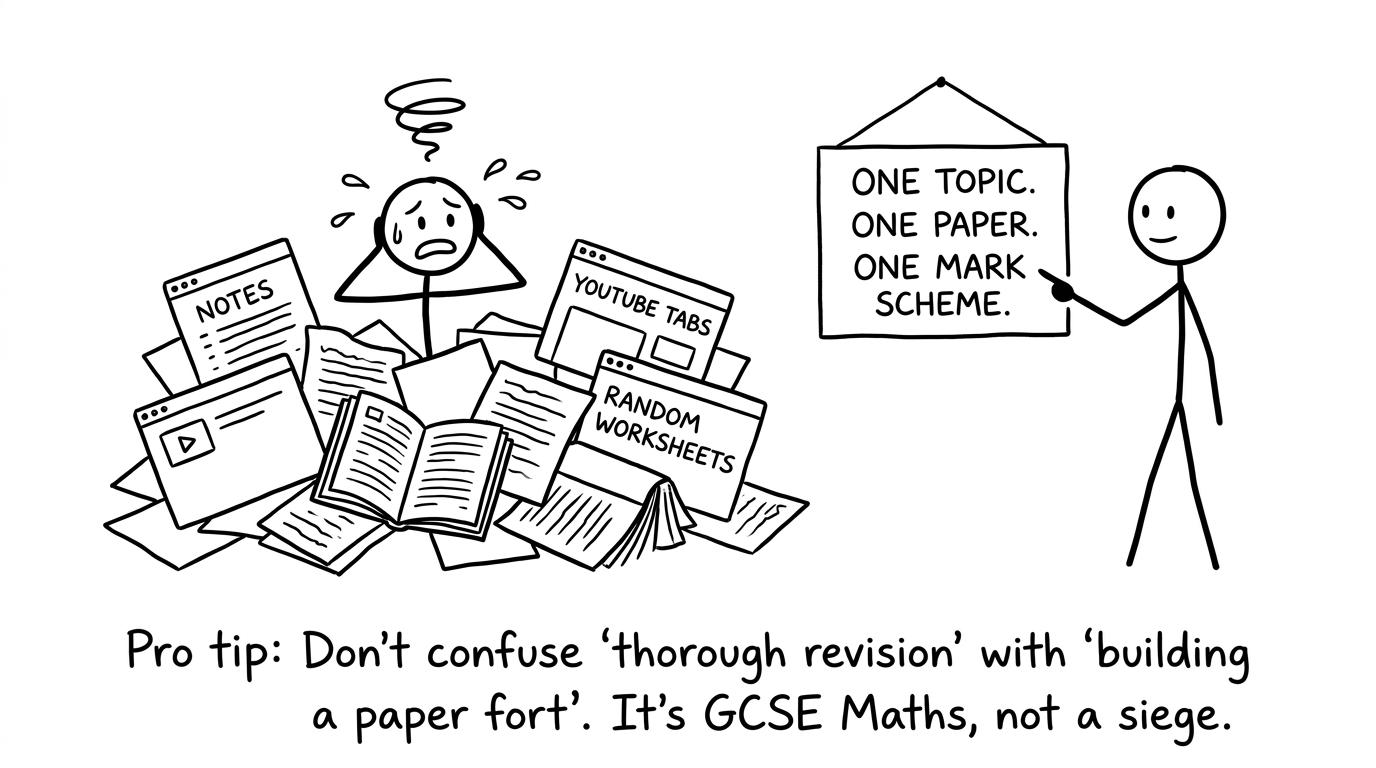 A student choosing one clear revision path instead of chaos
The no-waste Edexcel GCSE revision checklist
If you want a simple rule: revise like the exam marks you.
Use this checklist to stay honest:
- Pick the next topic based on evidence (not vibes): past paper performance and mistakes.
- Learn the method once (short lesson or revision guide), then practise immediately.
- Do exam-style questions, then mark them with the mark scheme.
- Fix one mistake properly, not ten mistakes vaguely.
- Repeat with spaced revision until the method is automatic.
On YesGenie, the fastest way to follow that loop is to work from the Edexcel GCSE hub, then move between lessons, revision guides, questions, and papers as your needs change: Edexcel GCSE Maths Revision.
Why Edexcel GCSE Maths revision wastes time (even when you’re “working”)
Edexcel GCSE Maths rewards accuracy, method, and habits under pressure. Most wasted time comes from doing tasks that feel productive but don’t train those three.
The three most common time traps
Passive revision
Reading, highlighting, and copying solutions can feel safe because you’re rarely wrong. But in the exam you don’t get marks for recognising a method; you get marks for producing it.
Random revision
Doing “a bit of everything” is comforting because you can avoid the topics you dislike. But your grade moves when your weakest topics stop being weak.
Delayed exam practice
Students often wait until they “finish the content” before doing papers. The problem is you don’t discover what you actually can’t do until a paper forces you to try.
A good Edexcel GCSE plan accepts this: you will learn a topic properly by making mistakes on exam-style questions, then correcting them.
Use YesGenie like a system: lesson → practise → paper → fix
A strong Edexcel GCSE routine doesn’t need to be complicated. It needs to be consistent.
Step 1: Learn the method quickly
If you’re shaky on a topic, use a short, focused resource, then move on.
- Use interactive topic lessons: Edexcel GCSE Maths Lessons
- Or use topic notes and worked examples: Edexcel GCSE Maths Revision Guides
Your goal is not “understanding forever”. Your goal is “can I do the next question without help?”.
Step 2: Practise in exam style immediately
After 10-15 minutes of learning, switch to questions. Don’t wait. Your brain needs the friction.
When you’re ready for full exam practice, go straight to:
Predicted papers are useful because they make you practise like it’s the real thing, especially when motivation is low but the exam is close.
Step 3: Mark harshly, then fix precisely
Marking is where your GCSE grade is built. A paper is only practice if you learn from it.
When you mark, write the mistake type next to the question:
- Concept: you didn’t know what to do.
- Process: you knew what to do, but your steps went wrong.
- Accuracy: you made a slip.
- Exam technique: you didn’t show enough method for marks.
Then fix one mistake at a time. Redo that question from scratch 24 hours later. That’s revision.
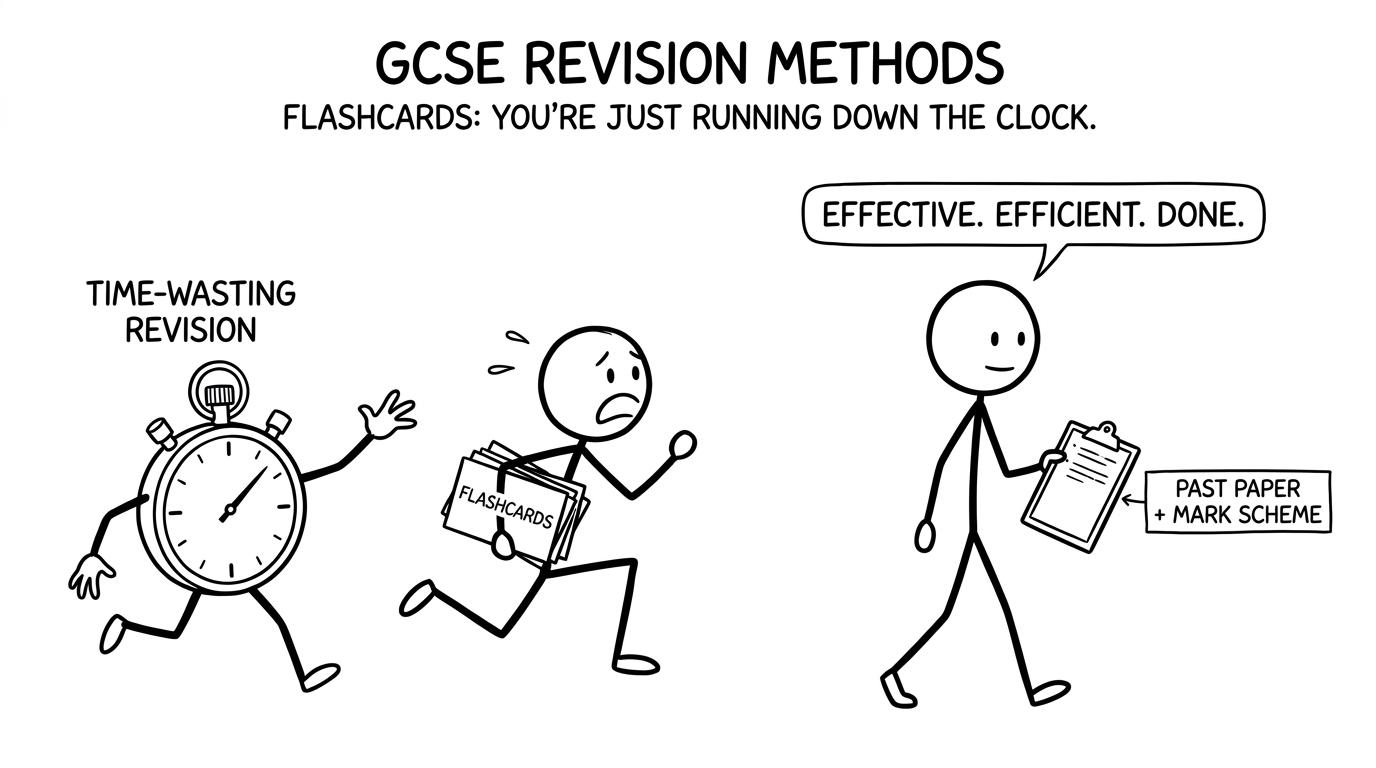 Time chasing ineffective revision vs calm past-paper practice
Worked examples: the kind of practice that earns GCSE marks
Edexcel GCSE mark schemes reward clear methods. Here are a few high-impact examples that show what “no wasted time” practice looks like.
Linear equations: get the method automatic
Solve 3(2x−5)=273(2x-5)=273(2x−5)=27.
Expand first:
3(2x−5)=6x−15 3(2x-5)=6x-15 3(2x−5)=6x−15So:
6x−15=27 6x-15=27 6x−15=27Add 151515 to both sides:
6x=42 6x=42 6x=42Divide by 666:
x=7 x=7 x=7Exam habit: keep each step as one operation. It reduces slips, and it makes method marks obvious.
Reverse percentages: stop guessing, use multipliers
A jacket is reduced by 20%20\%20% to £48. Find the original price.
A 20%20\%20% reduction means the new price is 80%80\%80% of the original, i.e. 0.80.80.8 times the original.
Let the original price be PPP.
0.8P=48 0.8P = 48 0.8P=48So:
P=480.8=60 P = \frac{48}{0.8} = 60 P=0.848=60Original price =£60= \pounds 60=£60.
GCSE pattern to remember: “after” === multiplier ×\times× “before”. If you’re going backwards, divide by the multiplier.
Probability with fractions: slow down, structure it
A bag has 555 red counters and 333 blue counters. Two counters are chosen without replacement. Find the probability of getting two red.
Total counters: 888.
Probability first is red: 58\frac{5}{8}85.
Then there are 444 red left out of 777 total:
47 \frac{4}{7} 74Multiply:
58×47=2056=514 \frac{5}{8}\times\frac{4}{7} = \frac{20}{56} = \frac{5}{14} 85×74=5620=145Probability =514= \frac{5}{14}=145.
Exam habit: write the two probabilities separately, then multiply. It stops “random fraction” answers.
Higher tier algebra: quadratic factorising as a time-saver
Factorise x2+7x+12x^2+7x+12x2+7x+12.
We need two numbers that multiply to 121212 and add to 777. That’s 333 and 444.
So:
x2+7x+12=(x+3)(x+4) x^2+7x+12=(x+3)(x+4) x2+7x+12=(x+3)(x+4)Time-saving tip: if you practise factorising daily for a week, it speeds up half of higher-tier algebra.
If this is a weak spot, build it using topic-by-topic support from the Edexcel GCSE area: Edexcel GCSE Maths Revision.
How to revise for Edexcel Paper 1 vs Papers 2 and 3
Edexcel GCSE Maths has:
- Paper 1: non-calculator
- Papers 2 and 3: calculator
The content overlaps, but the habits change.
Paper 1 (non-calculator): train mental methods
Your best time investment is practising questions that force efficient number work:
- fractions and percentage change
- exact value calculations
- algebraic manipulation without decimal crutches
Do full Paper 1s from the Edexcel set: Edexcel GCSE Maths Past Papers.
Papers 2 and 3 (calculator): train interpretation, not button-pressing
The calculator doesn’t fix weak understanding. It amplifies it.
Your focus should be:
- setting up equations correctly
- rounding appropriately
- using trig and standard form carefully
Use predicted papers when you want exam-like pressure without repeating the same older questions: Edexcel GCSE Maths Predicted Papers.
Common mistakes that waste GCSE marks (and how to stop)
Writing without checking what the question asked
Edexcel GCSE often hides the “real ask” in one word: estimate, show that, write down, hence, exact.
Fix: underline the command word and the final unit or form required (e.g. “in standard form”).
Rounding too early
If you round mid-calculation, you can drift away from the correct answer.
Fix: keep full accuracy until the end, then round to the requested number of decimal places or significant figures.
Not showing method for method marks
You might get the right answer but lose marks if the answer could be a guess.
Fix: always show a key step, especially when rearranging, substituting, or using a formula.
Treating mistakes as “bad topics” rather than patterns
Students say “I’m bad at algebra” when the pattern is really: sign errors, rushed expansion, or skipping a line.
Fix: label the mistake type, redo the question the next day, and practise that micro-skill in isolation.
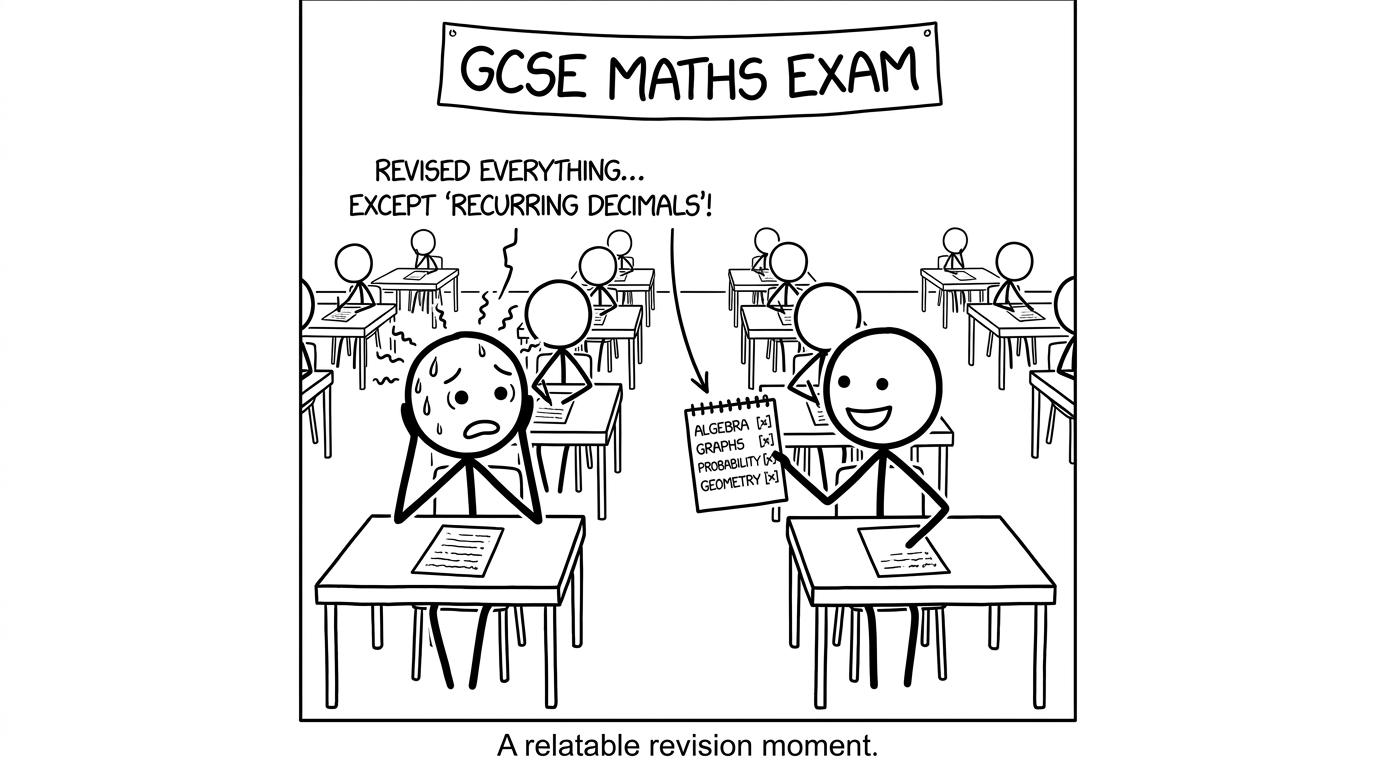 Revision checklist calm vs panic in the exam hall
A simple weekly plan that doesn’t waste time
If you want a routine you can repeat without thinking:
- Two short topic sessions (30-45 mins): lesson or revision guide, then exam questions.
- One timed paper session (45-90 mins): half paper or full paper depending on stamina.
- One review session (20-30 mins): redo the worst questions, write a “mistake rule” for each.
If you need ready-made resources to structure this, the YesGenie hub keeps everything together: lessons, revision guides, flashcards, question banks, and papers: Edexcel GCSE Maths Revision. For broader resources (mini tests, predicted paper collections, and more), browse: YesGenie Resources. If you’re revising multiple subjects and want to keep your maths plan connected to your wider timetable, start here: GCSE Subjects.
Conclusion: revise GCSE Maths like you want marks, not comfort
The quiet truth about Edexcel GCSE Maths is that revision is less about intensity and more about honesty. The exam doesn’t reward how long you sat at your desk. It rewards whether you can produce a method, under time pressure, with accurate steps.
So keep your revision simple: learn a skill, practise it immediately, do papers early, and treat marking as part of the work. Use past papers to find your gaps, predicted papers to rehearse the real thing, and short topic lessons to fix mistakes without drifting.
When you’re ready, build your no-waste routine around YesGenie’s free revision lessons, practice questions, mark schemes, video solutions, past papers, and predicted papers for Edexcel GCSE Maths: Edexcel GCSE Maths Revision.