

GCSE Geography Easter Holiday Revision Plan
GCSE geography Easter holiday revision made manageable: build a balanced two-week plan, practise exam skills and protect time to rest before exams.

Easter can create a strange kind of pressure. The school timetable disappears, exams feel close, and every unfinished topic suddenly seems urgent. Yet trying to revise from breakfast until bedtime rarely produces the calm confidence students hope for.
Effective GCSE geography Easter holiday revision is simpler: identify the topics that need attention, schedule focused sessions, practise recalling and applying knowledge, and leave genuine space for rest. Geography should have a clear place in your holiday without taking over the entire break, especially when maths and other GCSE subjects need attention too.
A balanced plan should help you:
- prioritise weak areas rather than revising everything equally
- cover physical geography, human geography and geographical skills
- revisit fieldwork and case studies
- answer exam questions, not just read notes
- balance geography with maths and other subjects
- protect evenings, social time and rest
- return to school knowing what still needs improvement
Start with the specification, not your anxiety
Revision often feels overwhelming because students think in terms of an entire subject: “I need to revise geography.” That task has no visible finish line.
A specification turns it into smaller decisions. Your exact content depends on whether you take AQA, Edexcel, OCR or Eduqas, so use the topic list supplied by your school and check it against your exam board’s current specification. Do not assume that another student’s case studies or optional units are the same as yours.
Divide your course into four broad categories:
- Physical geography: topics such as natural hazards, coasts, rivers, ecosystems and climate change, depending on your specification.
- Human geography: topics may include urban change, development, resource management and the changing economic world.
- Geographical skills: maps, graphs, photographs, data, calculations and unfamiliar resources.
- Fieldwork: methods, sampling, data presentation, conclusions and evaluation.
Mark each topic red, amber or green. Red means you cannot explain it without substantial help. Amber means your knowledge is incomplete or difficult to apply. Green means you can retrieve the detail and answer exam questions confidently.
Keep this judgement honest. Recognising a page of notes is not the same as recalling its content.
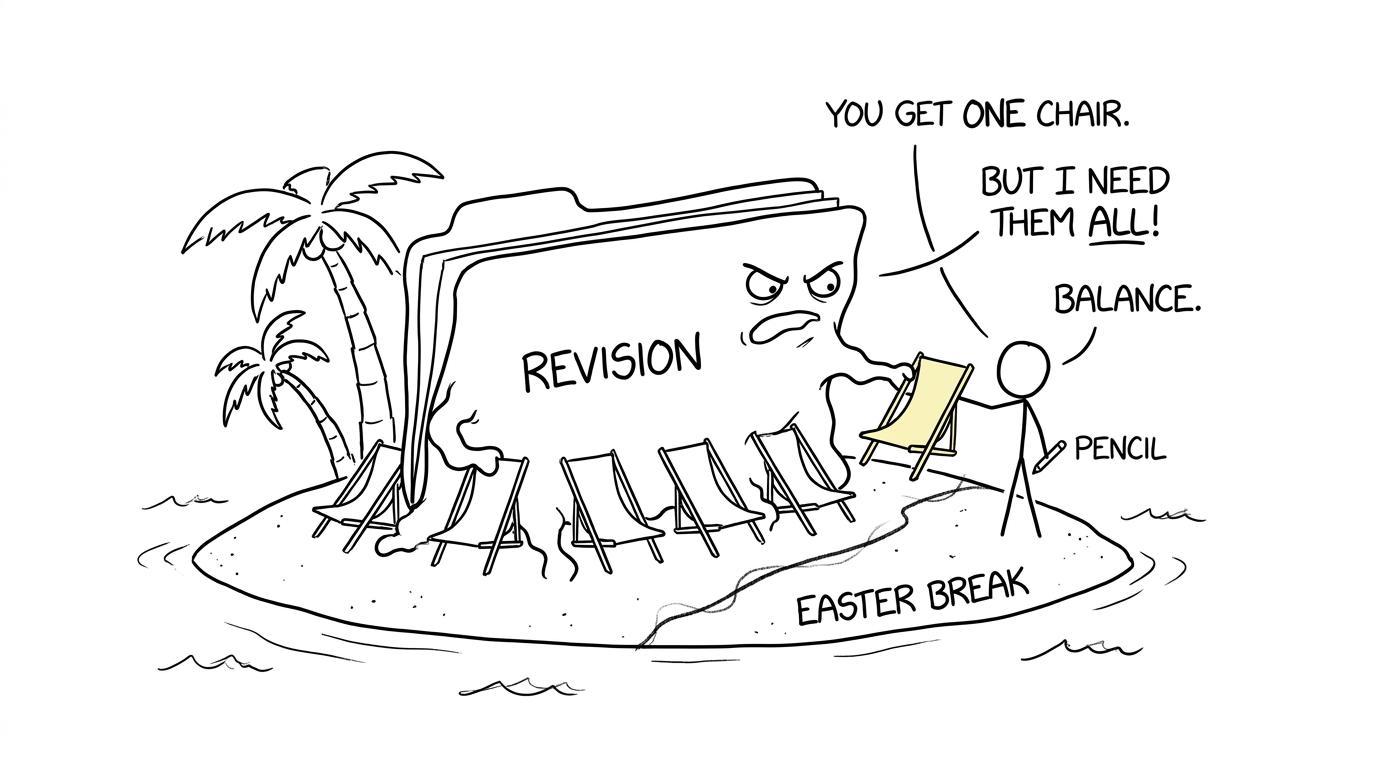 A revision folder negotiates for one deckchair on a student's peaceful holiday island
Build an Easter plan that leaves room for a holiday
A useful timetable is built around realistic revision blocks, not every available hour. Begin by marking commitments, family plans and complete rest days. Then add a limited number of focused sessions.
For many students, two or three blocks on selected days will be more sustainable than an all-day timetable. A block might last from 303030 to 505050 minutes, followed by a proper break. The right length depends on your concentration and the task: learning case-study detail may need less time than completing and marking an extended paper section.
Avoid planning every day identically. A balanced fortnight might look like this:
| Type of day | Sensible focus |
|---|---|
| Geography-focused day | One content block, one skills block and one exam-question block |
| Mixed-subject day | One geography block alongside maths and another subject |
| Light day | Flashcards, a short quiz or correcting previous answers |
| Rest day | No planned revision |
This is a framework rather than a quota. If you have fewer available days, shorten the plan instead of compressing the same workload into exhausting sessions.
Maths also benefits from regular contact across the holiday. The GCSE maths revision resources organise topics by grade, making it easier to select one precise area instead of writing “revise maths” on your timetable. That same principle should guide geography: name the topic and the task.
“Revise rivers” is vague. “Retrieve river landforms, check one case study and answer one extended question” creates a session you can actually finish.
Give each revision session a clear purpose
A strong session usually contains retrieval, checking and application. Begin without notes, expose what you cannot remember, then use your resources to repair the gaps.
Retrieve geographical knowledge
Close the textbook and write what you know about a process, location or case study. You could sketch a process diagram, create a mind map or list the stages of a geographical sequence. Afterwards, compare your attempt with your specification and class materials.
This is more informative than repeatedly highlighting a finished page. It also helps distinguish a missing fact from a weak explanation.
Case-study revision should focus on usable evidence. Learn the location, causes or context, significant effects, responses and the detail needed to support an argument. Avoid collecting dozens of disconnected facts. A smaller set of accurate, flexible evidence is easier to use under exam conditions.
Practise geographical skills
Skills can be neglected because they do not look like a single chapter. Include regular practice with maps, scale, direction, graphs, photographs, tables and numerical data. Use the conventions taught by your school and required by your specification.
There is useful overlap with maths. Percentages, averages, ratio, probability and interpreting graphs can all support geographical data work. If numerical skills are slowing you down, use MathsGenie’s percentage revision lesson, averages revision resources and ratio revision lesson to repair the underlying skill.
The goal is not to turn geography revision into another maths lesson. It is to make sure a manageable calculation does not prevent you from demonstrating geographical understanding.
Return to fieldwork
Fieldwork questions reward more than remembering where you went. Revisit your enquiry question, why the location was appropriate, the methods used, sampling decisions, risks, data presentation and whether the evidence supported the conclusion.
Evaluation needs particular attention. Be ready to explain limitations and realistic improvements. “Collect more data” is usually too general on its own. A stronger revision note identifies what additional data would be collected, where or when it would be collected, and how that change could improve reliability or representativeness.
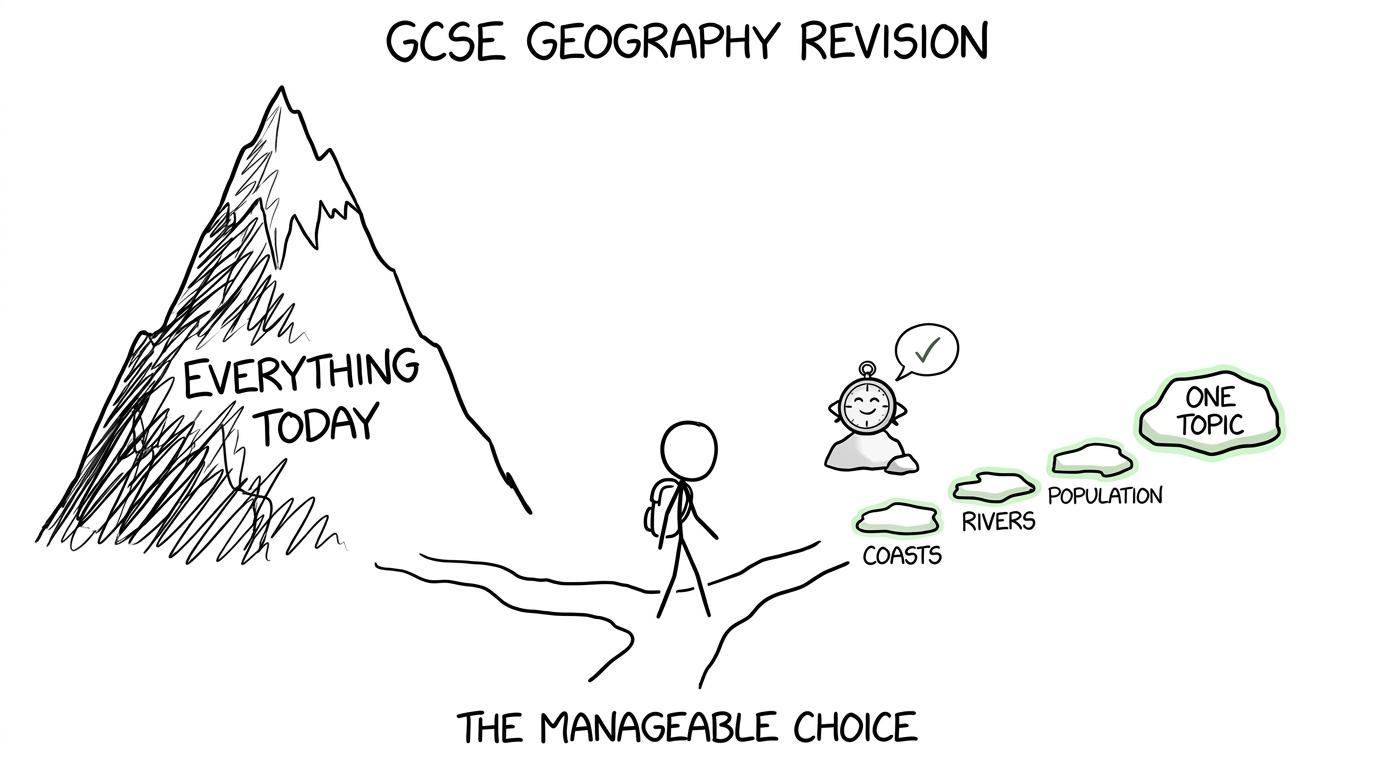 A student chooses small topic stepping stones instead of the mountain labelled everything today
Turn knowledge into exam marks
Knowing geography and expressing it under exam conditions are different skills. Easter is a useful time to connect them.
Choose questions from your own exam board wherever possible because paper structures, command words and mark tariffs vary. Start with short, untimed questions if confidence is low. Progress towards timed sections and, later, fuller papers.
Before writing, identify:
- the command word
- the geographical topic or issue
- any resource you must use
- the number of marks available
- whether evidence, judgement or evaluation is required
Extended responses should develop a line of reasoning rather than list facts. Make a relevant point, explain why it matters, support it with appropriate geographical evidence and keep returning to the question. If a judgement is requested, make one and justify it.
Marking matters as much as answering. Use the mark scheme, correct weak sections and record patterns in an error log. The purpose is not to predict an exact mark from one answer. It is to discover why marks were lost.
This approach works across subjects. MathsGenie’s GCSE maths past papers provide paper practice with mark schemes, while the predicted maths papers can support focused preparation nearer the exams. Use predicted papers as additional practice, not as a promise of what will appear.
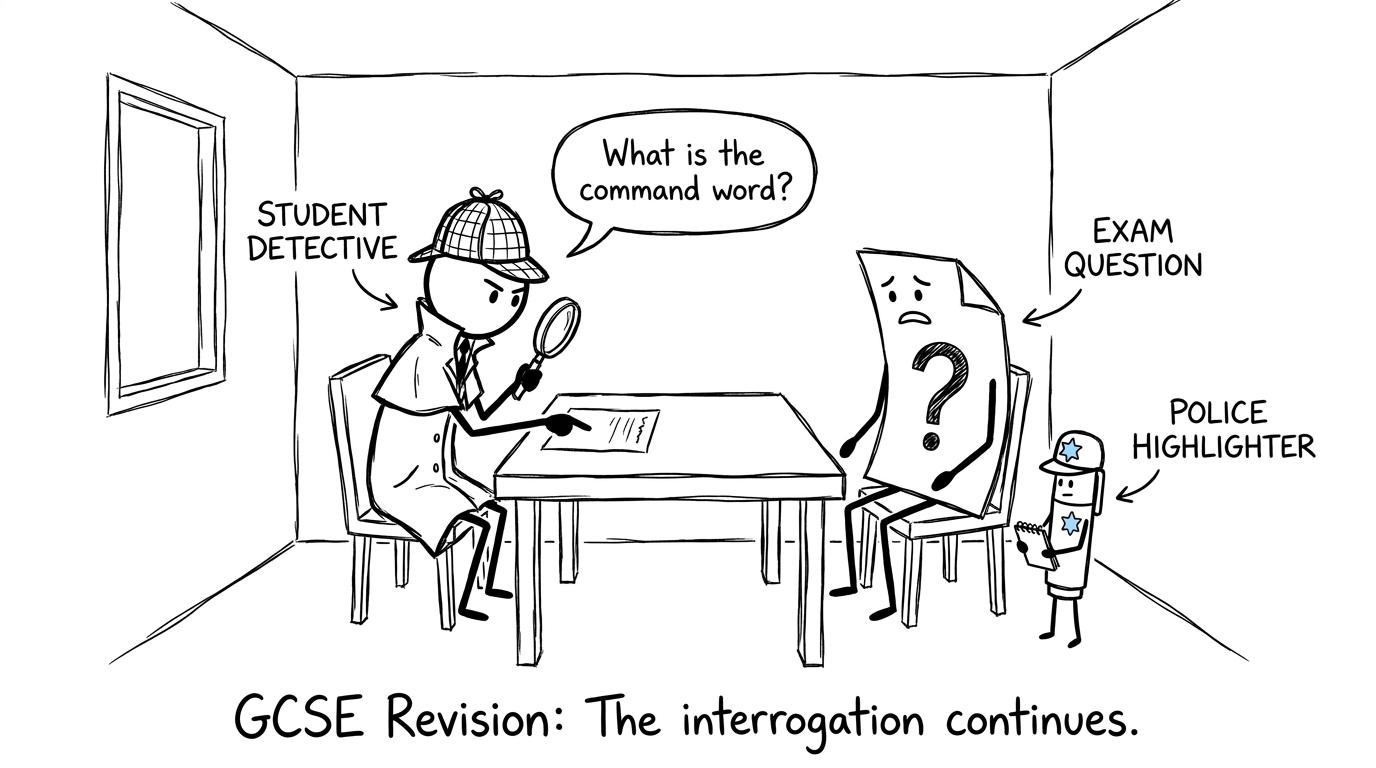 A student detective questions an exam paper about its command word
Balance geography with maths and other GCSEs
Balance does not mean giving every subject exactly the same number of minutes. It means allocating time according to need, exam demands and the work already completed.
At the beginning of each week, choose a small number of priorities for every subject. In geography, that might be one weak physical topic, one human topic and fieldwork evaluation. In maths, use your latest assessment or practice paper to identify specific weaknesses.
The MathsGenie homepage gives free access to revision lessons, practice questions and video solutions, so a maths block can be tightly focused. Mini tests can also show whether a topic is secure without consuming an entire afternoon.
Keep one flexible session near the end of each week. Use it for work that took longer than expected or for a weakness revealed by exam practice. Without this buffer, one disrupted day can make the whole timetable feel unsuccessful.
Rest belongs inside the plan. Protect some full evenings and complete days away from revision. Sleep, exercise, family time and ordinary enjoyment are not rewards for finishing an impossible workload. They are part of a sustainable Easter break.
Common mistakes during Easter revision
Making a timetable that records fantasy rather than reality
A schedule filled from morning to night can look committed while being almost impossible to follow. Plan fewer blocks, specify the task and include spare capacity.
Revising favourite topics first
Familiar topics feel productive because recall comes easily. Use the red, amber and green audit to give weak but important areas more attention.
Copying notes without testing recall
Neat notes may help organise information, but they do not show whether you can retrieve it. Begin sessions with closed-book recall and finish with questions.
Memorising case studies as isolated numbers
Evidence is valuable only when it supports an explanation or judgement. Learn accurate details in context and practise choosing evidence that answers the question.
Ignoring maps, data and fieldwork
Geographical skills and fieldwork are part of GCSE Geography, not optional extras. Place them explicitly on the timetable so content revision cannot crowd them out.
Completing papers without reviewing them
A marked paper is diagnostic information. Correct errors, compare your wording with the mark scheme and decide what to practise next.
Finish Easter with a shorter list
The aim of the holiday is not to complete revision forever. It is to return to school with fewer unknowns, stronger routines and a clear next step.
On the final day of your plan, repeat the red, amber and green audit. Record which topics improved, which questions still cause difficulty and what you want to ask your teacher. Then plan the first week back rather than attempting one last marathon session.
Keep geography focused and protect the wider balance of your GCSE preparation. For maths, use MathsGenie’s free GCSE revision hub to choose revision lessons, practice questions, mini tests and video solutions, then move towards past papers and predicted papers when the underlying topics are secure. A good Easter plan does not consume the holiday. It makes the remaining journey feel possible.










