GCSE Further Maths Grade 6 Meaning Explained
GCSE further maths grade 6 meaning: discover what ability it shows, how it compares with old letter grades, and how to plan smarter revision for exam success.
The difference between a grade that feels disappointing and one that feels encouraging is often context. A student may see a 666 in Further Maths and compare it with an 888 in GCSE Maths, without noticing that the two qualifications ask different questions.
The short answer to the GCSE further maths grade 6 meaning is this: it shows a sound level of achievement in mathematics beyond the standard GCSE course. It usually indicates that you can handle some demanding algebra, geometry and unfamiliar problem-solving, although your accuracy and consistency still have room to improve.
It is broadly comparable with a strong B under the former letter system, but that comparison is only approximate. A grade 666 is not officially fixed to one old letter grade, and its meaning depends on the exact Further Maths qualification you are taking.
Grade 666 at a glance
A grade 666 in a qualification using the 999-111 scale generally means that:
- you have demonstrated secure mathematical knowledge beyond ordinary GCSE content;
- you can apply several advanced techniques successfully;
- you are working above the standard associated with GCSE grade 555;
- you have not yet shown the consistency typically required for grades 777, 888 or 999;
- your raw mark cannot be predicted from the grade alone because grade boundaries change between exam series.
Most importantly, it is a respectable result. Further Maths is intended to stretch mathematically confident students and create a bridge towards more advanced work.
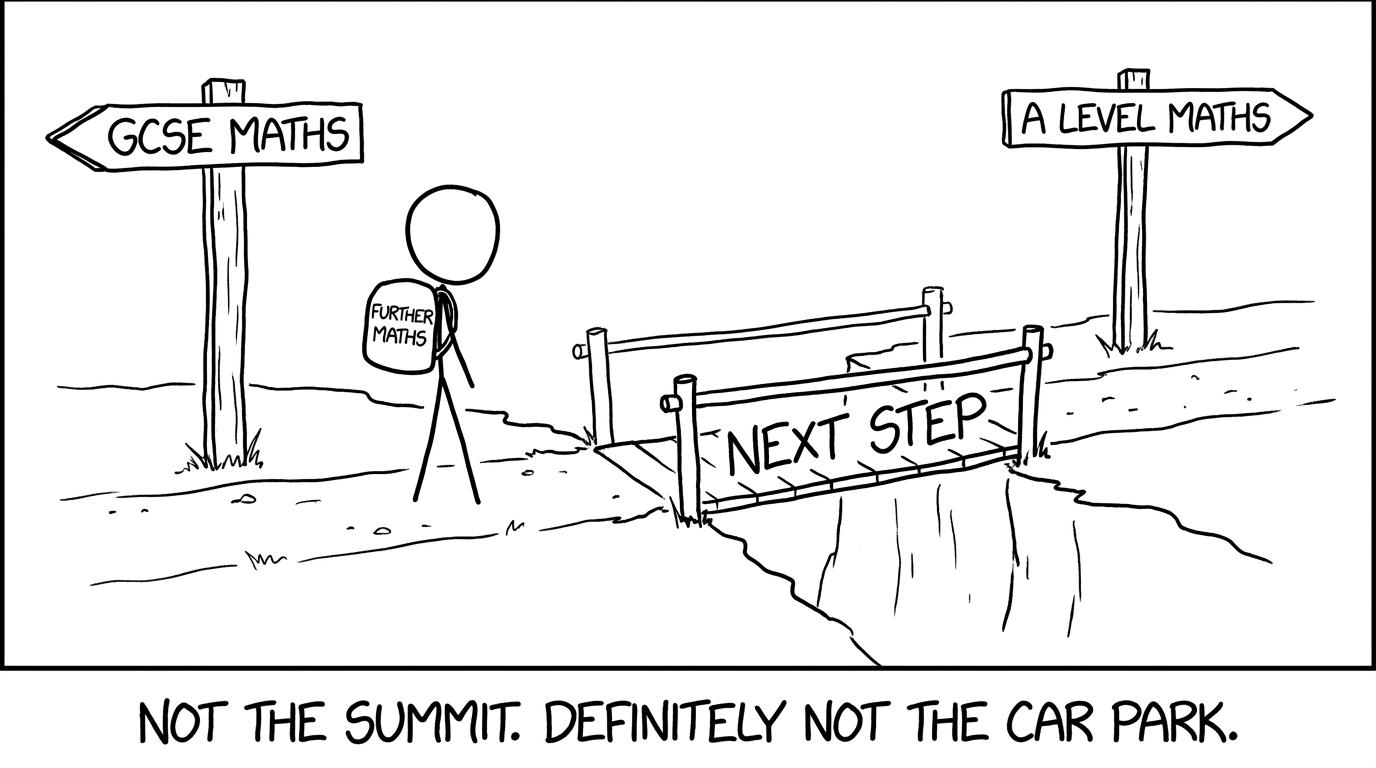 A student carrying Further Maths across the bridge between GCSE and A Level Maths
Check which Further Maths qualification you take
The phrase “GCSE Further Maths” is often used informally for several different qualifications. They are not interchangeable.
A common course in England is the AQA Level 222 Certificate in Further Mathematics. Although schools may teach it alongside GCSEs, it is a Level 222 certificate rather than a GCSE. Its current grading scale runs from 555 to 999, so grade 666 is the second available awarded grade on that scale.
Other courses have different names and grading arrangements. OCR offers an FSMQ in Additional Mathematics, while qualifications offered by Eduqas and international awarding bodies may use different structures or letter grades. Pearson Edexcel International GCSE Further Pure Mathematics also should not be confused with a domestic GCSE course.
Before interpreting a result, look at the qualification title and awarding body on your statement of entry. Your teacher or exams officer can confirm the precise specification. This matters because a grade 666 on one qualification should not automatically be treated as identical to a grade 666 on another.
For your standard GCSE preparation, MathsGenie's GCSE Maths revision resources organise lessons, questions and solutions by grade and topic.
What ability does a grade 666 represent?
A grade does not certify that you can answer every question from a particular list. Examinations are compensatory: stronger marks in one area can offset weaker marks elsewhere. Two students receiving grade 666 may therefore have different mathematical profiles.
Even so, the result usually suggests several useful strengths.
Secure algebraic foundations
Further Maths places considerable weight on algebra. A grade 666 commonly indicates that you can manipulate expressions, solve equations and work with algebraic relationships beyond routine GCSE questions.
Depending on the specification, you may encounter functions, factorised expressions, simultaneous equations, sequences and more demanding graph work. The important ability is not simply remembering a procedure. It is recognising which procedure fits a question.
If ordinary algebra still causes avoidable errors, revisiting the grade 666 GCSE Maths topics can strengthen the foundation beneath the Further Maths content.
Some success with unfamiliar problems
Further Maths questions often place familiar ideas in less familiar forms. A grade 666 suggests you can make progress when the route is not immediately obvious.
That might mean connecting several algebraic facts, interpreting a graph carefully or deciding which geometric result is relevant. You may not complete every demanding problem, but you can often establish a sensible method and earn method marks.
Readiness to develop further
A grade 666 shows potential for advanced mathematics, but it is not a guarantee that A Level Maths will feel easy. A Level courses move faster, demand more independent algebra and require sustained fluency.
If you are considering the next stage, explore MathsGenie's free A Level Maths revision lessons. Looking ahead can reveal which skills matter most, but your immediate priority should remain completing your current specification accurately.
How grade 666 compares with the old letter grades
There is no exact one-to-one conversion between numerical GCSE grades and the former A*-GGG system. The qualification structure and grade standards were redesigned, so any neat conversion chart hides some important detail.
Ofqual's established comparison points place the bottom of grade 777 broadly alongside the bottom of the former grade A. The bottom of grade 444 aligns broadly with the bottom of the former grade C. Grade 666 sits between those reference points and is normally described as broadly comparable with a strong B.
That wording matters. It does not mean:
grade 6=grade B in every circumstance.\text{grade } 6 = \text{grade B in every circumstance}.grade 6=grade B in every circumstance.A safer interpretation is:
grade 6≈a high B standard under the old scale.\text{grade } 6 \approx \text{a high B standard under the old scale}.grade 6≈a high B standard under the old scale.For an older Level 222 Further Mathematics qualification that previously used letter grades, the relationship may also depend on when the specification changed. Universities, colleges and employers can set their own entry requirements, so use the grade actually printed on your certificate rather than trying to replace it with a letter.
Why the required mark changes each year
A grade 666 is an awarded standard, not a permanent percentage. Awarding organisations set grade boundaries after the papers have been taken and marked. This allows them to account for differences in paper difficulty while maintaining standards over time.
Suppose one paper is more demanding than the previous year's paper. The raw mark needed for grade 666 may be lower. If another paper proves more accessible, it may be higher. This is why multiplying your mark by 100100100 and attaching a grade from an old boundary can be misleading.
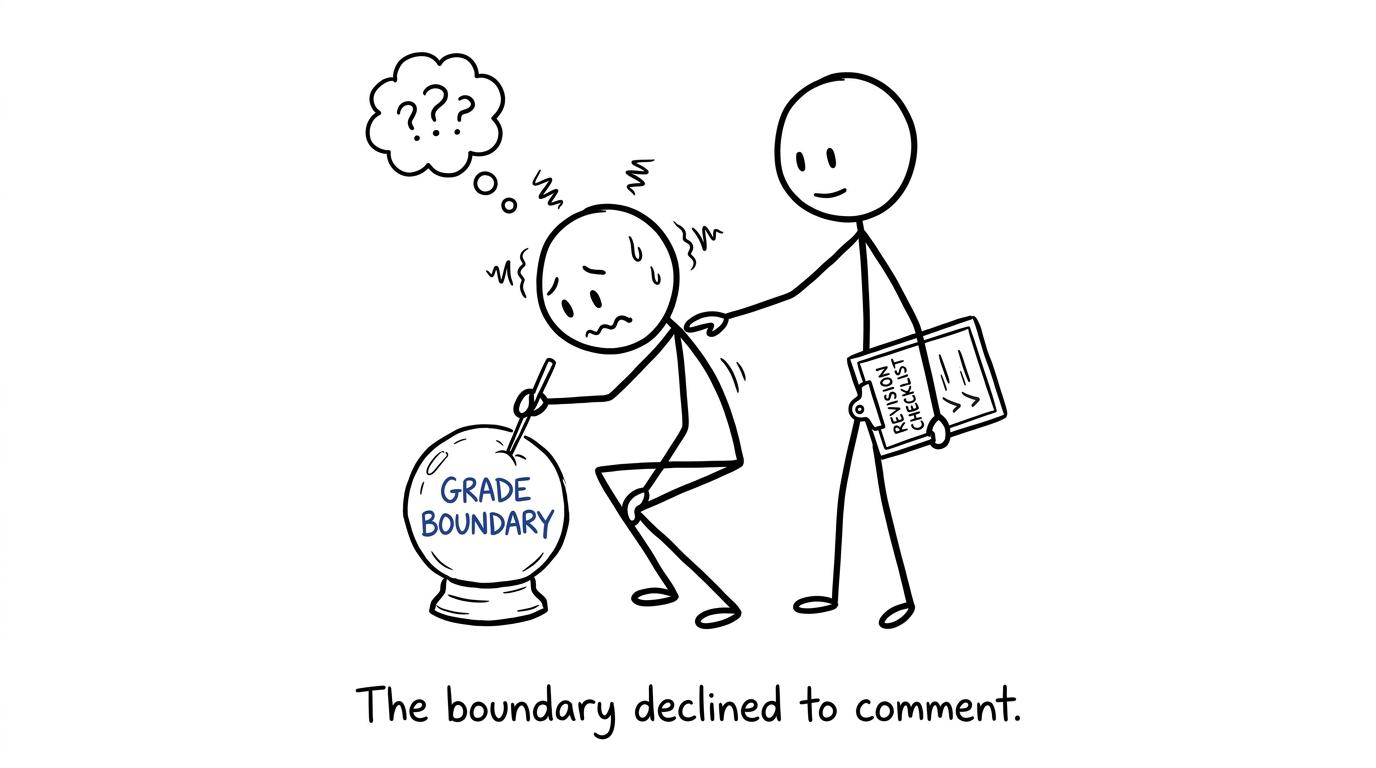 A student asks a silent grade-boundary crystal ball for answers
Use official boundaries only for the relevant awarding body, qualification code and exam series. When completing GCSE Maths past papers, treat the attached mark scheme and boundary information as evidence about that paper, not a promise about your next examination.
Is grade 666 good enough for A Level Maths?
Academically, it shows that you have engaged successfully with material designed to extend GCSE Maths. That is encouraging evidence. However, entry requirements are decided by individual schools and colleges, usually with greater emphasis on your standard GCSE Maths grade than on Further Maths alone.
Some centres ask for a particular grade in GCSE Maths, and requirements may be higher for A Level Further Maths. Check the published admissions information for the sixth form you are considering. Do not assume that a Further Maths grade automatically overrides its GCSE Maths requirement.
The more useful question is not simply, “Am I allowed to continue?” It is, “Which parts of my mathematics need to become more reliable before I continue?”
If algebraic manipulation is slow, prioritise fluency. If you lose marks through incomplete reasoning, practise writing connected arguments. If timing is the problem, complete full papers under controlled conditions. MathsGenie's grade 777 revision topics and grade 888 revision topics provide a sensible route towards more demanding GCSE work.
How to move from grade 666 towards grade 777 or higher
Improvement usually comes less from collecting new resources and more from using a small number of resources carefully.
Diagnose rather than guess
Mark a timed paper and classify every lost mark. Useful categories include knowledge gaps, algebra errors, misreading, incomplete reasoning and poor time management. The pattern tells you what to revise next.
Repair prerequisite skills
Advanced questions often collapse because of a simple weakness: signs, fractions, rearranging or expanding brackets. Use the relevant MathsGenie revision lesson, complete the practice questions, then return to the harder problem.
Practise mixed questions
Topic practice builds a method. Mixed practice builds recognition. You need both, because the examination does not announce which technique should be used.
Review the mark scheme intelligently
Do not merely count marks. Compare the structure of your reasoning with the accepted solution and identify the first point at which your method stopped being valid. Video solutions can then help you see how a complete argument is organised.
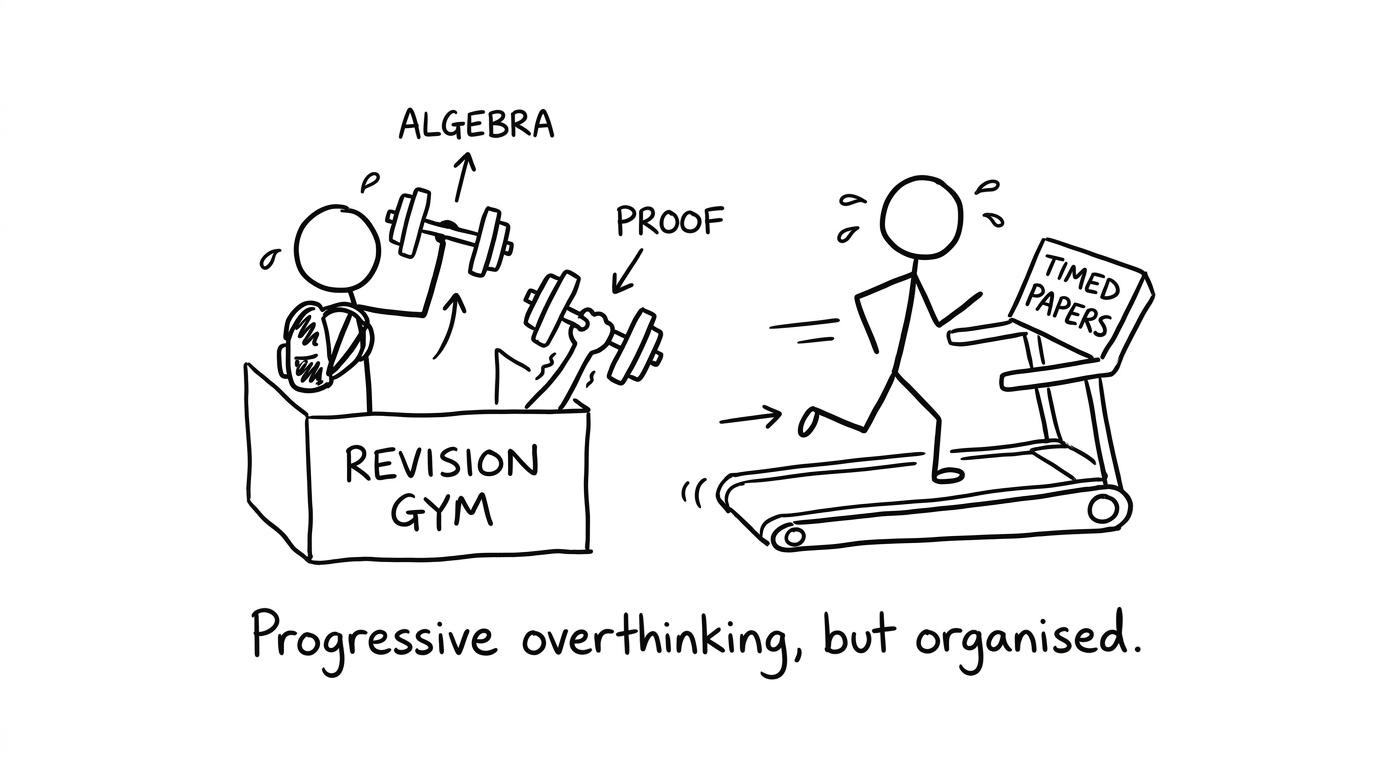 A student trains algebra, proof and timed-paper skills in a revision gym
Common mistakes when interpreting a grade 666
Treating it as an exact percentage
The mark required changes with the paper and exam series. Always use the correct official boundary when reviewing a past result.
Assuming all Further Maths courses are the same
AQA, OCR, Eduqas and Pearson qualifications can have different titles, specifications and grading systems. Check your qualification code before comparing grades.
Converting it rigidly to a B
A strong B is a useful broad comparison, not an official replacement grade. The numerical and letter systems are not perfectly equivalent.
Comparing it directly with GCSE Maths grade 666
The number looks the same, but the content and qualification may differ. A Further Maths result describes performance on a more specialised course.
Revising only the hardest topics
Students sometimes chase impressive-looking content while continuing to lose straightforward marks through weak algebra. Secure foundations usually produce the fastest improvement.
Turn the grade into a plan
A grade 666 in Further Maths is best understood as evidence of real mathematical ability with space to become more fluent, accurate and adaptable. It is broadly associated with a strong B on the former scale, but the exact meaning depends on your qualification, paper and exam series.
The grade is a snapshot, not a ceiling. Start with MathsGenie's free GCSE revision programme, use targeted practice questions and video solutions, then test your progress with past papers and mark schemes. Closer to the examination, MathsGenie predicted papers can add focused timed practice.
One result tells you where you were on one set of papers. Careful revision decides where you go next.