

GCSE exam week checklist (WJEC): stay calm, score marks
GCSE exam week checklist for WJEC students: a simple plan for Biology week, plus quick maths routines to protect marks across every paper.

You can feel it in your shoulders first.
It’s GCSE exam week, your Biology paper is looming, and suddenly every subject wants to be revised right now. The temptation is to sprint in ten directions and call it “hard work”. But the students who quietly pick up marks don’t do more; they do the right things, in the right order, when it matters.
This guide is a GCSE-friendly, WJEC-flavoured checklist for Biology exam week, written for students who mainly use YesGenie for maths, and want a simple plan that keeps Biology moving without letting maths slip.
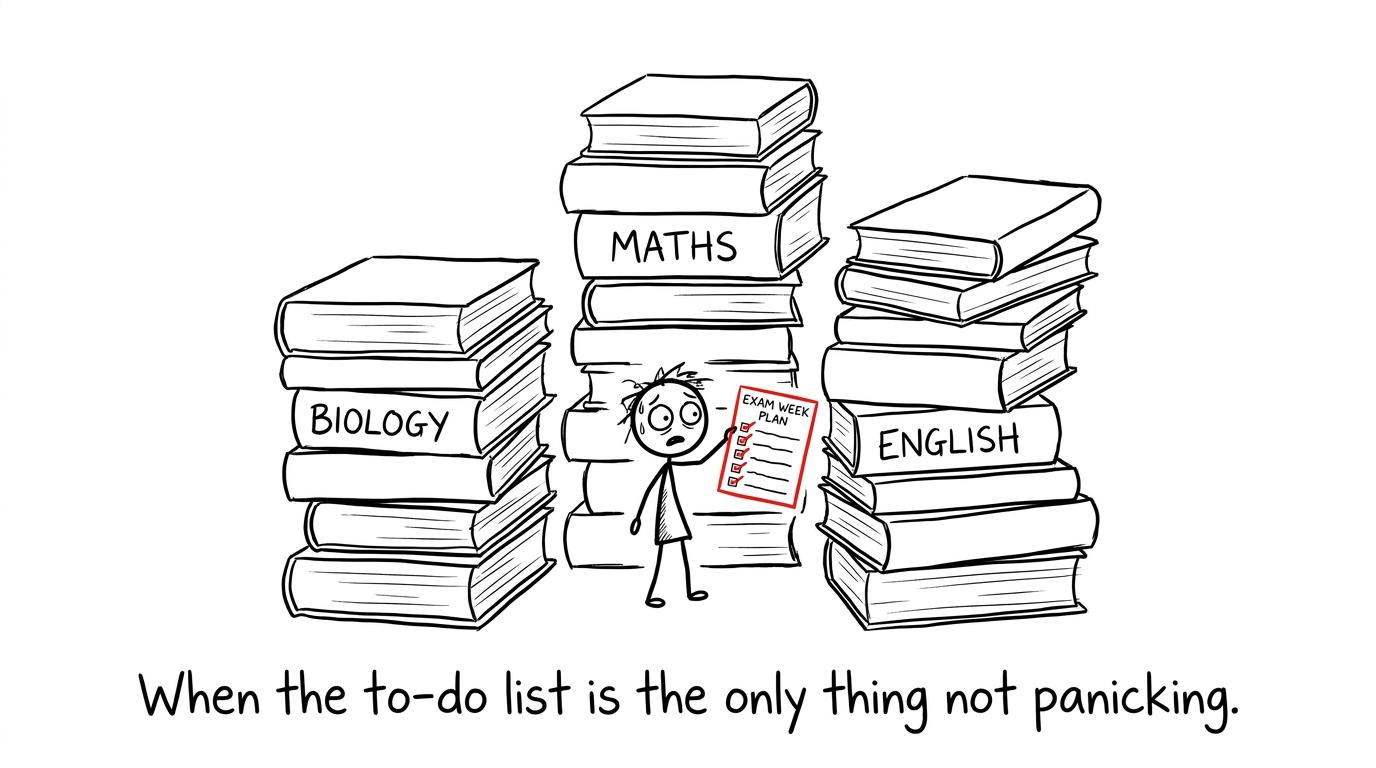 A stick-figure student using a checklist like a shield
Your simple GCSE exam week checklist (WJEC Biology)
Use this as your one-page rhythm for the week. It’s not meant to be perfect. It’s meant to be repeatable when you’re tired.
The daily non-negotiables
- Sleep a real amount (aim for roughly 888 hours).
- Eat something with actual substance before each exam.
- Pack your kit the night before (pens, ruler, calculator for maths, water).
- Do one timed Biology section each day (even 202020 minutes).
- Do one short maths mini-session each day (even 151515 minutes), so maths stays warm.
For your maths mini-session, YesGenie makes this easy: open a targeted revision page, do a few questions, check the method, move on.
Good starting points:
The night-before checklist
- Skim key Biology definitions and required practicals.
- Do one “show that” or calculation-style Biology question (units, rates, percentages).
- Prepare a micro-plan for tomorrow: 2 tasks, not 12.
- Stop revising early enough that you can actually switch off.
The morning-of checklist
- Breakfast first, panic second (ideally no panic).
- Read one page of notes max (confidence, not cramming).
- In the last 101010 minutes: practise calm breathing and remind yourself you only need the next question.
WJEC Biology exam week: what to prioritise (without overworking)
WJEC GCSE Biology rewards clarity. Not poetic clarity: exam clarity. If your answer is technically correct but vague, it leaks marks.
Priority one: command words and mark-scheme phrasing
Make a small list of WJEC-style command words you keep seeing:
- Describe: say what happens.
- Explain: give a reason (usually cause and effect).
- Compare: similarities and differences.
- Evaluate: pros/cons and a judgement.
- Calculate: show steps, include units, round sensibly.
During GCSE exam week, this matters more than rereading whole chapters. Marks come from matching the question’s demand.
Priority two: required practicals and variables
Required practicals are high value because they link to methods, variables, graphs, and evaluation.
For each practical, memorise:
- Independent variable, dependent variable, control variables.
- A fair test explanation.
- A couple of evaluation points (accuracy, repeatability, anomalies).
This is where maths quietly helps: variables, axes, scales, and interpreting trends are shared skills.
The hidden link: why maths routines protect GCSE Biology marks
A lot of WJEC Biology marks are lost on the bits that look “not really Biology”: rearranging, percentages, ratios, units, gradients, and reading graphs.
If you keep a tiny daily maths routine during GCSE exam week, you reduce careless errors across every paper.
Use YesGenie for focused practice:
- Edexcel GCSE Maths Revision Guides (topic list)
- OCR GCSE Maths Revision
- Resources: predicted papers, mini tests and more
Even if your exam board for maths isn’t Edexcel or OCR, the skills transfer.
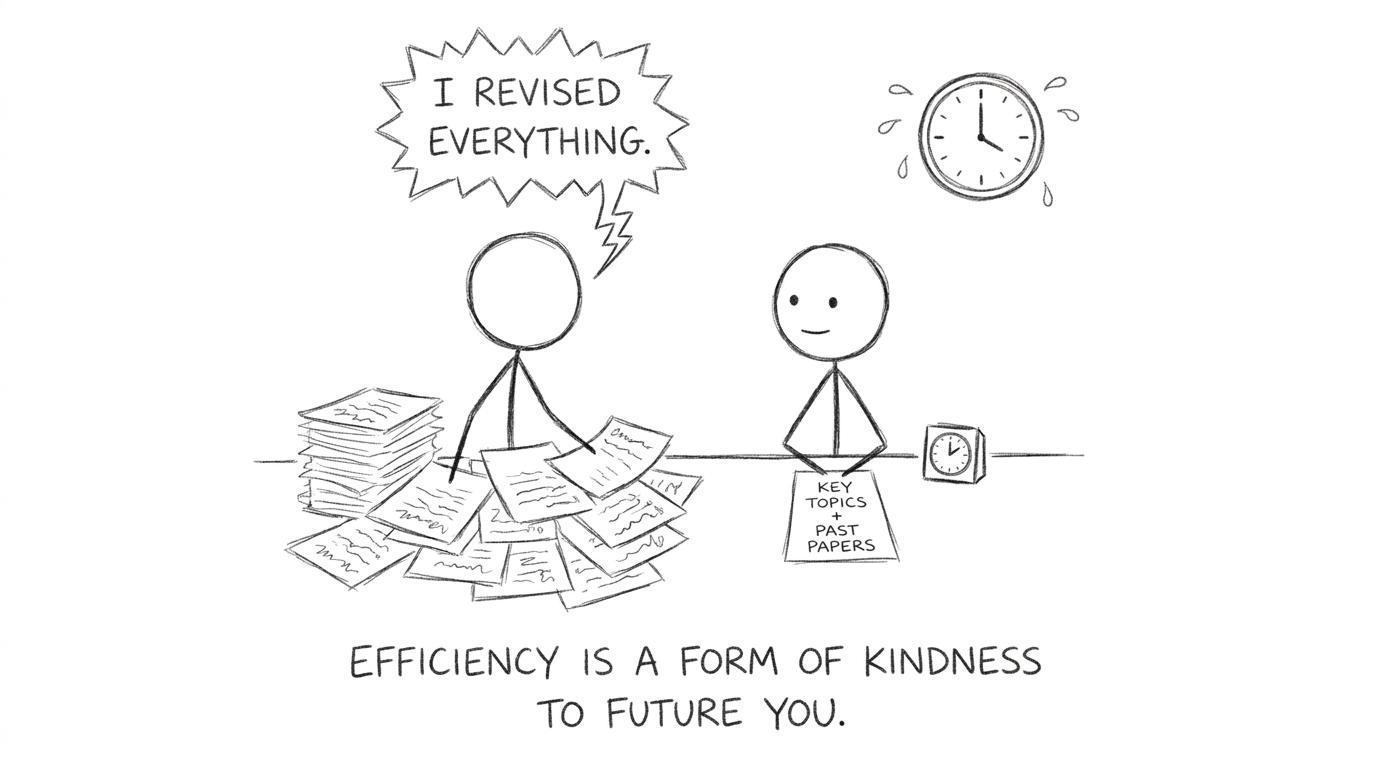 Two students: one with messy notes, one with a timer
Worked examples: the GCSE maths you actually use in Biology
These are the types of calculations that show up in WJEC GCSE Biology, and they’re exactly where students drop easy marks.
Percentage change (typical Biology data)
A plant’s mass increases from 48 g48\text{ g}48 g to 60 g60\text{ g}60 g.
Percentage increase is:
percentage increase=increaseoriginal×100 \text{percentage increase}=\frac{\text{increase}}{\text{original}}\times 100 percentage increase=originalincrease×100Increase =60−48=12=60-48=12=60−48=12.
So:
1248×100=25% \frac{12}{48}\times 100=25\% 4812×100=25%Exam habit: write the formula line first. It reduces panic and helps the examiner follow your method.
If you want to drill this skill quickly for GCSE exam week, do a short set on percentage change and check your workings against solutions.
Rate (biology loves “per unit time”)
A heart beats 420420420 times in 666 minutes.
Rate in beats per minute:
rate=4206=70 \text{rate}=\frac{420}{6}=70 rate=6420=70So the rate is 70 beats/min70\text{ beats/min}70 beats/min.
Exam habit: always attach units at the end. In science, units often carry a mark.
Mean and interpreting results
A student repeats an experiment and gets: 12,15,13,10,5012, 15, 13, 10, 5012,15,13,10,50.
Mean:
xˉ=12+15+13+10+505=1005=20 \bar{x}=\frac{12+15+13+10+50}{5}=\frac{100}{5}=20 xˉ=512+15+13+10+50=5100=20But 505050 is likely an anomaly. If the question asks you to comment, you might say the mean is affected by an outlier and the median might be more representative.
Maths crossover: averages and anomalies are GCSE maths staples and show up everywhere in Biology.
Gradient from a graph (rate of change)
Suppose a graph shows a line passing through (2,8)(2, 8)(2,8) and (6,20)(6, 20)(6,20).
Gradient is:
m=ΔyΔx=20−86−2=124=3 m=\frac{\Delta y}{\Delta x}=\frac{20-8}{6-2}=\frac{12}{4}=3 m=ΔxΔy=6−220−8=412=3So the rate is 333 units of yyy per 111 unit of xxx.
Exam habit: choose two points far apart on the line to reduce reading error.
How to use YesGenie in GCSE exam week (without falling into the “resource spiral”)
Resources are supposed to remove decisions, not create them.
Here’s a simple way to use YesGenie during GCSE exam week:
For maths: one topic, one paper section, done
- Pick one weak topic (for example, probability or fractions).
- Do 101010-151515 minutes of focused questions.
- Watch a solution only when you’re stuck, then redo the question.
Useful WJEC-flavoured pages:
- Probability (WJEC revision guide)
- Substitution (WJEC revision guide)
- Fractions of an Amount (WJEC revision guide)
For confidence: short past-paper exposure
Doing a full paper every night can be too much. But touching real questions keeps you exam-ready.
- Use GCSE Past papers to find what you need.
- If you’re doing WJEC maths, go straight to WJEC GCSE Maths Past Papers.
The goal in GCSE exam week is not to “finish the internet”. It’s to reduce surprises.
 A stick figure trying to plug knowledge in like USB
Common mistakes during GCSE Biology exam week (and how maths revision fixes them)
Dropping units or rounding too early
Students often do the calculation correctly, then lose the mark by forgetting units or rounding mid-way.
Fix: keep full calculator accuracy, round at the end, and write units every time.
Confusing percentage of a value with percentage change
“20%20\%20% of 505050” is not the same as “increase by 20%20\%20%”.
- 20%20\%20% of 505050 is 0.2×50=100.2\times 50=100.2×50=10.
- Increasing 505050 by 20%20\%20% gives 50+10=6050+10=6050+10=60.
Misreading graphs under time pressure
Common errors include skipping axis labels, using uneven scales, and reading off the wrong curve.
Fix: take 555 seconds to check axis labels and units before you read anything.
Writing beautiful Biology and messy calculations
A surprising number of GCSE science questions are “explain your result” plus a small calculation. If the calculation is unclear, the explanation can’t rescue it.
Fix: lay out steps like a maths question: formula, substitution, answer with units.
A calm ending: your GCSE week is a sequence, not a single moment
When you’re in the middle of GCSE exam week, it’s easy to treat every paper like it decides your whole future. In reality, it’s more like a sequence of small, manageable choices: sleep, short practice, one timed task, check mistakes, repeat.
If you want a revision home base that keeps those choices simple, use YesGenie for the boring-but-brilliant work: revision lessons, practice questions, mark schemes, video solutions, mini tests, and past papers. Start with WJEC GCSE Maths Revision, then use GCSE Past papers to keep your exam technique sharp.
Your Biology grade will thank you for the calm. Your maths paper will thank you for staying warm. And your future self will thank you for choosing a plan you can actually follow in GCSE exam week.










