

GCSE English Language Spec Changes Explained
GCSE English Language spec changes explained: learn what is different, which older resources may mislead you and how to revise for your exam board.
There is a particular kind of revision panic that begins when an old workbook looks almost right. The questions resemble the ones you know, the cover says GCSE, and somebody has written reassuring notes in the margins. Then you notice a reference to coursework, tiers or an unfamiliar paper structure.
The short answer is that the most important GCSE English Language spec changes happened when the reformed qualification was introduced in England, with first teaching from 2015 and first examinations in 2017. Coursework disappeared, the qualification became linear and untiered, grades 9-1 replaced letter grades, and Spoken Language became a separately reported endorsement. More recent changes tend to be exam-board-specific updates rather than another complete national redesign.
That distinction matters. A resource from before the reform may prepare you for the wrong assessment system. A paper from a few years ago may still be extremely useful, provided it matches your current exam board and specification.
A quick resource checklist
Before using an English Language revision resource, check:
- the exam board: AQA, Pearson Edexcel, OCR or Eduqas;
- the exact qualification or specification code where one is given;
- whether it uses grades 9-1 rather than A* to G;
- whether it describes terminal written examinations rather than coursework;
- whether its paper names, timings and marks match your current specification;
- whether it includes a current mark scheme;
- whether any references to pandemic adaptations or advance information are now obsolete;
- whether your teacher has confirmed that the resource fits your course.
The principle is familiar from maths revision. A question can be mathematically sound yet poorly matched to the paper you are about to sit. MathsGenie separates GCSE maths revision by topic and grade from GCSE maths past papers because learning a skill and rehearsing an assessment are related, but not identical, jobs.
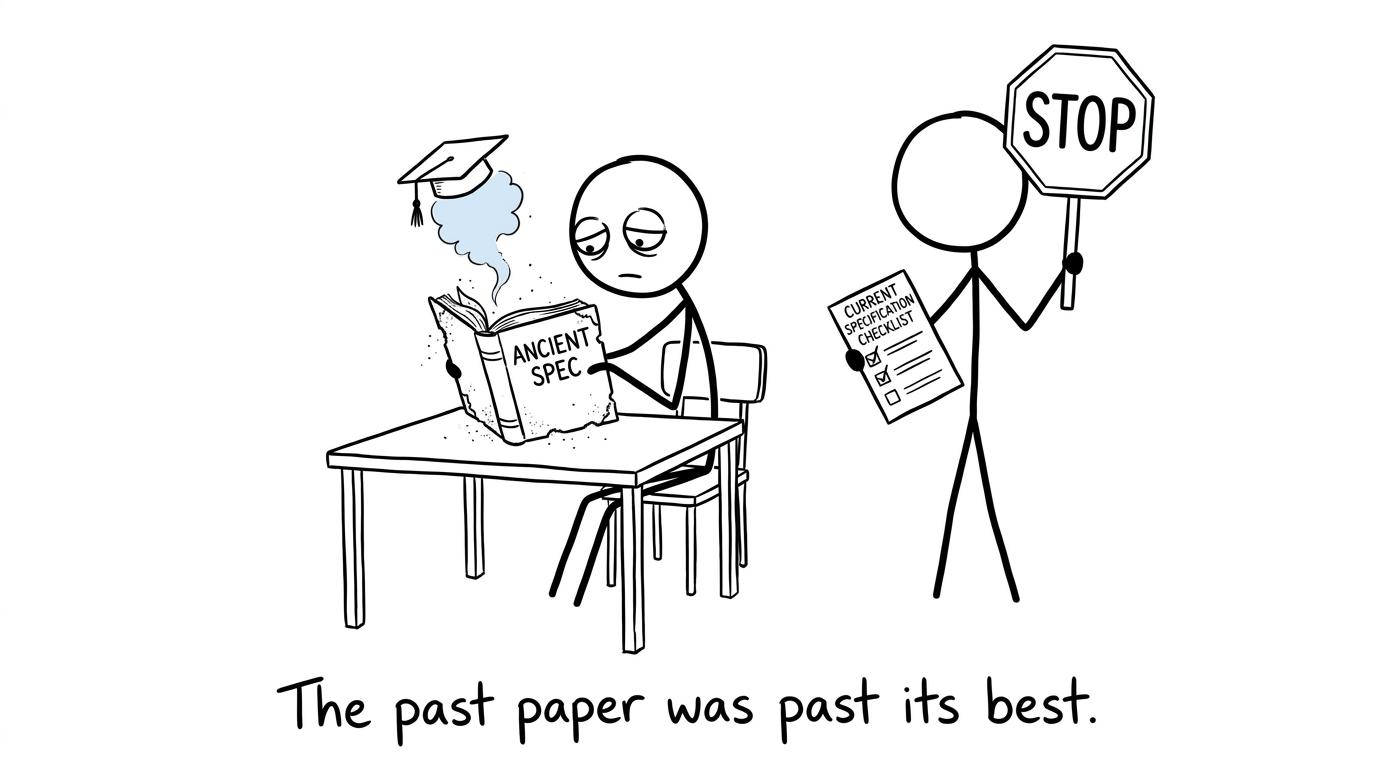 A student discovers that an ancient specification has followed an old past paper into revision
The major reform behind today’s GCSE
The present GCSE English Language model in England grew from reforms introduced in the middle of the 2010s. If a book or website predates those reforms, do not assume that its assessment advice remains current.
The qualification became linear
Under the reformed model, assessment takes place through examinations at the end of the course. Earlier GCSEs commonly included controlled assessment completed during the course.
This changed the rhythm of revision. Students now need to sustain reading and writing skills across complete examination papers, under timed conditions. An old controlled-assessment task might still prompt useful writing, but its planning rules, conditions and marking context will not reproduce the current examination.
Coursework and controlled assessment were removed
Current GCSE English Language qualifications in England are assessed through external written examinations. There is no coursework component contributing to the final numerical grade.
Older materials can therefore mislead students by devoting time to controlled-assessment titles, drafting arrangements or teacher-marked portfolios. Those tasks may offer general practice, but they should not determine your revision plan.
Grades 9-1 replaced A* to G
The reformed GCSE uses the numerical grading scale from 9 to 1, with 9 as the highest grade. Older grade labels do not translate through a simple one-to-one conversion, and historical grade boundaries should not be used to predict a result on a current paper.
Grade boundaries vary between examination series because awarding considers the demand of the paper and the performance shown. Your best evidence comes from recent papers, their official mark schemes and the boundaries published for that particular series.
English Language is untiered
Unlike GCSE maths, which has foundation and higher tiers, GCSE English Language is untiered. Students following a specification sit the same relevant papers and can access the full grade range.
This is an easy detail to miss when your revision week moves between subjects. In maths, tier choice affects the questions and grades available, so students should use appropriately matched resources such as Grade 4 maths revision, Grade 5 maths revision or Grade 7 maths revision. English Language requires a different mindset: improvement comes from the quality of reading, interpretation, comparison, organisation and writing rather than moving to a separate higher-tier paper.
Spoken Language became a separate endorsement
Speaking and listening once contributed differently within earlier GCSE arrangements. Under the reformed English Language GCSE in England, Spoken Language is reported separately as Pass, Merit, Distinction or Not Classified. It does not contribute to the 9-1 English Language grade.
It still matters and should be taken seriously. The important revision point is simply that an older resource may describe its relationship with the final grade incorrectly.
What changed in the content and assessment emphasis?
The reform placed clear emphasis on reading substantial unseen material and writing accurately for different purposes and audiences.
Students encounter challenging fiction and non-fiction drawn from the nineteenth, twentieth and twenty-first centuries across the qualification. They may need to retrieve information, make inferences, analyse language and structure, evaluate ideas, and compare writers’ viewpoints or methods. Writing tasks assess communication as well as technical accuracy, including spelling, punctuation, grammar and sentence control.
That does not mean every exam board arranges these elements in the same order. One board may place particular reading tasks on one paper while another organises its components differently. Question wording, source combinations, total marks and recommended timings can also differ.
This is why a generic video claiming to reveal “the GCSE English Language paper” deserves caution. There is common national subject content, but there is not one universal paper shared by AQA, Edexcel, OCR and Eduqas.
Recent updates are usually specification-specific
A common misunderstanding is that the national reform and every later amendment are the same kind of change. They are not.
Exam boards periodically update specification documents, assessment materials and administrative guidance. An update might clarify wording, adjust instructions or change how a particular paper is presented. Pearson Edexcel also offers more than one English Language qualification in England, including its English Language 2.0 route, so the word “Edexcel” alone may not identify the paper you are taking.
The safe approach is to use the issue date or version number on the current specification and compare its assessment overview with your resource. Ask three questions:
- Does the paper title match?
- Do the sections, marks and timings match?
- Does the task wording resemble the board’s current specimen or recent papers?
If one answer is no, pause before memorising the resource’s advice. Your teacher or examinations officer can confirm the precise entry.
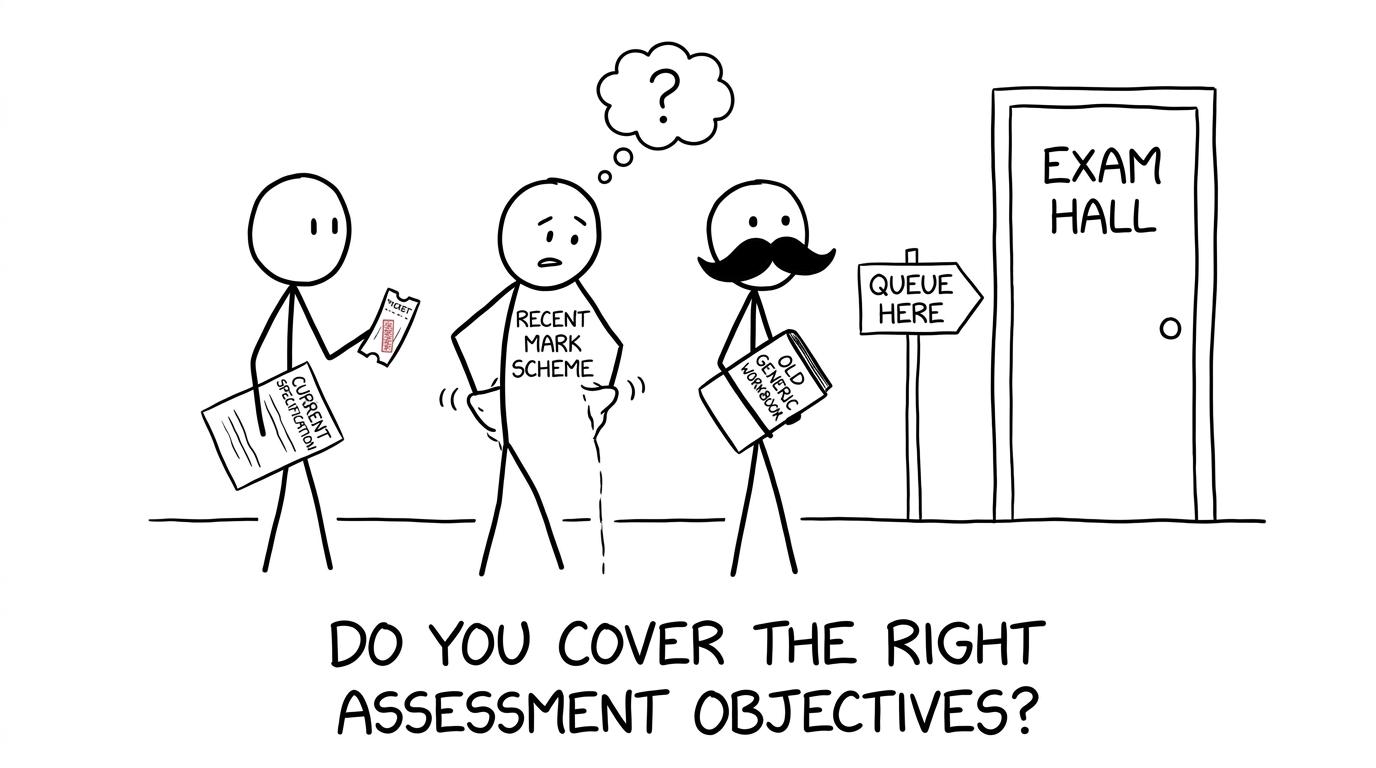 Revision resources attempt to prove that they belong to the current specification
Are older English Language resources still useful?
Age is not the only test. Alignment is.
A pre-2017 guide explaining controlled assessment is obsolete as examination guidance. Yet an older extract could still help you practise close reading, while a writing prompt could still develop control of tone and structure. The resource becomes risky when it tells you what will appear, how marks are allocated or how long you should spend without matching your present specification.
A post-reform past paper from several years ago is usually much more relevant. It can provide valuable practice if the specification has remained applicable, but you should pair it with the mark scheme for the same series and check for later board notices.
Resources produced during the pandemic require special care. References to cancelled examinations, advance information, optional content or temporary grading arrangements describe exceptional series, not automatic rules for a current exam. A genuine paper remains useful practice; temporary instructions may not.
Use this hierarchy when choosing materials:
- current specification and assessment overview;
- current specimen assessment materials where applicable;
- recent papers with matching mark schemes;
- older papers from the same specification;
- generic or legacy resources used only for clearly identified skills.
The same hierarchy works in maths. Start with the topic, test it, and then move towards authentic paper practice. MathsGenie’s predicted GCSE maths papers can support final preparation, but they complement rather than replace official-style past-paper practice.
Why English specification changes matter to maths students
English and maths compete for the same finite revision hours. An hour spent learning an obsolete English paper routine is an hour that cannot be used to repair an algebra weakness, complete a mini test or review a mark scheme.
There is also a useful connection between the subjects. GCSE maths questions reward precise reading. Words such as “estimate”, “show”, “hence” and “give a reason” tell you what evidence is required. English Language develops the habit of attending to wording, selecting evidence and explaining an interpretation. Maths demands the same discipline in a different form.
A balanced plan might reserve separate sessions for English reading, English writing, maths topic practice and full-paper work. Keep the tasks specific. “Revise English” is difficult to begin; “complete one timed reading section and mark it” is actionable. “Do maths” is equally vague; working through targeted Grade 5 topics gives the session a boundary.
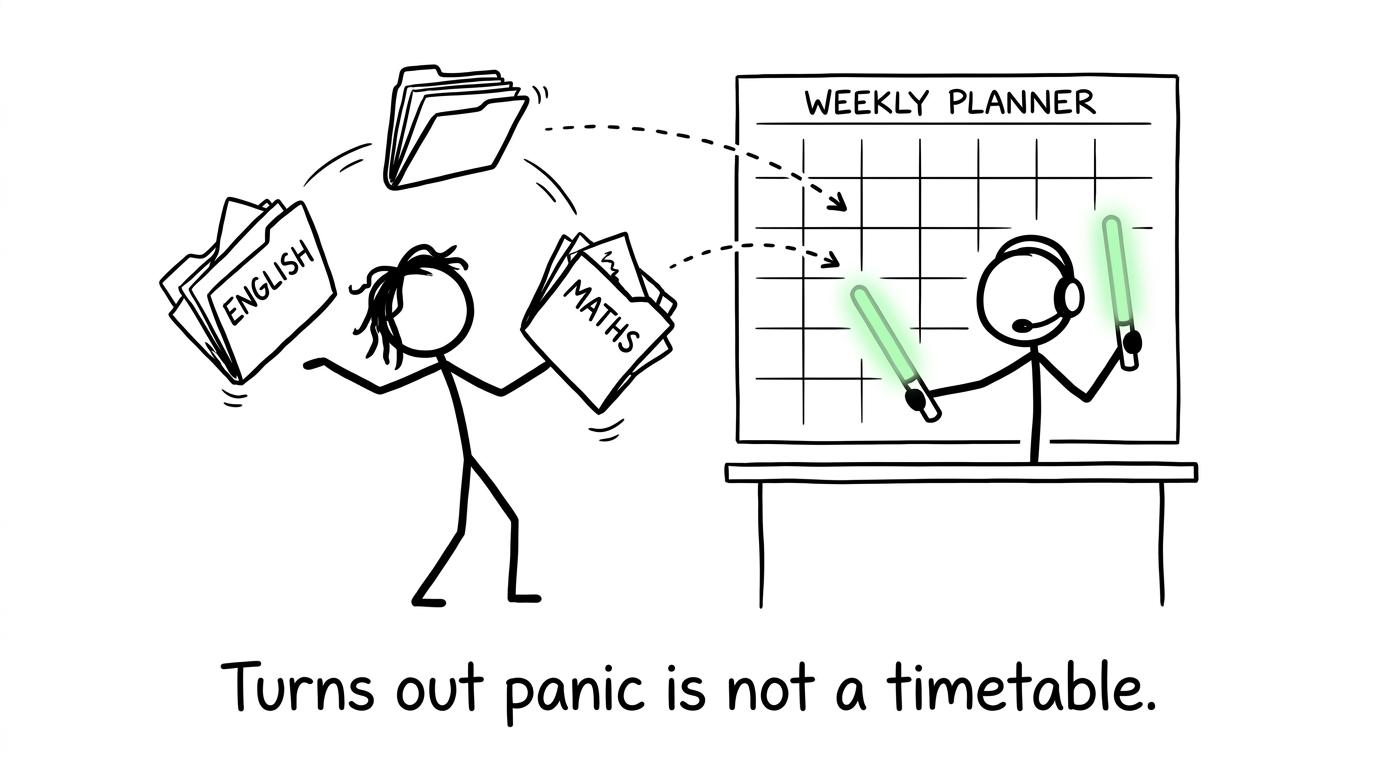 A weekly planner safely directs English and maths revision onto the same desk
Common mistakes when using older resources
Assuming every old paper is irrelevant
Post-reform papers can remain excellent practice. Check the specification, paper structure and mark scheme rather than rejecting a resource because of its date alone.
Assuming every resource labelled GCSE is suitable
The board and qualification matter. A strong AQA technique guide does not automatically describe an OCR, Eduqas or Edexcel paper accurately.
Memorising timings without checking the current paper
Suggested time allocations are often advice rather than rules, and they must fit the correct total examination time and marks. Confirm both before rehearsing a routine.
Using old mark schemes with new questions
A mark scheme belongs to its particular paper. Reading the wrong one can distort your understanding of what the examiner rewards.
Treating Spoken Language as part of the numerical grade
The endorsement is separately reported under the reformed qualification in England. Complete it properly, but do not calculate it as part of your 9-1 result.
Applying pandemic arrangements to a current series
Temporary adaptations were designed for exceptional circumstances. Never assume that advance information or altered arrangements continue unless your school and exam board have confirmed this for your series.
Check the label before trusting the strategy
The deepest lesson is simple: useful revision begins by identifying the exam you are actually taking. The major GCSE English Language spec changes created a linear, untiered, examination-based qualification with grades 9-1 and a separate Spoken Language endorsement. Since then, boards have continued to maintain their own specifications and materials.
Keep older resources when they build a relevant skill. Set them aside when they teach an obsolete assessment. Then protect the rest of your timetable by using MathsGenie for focused, free maths revision: choose GCSE revision lessons and practice questions, move to past papers and mark schemes, and use predicted papers to rehearse the final stage. If you are already looking beyond GCSE, the A Level maths revision hub shows where those habits can take you next.










