

GCSE English Language Paper 1 Exam Date 2026
GCSE English Language Paper 1 exam date 2026: check the scheduled date, paper duration, essential equipment and how to balance English with maths revision.
The hardest part of an exam timetable is rarely reading the dates. It is seeing several important subjects crowded into the same few weeks and wondering how your revision will fit.
The GCSE English Language Paper 1 exam date 2026 is Thursday 21 May 2026 in the morning for AQA, Pearson Edexcel, OCR and Eduqas. This date appears in the published summer 2026 timetables for these exam boards. Your personalised timetable from your school or college remains the final instruction because it confirms your entry, room, seat and arrival time.
For students also preparing for GCSE Maths, the date matters for another reason: English Language Paper 1 falls within an already busy part of the exam season. A good plan protects your English preparation without allowing maths skills to fade.
English Language Paper 1 date at a glance
Here is the essential information to check first:
- Exam date: Thursday 21 May 2026
- Session: Morning
- Exam boards: AQA, Pearson Edexcel, OCR and Eduqas
- Arrival time: Set by your school or college
- Final authority: Your personalised candidate timetable
- Main equipment: Black pens and any additional items permitted by your centre
- Immediate action: Record the date, check your exam board and plan backwards
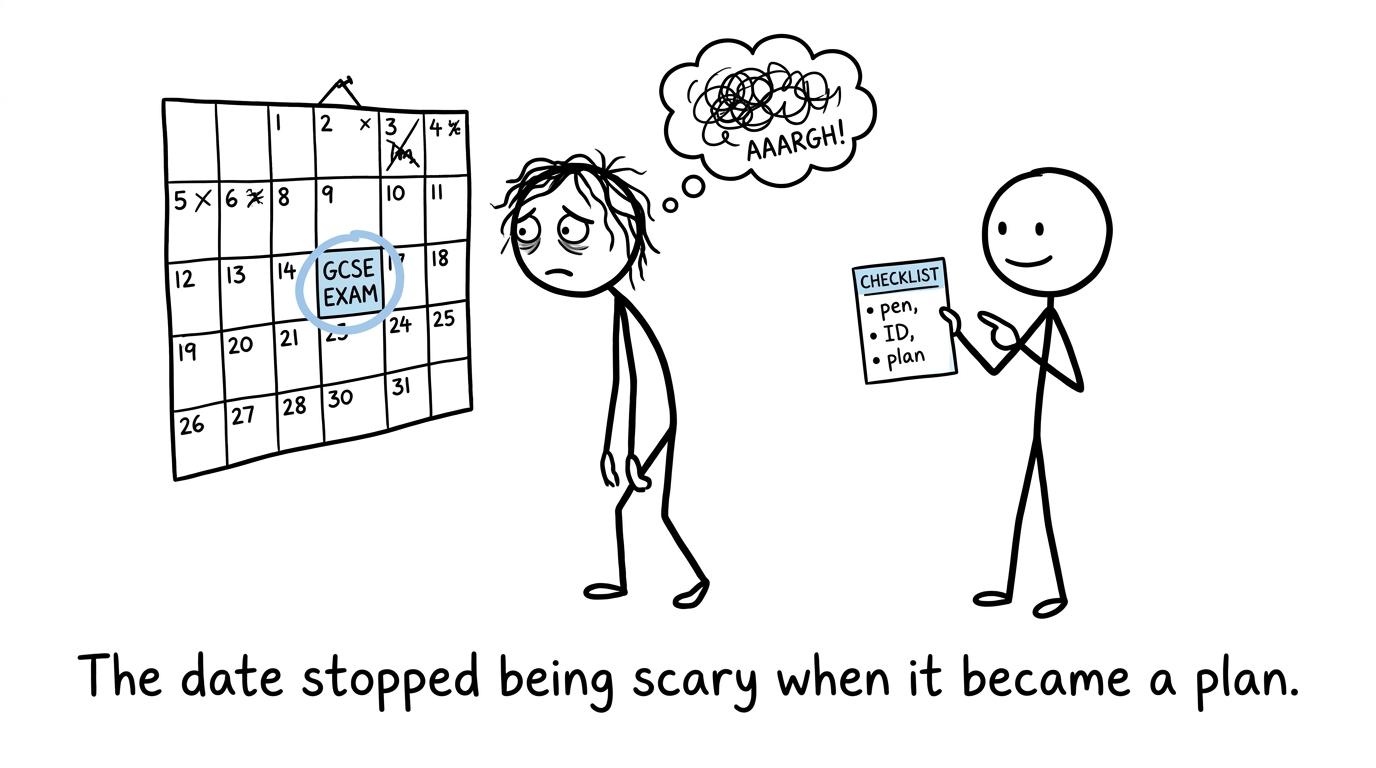 A student turns an intimidating exam date into a manageable checklist
Is the date the same for every exam board?
The main GCSE English Language specifications offered by AQA, Pearson Edexcel, OCR and Eduqas schedule their first paper or component for the morning of Thursday 21 May 2026. However, the content, wording and duration are not identical.
| Exam board | Paper or component | Scheduled duration | | --- | --- | | AQA | Paper 1: Explorations in Creative Reading and Writing | 111 hour 454545 minutes | | Pearson Edexcel | Paper 1: Fiction and Imaginative Writing | 111 hour 454545 minutes | | OCR | Paper 1: Communicating Information and Ideas | 222 hours | | Eduqas | Component 1: 20th Century Literature Reading and Creative Prose Writing | 111 hour 454545 minutes |
Do not assume that a friend at another school is preparing for exactly the same tasks simply because the date matches. Revision advice, question structures and timing strategies need to fit your specification.
There can also be qualifications with similar names, including international GCSEs and WJEC qualifications used in Wales. Their timetables may differ. Look for the exam-board name and specification code on your candidate timetable rather than relying on a social-media post or a generic calendar.
What to have ready before the exam
A calm exam morning is usually built the evening before. The aim is not to predict every inconvenience. It is to remove the small decisions that consume attention when you are already nervous.
Your confirmed timetable details
Check all of the following:
- the exam-board name and specification code;
- the paper or component number;
- the morning session and your centre's arrival time;
- your exam room and seat number, if supplied;
- your candidate number;
- any access arrangements confirmed by your school;
- the journey and the time you need to leave home.
Schools decide precise start and arrival arrangements within the examination rules, so do not infer your arrival time from the word “morning”. Use the instructions issued by your exams officer.
Suitable writing equipment
Have at least two reliable black pens ready. The paper instructions for these qualifications generally require black ink or black ballpoint pen, but you should follow the wording on your own question paper and your centre's instructions.
A sensible equipment check includes:
- black pens that you have tested;
- permitted stationery in a transparent pencil case;
- your candidate card or identification if your centre requires it;
- a clear, label-free water bottle if your centre permits one;
- any authorised equipment or access-arrangement materials.
Do not bring unauthorised notes, a mobile phone, a smartwatch or another internet-enabled device into the examination room. Your school will explain where these items must be left. Dictionaries are not normally permitted for GCSE English Language unless a specific approved arrangement applies.
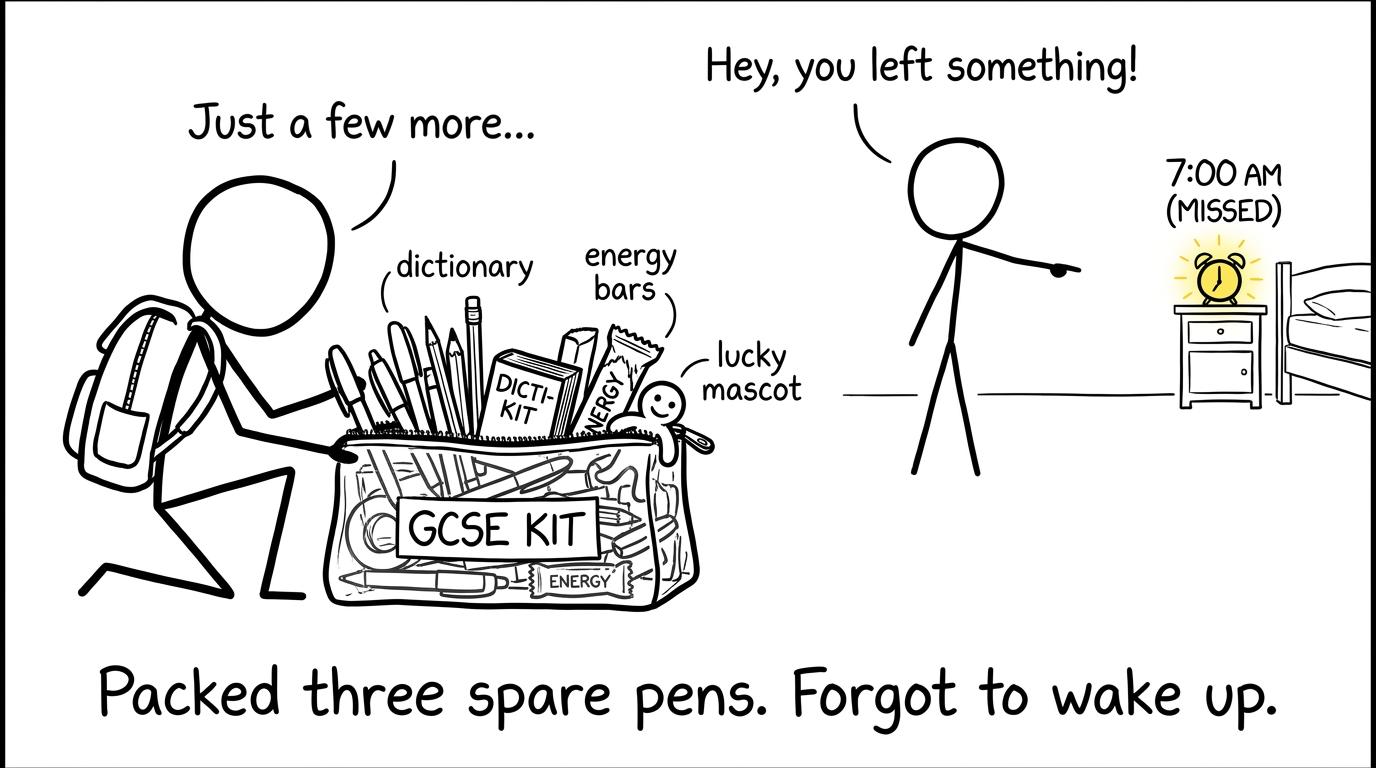 A student remembers spare pens but nearly forgets to wake up
Knowledge of your own paper
Before 21 May, you should know more than the paper's title. Make sure you understand:
- which reading and writing skills are assessed;
- how the marks are distributed;
- which questions require close reference to a source;
- how long you intend to spend on each section;
- whether spelling, punctuation and grammar are assessed in a particular task;
- what the command words require.
Use papers and mark schemes produced for your own specification. A response that suits one exam board may not match the wording, assessment objectives or mark allocation used by another.
How to plan backwards from 21 May
An exam date becomes useful when it changes what you do next.
Begin by placing Thursday 21 May in your calendar. Add your other confirmed exams, then identify the days when English and maths compete for revision time. The answer is not to abandon one subject for a fortnight. It is to give each subject a clear job.
In the weeks before the paper
English Language benefits from regular reading, annotation and timed writing. GCSE Maths depends on retrieval and repeated problem solving. Both subjects punish passive revision, although in different ways.
A balanced week could contain:
- timed English reading questions;
- one planned or timed writing task;
- targeted maths practice on weak topics;
- a mixed maths paper or mini test;
- time to mark, correct and revisit mistakes.
For structured maths preparation, begin with the free GCSE Maths revision lessons. They organise topics by grade and include videos and exam-style questions, making it easier to choose a precise task rather than vaguely deciding to “do some maths”.
Use GCSE Maths past papers when you need to practise selecting methods across a whole paper. A paper is most valuable after it has been marked: the mistakes tell you which revision lesson should come next.
MathsGenie predicted papers can add current exam-style practice, but they should complement rather than replace past papers and topic revision. No predicted paper can guarantee which questions will appear.
During the final week
The final week is for control, not reinvention. Keep English practice close to the real paper, but avoid exhausting yourself with a full timed paper every day. Review the feedback from earlier attempts and focus on the weaknesses that still cost marks.
Continue short maths sessions where your timetable allows. A small set of purposeful questions can preserve fluency better than waiting until English is over and trying to restart maths from cold.
The MathsGenie GCSE resources provide focused practice materials, while the MathsGenie home page gives direct access to GCSE and A Level revision areas when you need to move quickly between topics and papers.
The evening before
Stop early enough to sleep properly. Pack your equipment, set an alarm and check your route. You may choose to review a short checklist or a few reminders, but the night before is not the time to memorise elaborate phrases that may not fit the source or task.
Your preparation should leave room for judgement. English Language rewards a response to the paper in front of you, not a performance copied from a script prepared for an imaginary question.
Balancing English Language with GCSE Maths
English and maths can feel like two separate revision mountains. In practice, the same planning habits help with both: know the assessment, practise under realistic conditions, mark honestly and return to errors.
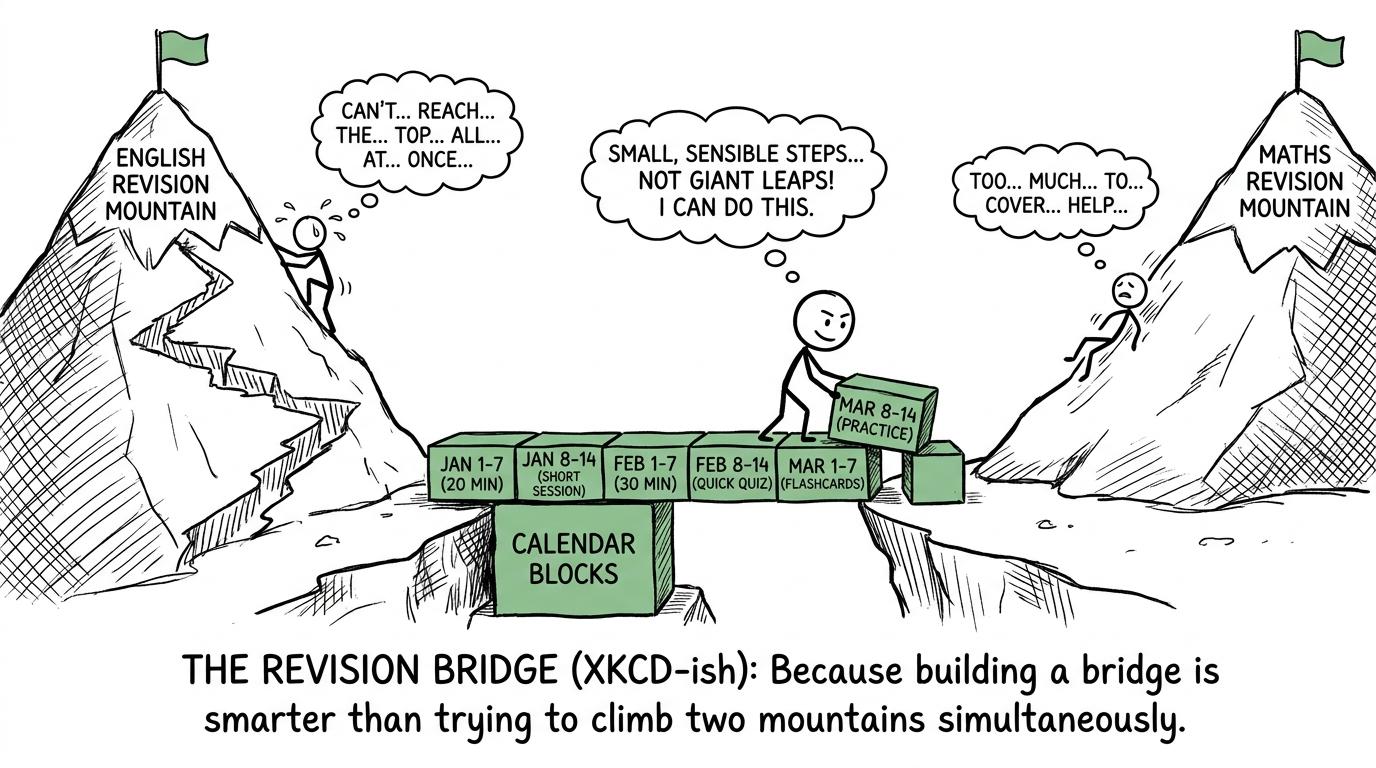 A student builds a sensible revision bridge between English and maths
Do not measure revision only by time spent. One hour rereading notes is not automatically more useful than twenty focused minutes correcting a misconception. Give each session an observable outcome, such as completing one English section or correcting every error from a maths mini test.
If you are taking higher or foundation tier maths, use resources made for the correct tier. English Language is not tiered in the same way, which is another reason not to transfer assumptions from one subject to another.
Students continuing beyond GCSE can also explore the free A Level Maths revision resources. For now, however, the priority is the next confirmed paper and the skills that can still be improved before it.
Common mistakes to avoid
Checking the subject but not the specification
“English Language Paper 1” is not enough information. Confirm the board, specification code and paper number so that you use the correct practice materials.
Treating an online date as your complete timetable
Thursday 21 May 2026 tells you the national session. It does not tell you your room, seat or required arrival time. Those details come from your centre.
Revising another board's question structure
The boards assess broadly related language skills, but their papers are organised differently. Learn the timing, command words and mark scheme for your own qualification.
Leaving equipment until the morning
A missing pen is a small problem, but small problems feel larger under pressure. Test and pack your equipment the previous evening.
Pausing maths revision completely
English may be the immediate exam, but later maths papers still require fluent recall. Maintain short, deliberate maths practice and expand it again after English Language Paper 1.
Confusing predicted papers with predictions of exact questions
Predicted papers provide useful exam-style practice. They cannot promise the content of the live examination. Build broad understanding with revision lessons, practice questions, past papers, video solutions and mark schemes.
Turn the date into a plan
The GCSE English Language Paper 1 exam date is Thursday 21 May 2026 in the morning for the main AQA, Pearson Edexcel, OCR and Eduqas specifications. Write it down, but do not stop there. Confirm your personal timetable, identify your exact specification, prepare your equipment and work backwards from the date.
Then protect the rest of your exam season. MathsGenie offers free revision lessons, practice questions, video solutions, mini tests, past papers, predicted papers and mark schemes for GCSE and A Level Maths. Choose the next weak topic, complete a focused task and correct it carefully. A timetable tells you when the exam arrives. Good revision decides how ready you are when it does.










