GCSE Engineering Exam Board Differences Explained
GCSE engineering exam board differences explained: compare GCSE and vocational routes, assessment styles and the maths revision that genuinely affects grades.
A qualification can feel harder simply because its assessment style works against your strengths. A student who enjoys building and refining prototypes may prefer coursework. Another may feel safer with a written paper and a precise mark scheme. That is why GCSE engineering exam board differences matter, but not because one board quietly gives away easier grades.
The short answer is that the board itself does not automatically make Engineering easier or harder. What matters more is the exact qualification, how it is assessed, the content your school teaches and whether the assessment format suits you. There is also an important complication: courses from different awarding organisations may all be described informally as “GCSE Engineering”, even when some are vocational Level 1/Level 2 qualifications rather than GCSEs.
The exam board checklist
Before comparing courses, find out:
- the full qualification title and qualification number
- whether it is a GCSE or a Level 1/Level 2 vocational award
- the awarding organisation, such as AQA, OCR, Pearson or WJEC
- how much is assessed by written examination and non-exam assessment
- whether practical work is completed under controlled conditions
- which specification version your school follows
- how the final result is graded
Your teacher or examinations officer can confirm these details. Do not rely on the name used on your timetable alone.
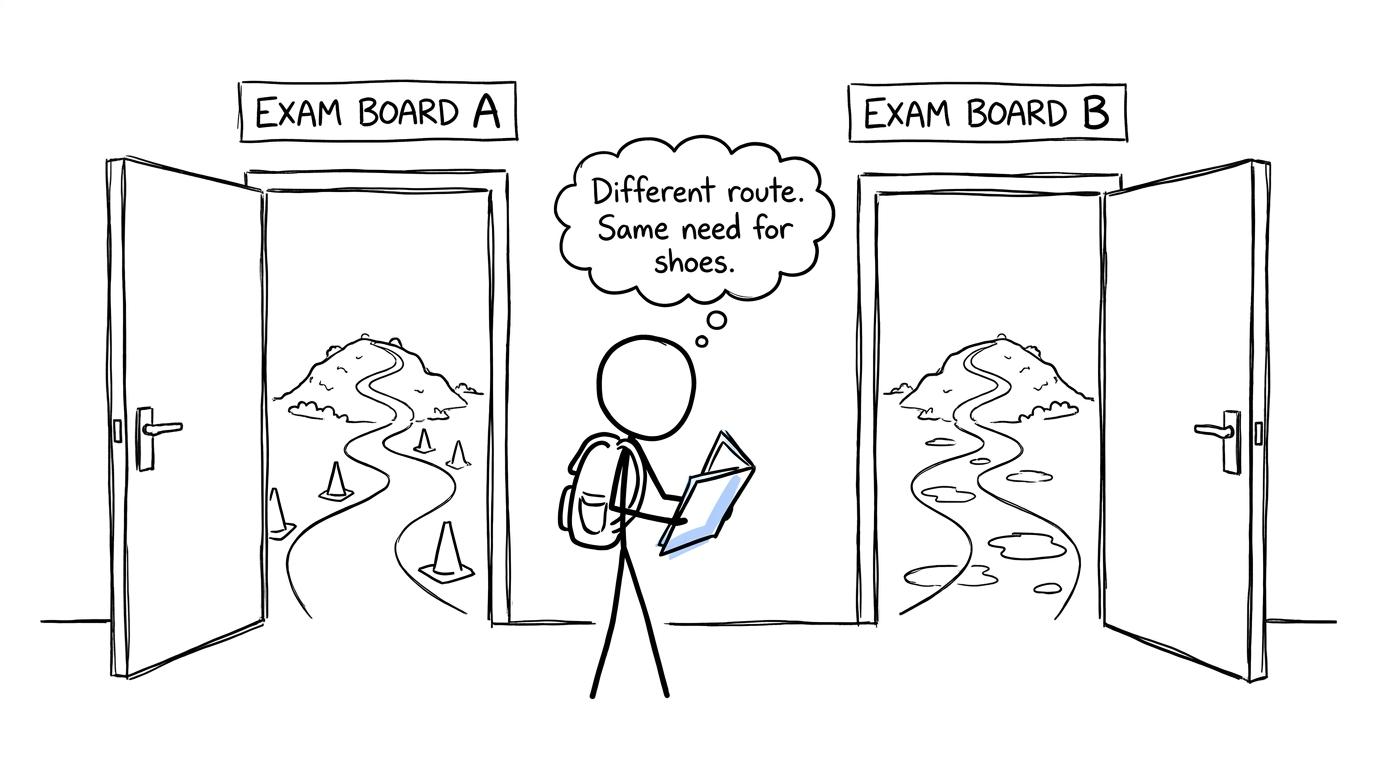 A student choosing between two exam board routes
Is GCSE Engineering available from every exam board?
No. This is the most important distinction in the comparison.
AQA offers a qualification specifically titled GCSE Engineering. Its specification combines engineering knowledge, mathematical application, design, manufacturing and practical problem-solving. The course is assessed through a written examination worth 60%60\%60% and non-exam assessment worth 40%40\%40%. The written paper lasts 222 hours and carries 120120120 marks, while the non-exam assessment carries 808080 marks.
Other awarding organisations offer related courses with different titles and structures. Examples include OCR Cambridge Nationals in Engineering Design, Pearson BTEC Tech Award qualifications in Engineering and WJEC vocational engineering awards. Eduqas also offers GCSE Design and Technology, which can include engineering-related materials and design principles, but it should not automatically be treated as the same qualification as AQA GCSE Engineering.
These courses can occupy a similar place in a school timetable, yet they are not simply four versions of one identical GCSE. Their assessment objectives, practical requirements, grading systems and balance between examined and internally assessed work can differ.
That makes the phrase “Which Engineering exam board is easiest?” less useful than it first appears. In some cases, you would be comparing different qualifications rather than different papers for the same qualification.
Does one board make Engineering harder or easier?
Not in a simple or reliable sense.
Qualifications are designed against published standards, and awarding organisations use assessment processes to set grade boundaries after students have taken the assessments. A paper that feels unusually demanding does not necessarily lead to lower grades because grade boundaries can reflect the overall difficulty of that assessment.
However, equal intended standards do not mean every course feels identical. Difficulty has several layers.
Assessment style
A course with substantial non-exam assessment rewards organisation over time. You may need to investigate a problem, communicate design decisions, produce or model an outcome, test it and evaluate it against a specification.
A more examination-heavy route places greater pressure on recall, interpretation and speed under timed conditions. Neither route is universally easier. They test overlapping knowledge through different habits.
The precise content
Engineering qualifications may place different emphasis on materials, manufacturing methods, systems, design communication, sustainability or commercial production. Even where headings sound similar, the required depth may differ.
This is why revising from a random engineering textbook or another board’s paper is risky. The resource may be useful for general understanding, but it cannot replace your own specification.
Teaching and available equipment
Practical engineering depends partly on how a course is delivered. Access to suitable tools, modelling facilities and teacher guidance can affect how confidently students approach practical tasks. That does not change the official standard, but it can change the learning experience.
Your strengths
Coursework can feel easier if you plan carefully and act on feedback at permitted stages. It can feel much harder if deadlines accumulate. Written examinations may suit students who retrieve knowledge quickly, while practical assessment may suit those who communicate ideas more effectively through drawings, models and testing.
The best-matched course is not necessarily the course with the lowest workload. It is the one whose demands you understand early enough to prepare properly.
Why the specification matters more than the logo
An exam-board logo is memorable. A specification is useful.
The specification tells you what can be assessed, the assessment objectives, command words, mathematical requirements and practical expectations. It also prevents a common revision failure: spending hours learning something related to engineering but absent from your course.
Use this sequence:
- read the content statements in your specification
- turn each statement into a revision checkpoint
- match it to class notes and approved resources
- complete questions from your exact qualification
- compare your response with the relevant mark scheme
- record weak areas and revisit them
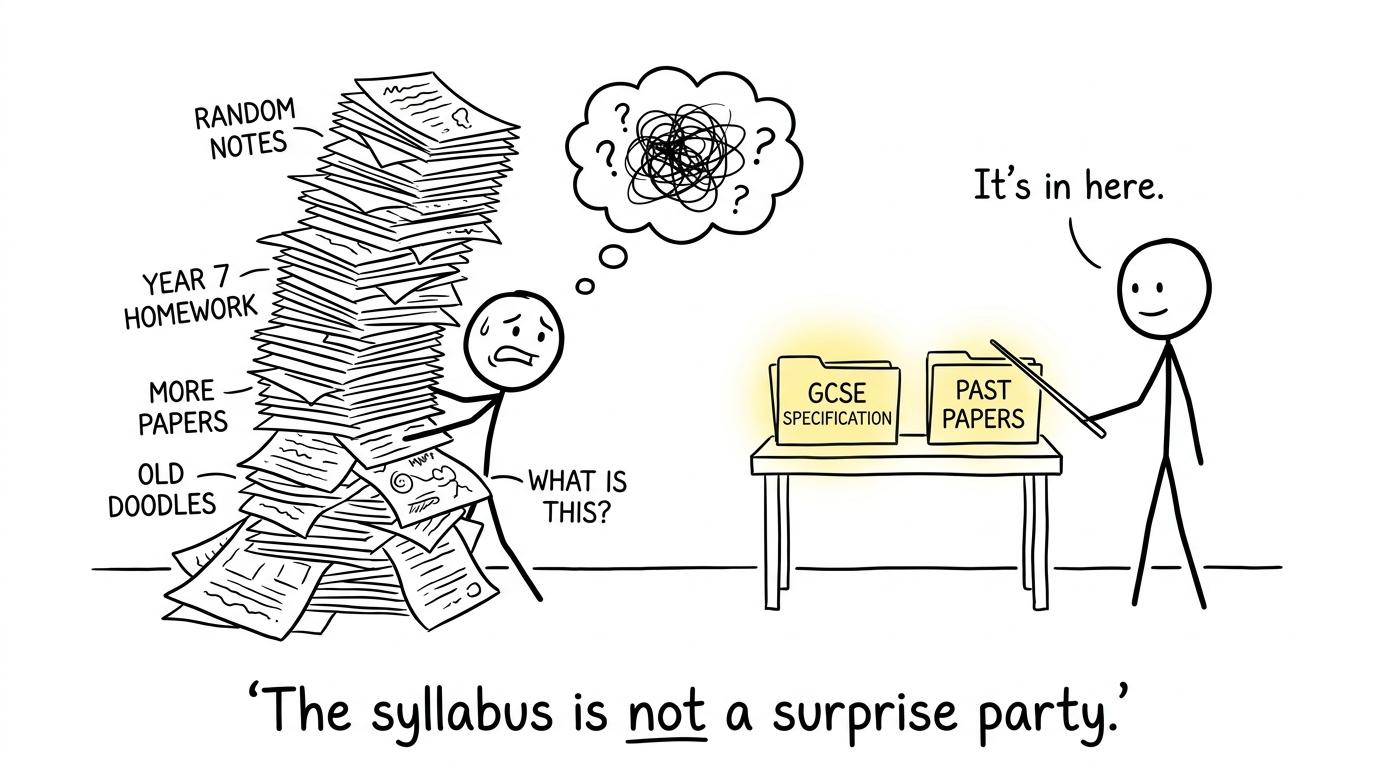 A calm revision plan replacing a pile of random papers
This same principle applies to GCSE Maths. Begin with the GCSE Maths revision lessons, then use GCSE past papers from the board and tier you will actually sit. Topic knowledge is transferable, but question wording and paper familiarity are board-specific.
The maths behind GCSE Engineering
Engineering turns school maths into decisions. A dimension must fit. A drawing must communicate scale. A quantity of material must be estimated. A graph must reveal what happened during a test.
Depending on the qualification, useful mathematical areas can include:
- ratios, proportion and scale
- unit conversion
- percentages and tolerances
- area, surface area and volume
- speed, distance and time
- rearranging formulae
- interpreting tables and graphs
- accuracy, estimation and standard form
For example, relationships such as
speed=distancetime\text{speed}=\frac{\text{distance}}{\text{time}}speed=timedistanceor
density=massvolume\text{density}=\frac{\text{mass}}{\text{volume}}density=volumemassare not isolated facts. They describe how quantities depend on one another. Engineering questions may require you to select a relationship, substitute consistently measured quantities and communicate an answer with an appropriate unit.
MathsGenie’s lessons on ratio, speed, distance and time, area and perimeter, volume and standard form can strengthen these foundations. Each topic is easier to improve when you combine the video lesson with practice questions, a mini test and careful checking against the solutions.
How to revise when assessment structures differ
A good revision plan follows the assessment rather than treating every topic equally.
For the written examination
Practise recalling technical knowledge without notes, interpreting unfamiliar engineering contexts and responding precisely to command words. “State”, “describe”, “explain”, “calculate” and “evaluate” ask for different forms of response.
Use past papers under timed conditions once your topic knowledge is secure. Mark them carefully. A missing unit, unsupported judgement or vague technical phrase can lose a mark even when the general idea is sensible.
MathsGenie predicted papers are designed for GCSE Maths rather than Engineering, but they can help you practise the mathematical fluency and exam discipline that engineering calculations require. They should complement, not replace, official papers for your Engineering qualification.
For non-exam assessment
Start by understanding the task, assessment criteria and rules on teacher assistance. Keep evidence organised as the work develops rather than trying to reconstruct your reasoning at the end.
A strong engineering portfolio usually needs more than an attractive final design. Decisions should connect to the brief, user needs, measurable requirements, manufacturing constraints, testing and evaluation. Follow your board’s current instructions exactly because controlled-assessment rules are qualification-specific.
For mathematical accuracy
Write units throughout your working. Convert quantities before combining them, and check whether an answer is realistic. If a component is drawn at scale 1:n1:n1:n, lengths change by a factor of nnn, but areas change by a factor of n2n^2n2 and volumes by a factor of n3n^3n3.
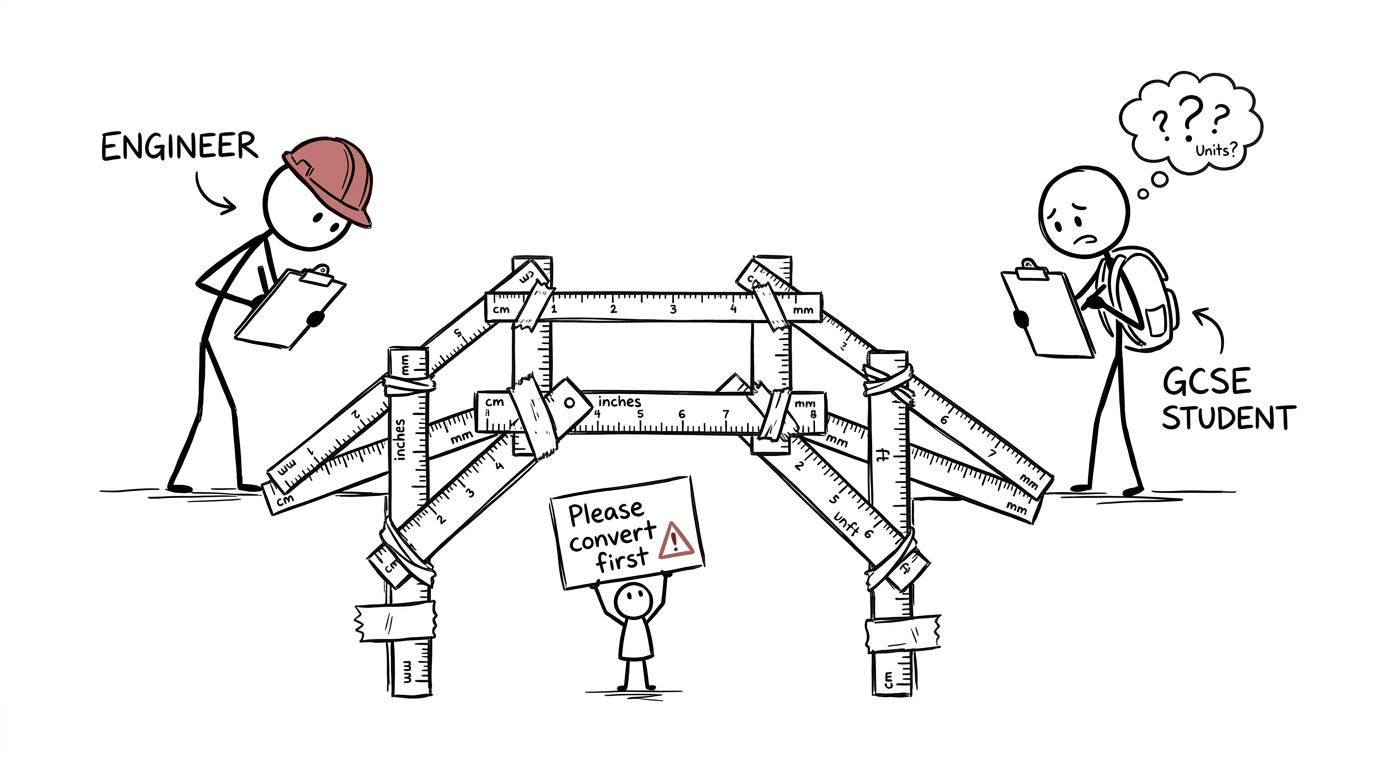 An engineering student receives an urgent reminder about units
Common mistakes when comparing Engineering courses
Assuming every engineering course is a GCSE
Check the qualification title. A GCSE and a vocational Technical Award may have similar subject matter without sharing the same assessment or grading structure.
Choosing resources by subject name alone
A paper labelled “engineering” may belong to another specification or an older course. Confirm the board, qualification code and assessment series before using it.
Treating coursework as guaranteed marks
Non-exam assessment still has strict criteria, deadlines and authentication rules. Practical ability matters, but so do evidence, technical communication and evaluation.
Ignoring maths until the final weeks
Mathematical skills become more reliable through spaced practice. Waiting until the examination makes unit conversions, formulae and proportional reasoning feel less familiar than they need to be.
Comparing raw grade boundaries
A lower boundary does not prove that a board is easier. Boundaries are connected to the demand of a particular assessment and the evidence available during awarding. They can change between series.
Revising every board at once
Another board’s questions can provide extension practice, but begin with your own specification and papers. Relevance beats volume.
The verdict on GCSE engineering exam board differences
The exam board matters because it defines the specification, assessment structure, permitted task conditions and qualification title. It does not matter in the simplistic sense that one familiar logo guarantees an easier grade.
For many students, the decision has already been made by their school. Your advantage comes from knowing exactly what you are taking and preparing for its demands. Confirm the qualification. Read the specification. Use the correct papers. Build practical evidence carefully. Strengthen the maths that supports engineering decisions.
MathsGenie can help with that final part. Use the free revision lessons and practice questions to repair individual weaknesses, then move to mini tests, mark schemes, video solutions, past papers and predicted papers. A focused revision plan does more than make an exam board feel less mysterious; it turns the course into a sequence of skills you can steadily master.