GCSE Eduqas: Night-Before Maths Plan to Avoid Panic
GCSE night-before plan for Eduqas Maths: a calm checklist, quick wins, worked examples and smart past-paper practice to avoid panic and boost marks.
The night before a GCSE Maths exam has a specific kind of noise. Not actual sound: more like a mental buzzing. You try to revise everything, so you revise nothing properly. You open a past paper, see a topic you half-recognise, and suddenly you’re convinced you’ve forgotten all of maths.
This guide is a simple, Eduqas-friendly GCSE night-before plan that avoids panic. It doesn’t pretend you can learn a whole specification overnight. Instead, it helps you convert what you already know into reliable marks, using a calm routine: small bursts of practice, quick method checks, and a clear stopping point.
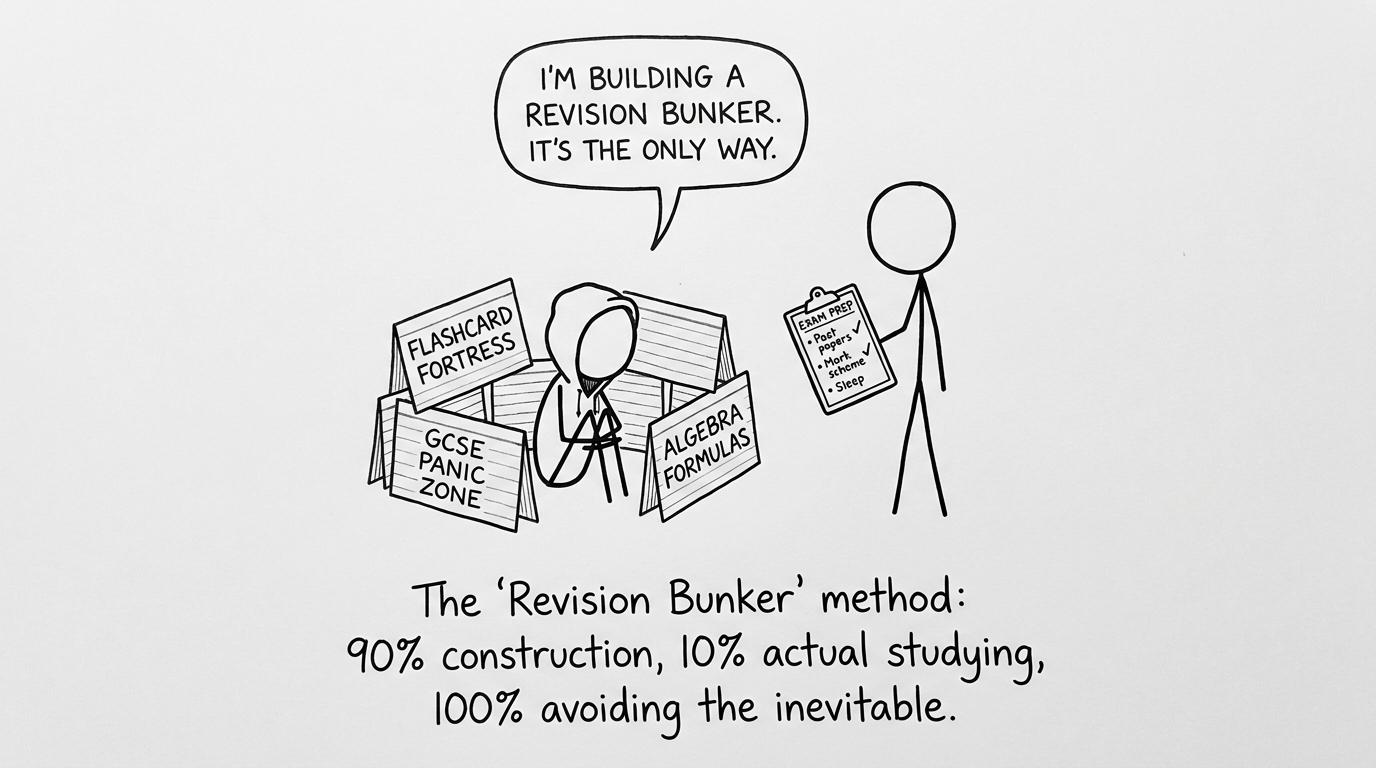 A student building a revision bunker out of flashcards
The night-before GCSE checklist (Eduqas-focused)
Use this as your anchor. When your brain starts bargaining (“maybe I should relearn circle theorems from scratch at 11:47pm”), come back to the list.
- Confirm your GCSE exam board and tier (Eduqas, Foundation or Higher).
- Choose one paper to practise: a recent Eduqas paper or a focused set of questions.
- Do a short, timed attempt (not a full marathon).
- Mark it immediately and write a “tomorrow list” of 5 fixes.
- Rehearse 3 high-frequency methods (examples below).
- Pack equipment and plan your morning.
- Stop revising at a sensible time and protect sleep.
Helpful YesGenie starting points:
Why a night-before GCSE plan works (and cramming doesn’t)
Panic is rarely caused by the exam itself. It’s caused by uncertainty: you don’t know what will come up, you don’t know what you know, and you don’t know what to do next. A plan reduces uncertainty.
For GCSE Maths, the most valuable night-before work is:
- Retrieval: can you bring methods to mind without rereading pages?
- Exam habits: can you show working, keep units, estimate, and spot nonsense?
- Confidence building: can you collect a few “I can definitely do that” wins?
That’s why the plan uses short practice plus immediate feedback. It gives your brain closure: “I have checked this, and I know my next step.”
The 90-minute night-before GCSE schedule (calm and specific)
You can start at 6pm or 9pm; it still works. Adjust the times, not the structure.
Set-up (10 minutes)
- Open YesGenie and choose your resources for Eduqas.
- Get paper, pen, ruler, calculator, protractor/compasses if needed.
- Write one sentence at the top of the page: “Tonight I’m here to secure marks, not to panic.”
If you’re doing Eduqas past papers, use:
- Eduqas Past Papers (YesGenie hosts Eduqas past paper collections across subjects; for Maths, use the Eduqas maths area plus the general past paper hub above.)
Sprint practice (25 minutes)
Do a short timed attempt of exam-style questions (a chunk of a paper, or a targeted booklet). The goal is to feel the exam rhythm.
If you’re not sure where to start, use a revision guide topic list and pick 3 areas you frequently drop marks on.
Mark and write your “tomorrow list” (20 minutes)
Mark your attempt straight away. Don’t just circle wrong answers; write the reason.
Your “tomorrow list” should be 5 bullets, like:
- “When fraction of an amount, I must multiply, not divide.”
- “Probability: check totals add to 111.”
- “Bounds: write the interval first.”
This is powerful because it turns vague anxiety into specific actions.
Rehearse 3 methods (25 minutes)
Choose three methods that show up relentlessly in GCSE papers. Below are three high-return worked examples.
Pack-down and sleep protection (10 minutes)
- Pack equipment.
- Decide your wake-up time.
- Stop revising. Sleep is part of performance.
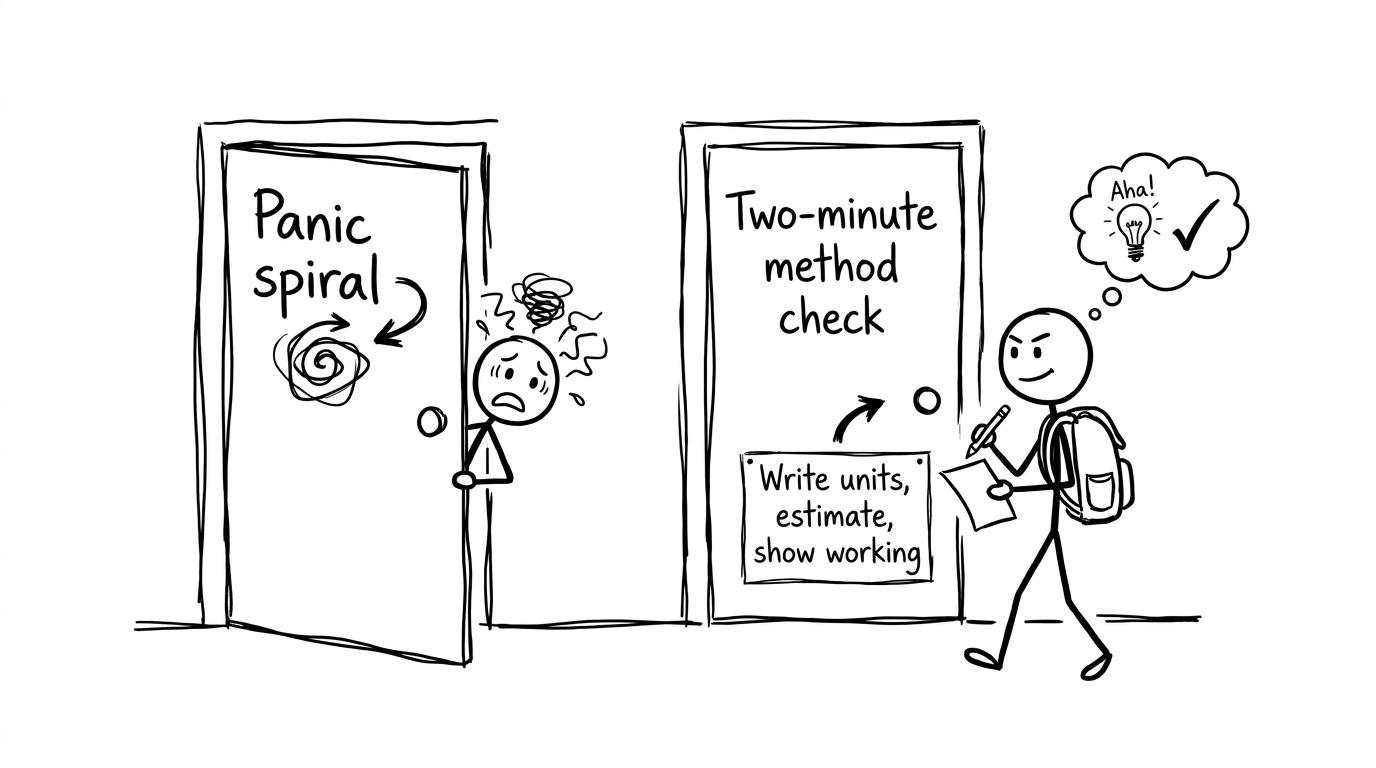 Two doors: panic spiral vs method check
Three worked examples that secure GCSE marks
These aren’t “hard” by design. Night-before revision should prioritise reliable methods you can reproduce under pressure.
Fractions of an amount (core GCSE skill)
Example: Find 35\frac{3}{5}53 of £70.
Method:
35×70 \frac{3}{5} \times 70 53×70First divide by 555:
70÷5=14 70 \div 5 = 14 70÷5=14Then multiply by 333:
14×3=42 14 \times 3 = 42 14×3=42So 35\frac{3}{5}53 of £70 is £42.
Night-before takeaway: when the question says “ab\frac{a}{b}ba of”, you are almost always doing ab×\frac{a}{b} \timesba× the amount. Write it as a multiplication first, then simplify.
Rearranging a formula (often drops easy GCSE marks)
Example: Make xxx the subject of y=3x−7y = 3x - 7y=3x−7.
Add 777 to both sides:
y+7=3x y + 7 = 3x y+7=3xDivide both sides by 333:
x=y+73 x = \frac{y+7}{3} x=3y+7Night-before takeaway: do it like a balance. One operation at a time. If you jump steps, you’re more likely to lose sign accuracy.
Bounds (a common Eduqas-style higher-mark area)
Example: A length is given as 12 cm12\text{ cm}12 cm correct to the nearest cm\text{cm}cm. Write the error interval.
Nearest 1 cm1\text{ cm}1 cm means half a centimetre either side:
- Lower bound: 12−0.5=11.512 - 0.5 = 11.512−0.5=11.5
- Upper bound: 12+0.5=12.512 + 0.5 = 12.512+0.5=12.5
So the interval is:
11.5≤L<12.5 11.5 \le L < 12.5 11.5≤L<12.5Night-before takeaway: write the inequality carefully. The lower bound is included (≤\le≤) and the upper bound is excluded (<<<).
If bounds is a weak spot, do a focused read and practise on:
The “calculator isn’t the plan” reminder
A lot of night-before GCSE stress hides inside a single habit: typing numbers too early. If you don’t understand what the question is asking, the calculator can’t rescue you. It only makes your wrong plan faster.
A better sequence is:
- Write the method (even one line).
- Estimate the answer range.
- Then calculate.
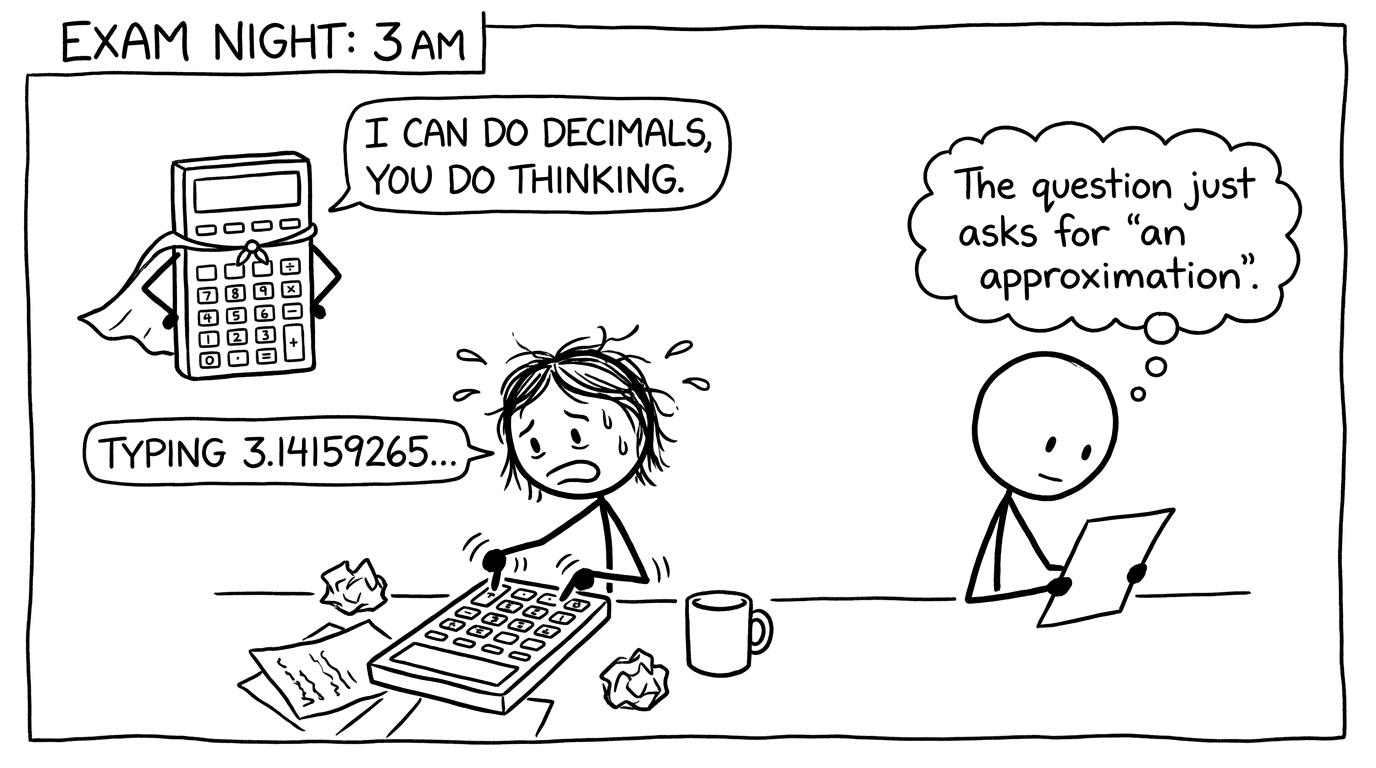 A calculator in a superhero cape
Common mistakes to avoid the night before a GCSE exam
These are the traps that feel productive but often reduce your marks tomorrow.
- Doing huge sessions with no marking. You don’t learn from unanswered questions. Marking is where you see the pattern.
- Rereading notes instead of practising. Notes feel safe because they don’t challenge you. Practice questions force recall.
- Switching topic every 3 minutes. Depth beats breadth the night before. Pick a few methods and make them automatic.
- Ignoring exam language. Words like “estimate”, “exact”, “show that”, “hence” matter in GCSE mark schemes.
- Dropping working. Even if your final answer is wrong, correct method steps can earn method marks.
- Learning brand-new topics at midnight. That’s how panic starts. If you must, do it earlier in the evening and keep it small.
Eduqas GCSE night-before resources on YesGenie
For a calm, structured approach, you want resources that are quick to navigate.
- Use topic notes and videos via Eduqas GCSE Maths Revision Guides
- If you prefer topic lists in lesson form, explore the lesson format (example board page): GCSE Maths Lessons (topic list view)
- For past paper practice across boards: GCSE Past Papers Hub
- For extra practice options: Resources (including predicted papers and mini tests)
If you also support younger siblings or you’re bridging content gaps, you can use board-specific areas as a navigation model, such as:
Even when you’re sitting Eduqas, these sections are useful to understand how YesGenie organises lessons, mini tests, mark schemes, and video solutions for GCSE exam practice.
A calm ending: your GCSE mark total is built from small habits
The night before GCSE Maths isn’t the time to become a new person. It’s the time to behave like the person who gets marks reliably. That means doing a short, honest attempt; marking it; fixing a few repeat errors; and then stopping.
If you want that structure without paying for it, YesGenie is built for exactly this moment: revision lessons that don’t waffle, practice questions that look like the exam, mark schemes that show what the examiner wants, and video solutions when you need to see the method again. Use the Eduqas GCSE Maths Revision Guides for fast topic refreshers, then move to the GCSE Past Papers Hub for exam practice. If you’re building confidence in short bursts, explore Resources for mini tests and predicted papers.
Tonight, make your plan. Tomorrow, collect your marks. Your GCSE is closer than it feels.