GCSE: Turn Edexcel Maths Notes Into Active Recall
GCSE Edexcel maths revision: turn notes into active recall using retrieval practice, worked examples, past papers and mark schemes on YesGenie.
The problem with beautiful notes (and why GCSE maths punishes it)
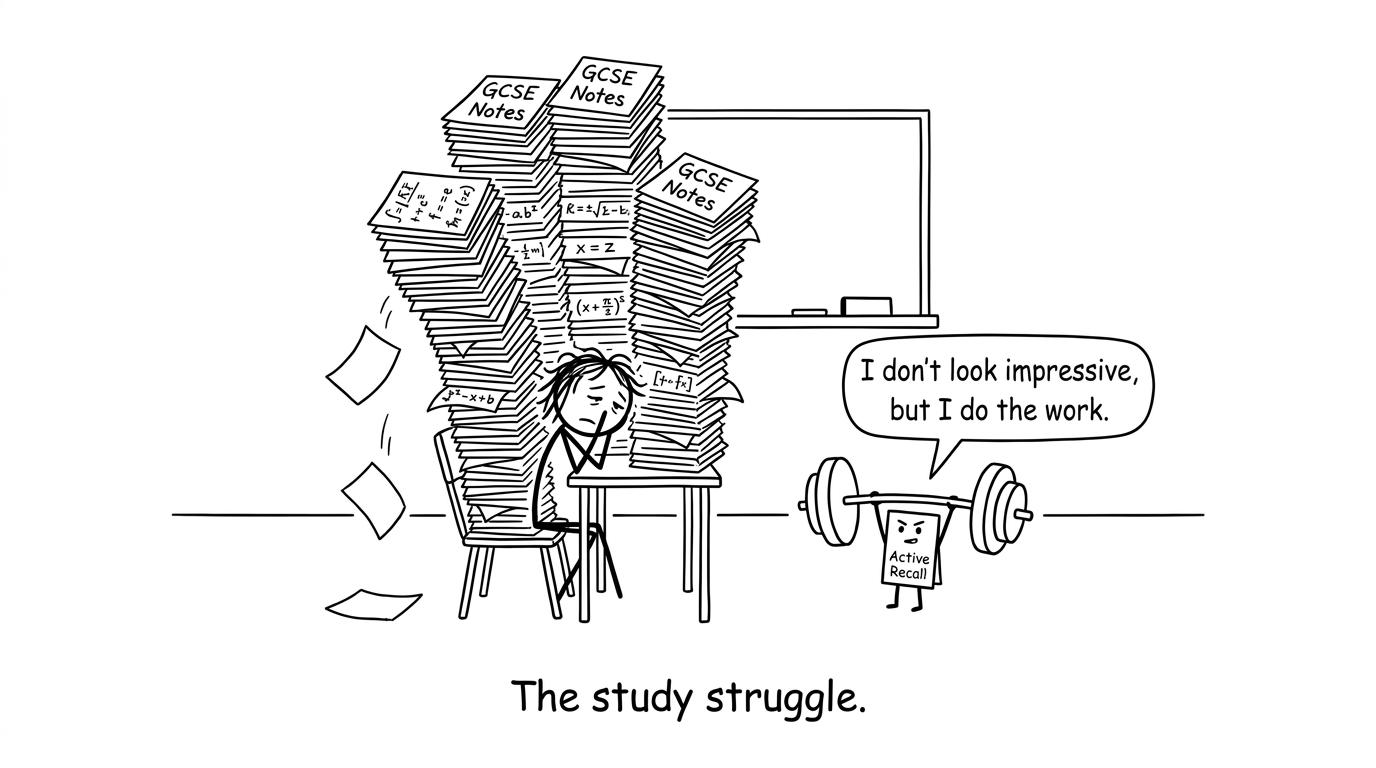
There’s a moment most Edexcel students recognise. You open your notebook and it looks… brilliant. Headings, colours, neat examples, maybe even a page of formulas. Then you try a GCSE exam question and your mind goes oddly quiet. You know you revised. You can see the method on the page. But you can’t do it.
That gap is the difference between recognition and active recall. For GCSE maths, recognition feels safe but it doesn’t score marks. Active recall is the quieter skill: the ability to pull a method out of your head under time pressure, with unfamiliar numbers, and still keep the structure.
 Student vs flashcard active recall
The good news is you don’t need to throw your notes away. You just need to convert them into prompts that force retrieval, then prove the retrieval works using Edexcel-style practice and mark schemes.
A quick checklist: notes to active recall in 20 minutes
Use this as your repeatable routine for any topic on the Edexcel GCSE specification:
- Choose one micro-topic (e.g. “solving linear equations” or “best buy”).
- Close your notes and write the method from memory in 4-6 lines.
- Attempt 3-5 exam-style questions immediately.
- Check with a mark scheme and fix one mistake pattern.
- Schedule the topic again using spaced retrieval (tomorrow, 3 days, a week).
A good place to anchor this is the main Edexcel GCSE Maths Revision page on YesGenie, because it lets you move from lesson to questions to solutions without changing platform.
What “active recall” actually looks like in GCSE maths
Active recall in GCSE maths isn’t memorising paragraphs. It’s remembering decisions.
- Which method fits this question?
- What’s the first line I always write?
- Which calculator buttons or non-calculator tricks apply?
- What does the examiner usually award method marks for?
This is why retrieval practice works: it builds a path from cue to method. Your notes are still useful, but only if they become a set of cues.
On YesGenie, you can support this with:
- Revision guides you can turn into prompts: Edexcel revision guides
- Exam questions that force recall, not comfort: question banks and worksheets inside Edexcel GCSE Maths Revision
- Full exam practice when you’re ready: Edexcel GCSE Maths Past Papers
The “cover, write, compare” method (how to use notes without re-reading)
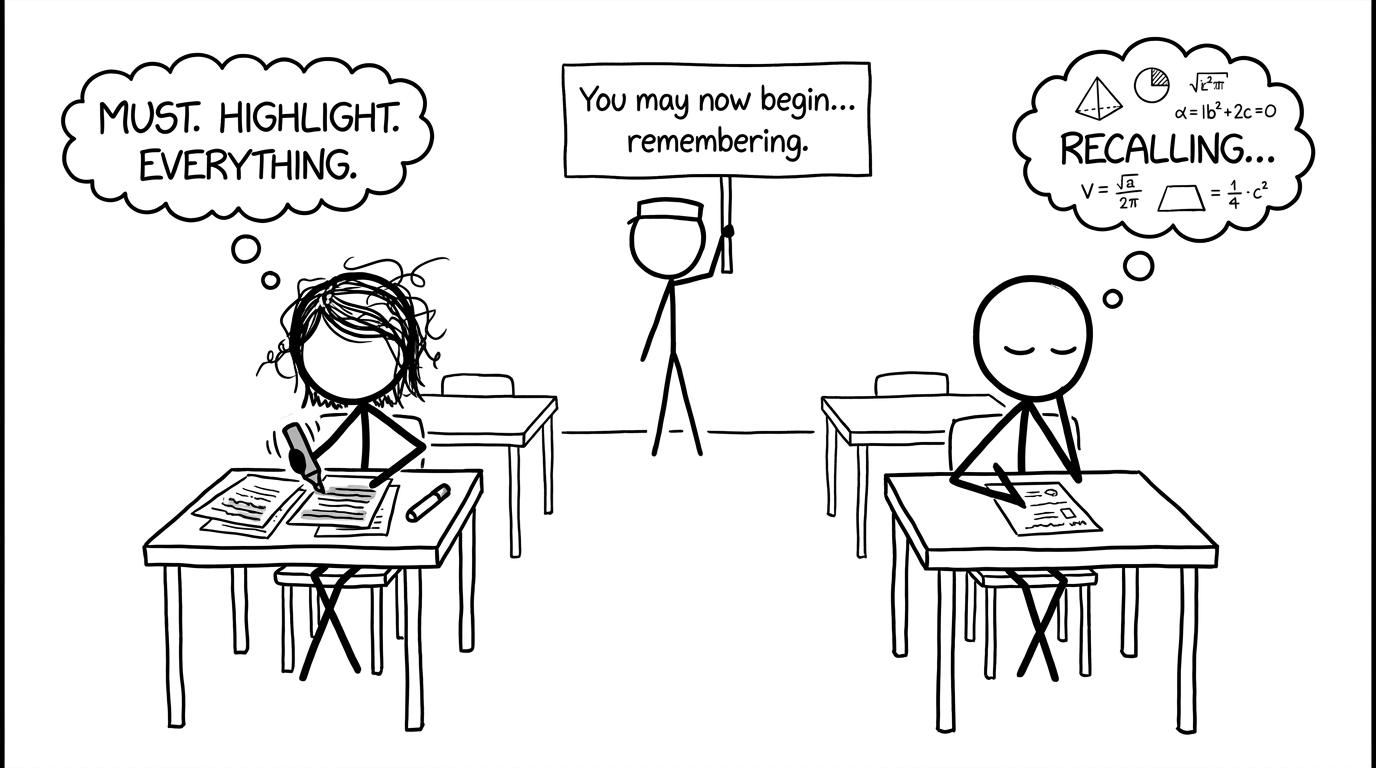
Most students re-read because it’s frictionless. Active recall adds a little friction on purpose.
Step 1: cover
Pick a single example or method from your notes. Cover the working.
Step 2: write
On blank paper, rewrite the method from memory. If it’s a procedure, limit yourself to 5 bullets.
Step 3: compare
Uncover your notes and compare line by line. Circle what you missed, then rewrite only the missing part.
This matters for GCSE because errors often come from a single skipped step (like not multiplying every term, not writing units, or mishandling negatives).
 Exam hall active recall vs highlighting
Worked example: turn “solving equations” notes into active recall
A common Edexcel GCSE pattern is an equation with brackets and fractions. Your notes probably show a clean example. Active recall means you can reconstruct the method when the numbers change.
Your active recall prompt
Without looking, write the steps for solving:
3(2x−5)=4x+7 3(2x-5)=4x+7 3(2x−5)=4x+7Retrieval working (from memory)
Expand the brackets:
6x−15=4x+7 6x-15=4x+7 6x−15=4x+7Collect like terms (subtract 4x4x4x from both sides):
2x−15=7 2x-15=7 2x−15=7Add 151515 to both sides:
2x=22 2x=22 2x=22Divide by 222:
x=11 x=11 x=11How to turn this into an Edexcel mark-winning habit
In Edexcel mark schemes, method marks often come from showing the algebraic transformation clearly. So your active recall cue isn’t “do the maths”: it’s “show the algebra move”. After retrieval, go straight to a small set of questions on the same micro-skill from the Edexcel question bank or worksheets on Edexcel GCSE Maths Revision.
Worked example: turning ratio notes into retrieval cues (Edexcel loves this)
Ratio is one of those GCSE topics where notes feel clear but questions feel slippery. The trick is to recall the structure: parts, total parts, scale factor.
Example
Sam and Tia share £45 in the ratio 3:23:23:2. How much does Sam get?
Total parts: 3+2=53+2=53+2=5.
Sam’s fraction: 35\frac{3}{5}53.
Sam’s share:
35×45=27 \frac{3}{5}\times 45=27 53×45=27So Sam gets £27.
Your active recall flashcard cue
Front: “Ratio share question: what are the three lines I always write?”
Back (what you must retrieve):
- total parts
- fraction for the person
- multiply by total
If ratio is a weak spot, build it from a strong explanation, then drill retrieval. YesGenie’s topic guides across boards are consistent, and you can cross-check your understanding using a clear ratio guide like Writing a Ratio as a Fraction or Linear Function (the skill transfers directly to Edexcel GCSE questions).
From prompts to pressure: using Edexcel papers for true active recall
Notes can only simulate difficulty. Papers create it.
Here’s a reliable ladder for Edexcel GCSE revision:
Start with topic-only retrieval
Use revision guides, then immediately do topic questions. This is where you correct misconceptions quickly.
Use: Edexcel revision guides.
Move to mixed retrieval
Pick a random selection of topics and do short bursts. This matters because Edexcel papers switch context fast.
Use: Resources for mini tests and shorter practice formats.
Finish with full-paper recall
Do full papers under timed conditions, then mark them properly.
Use: Edexcel GCSE Maths Past Papers.
Add predicted papers near the end
Predicted papers are not magic, but they’re a strong way to practise fresh questions under exam conditions once you’ve built baseline coverage.
Use: Edexcel GCSE Maths Predicted Papers.
How to mark for learning (not just for a score)
Active recall gets powerful when you mark like an examiner.
- First pass: tick only what is fully correct.
- Second pass: for each lost mark, write the reason in one line.
- Third pass: convert that reason into a retrieval prompt.
Example reasons that become great prompts:
- “Forgot to square-root at the end” becomes “When solving x2=ax^2=ax2=a, what are the two answers?”
- “Rounded too early” becomes “When do I round in multi-step problems?”
- “Didn’t state units” becomes “Where do Edexcel mark schemes expect units?”
This is where video solutions help: they show not just the answer, but the shape of a method. You can see this style on YesGenie’s paper pages, such as November 2020 Paper 2 - Video Solutions.
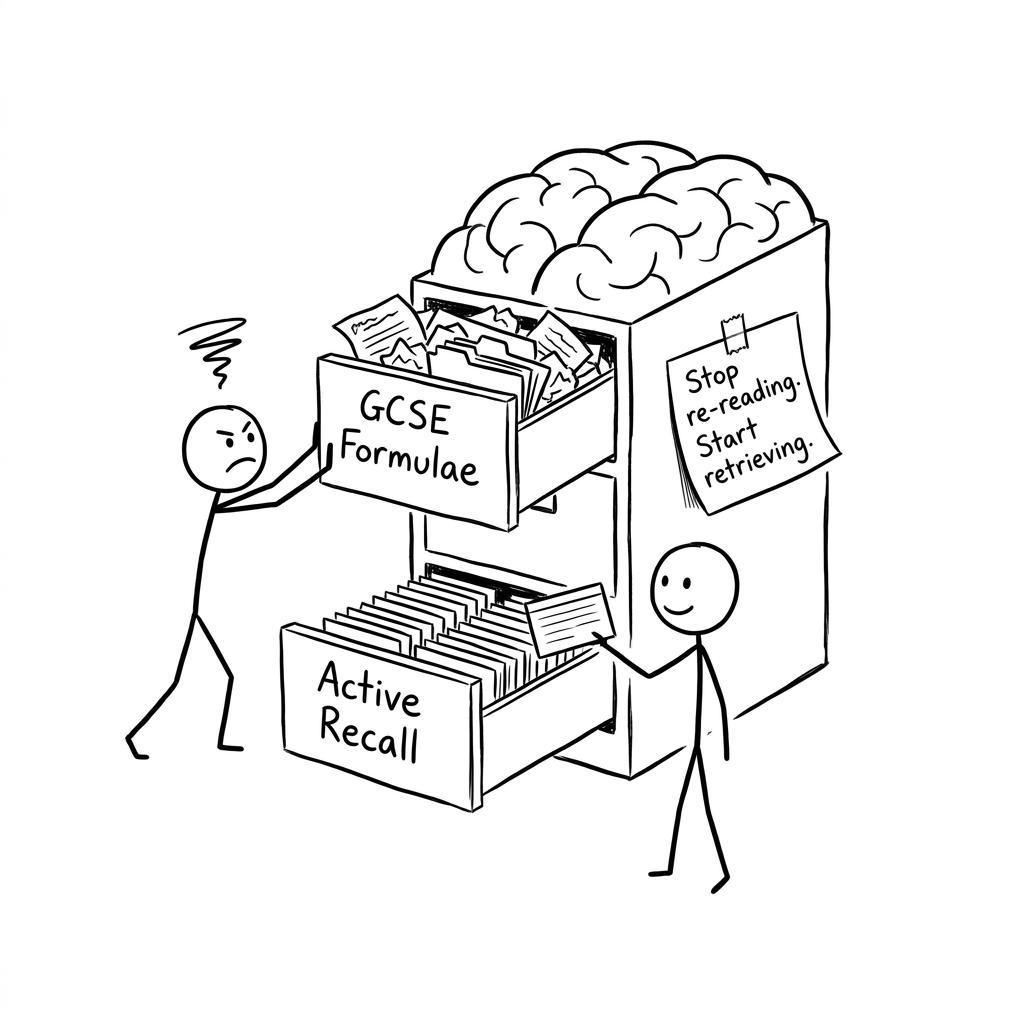 Brain filing cabinet active recall
A simple active recall timetable for Edexcel GCSE (that doesn’t burn you out)
You don’t need heroic hours. You need repetitions spaced over time.
- Day 1: learn + immediate retrieval (20-40 mins)
- Day 2: short retrieval (10-15 mins)
- Day 5: mixed questions (20 mins)
- Day 12: half paper or topic booklet (30-45 mins)
- Day 25: full paper + mark scheme (60-90 mins)
If you keep your retrieval prompts small, you can fit them into busy weeks. YesGenie’s Resources page is useful here because it helps you choose shorter formats when full papers feel too big.
Common mistakes when turning notes into active recall
- Turning notes into longer notes. If your “active recall” revision is rewriting pages, it’s still passive. Prompts must force you to produce an answer.
- Only practising your favourite topics. GCSE grades improve fastest when you target weak areas, because each fixed weakness stops a predictable mark leak.
- Marking without reflection. A score tells you how you did. A one-line error reason tells you what to fix. You need the second.
- Not using Edexcel-style wording. Active recall includes recalling what the question is really asking. Past papers train that translation skill.
- Doing full papers too early. If you can’t retrieve methods for common topics yet, full papers become demoralising. Build from micro-topics to mixed sets to papers.
Bringing it together: make GCSE active recall your default
In the end, the best revision method is the one that still works when you’re tired, under time pressure, and a question looks unfamiliar. That’s why active recall beats perfect notes for GCSE maths, especially for Edexcel papers where method marks reward clear structure and calm decisions.
Use your notes as a starting point, not a finish line. Turn each topic into prompts. Retrieve on blank paper. Then prove it with questions, mark schemes, and full papers.
If you want a simple system that supports the whole cycle, build your routine around YesGenie: start with Edexcel GCSE Maths Revision, strengthen understanding with Edexcel revision guides, and sharpen exam recall using Edexcel GCSE Maths Past Papers and Edexcel GCSE Maths Predicted Papers. Your GCSE notes don’t need to get longer. They need to start asking you questions.