GCSE Economics Command Words: What They Really Mean
GCSE economics command words explained: learn what calculate, explain, analyse and evaluate demand, avoid common errors and write sharper answers under pressure.
A GCSE Economics question can feel familiar right up to the moment one word changes everything. You know the content, recognise the context and understand the data, but should you describe it, explain it or evaluate it?
That is why GCSE economics command words matter. They tell you what intellectual job the examiner wants you to perform. State asks for a direct fact. Explain requires a linked reason. Analyse asks you to develop consequences. Evaluate demands a supported judgement.
Misreading that instruction can leave a knowledgeable answer earning fewer marks than it should. The solution is not to memorise one rigid paragraph structure. It is to recognise the task, use the context and build an answer whose depth matches the available marks.
Your command-word checklist
Before writing, take a few seconds to identify:
- The command word: Are you calculating, describing, explaining, analysing or judging?
- The subject: What exact issue must your answer address?
- The context: Which business, market, household or government policy is named?
- The evidence: Is there a graph, table, extract or numerical result to use?
- The mark tariff: How much depth is realistically expected?
- The endpoint: Does the question require a conclusion or simply an explanation?
Those few seconds are not wasted time. They prevent you from producing the right knowledge in the wrong form.
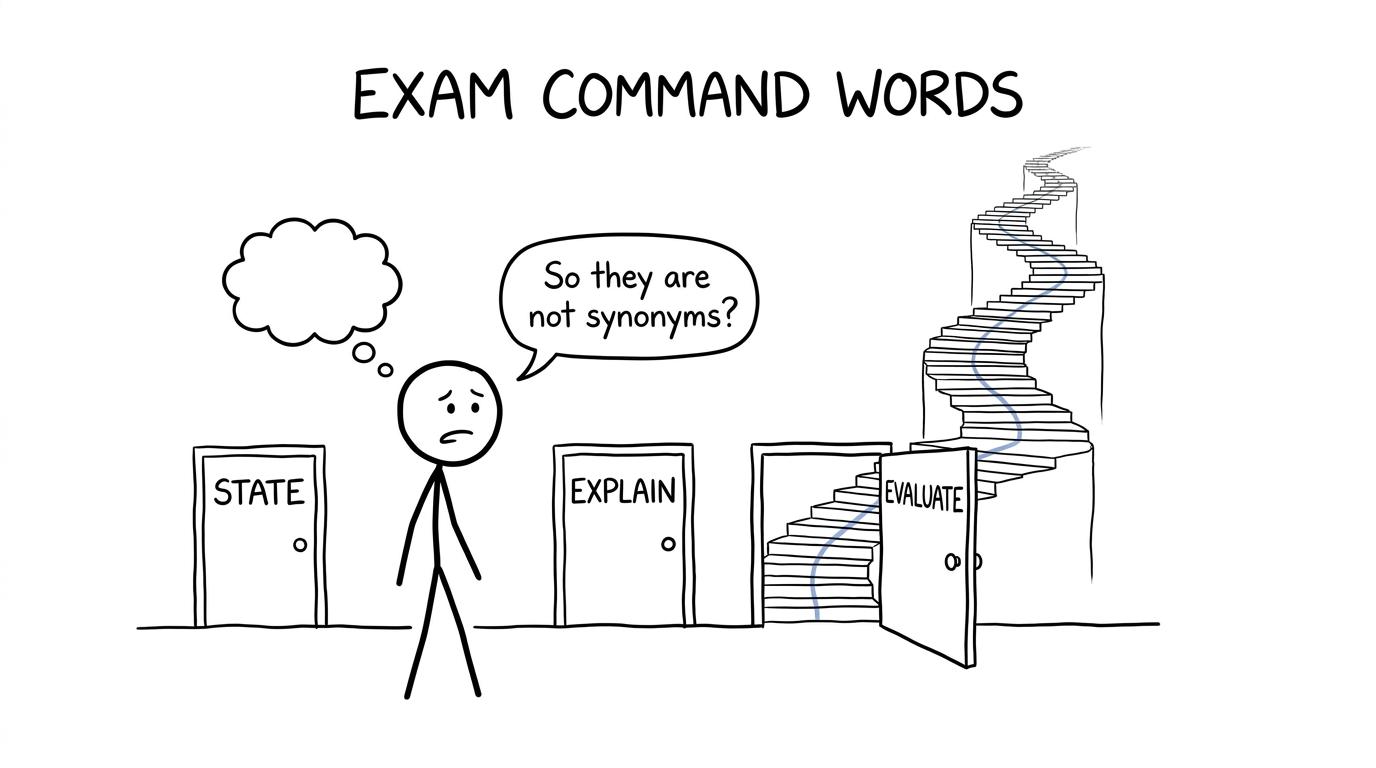 A student discovers that state, explain and evaluate lead to very different tasks
What the main GCSE Economics command words require
Exact definitions and mark tariffs can vary between specifications and individual questions. AQA, OCR and other awarding bodies publish their own specifications, assessment materials and mark schemes, so your board's wording should always take priority. In particular, do not assume that command-word conventions from an Edexcel International GCSE paper are identical to those used in a domestic GCSE qualification.
The following interpretations provide a reliable practical guide.
Identify, name or give
These words normally ask for a brief, precise response. Select the relevant fact, factor, stakeholder or economic term. Unless the question also asks for explanation, a long chain of reasoning is unnecessary.
The danger is over-answering. Students sometimes spend valuable time writing a paragraph when a short statement would complete the task.
State
State asks you to present a fact, feature or conclusion clearly. It does not usually require you to explain why it is true.
If the answer comes from supplied data, quote the relevant information accurately and include appropriate units. Avoid surrounding a direct answer with uncertain language such as “perhaps” or “it could be”.
Define
A definition should give the precise economic meaning of a term. It should distinguish that term from similar ideas rather than merely placing it in a sentence.
Good definitions identify the essential characteristics. Adding every fact you remember can make the meaning less clear, not more secure.
Describe
Describe asks what something is like or what is happening. You might need to report a pattern, direction, feature or change shown by a graph or table.
For quantitative evidence, use values and units where they support the description. If a trend rises overall but includes a fall during one period, acknowledge both. Description reports the pattern; it does not automatically explain its cause.
Calculate
Calculate requires a numerical result obtained from the information provided. Show enough working for the examiner to follow your method, especially where method marks may be available. Give suitable units and check whether rounding is required.
Economics questions may draw on the same numerical confidence developed through GCSE percentages revision, percentage change practice and ratio revision.
For example, the general percentage-change relationship is:
Percentage change=new value−original valueoriginal value×100\text{Percentage change}=\frac{\text{new value}-\text{original value}}{\text{original value}}\times 100Percentage change=original valuenew value−original value×100This is a formula, not a complete answer strategy. You must still select the correct values, retain the sign where it matters and interpret the result in the economic context.
Compare
Compare asks you to identify relevant similarities, differences or both. Make the relationship explicit with language such as “higher than”, “whereas” or “by contrast”.
Two separate descriptions do not necessarily form a comparison. When data are provided, use them selectively to establish the size or direction of the difference.
Explain
Explain means show how or why something happens. Begin with a relevant economic point, then connect it to an effect through a logical chain.
A useful mental pattern is:
cause →\rightarrow→ mechanism →\rightarrow→ consequence
Words such as “because”, “this means” and “therefore” can help, but they do not earn marks by themselves. The economics between them must be accurate. An explanation of a price change, for instance, should make clear why the stated factor affects demand, supply, incentives or behaviour.
Analyse
Analyse requires developed reasoning. Break the issue into relevant relationships and trace the likely consequences. Application matters: the answer should respond to the market, firm, household or policy in the question rather than reproduce a generic paragraph.
Analysis often extends beyond the immediate effect. It might consider how one change affects costs, prices, demand, revenue, employment or living standards, provided each link is economically justified.
Do not mistake length for analysis. One coherent chain is worth more than several disconnected assertions.
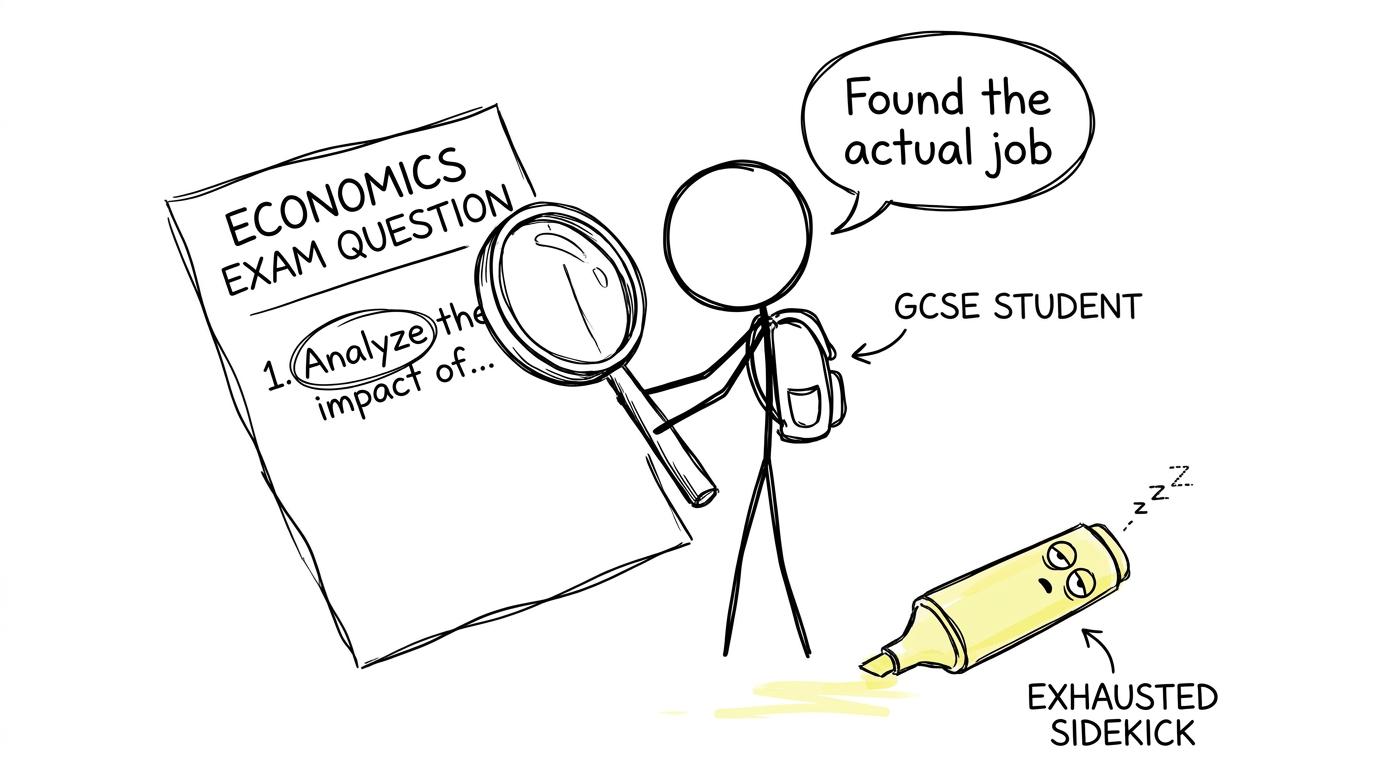 A student finds the command word hiding inside an exam question
Discuss
Discuss usually invites examination of more than one relevant argument or perspective. Develop the case rather than listing advantages and disadvantages.
The exact demand depends on the tariff and board wording. In a longer question, you may need to consider competing effects, affected groups, short-run and long-run consequences, or conditions that make one outcome more likely. A reasoned overall view may also be appropriate.
Assess or evaluate
These command words ask you to judge. Evaluation is not achieved by attaching “however” to a second paragraph. You need criteria, developed reasoning and a conclusion supported by the analysis.
Useful evaluative questions include:
- How significant is the effect?
- Which stakeholder gains or loses?
- Does the outcome depend on the time period?
- What assumptions are being made?
- Is another factor more influential?
- Does the evidence support the proposed judgement?
A strong conclusion answers the precise question. It explains which argument carries greater weight and why, often identifying the condition on which the judgement depends.
Justify
Justify asks you to support a choice, decision or conclusion with relevant reasoning. Do not simply restate the option selected. Show why it is preferable according to an appropriate economic objective or evidence from the question.
To what extent
This phrase requires a judgement about degree. The answer is rarely just “yes” or “no”. Consider how far the claim is valid, what limits it and under which circumstances it becomes more or less convincing.
Your conclusion should express a clear position. A balanced answer does not mean refusing to decide.
Match the answer to the marks and assessment demand
Command words work alongside the mark tariff. A low-tariff explanation is unlikely to need several pages, while a high-tariff evaluation cannot normally be completed with one unsupported sentence.
Avoid mechanical rules such as writing one paragraph for every two marks. Different papers use different levels-based and point-based approaches. Instead, ask what evidence the examiner needs to see:
- accurate knowledge;
- application to the given context;
- connected economic reasoning;
- and, where requested, a supported judgement.
Past mark schemes are especially useful because they reveal the difference between merely mentioning an idea and developing it. The lesson also transfers to maths: reading the instruction precisely is essential when a question says calculate, estimate, show, prove or interpret. MathsGenie's GCSE revision lessons and practice questions help make that habit automatic.
Handling numerical and graphical evidence
Economics questions often combine written reasoning with quantitative evidence. Treat the calculation as part of the argument, not as an isolated box of arithmetic.
Check:
- whether the question asks for a value or a percentage change;
- whether a negative sign has economic meaning;
- whether the unit is pounds, people, tonnes, an index or a percentage;
- whether the graph uses an unusual scale;
- and whether your written interpretation matches your result.
If you need to strengthen these skills, use MathsGenie's lessons on averages and real-life graphs. The content is mathematical, but the habits, checking scales, selecting evidence and interpreting values, are directly useful when economics presents information numerically.
A practical method under exam pressure
When you first read a question, pause before chasing the topic words. Find the command word and quietly translate it into an action:
- State: give the fact.
- Describe: report the relevant pattern or feature.
- Calculate: show a valid method and result.
- Explain: make the causal link clear.
- Analyse: develop the chain in context.
- Evaluate: weigh the analysis and decide.
Then underline any restriction. A question might ask about consumers rather than firms, one policy rather than the whole economy, or evidence from a named extract. Answering the broader topic is not the same as answering the question.
Finally, reread your opening and final sentences. The opening should begin the requested task immediately. If judgement is required, the ending should make that judgement unmistakable.
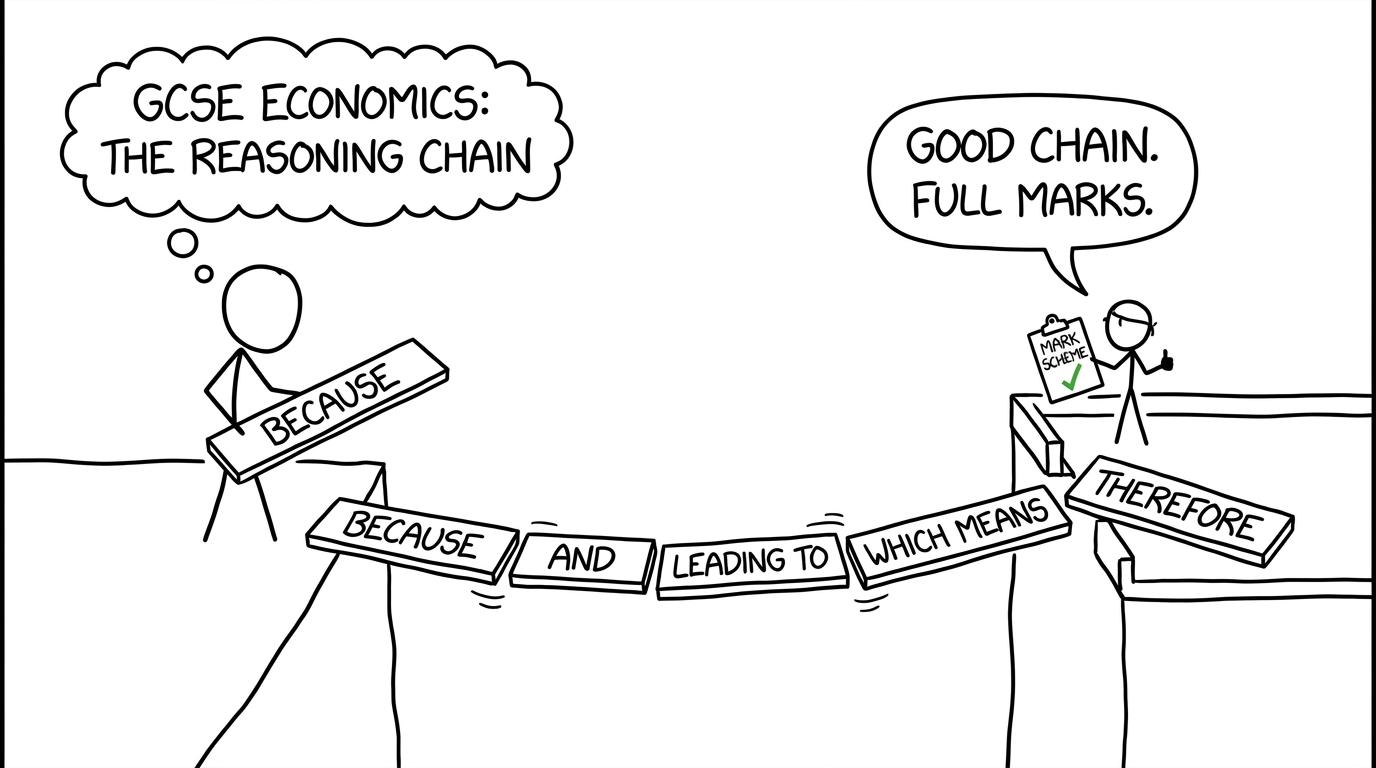 A bridge made from because and therefore carries reasoning towards the mark scheme
Common mistakes with command words
Explaining when asked to describe
This often wastes time and can hide the required pattern. Describe what the evidence shows first. Only give causes if the question asks for them.
Giving a list instead of a chain
Several brief factors may demonstrate knowledge but not developed analysis. Connect each chosen factor to a relevant consequence.
Writing a generic answer
If the question provides a business, market or data extract, use it. Repeating the business's name is not enough; explain why its circumstances affect the outcome.
Treating evaluation as two opposing lists
Advantages followed by disadvantages do not automatically produce evaluation. Weigh their importance, consider conditions and make a supported decision.
Hiding the calculation
A bare answer can lose access to method marks when the final value is wrong. Show the important stages, retain sensible accuracy and include units.
Ignoring the exact object of the question
Students sometimes evaluate whether a policy is good for “the economy” when the question asks about workers, consumers or one firm. Keep returning to the named focus.
Using a memorised structure too rigidly
Paragraph frameworks can organise thoughts, but they cannot decide what the question means. Let the command word, context and tariff shape the response.
Turn command words into a revision habit
The most useful revision is not simply reading definitions. Take questions from your own board, cover the mark scheme and identify the task before planning an answer. Afterwards, compare your response with the published criteria and note where reasoning stopped too early.
For the quantitative side of your preparation, build the same routine with GCSE maths past papers. Use revision lessons to repair weak topics, mini tests and practice questions to check them, then complete papers under timed conditions. Near the examination period, MathsGenie predicted papers can provide further practice alongside official past papers, never as a claim about what will definitely appear.
Command words are small, but their effect is large. They convert knowledge into a specific performance. Once you learn to see the instruction before the topic, questions become less mysterious: calculate accurately, explain the mechanism, analyse the consequences and judge when judgement is required.
Start with MathsGenie's free GCSE revision resources, use the revision planner to organise practice, and combine topic lessons, video solutions, mark schemes, past papers and predicted papers into a routine you can repeat. The aim is not to write more. It is to make every sentence do the job the question actually set.