

GCSE Drama Last Minute Revision Plan: 3 Calm Days
GCSE drama last minute revision plan: use three calm days to prioritise your set text, live theatre, exam technique and recall without panic.
The exam is three days away. Your notes are scattered, the set text suddenly feels unfamiliar, and every production detail appears to have left your memory at once.
A GCSE drama last minute revision plan cannot recreate months of preparation. It can do something more useful: help you identify what matters, retrieve what you already know and enter the exam with a workable method. Over the next three days, focus on your exam board's requirements, your set text, live theatre and timed planning. Do not attempt to revise everything equally.
Panic asks you to move faster. A plan asks you to choose better.
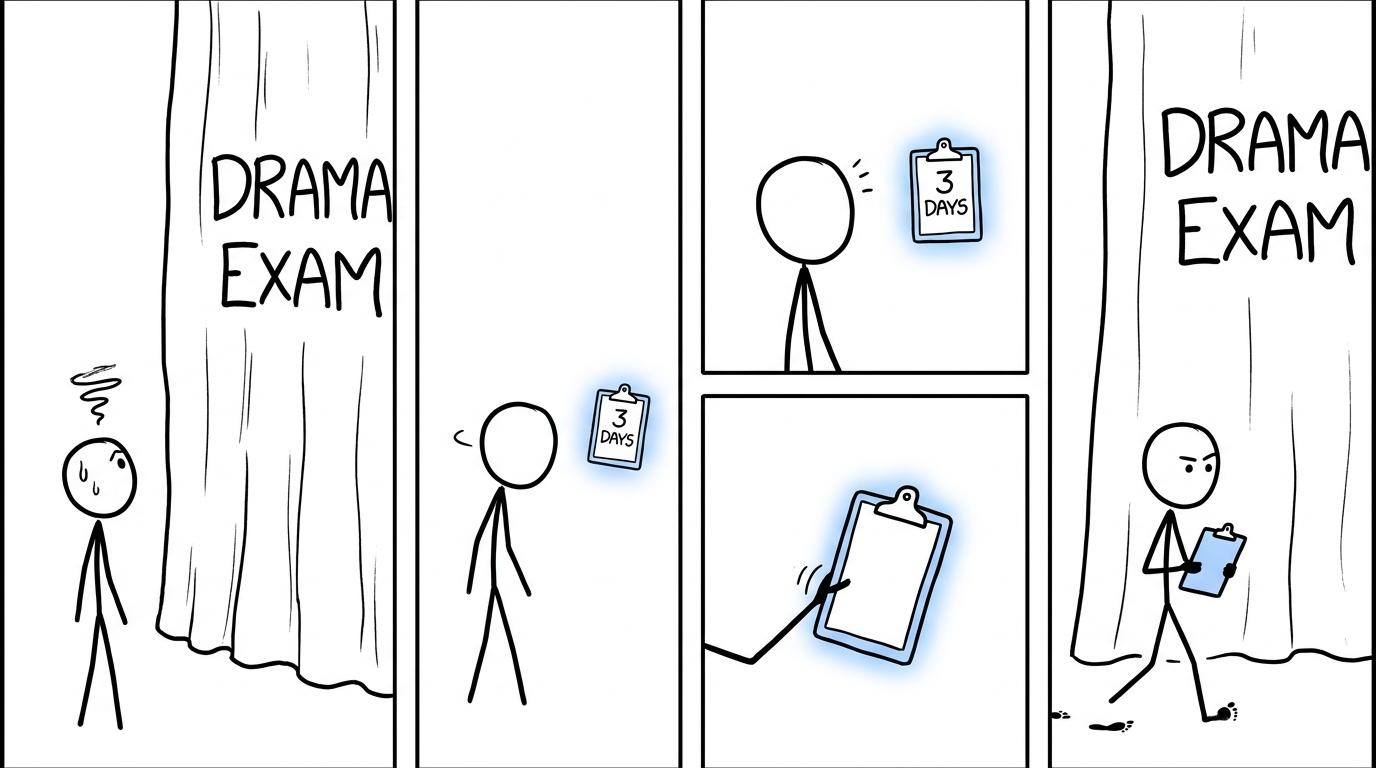 A worried student turning an enormous drama exam into three manageable days
Your three-day revision checklist
Before starting, find your exam-board guidance, class materials and any feedback from your teacher. GCSE Drama specifications differ between AQA, Edexcel, OCR and Eduqas, including their question structures, prescribed texts and assessment arrangements. Your own specification and teacher's instructions must therefore take priority over generic advice.
Your plan is simple:
- Day one: establish what the examination requires and rebuild your essential knowledge.
- Day two: practise retrieving and applying that knowledge to questions.
- Day three: sharpen exam technique, complete light recall and protect your sleep.
- Every day: keep other subjects moving with one short, deliberate revision block.
Use focused sessions with proper breaks. At the end of each session, close your materials and write down what you can remember. Reading can make a page feel familiar; retrieval shows whether you could actually use it in an examination.
Day one: replace uncertainty with a map
The first day is not about producing beautiful notes. It is about removing ambiguity.
Confirm exactly what you need to revise
Write a one-page examination map using information supplied by your school or exam board. Record:
- the duration of the written examination;
- the sections and question types you will face;
- your prescribed or set text;
- whether you need to discuss a live theatre production;
- which roles or perspectives may be assessed;
- the materials you are permitted to take into the examination.
Do not assume that a friend's revision video matches your specification. Even when exam boards assess similar dramatic understanding, the wording, mark allocation and permitted materials can differ. If anything is unclear, ask your drama teacher rather than guessing.
Build a set-text survival sheet
Reduce your set text to information you could genuinely use in an answer. Include:
- the plot and turning points;
- central characters and relationships;
- themes, context and the playwright's intentions;
- a small selection of accurate quotations or precise textual references;
- acting choices such as voice, movement, gesture, facial expression and interaction;
- design possibilities involving set, costume, lighting and sound;
- intended effects on the audience.
The strongest revision notes connect these elements. A design choice is not valuable merely because it sounds imaginative. You need to explain how it communicates meaning and affects an audience.
For each major moment, ask four questions: What happens? What would the performer or designer do? Why is that choice appropriate? What should the audience understand or feel?
Reconstruct your live theatre evidence
Use your original notes, programme, teacher resources and legitimate recordings or production materials available through your school. Create an evidence bank containing several precise moments from the production.
For each moment, record who was involved, what happened on stage, the performance or design choice you observed, and its effect. Specific detail is more persuasive than general praise. Statements such as “the acting was effective” give you little to analyse; a remembered change in pace, posture, spacing, lighting or sound gives you something concrete.
Finish day one by testing yourself without notes. Anything you cannot recall becomes tomorrow's priority.
Keep maths alive without splitting your attention
Drama may be urgent, but it is rarely your only examination. The danger is allowing one approaching paper to consume all available time.
Set aside one contained maths session rather than repeatedly switching between subjects. Choose a weak topic from the GCSE Maths revision lessons, attempt a few questions and check the solutions. If you need a quick diagnosis rather than a full lesson, use the GCSE target tests.
This is not the moment for an entire maths paper unless one is already scheduled. The aim is maintenance: keep familiar methods retrievable while Drama receives the larger share of attention.
Day two: turn knowledge into usable answers
Day one organised the material. Day two is where revision becomes examination preparation.
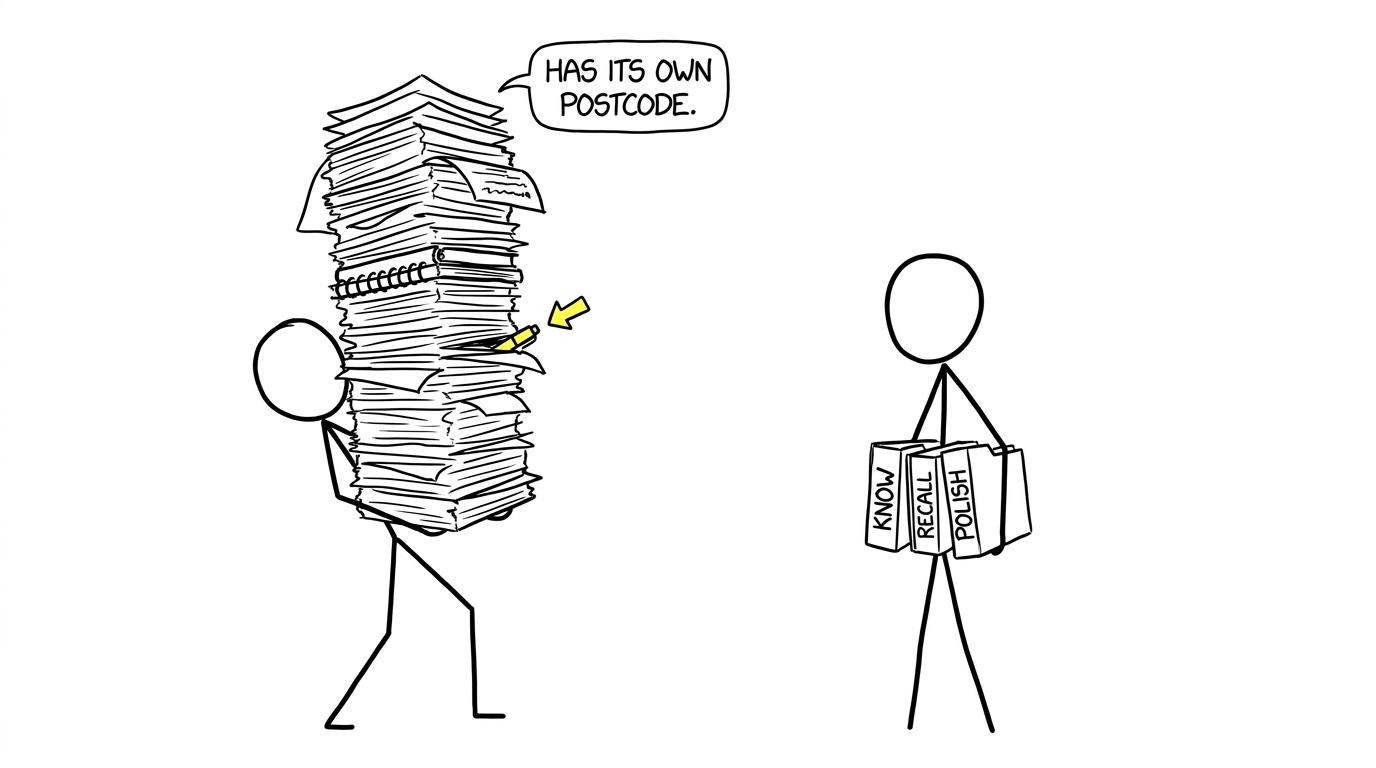 One student carrying endless notes while another uses three purposeful folders
Revise by question, not by chapter
Select questions that reflect your own exam board's current format. Before writing, identify the command word and the evidence needed.
A question asking you to describe requires accurate detail. Explain requires reasons and effects. Analyse asks you to explore how choices create meaning. Evaluate requires a supported judgement, not merely a list of strengths and weaknesses.
For each question, make a brief plan containing:
- the exact focus of the question;
- two or three relevant moments;
- precise dramatic evidence;
- the meaning or intention behind each choice;
- the audience response;
- an overall judgement where required.
Then write selected responses under timed conditions. You do not need to complete every possible essay. It is better to plan several questions and write one or two carefully than to rush through pages without reviewing them.
Use the evidence chain
A reliable Drama paragraph usually moves through a chain:
choice, precise detail, reason, audience effect, link to the question.
That structure prevents two common problems: retelling the plot and listing theatrical vocabulary without analysis. Technical terminology helps only when it identifies what happens clearly. Accuracy is more important than decoration.
After each response, compare it with your teacher's feedback, assessment criteria or an official mark scheme supplied for your course. Highlight where you gave specific evidence and where you merely asserted an effect.
Practise active recall between writing sessions
Put your notes away and retrieve:
- key moments from the set text;
- quotations or textual references;
- acting and design terminology;
- live theatre details;
- possible audience effects;
- the playwright's or production's intentions.
Say answers aloud, use flashcards or create a blank-page memory dump. Then check omissions immediately. This is less comfortable than rereading, which is precisely why it reveals more.
For your short maths block, select questions from the GCSE Maths practice resources. Keep the task narrow: one topic, careful marking and a note of any error to revisit after the Drama examination.
Day three: polish, do not rebuild
The final day should feel quieter. Trying to relearn the whole course now usually creates noise rather than confidence.
Complete a controlled final rehearsal
In the morning or early afternoon, choose one of these tasks:
- plan a full paper using realistic timings;
- complete one demanding extended response;
- practise several shorter questions;
- retrieve your entire evidence bank from memory.
Use the format appropriate to your exam board. Mark or review the work while you still have enough time to correct a weakness. If timing is a problem, decide in advance how you will divide the examination and when you will move on.
Then create a final one-page prompt sheet. It might contain essential quotations, production moments, dramatic terminology, character intentions and reminders about audience effect. This sheet is for final retrieval practice, not for squeezing in every detail from the course.
Prepare the practical details
Check the examination time, location and permitted equipment. Pack what your school has instructed you to bring. Set an alarm and arrange your journey.
These actions appear trivial until uncertainty steals attention on the morning of the exam. Calm often comes from making small decisions in advance.
Stop at a sensible time
Late-night cramming can leave you tired when you need concentration and controlled writing. Finish intensive revision early enough to wind down, and aim for your normal sleep routine.
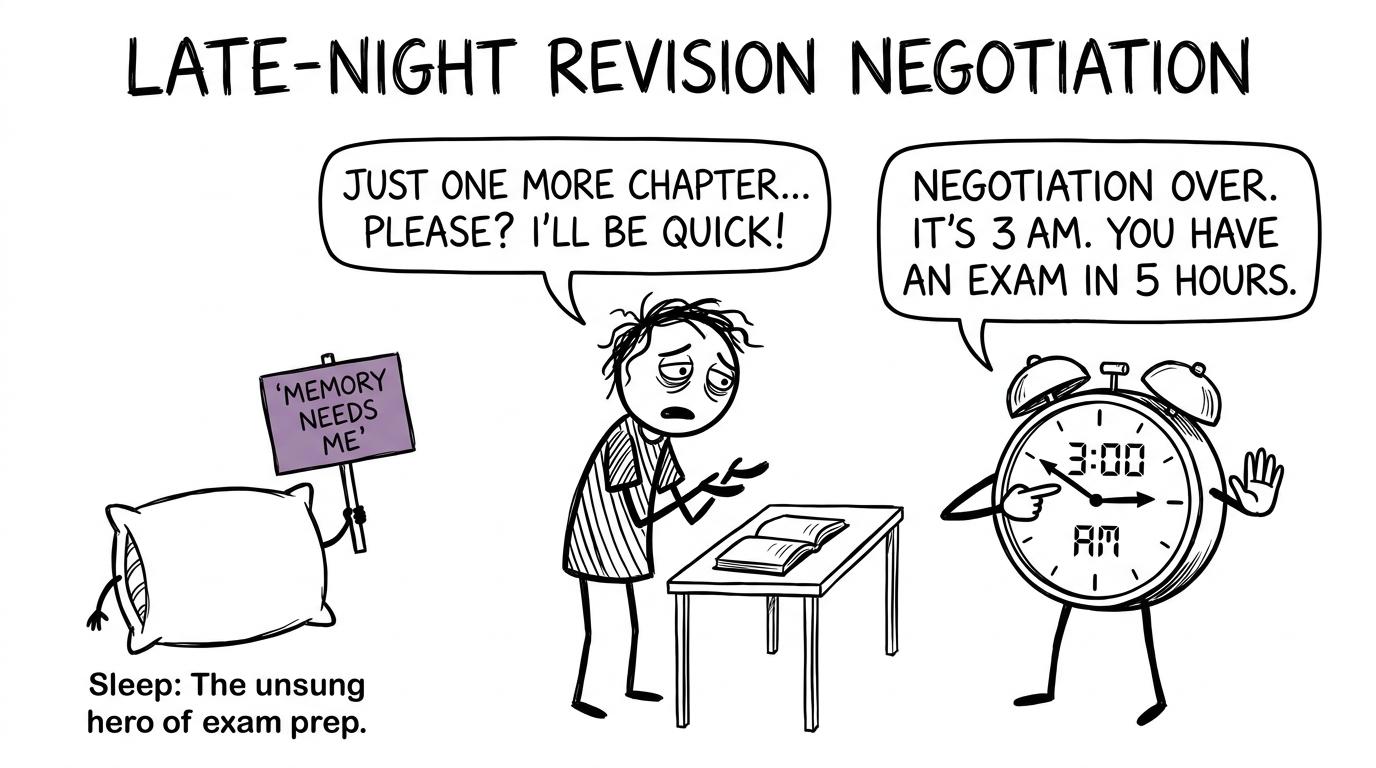 An alarm clock debating with a pillow that represents memory
If maths is also approaching, bookmark the appropriate GCSE Maths past papers rather than starting one late at night. You can return to them with a clear head. MathsGenie's predicted papers can also support focused preparation, but they should complement specification content and past papers rather than replace them.
What to do on the examination morning
Use the morning for recall, not discovery. Review your one-page sheet, mentally rehearse several useful moments and then put it away.
Once the paper begins:
- read the instructions carefully;
- underline the focus and command word;
- plan extended responses briefly;
- use precise performance, design or production evidence;
- explain intention and audience effect;
- keep an eye on time;
- leave space and return later if one idea will not come.
If panic rises, pause and breathe slowly. Begin with information you know for certain: the character, moment, choice or effect. Writing one accurate sentence gives the next sentence somewhere to begin.
Common last-minute Drama revision mistakes
Treating every topic as equally urgent
Your time is limited. Prioritise material that appears in your examination, weaknesses identified by your teacher and evidence you can adapt to several questions.
Rereading without retrieval
Familiar-looking notes can create false confidence. Close the book and reproduce the ideas before checking them.
Retelling the plot
Plot establishes context, but marks usually depend on addressing the question through dramatic choices, analysis and evidence. Keep narrative summary brief.
Inventing live theatre details
Use moments you genuinely remember and can describe precisely. Do not fabricate quotations, staging choices or audience reactions. If your memory is incomplete, return to authorised class resources.
Naming techniques without explaining them
Terms such as pace, proxemics, levels or lighting state are starting points. Explain what the choice communicates and why it matters at that moment.
Sacrificing sleep for one more revision session
A tired extra hour is not automatically a productive hour. Protect the concentration you will need to read, plan and write.
Three days can still be useful
Last-minute revision works best when it stops pretending time is unlimited. You cannot cover everything, but you can establish the paper's demands, strengthen adaptable evidence, practise applying it and arrive rested enough to think.
Follow the plan one session at a time. After the Drama paper, return to MathsGenie for free GCSE Maths revision lessons, practice questions, video solutions, past papers, predicted papers and mark schemes. Drama needs calm decisions now. Your wider revision needs the same thing next: a clear target, honest practice and another manageable step.











