

GCSE Dance Year 10 Revision Head Start: Worth It?
GCSE dance Year 10 revision head start: discover when early revision helps, how to prevent burnout and protect time for GCSE maths and other subjects.
Revision has a strange habit of feeling both too early and too late. In Year 10, GCSE Dance may already involve practical rehearsals, choreography notes and unfamiliar terminology, while maths keeps adding topics that will matter in the final exams. It is natural to wonder whether a GCSE dance Year 10 revision head start is sensible preparation or simply an early route to burnout.
The short answer is that starting in Year 10 usually helps, provided that “revision” means short, purposeful review rather than following a Year 11 timetable twelve months early. Your goal is not to reach peak exam intensity now. It is to build knowledge, preserve evidence from practical work and prevent Year 11 from becoming a rescue mission.
The Year 10 head-start checklist
Early Dance revision is likely to be worthwhile when it includes:
- brief weekly or fortnightly review rather than long daily sessions;
- active recall of terminology, anthology knowledge and performance skills;
- organised notes about choreography and practical decisions;
- regular attention to teacher feedback;
- enough flexibility for maths, English, science and other subjects;
- rest, hobbies and rehearsal recovery;
- a clear point at which you stop working.
If your plan is already affecting sleep, enjoyment or concentration, it is too intense. Starting earlier should reduce pressure, not move it forwards.
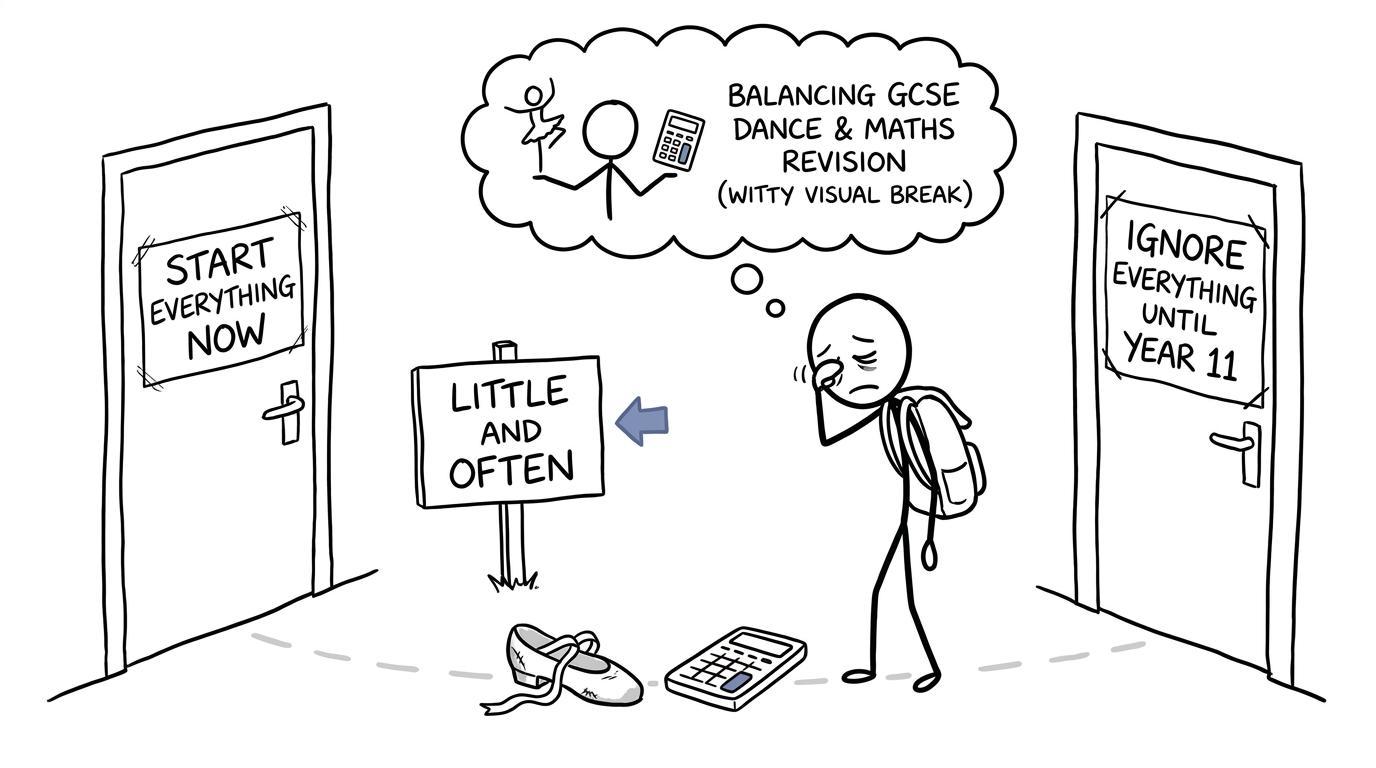 A student choosing the sensible middle path of little-and-often revision
Why starting GCSE Dance revision in Year 10 can help
GCSE Dance is not a subject that can be compressed neatly into a few evenings before an exam. Practical ability develops through rehearsal, while analytical writing depends on knowledge that must be recalled and applied accurately.
For students taking AQA GCSE Dance, the qualification currently combines performance and choreography with a written Dance Appreciation assessment. The practical component carries more of the qualification overall, but the written paper remains substantial. Students should always follow their school’s current specification and assessment plan because course delivery and deadlines vary.
A sensible Year 10 head start helps in several distinct ways.
It gives practical feedback time to work
Feedback is most valuable when there is another rehearsal in which to use it. If a teacher comments on timing, projection, spatial awareness or technical control, recording that advice creates a useful trail. You can then identify whether the same issue keeps returning.
This is different from simply writing “practise more”. Effective notes are specific: what needs to improve, where it happens and what action you will take next. That turns feedback into a rehearsal decision.
It protects details that are easy to forget
Choreographic intentions and rehearsal decisions often make sense when they are fresh. Several months later, the reasoning can become blurred. Keeping concise notes about motif development, structure, relationships, dynamics and use of space gives you accurate material to revisit.
The same principle applies to maths. A topic can feel obvious in the lesson and surprisingly distant later. The GCSE maths revision lessons on MathsGenie let you return to individual skills before those gaps grow.
It makes spacing possible
Learning research generally supports revisiting material across separate sessions rather than relying on one concentrated burst. In practice, that means testing yourself on Dance terminology this week, returning to it later and mixing it with questions about different works or production features.
Spacing does not require more total revision. It changes when the work happens. Ten calm reviews spread across the course are usually more useful than discovering the same notes for the first time during Year 11.
What early Dance revision should actually look like
The phrase “start revising” can sound enormous. A better approach is to separate the course into manageable kinds of work.
Build a small retrieval routine
Close your notes and retrieve what you know before checking them. You might recall definitions, features of a professional work, choreographic devices or ways a production feature contributes to meaning.
The checking stage matters. Retrieval without correction can strengthen an inaccurate answer, so compare your response with trusted class materials and your teacher’s guidance. Add only the missing information rather than copying the entire page again.
Maintain a practical evidence log
After a meaningful rehearsal, note:
- the section rehearsed;
- the feedback received;
- the change attempted;
- whether that change improved the performance;
- the next priority.
This should be brief. It is a memory tool, not a second choreography project. Where your school permits recording, follow its rules on consent, storage and assessment authenticity.
Learn the command words
Written Dance questions may ask you to describe, explain, analyse, interpret or evaluate. These instructions require different depths of response. Knowing material is only one part of the task; you must shape it around the command word and the number of available marks.
This transfers directly to maths. “Show that”, “prove”, “estimate” and “give a reason” are not interchangeable. Using GCSE maths past papers helps you practise responding to the precise demand of each question.
How to avoid burning out before Year 11
Burnout is not prevented by caring less. It is prevented by making effort sustainable.
The danger is rarely one short Dance review. It is the accumulation of Dance, maths homework, science tests, English coursework, rehearsals and everything outside school. A revision plan that ignores the whole workload will eventually fail, however attractive it looks on paper.
Use a minimum effective routine
In Year 10, begin with the smallest routine that keeps knowledge alive. That might involve one short theory review and one check of practical feedback during an ordinary week. Increase the workload temporarily around internal assessments or deadlines, then reduce it again.
Do not turn every evening into a mock examination. Full papers are useful when you have enough course knowledge to interpret the result. Topic questions and short recall tasks are often more appropriate earlier on.
Keep recovery in the timetable
Sleep and recovery are not rewards for finishing revision. They are part of being able to learn, rehearse safely and concentrate. Avoid filling every spare space because an overpacked plan has no room for illness, school events or a difficult topic.
A workable timetable contains blank space. That is not wasted time; it is what stops one disrupted evening from ruining the entire week.
Track consistency, not heroic sessions
A long revision day can feel productive because it is memorable. Quiet consistency is less dramatic, but it gives you more opportunities to notice gaps and act on feedback.
If you miss a session, resume at the next planned opportunity. Do not repay a missed half-hour with an exhausting evening. Revision is a system, not a debt.
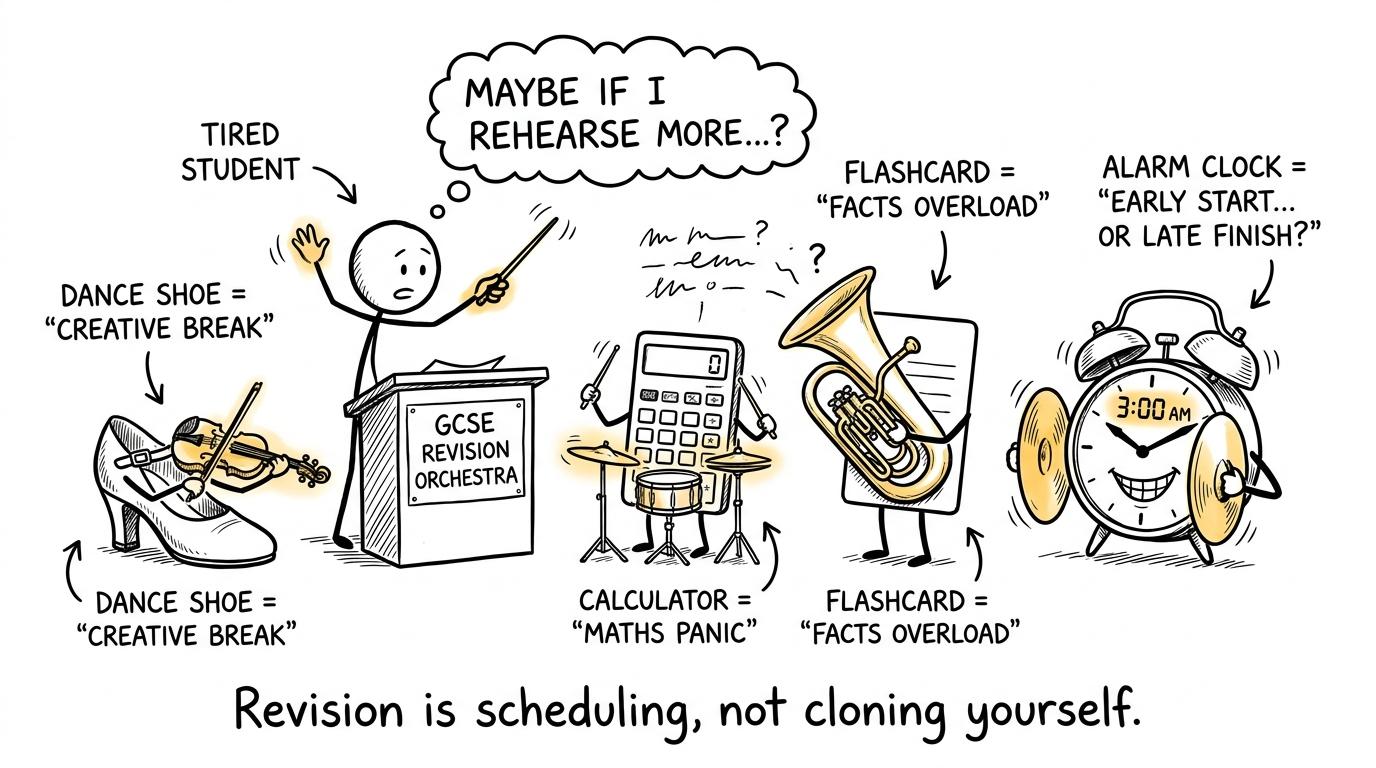 A student conducting an orchestra of competing revision demands
Balancing Dance revision with GCSE maths
Maths differs from Dance in one important respect: later skills often depend directly on earlier ones. Weak algebra can make graphs, equations and higher-tier topics harder. This makes regular diagnosis particularly valuable.
Use the MathsGenie GCSE revision page to identify topics at an appropriate grade level, then watch the revision video and complete the accompanying practice questions. Mark the work carefully rather than judging progress by how familiar the video felt.
Your exam board also matters when you move into paper-based practice. MathsGenie provides dedicated collections for Edexcel GCSE maths papers, AQA GCSE maths papers and OCR GCSE maths papers. Check your tier and specification with your school before choosing a paper.
A useful weekly balance has three layers:
- maintenance: brief Dance recall and maths skills practice;
- current priorities: homework, rehearsals and upcoming assessments;
- diagnosis: checking marked work to decide what needs attention next.
This prevents the loudest subject from taking every available hour. Dance may need more time near a practical deadline; maths may need more time before an internal paper. The balance should move as your needs move.
When predicted papers and full papers become useful
Full papers are most informative once you have covered enough of the specification. Used too early, they may mainly reveal that your class has not yet studied certain topics.
Later in the course, MathsGenie predicted papers can provide additional exam-style practice alongside official past papers. Predicted papers are practice resources, not guarantees of what will appear in the real examination, so they should never replace broad specification coverage.
When marking a maths paper, classify each lost mark. Was the cause missing knowledge, an incorrect method, weak notation, misreading or a careless calculation? That distinction tells you what to do next. Rewatching an entire course because of one arithmetic slip would be inefficient; ignoring a repeated algebra gap would be equally unhelpful.
Students considering maths beyond GCSE can also explore the free A Level maths resources, although Year 10 revision should remain focused on current GCSE foundations.
Common mistakes with a Year 10 revision head start
Revising at Year 11 intensity
Starting earlier does not mean doing more every week. It means spreading necessary work across a longer period. If the routine cannot survive an ordinary school term, simplify it.
Rewriting notes without testing recall
Neat notes may help organise the course, but recognition is not the same as retrieval. Close the page, answer a focused question and then check what was missing.
Treating practical rehearsal as automatically effective
Repeating a sequence without a clear focus can reinforce the same weakness. Use teacher feedback to choose one technical, expressive or choreographic priority for the session.
Letting Dance crowd out cumulative maths practice
A practical deadline can dominate attention because it feels immediate. Protect at least a small amount of regular maths practice so that foundational skills do not fade.
Collecting papers without learning from them
The value of a paper lies in the marking and follow-up. Use mark schemes, video solutions and targeted practice to repair the underlying gap. The MathsGenie free revision resources are designed to connect explanation, practice and exam preparation rather than leave you with a folder of unanalysed scores.
Start early, but stay patient
A GCSE Dance Year 10 revision head start genuinely pays off when it preserves knowledge, turns feedback into action and reduces the amount you must relearn under pressure. It becomes counterproductive when it imitates last-minute exam intensity for an entire year.
Keep the routine light enough to repeat. Review Dance knowledge actively, record useful practical feedback and adjust your timetable around real deadlines. At the same time, give cumulative subjects such as maths regular attention.
Start with the MathsGenie GCSE revision lessons, choose practice questions at the right level and use mark schemes honestly. As the examinations approach, add past papers, predicted papers and video solutions. The aim is not to feel busy sooner. It is to arrive in Year 11 with fewer surprises and a revision system you can trust.











