GCSE Combined Science AQA Grade Boundaries 2026
GCSE combined science AQA grade boundaries for June 2026: the official Foundation and Higher table, how double grades work and how to set your next target.

The official AQA GCSE Combined Science: Trilogy (8464) grade boundaries for June 2026 were published on results day, Thursday 20 August 2026. Each figure is the minimum total mark out of 420420420 across all six papers for that double grade.
June 2026 AQA Combined Science grade boundaries (8464)
| Double grade | Foundation 8464F8464\text{F}8464F | Higher 8464H8464\text{H}8464H |
|---|---|---|
| 9-99\text{-}99-9 | Not available | 298298298 |
| 9-89\text{-}89-8 | Not available | 280280280 |
| 8-88\text{-}88-8 | Not available | 262262262 |
| 8-78\text{-}78-7 | Not available | 245245245 |
| 7-77\text{-}77-7 | Not available | 228228228 |
| 7-67\text{-}67-6 | Not available | 208208208 |
| 6-66\text{-}66-6 | Not available | 188188188 |
| 6-56\text{-}56-5 | Not available | 168168168 |
| 5-55\text{-}55-5 | 276276276 | 149149149 |
| 5-45\text{-}45-4 | 257257257 | 130130130 |
| 4-44\text{-}44-4 | 238238238 | 111111111 |
| 4-34\text{-}34-3 | 208208208 | 101101101 |
| 3-33\text{-}33-3 | 178178178 | Not available |
| 3-23\text{-}23-2 | 149149149 | Not available |
| 2-22\text{-}22-2 | 120120120 | Not available |
| 2-12\text{-}12-1 | 919191 | Not available |
| 1-11\text{-}11-1 | 626262 | Not available |
Source: AQA GCSE grade boundaries, June 2026, published 20 August 2026.
Boundaries change every series. These are the June 2026 figures only, and past boundaries do not predict where future ones will fall.
Aiming for a higher grade next time? See exactly which topics to revise across Biology, Chemistry and Physics in GCSE Combined Science Topics Breakdown: Revision Time.
Reading the table: one total out of 420 gives one double grade
- Combined Science: Trilogy has six papers: two Biology, two Chemistry and two Physics, each worth 707070 marks.
- Your six paper marks are added together, giving a total out of 6×70=4206 \times 70 = 4206×70=420.
- That total is compared with the boundary for your tier, so a Foundation total must be read against the Foundation column only.
- The result is one double grade worth two GCSEs, such as 6-56\text{-}56-5, not separate Biology, Chemistry and Physics grades.
- The two numbers are always equal or next to each other, so 7-67\text{-}67-6 is possible but 7-57\text{-}57-5 is not.
- Foundation awards 1-11\text{-}11-1 to 5-55\text{-}55-5, and Higher awards 4-44\text{-}44-4 to 9-99\text{-}99-9, with 4-34\text{-}34-3 as a safety net just below 4-44\text{-}44-4.
For example, a Higher total of 150150150 clears the 5-55\text{-}55-5 boundary of 149149149 by one mark, while 148148148 would earn a 5-45\text{-}45-4.
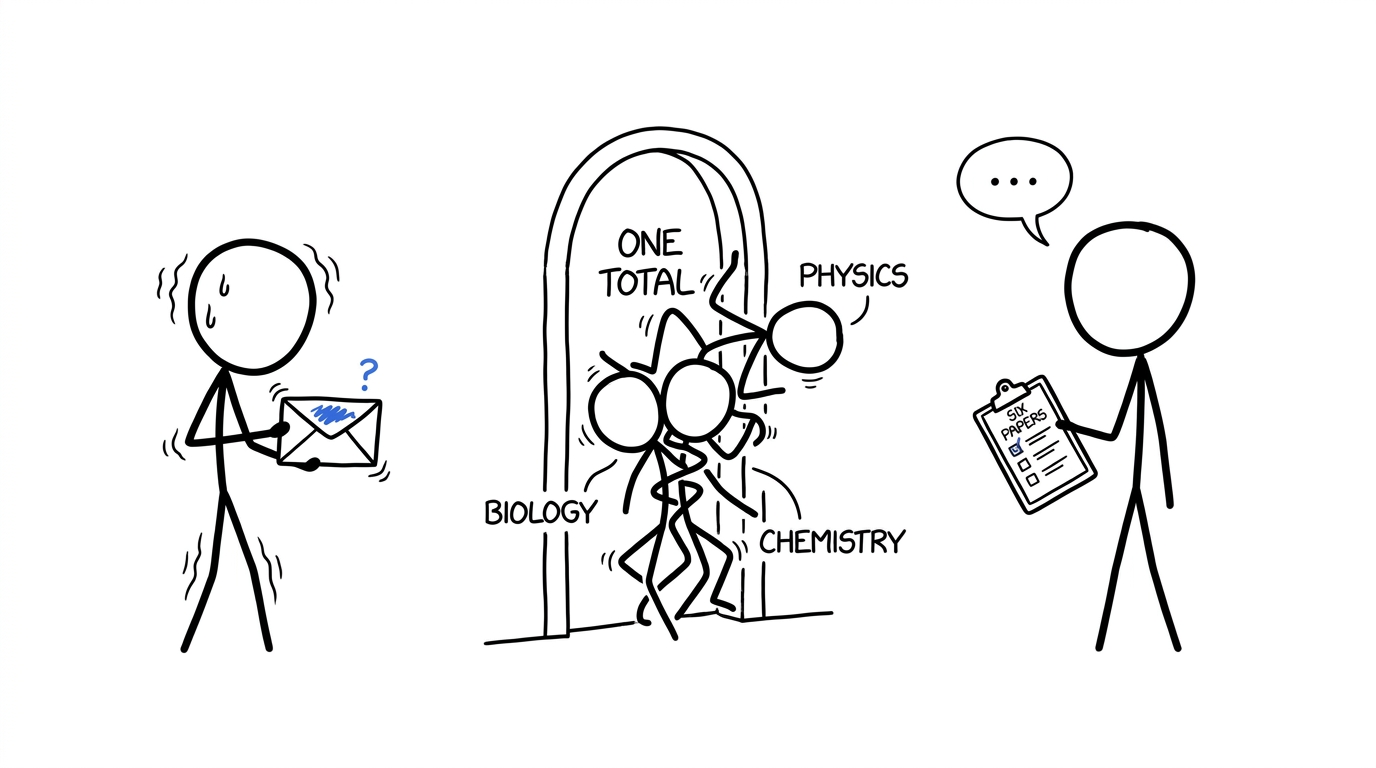 Three science subjects squeezing through one doorway marked one total
Why boundaries move: they are set after the papers are marked
- AQA sets boundaries once marking is nearly complete, using statistical evidence and senior examiners' judgement of scripts near each grade.
- A harder set of papers can lead to lower boundaries, and an easier set can lead to higher ones.
- There is no fixed percentage that always guarantees a grade, so the June 2026 table explains 2026 results but cannot fix the 2027 figures.
- To see how far the numbers have moved over time, read GCSE Combined Science Grade Boundaries History.
Didn't get the grade you needed? Your options now
- Need a grade for sixth form or college: speak to the provider straight away, because many will discuss a near miss.
- Think a mark looks wrong: ask your exams officer about a review of marking, and read GCSE Combined Science Remark: Results Day Guide first, because marks can go down as well as up.
- Planning to resit: AQA's November series covers GCSE English Language and Maths only, so a Combined Science resit is sat in the summer series.
- Ready to revise: build a plan from your weakest papers with the GCSE Combined Science Resit Revision Plan.
- Also resitting maths in November: the November GCSE Resits: Maths and English Guide and GCSE Maths Resit: Your Results Day Revision Plan cover the dates and a revision plan.
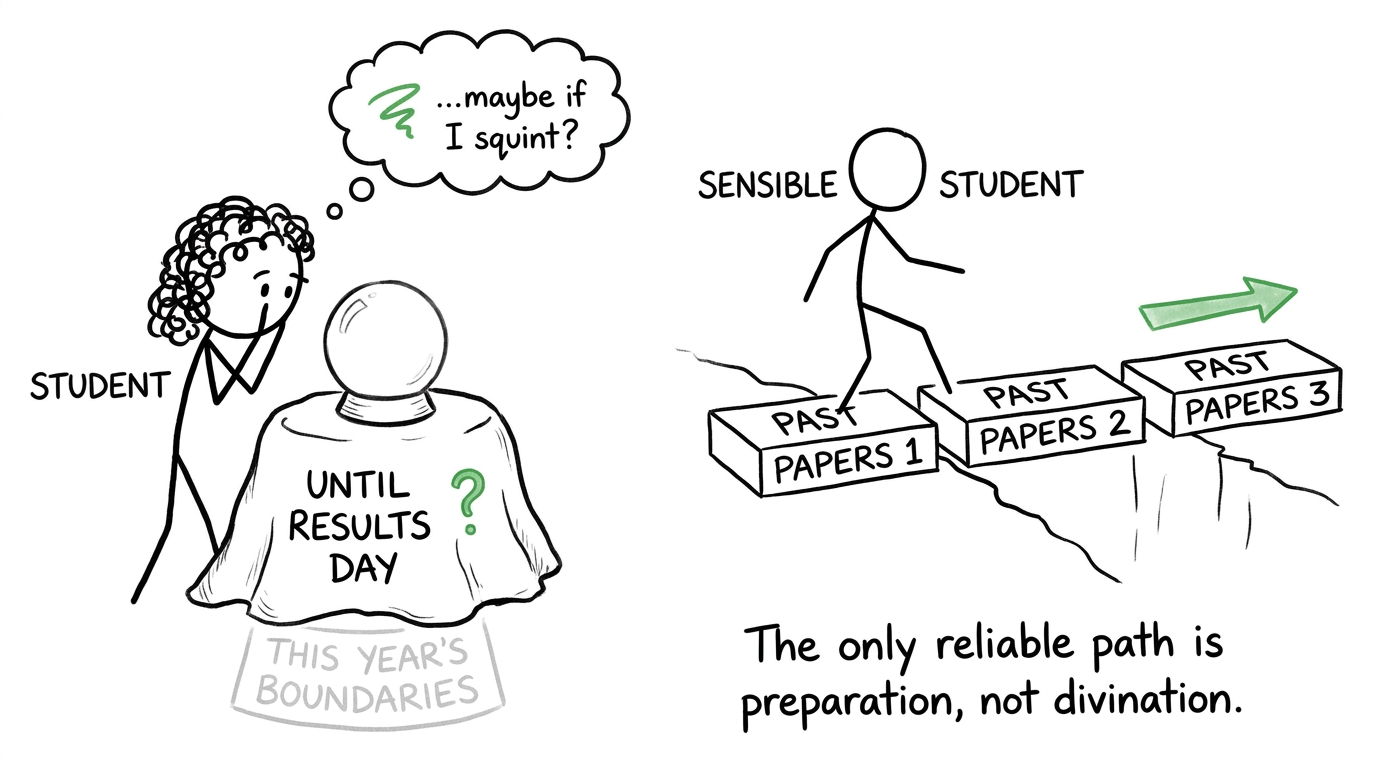 Student choosing past-paper stepping stones instead of a covered grade-boundary crystal ball
How many marks will you need? Use boundaries as a range, not a target
Past boundaries cannot predict next year's, but they show roughly where a grade has sat. In June 2026, these were the key Higher boundaries as a share of 420420420:
| Double grade (Higher) | Marks needed | Share of 420420420 |
|---|---|---|
| 4-44\text{-}44-4 | 111111111 | 26%26\%26% |
| 5-55\text{-}55-5 | 149149149 | 35%35\%35% |
| 6-66\text{-}66-6 | 188188188 | 45%45\%45% |
| 7-77\text{-}77-7 | 228228228 | 54%54\%54% |
On Foundation, 4-44\text{-}44-4 needed 238238238 (57%57\%57%) and 5-55\text{-}55-5 needed 276276276 (66%66\%66%).
- Set your target above the boundary, not on it. If you want a 6-66\text{-}66-6 on Higher, aim for about 200200200 in mocks so one hard paper does not drop you a grade.
- Split the target across six papers. A total of 200200200 works out at roughly 333333 to 343434 marks out of 707070 per paper.
- Find where the marks are. Mark a full past paper and note which topic every dropped mark came from.
- Fix the biggest losses first, then re-test with a timed paper every few weeks.
- Use a grade-band plan: GCSE Combined Science 4 to 6: A Practical Plan or GCSE Combined Science 6 to 9: A Practical Plan.
- Sharpen the maths. Rearranging equations, converting units and reading graphs earn marks across all three sciences, and the AQA GCSE Maths revision hub covers those skills.
Your next step: practise AQA Combined Science
Get free AQA Combined Science revision guides and past papers in one place:
Start with the paper that cost you the most marks, and use the MathsGenie revision planner to fit it into a weekly plan.