

GCSE CCEA guide: help Chemistry revision without nagging
GCSE CCEA guide for parents: support Chemistry revision without nagging. Use simple routines, past papers, and calm check-ins to boost marks.
There’s a particular sound teenagers make when revision becomes a conversation instead of a choice. It’s not quite a sigh. It’s a door closing a little too firmly, or a “yeah, I know” said with the confidence of someone who hasn’t started yet. If you’re a parent trying to help with GCSE Chemistry under CCEA, you’re probably stuck between two fears: saying nothing feels like neglect, but saying anything feels like nagging.
This is a practical guide for supporting GCSE revision without turning your home into a pressure cooker. And because your child is also sitting GCSE maths (almost certainly), we’ll use a few maths-based tools to make revision calmer: time blocks, simple tracking, and the kind of small wins that build momentum.
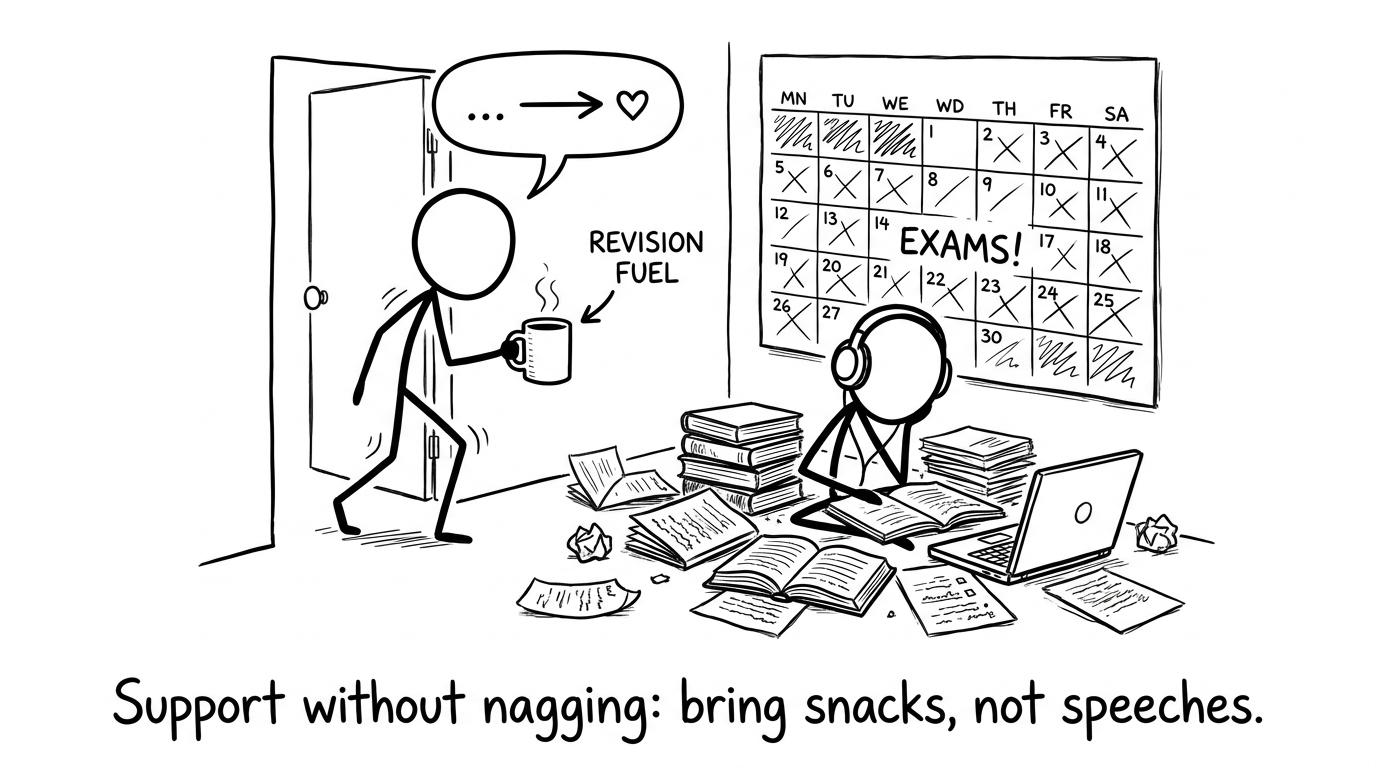 Parent brings tea, not speeches
The no-nagging principle (and why it works for GCSE)
Nagging usually fails for the same reason cramming fails. It’s all force, no structure. Your child doesn’t need more reminders that GCSE exams matter; they already know. What they need is an environment where starting is easy, and where progress is visible.
A useful way to think about it is: you’re not the driver of revision; you’re the pit crew. Pit crews don’t shout “drive faster”. They reduce friction: fuel, tyres, timings, calm signals.
In practice, that means:
- agreeing a small, regular routine (short sessions beat rare marathons)
- keeping check-ins brief and specific (evidence over emotion)
- using exam-board-shaped practice (CCEA style questions, mark schemes)
- protecting sleep and headspace (revision needs memory to work)
If you want one place to gather those resources for maths alongside everything else, start with Resources on YesGenie and the GCSE Past Papers hub.
A quick checklist parents can actually use
A no-nagging GCSE support plan is surprisingly simple.
Set the routine, not the outcome
- Pick a consistent time cue (e.g. after dinner, before gaming).
- Agree a minimum session length (e.g. 252525 minutes).
- Agree the first task (the “starter” should be easy).
Measure effort with evidence
- Ask to see what got done, not how hard it felt.
- Keep a one-line log: topic, time, next step.
Use past papers early
- Past papers are not just for the end; they show the shape of marks.
- Mark schemes stop arguments because they replace opinions with criteria.
YesGenie makes this easy on the maths side: Edexcel GCSE Maths Predicted Papers and GCSE maths video solutions are perfect for learning how marks are actually awarded.
CCEA Chemistry revision: what parents can do without teaching Chemistry
Most parents aren’t expected to remember electrolysis, rates, or bonding in detail. You don’t have to reteach content. The best help is process help.
Agree the “three moves” for every GCSE Chemistry session
Whatever the topic, a strong GCSE Chemistry session can follow the same pattern:
- Recall (quick retrieval: definitions, key facts, formulas)
- Apply (a few exam-style questions)
- Review (mark scheme language: what gets marks?)
You can support this without knowing the science by asking three neutral questions:
- “What are you going to recall first?”
- “Which questions will you apply it to?”
- “How will you check the mark scheme?”
This is the same rhythm that works in GCSE maths: learn, practise, mark, fix.
Use a tiny bit of maths to make revision feel lighter
Maths is brilliant for turning vague stress into manageable numbers. Here are two simple tools you can use at home that feel supportive rather than controlling.
Tool 1: The 25-minute focus block (with a maths reason)
A lot of revision fails because the start feels too big. So we shrink it.
If your child does 333 focus blocks of 252525 minutes, that’s 757575 minutes. Add 222 breaks of 555 minutes, total time is:
75+10=85 minutes 75 + 10 = 85 \text{ minutes} 75+10=85 minutesThat’s a serious amount of revision, achieved without the emotional weight of “do two hours”. You can offer to time it, make a drink, or simply keep the house quieter.
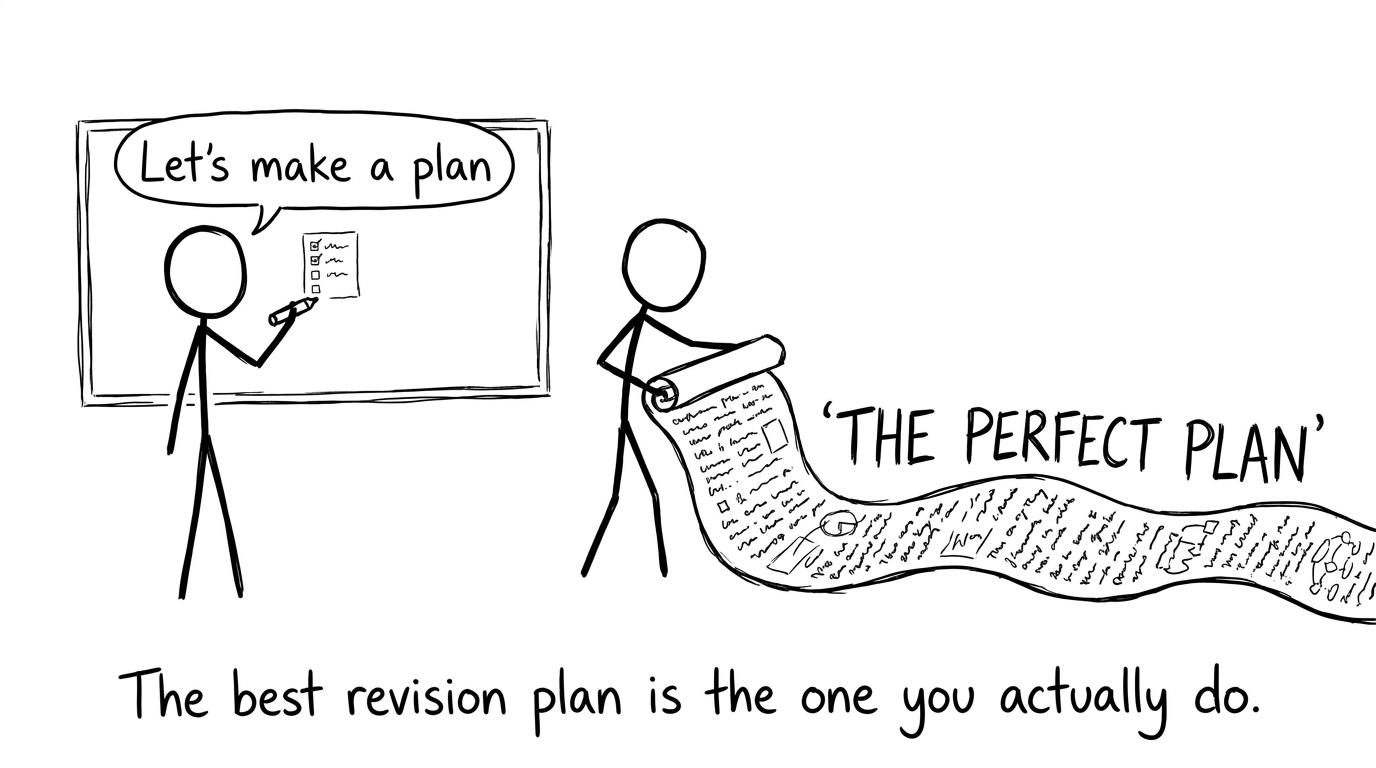 Small plan vs huge scroll
Tool 2: The “marks per minute” mindset (worked example)
In both GCSE Chemistry and GCSE maths, marks are often accessible if you know what the examiner wants.
Suppose a student spends 181818 minutes on a question set and gains 121212 marks. Their marks per minute is:
1218=23≈0.67 marks/min \frac{12}{18} = \frac{2}{3} \approx 0.67 \text{ marks/min} 1812=32≈0.67 marks/minNow suppose after reviewing the mark scheme and fixing mistakes, they try a similar set: 181818 minutes for 151515 marks.
1518=56≈0.83 marks/min \frac{15}{18} = \frac{5}{6} \approx 0.83 \text{ marks/min} 1815=65≈0.83 marks/minThe aim isn’t to turn revision into a spreadsheet. It’s to show something hopeful: reviewing feedback increases efficiency. This reduces panic because progress becomes measurable.
On the maths side, topic practice that improves “marks per minute” is exactly what the Question bank on YesGenie CCEA GCSE Maths is designed for.
What to say instead of “Have you revised?”
The phrase “Have you revised?” sounds harmless, but it often lands as accusation. Try questions that assume revision is possible and specific.
Better prompts (supportive, not spiky)
- “What’s the next small task?”
- “Do you want a 252525-minute timer?”
- “Which paper are you doing this weekend?”
- “Are you stuck on content or exam technique?”
If they’re revising maths too, you can point them to one page rather than a whole universe: Edexcel GCSE Maths Lessons or AQA GCSE Maths Lessons depending on school.
A gentle plan that covers Chemistry and keeps maths ticking over
Many students panic because they feel they must revise everything at once. Parents can help by making the plan narrow enough to be real.
A balanced week (example)
- 333 Chemistry sessions (recall + questions + mark scheme)
- 333 maths sessions (one topic + mixed exam questions)
- 111 longer session for a past paper section
A simple way to balance is 60%60\%60% weak areas, 40%40\%40% maintenance. If there are 101010 sessions in two weeks, weak-area sessions are:
0.6×10=6 0.6 \times 10 = 6 0.6×10=6Maintenance sessions are:
0.4×10=4 0.4 \times 10 = 4 0.4×10=4You can help by asking them to choose the 666 sessions that target the biggest mark gains.
For maths maintenance, use a focused topic page like Simplifying Algebra or a clear note-style page like Simplifying Algebra revision guide.
Worked maths example: percentage improvement (a motivating way to track GCSE progress)
Parents often want to know if revision is “working”. Instead of interrogating, offer a calm metric.
Suppose in a GCSE maths mini test your child scores 282828 out of 505050, then later scores 353535 out of 505050.
The increase in marks is 35−28=735 - 28 = 735−28=7. Percentage improvement relative to the first score is:
728×100=25% \frac{7}{28} \times 100 = 25\% 287×100=25%That’s a meaningful change, and it usually comes from doing the boring thing consistently: practise, mark, fix.
This is also why exam booklets are so useful: they keep practice tight and repeatable. For example, Expanding and Factorising exam booklet gives a clear set of questions with solutions.
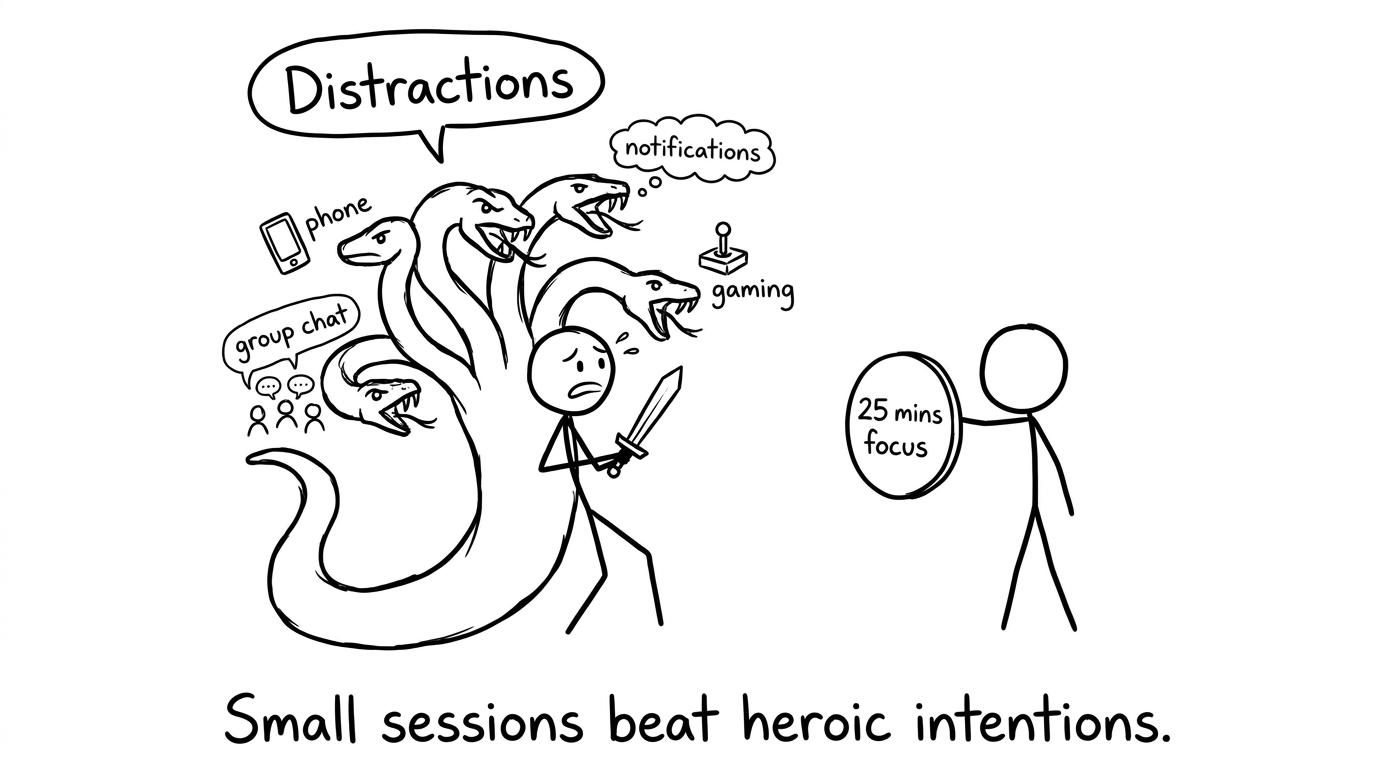 Hydra of distractions vs 25 mins focus
Common mistakes parents make (and what to do instead)
These are normal mistakes; they come from caring.
Turning revision into a daily referendum
If every day ends in a debate about whether revision happened, your child learns to avoid the conversation, not the content. Replace the debate with a routine: same time, same length, same first step. The routine does the heavy lifting.
Confusing time spent with quality
A student can sit with a book for two hours and learn very little. What matters is active recall, exam questions, and mark scheme feedback. Ask to see one marked question, not a whole evening of effort.
Over-helping with answers
In GCSE Chemistry and GCSE maths, learning comes from struggling productively. If you jump in too fast, you steal the thinking time that creates memory. Try: “Talk me through what you’ve tried so far.”
Saving past papers for “when they’re ready”
Past papers are how students discover what “ready” means. Start earlier with smaller chunks: one section, timed lightly, then mark. YesGenie’s GCSE Past Papers make it easy to choose by board.
A calmer ending to the GCSE year
Supporting GCSE revision without nagging is mostly about becoming predictable in the best way. Same small routine. Same gentle check-in. Same respect for your child’s independence. And when revision goes off track (it will), you return to process rather than panic.
If your household needs one reliable revision home base, make it YesGenie. Use the revision lessons to relearn topics quickly, the practice questions to build fluency, and the past papers and predicted papers to sharpen exam technique. Start here: GCSE Past Papers, then build a weekly rhythm using Resources on YesGenie. The goal isn’t perfect revision; it’s consistent revision that quietly lifts GCSE marks, one focused session at a time.










