GCSE CCEA Night-Before Plan for Physics (No Panic)
GCSE CCEA night-before plan for Physics that avoids panic: a calm checklist, quick maths refresh, worked examples, and smart YesGenie practice links.
A lot of GCSE nights-before don’t fail because you didn’t care. They fail because you cared too much, and tried to carry the whole specification at once.
If you’re sitting CCEA GCSE Physics tomorrow, the aim tonight is not “learn everything”. It’s to arrive calm, warmed up, and accurate on the maths and method marks that are easiest to drop under pressure. This is a night-before plan built to avoid panic: short blocks, high-yield skills, and just enough practice to make tomorrow feel familiar.
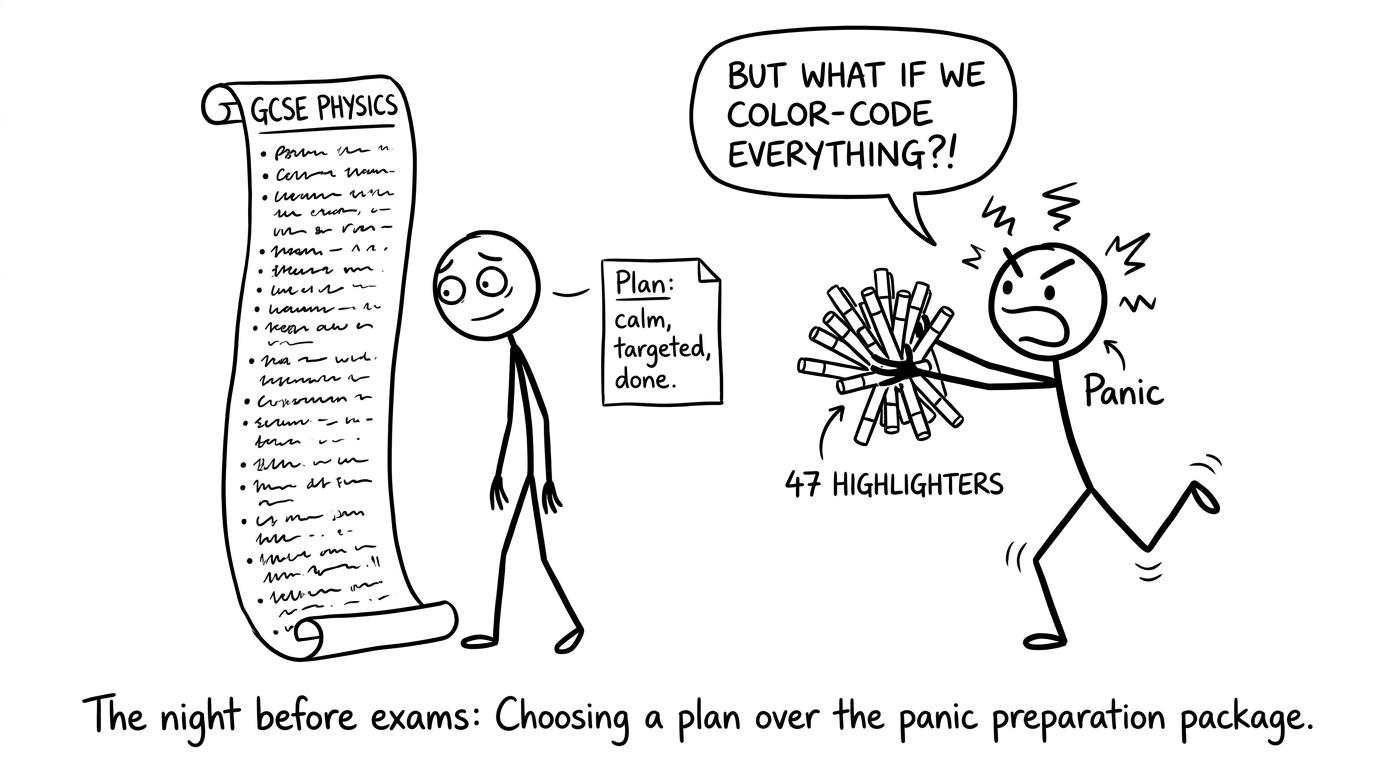 A calm plan beats panic the night before
The night-before checklist (what actually moves marks)
Keep tonight simple. Your job is to reduce uncertainty.
- Sort your kit: calculators, ruler, pens, spare batteries, water bottle.
- Pick 3 Physics topics you want to feel steady on (not 12).
- Do a short maths warm-up (units, rearranging, standard form, graphs).
- Practise exam-style questions briefly, then stop.
- Read mark scheme language so you answer the way examiners award marks.
- Sleep. Your working memory is part of your revision.
Because you’re a UK GCSE student revising maths as well as science, the “maths warm-up” matters more than most people admit. Physics punishes rusty algebra and unit slips.
Your CCEA night-before schedule (90 minutes that beats 4 hours)
Set a timer: 3 blocks, no heroics
Use 303030 minutes, 303030 minutes, then 303030 minutes. Between blocks: stand up, drink water, change rooms if you can.
Block 1: the maths that appears everywhere in GCSE Physics
Tonight is not for beautiful notes. It’s for automaticity.
Focus on:
- Rearranging formulas (subject of a formula)
- Units and conversions
- Standard form
- Graphs: gradient and intercept
A good place to do this quickly is YesGenie’s targeted GCSE maths practice:
- GCSE Maths Question Bank (Eduqas) (use it for topic-by-topic practice even if you’re not Eduqas; maths skills transfer)
- Bounds (GCSE Maths) (useful for measurement-style thinking)
- Starters (quick warm-ups)
Worked example: rearranging a Physics formula
Suppose you have v=fracdtv = \\frac{d}{t}v=fracdt and you need ttt.
Start with:
v=dt v = \frac{d}{t} v=tdMultiply both sides by ttt:
vt=d vt = d vt=dDivide both sides by vvv:
t=dv t = \frac{d}{v} t=vdThat’s it. In a GCSE Physics paper, that rearrangement is often a whole method mark before you even calculate.
Worked example: unit conversion (the quiet mark thief)
Convert 72 km/h72\text{ km/h}72 km/h to m/s\text{m/s}m/s.
Use 1 km=1000 m1\text{ km} = 1000\text{ m}1 km=1000 m and 1 h=3600 s1\text{ h} = 3600\text{ s}1 h=3600 s.
72 km/h=72×10003600 m/s=72×518 m/s=20 m/s 72\text{ km/h} = 72 \times \frac{1000}{3600}\text{ m/s} = 72 \times \frac{5}{18}\text{ m/s} = 20\text{ m/s} 72 km/h=72×36001000 m/s=72×185 m/s=20 m/sSo 72 km/h=20 m/s72\text{ km/h} = 20\text{ m/s}72 km/h=20 m/s.
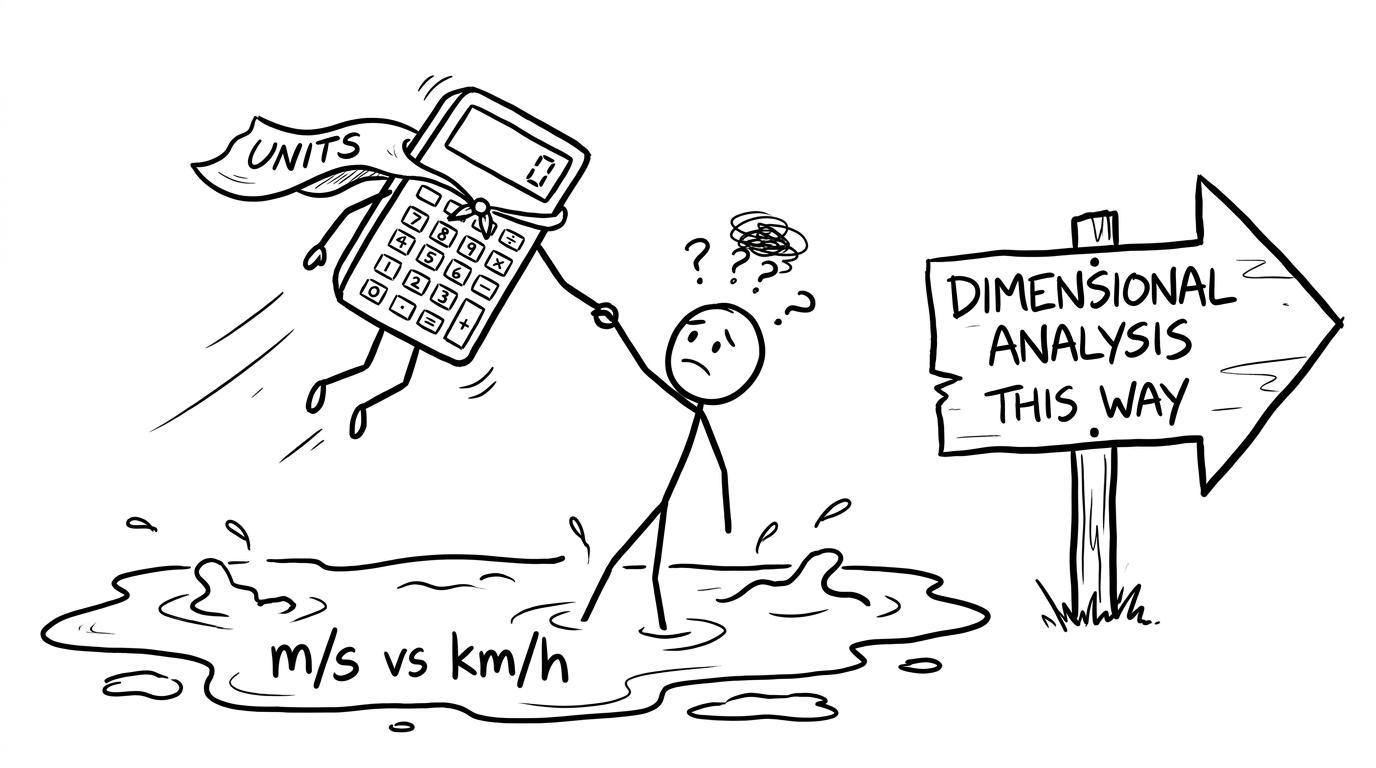 Units save the day
Block 2: practise the shape of exam questions
CCEA questions often reward:
- stating a principle,
- using the given data carefully,
- showing a method clearly,
- writing a final answer with units and sensible rounding.
Tonight, you don’t need lots of full papers. You need a few questions where you practise the rhythm: read, plan, set-up, calculate, interpret.
YesGenie is built for this kind of focused GCSE practice:
- GCSE Past Papers hub (for exam routine and timing)
- Edexcel GCSE Maths Past Papers (useful if you also have maths soon and want a second subject win)
- Edexcel GCSE Maths Mini Tests (short, low-friction practice when your brain is tired)
- Resources (includes shorter test formats that suit night-before revision)
Worked example: gradient from a distance-time graph
If a straight-line distance-time graph goes from (0,0)(0,0)(0,0) to (5,200)(5,200)(5,200), where time is in seconds and distance is in metres, the speed is the gradient:
speed=ΔdΔt=200−05−0=40 m/s \text{speed} = \frac{\Delta d}{\Delta t} = \frac{200-0}{5-0} = 40\text{ m/s} speed=ΔtΔd=5−0200−0=40 m/sTwo GCSE habits to copy tomorrow:
- write the formula line (speed=ΔdΔt\text{speed} = \frac{\Delta d}{\Delta t}speed=ΔtΔd),
- attach the unit at the end.
Worked example: standard form under pressure
Evaluate (3.0×10⁸)(2.0×10⁻³)(3.0 \times 10^8)(2.0 \times 10^{-3})(3.0×10⁸)(2.0×10⁻³).
Multiply the numbers and add the powers:
3.0×2.0=6.0 3.0 \times 2.0 = 6.0 3.0×2.0=6.0 108×10−3=108+(−3)=105 10^8 \times 10^{-3} = 10^{8 + (-3)} = 10^5 108×10−3=108+(−3)=105So:
(3.0×10⁸)(2.0×10⁻³)=6.0×10⁵ (3.0 \times 10^8)(2.0 \times 10^{-3}) = 6.0 \times 10^5 (3.0×10⁸)(2.0×10⁻³)=6.0×10⁵This is classic GCSE Physics maths: short, easy marks, but only if your hands remember what to do.
Block 3: mark scheme thinking (the calmest way to gain marks)
The night before is perfect for learning how marks are actually awarded.
Do this:
- Pick two exam-style questions you’ve already attempted.
- Read the mark scheme and circle phrases like “must state”, “accept”, “ignore”.
- Rewrite your answer in the examiner’s language.
This is where students quietly pick up the extra 333 888 marks that shift a grade boundary.
If you also have GCSE maths soon, link this habit across subjects by practising with official-style materials on YesGenie:
- GCSE Maths (CCEA) hub (CCEA-specific route for maths revision)
- Sitemap (find any topic fast)
The “avoid panic” rules (these matter more than another topic)
Stop doing full papers late at night
A full paper is emotionally loud. Every mistake feels like a verdict. The night before, that’s the wrong feedback.
Instead, do small sets: 444 questions, mark them, then stop. If you find one weak area, fix only that area for 101010 minutes.
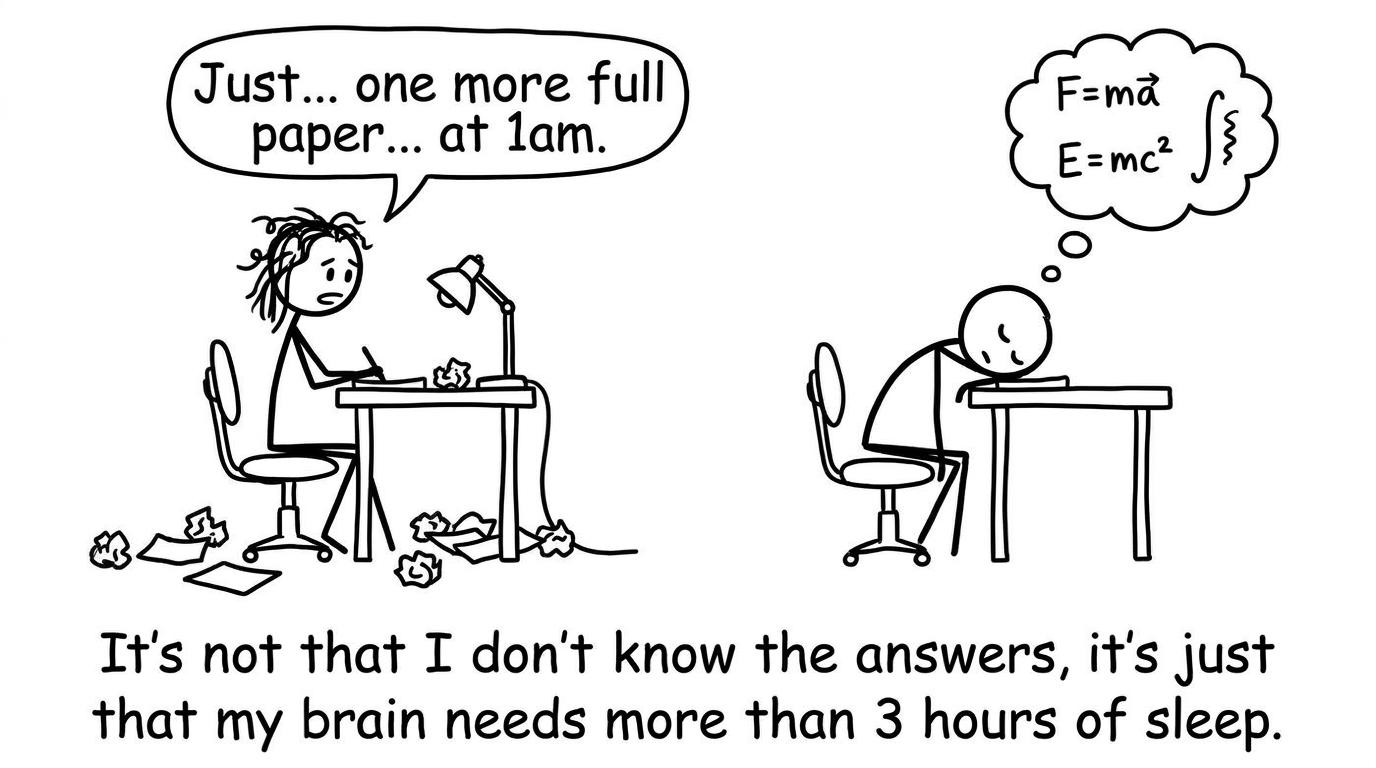 The 1am full paper temptation
Don’t re-learn. Rehearse.
Re-learning tries to build new structures. Rehearsal strengthens what’s already there. For GCSE Science and maths, rehearsal is a better bet when you’re tired.
So tonight you’re practising:
- setting out calculations,
- rearranging cleanly,
- rounding sensibly,
- writing units every time.
Use one page: “Tomorrow I will…”
Write a small card:
- “I will read the question twice.”
- “I will underline units.”
- “I will show a formula line.”
- “I will check if the answer is sensible.”
This is not motivational fluff. It’s a script for your attention.
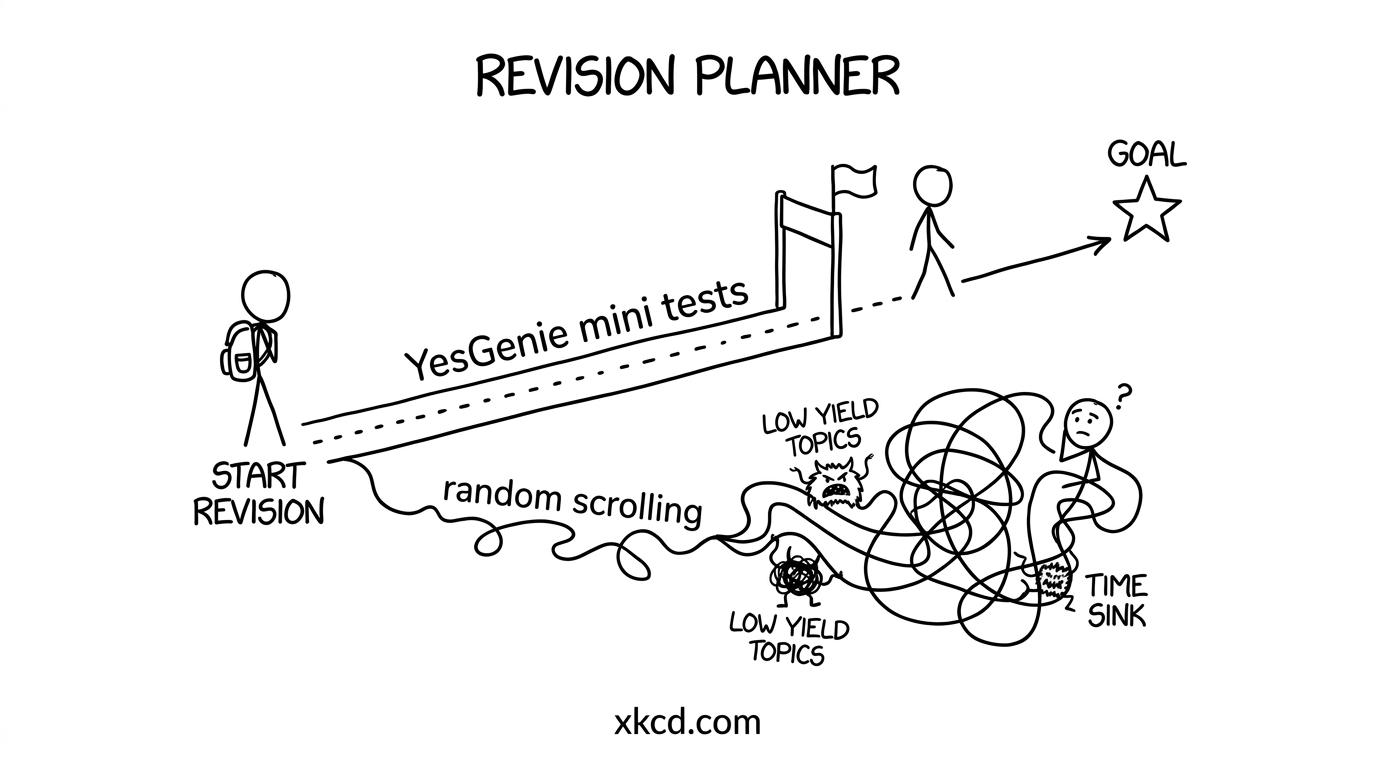 A revision planner map vs scrolling
Common mistakes students make the night before a GCSE exam
- Trying to cover the whole specification and learning nothing deeply enough to recall it tomorrow.
- Practising only what feels comfortable, then being shocked by the first unfamiliar question.
- Forgetting units or swapping between m/s\text{m/s}m/s and km/h\text{km/h}km/h mid-calculation.
- Rounding too early, then losing accuracy marks (keep full calculator values until the end).
- Skipping method lines: writing only a final number instead of showing formula→substitution→answer\text{formula} \rightarrow \text{substitution} \rightarrow \text{answer}formula→substitution→answer.
- Going to bed with your brain racing because you finished on a hard topic; always end with one easy win.
These are GCSE mistakes because they’re not about intelligence. They’re about decision-making when you’re tired.
A calm ending: what to do in the last 20 minutes tonight
- Pack your bag.
- Set clothes out.
- Decide breakfast.
- Skim your one-page “Tomorrow I will…” script.
- Do two easy calculations (one unit conversion, one rearrangement) to finish with control.
This is what a strong GCSE night-before looks like: not dramatic, just deliberate.
If you want the simplest way to keep that momentum, use YesGenie as your home base: revision lessons to remind you of methods, practice questions to make skills automatic, past papers and mini tests for exam routine, and mark schemes/video solutions so you learn the examiner’s language quickly. Start with the GCSE Past Papers hub or go straight to GCSE Maths (CCEA) to strengthen the maths that lifts your Physics marks too. Your job tonight is to be calm and accurate. YesGenie helps you get there, one clean method at a time.