GCSE: Using Mark Schemes to Improve (CCEA Chemistry)
GCSE CCEA Chemistry tip: learn to use mark schemes like a checklist. Improve exam technique with maths-style methods, worked examples and routines.
Mark schemes are an awkward kind of honesty. They don’t care how hard you revised, how close you felt, or how much you “basically meant” the right thing. They care about what you wrote. For CCEA students, learning to use a mark scheme properly can be the fastest way to lift your GCSE Chemistry marks, and, surprisingly, it’s the same skill that lifts GCSE maths marks too: writing what the examiner can actually award.
This post is written for UK GCSE and A Level maths students using YesGenie, because the habit you build in Chemistry carries straight into maths papers: turn feedback into a repeatable method, practise it on exam questions, then repeat until it’s boring (and your marks rise).
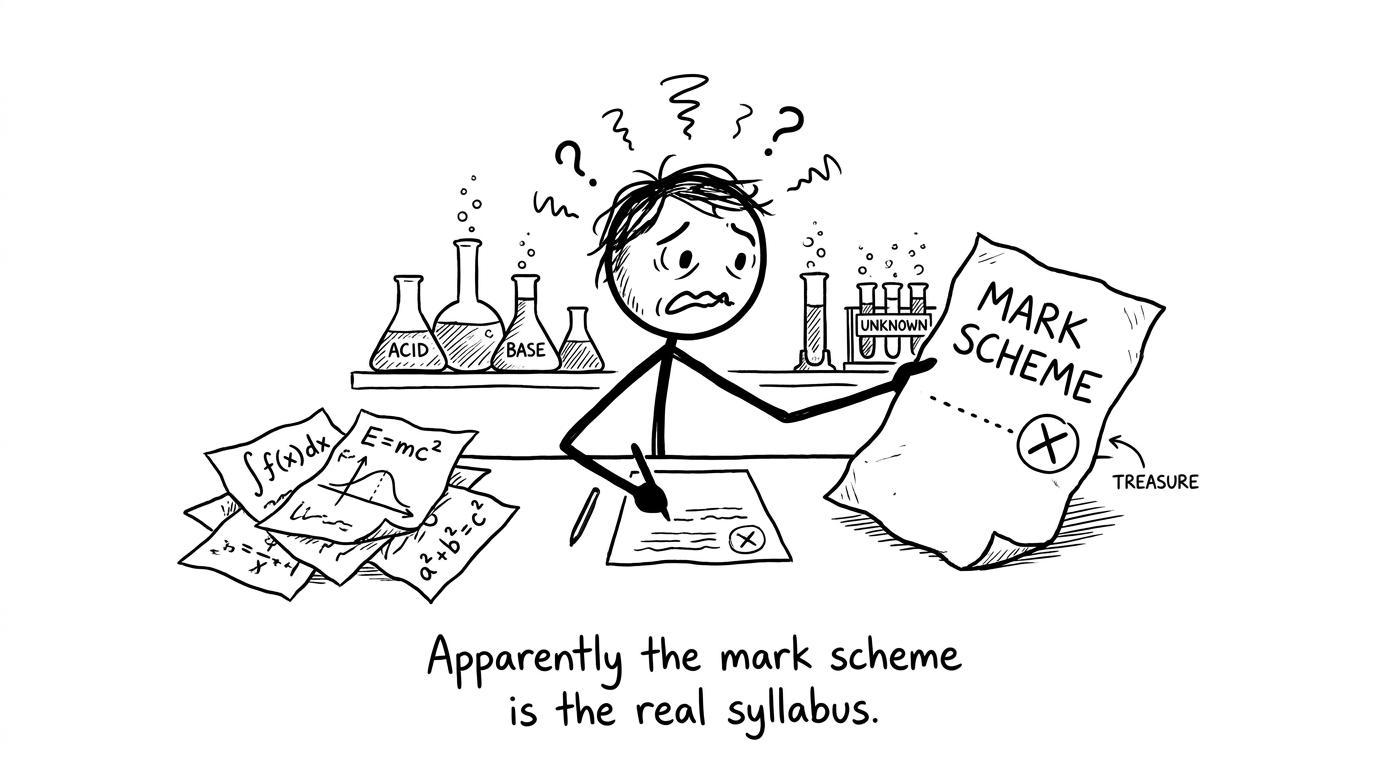 A student holding a mark scheme like a treasure map
The mark scheme mindset (and why it works)
A mark scheme is not just “the answers”. It is a model of what gets rewarded.
If you’ve ever done a maths question and thought, “But I did the right idea”, you’ve already met the core lesson: exams mark evidence, not intentions. In GCSE maths, the evidence might be a clear substitution, a correct rearrangement, or the right units. In CCEA GCSE Chemistry, the evidence might be a balanced equation, a correct calculation with units, or the exact key term.
Using a mark scheme well means you stop guessing what the examiner wants and start seeing patterns:
- which words appear again and again (and which don’t)
- where method marks are awarded (even if the final answer is wrong)
- what counts as “reason” vs “description” vs “explanation”
- how strict units and significant figures are in calculations
That’s why mark schemes are revision gold: they convert a vague goal (“get better”) into a concrete target (“write this”).
Quick checklist: how to use a mark scheme like a scientist
Use this routine after every practice paper or topic set. It’s deliberately maths-like.
- Attempt first: no mark scheme, no notes. Treat it like the real GCSE.
- Self-mark in two passes:
- Pass 1: tick only what is undeniably correct.
- Pass 2: use the mark scheme to award method marks.
- Annotate your answer with the exact phrase or step the mark scheme wanted.
- Make a ‘next time’ line for each question: one sentence beginning with “Next time I will…”.
- Practise the same skill again within 48 hours using fresh questions.
If you want a home for this habit in maths, YesGenie is built for it: you can do real papers, check mark schemes, and then watch the video solutions to see how examiners expect working to be set out.
Useful starting points on YesGenie:
- GCSE Past papers
- Resources (including predicted papers)
- CCEA GCSE Maths revision
- GCSE Maths OCR revision
- Edexcel GCSE Maths past papers
- Edexcel GCSE Maths predicted papers
What CCEA mark schemes quietly teach you (and how to copy it in maths)
CCEA Chemistry mark schemes tend to reward three things repeatedly:
Precision
A lot of GCSE Chemistry is vocabulary under pressure. Mark schemes often require specific terms (for example, “oxidation is loss of electrons”, not “it reacts with oxygen” unless the question context allows it).
In GCSE maths, “precision” is usually about notation and units. If the mark scheme wants cm2\text{cm}^2cm2 and you write cm\text{cm}cm, you’re not “basically right”. You’re demonstrably wrong.
Structure
Good answers are often built in a predictable order. In calculations, that order is usually:
- write the equation you’re using
- substitute numbers
- calculate
- state the answer with units (and sometimes significant figures)
That is exactly the structure of high-mark maths solutions too.
Evidence
Mark schemes reward what can be checked. “Because it has a stronger bond” might not score unless you specify which bond, what happens, or what that implies.
In maths, evidence is working. Even if you make an arithmetic slip, clear working can earn method marks.
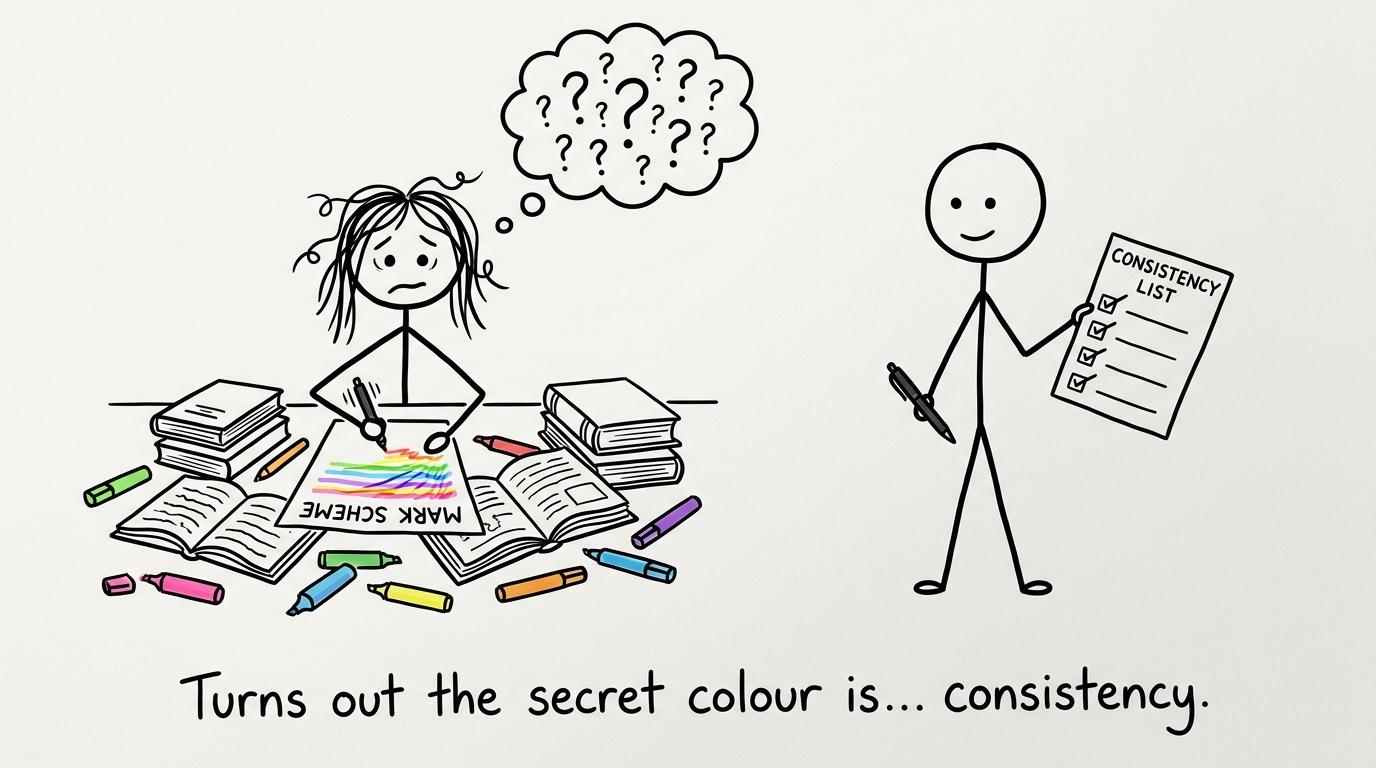 Highlighting vs checklist consistency
Worked example: turning a Chemistry calculation into a maths-style method
Even though this is a GCSE Chemistry scenario, the improvement comes from maths thinking: define variables, choose the relationship, substitute cleanly, and finish with units.
Example 1: Concentration calculation (core GCSE skill)
A student prepares 250 cm3250\text{ cm}^3250 cm3 of solution containing 5 g5\text{ g}5 g of solute. Find the concentration in g dm−3\text{g dm}^{-3}g dm−3.
Step 1: Convert units Remember 1 dm3=1000 cm31\text{ dm}^3 = 1000\text{ cm}^31 dm3=1000 cm3.
So:
250 cm3=2501000 dm3=0.25 dm3. 250\text{ cm}^3 = \frac{250}{1000}\text{ dm}^3 = 0.25\text{ dm}^3. 250 cm3=1000250 dm3=0.25 dm3.Step 2: Use the relationship
concentration=massvolume. \text{concentration} = \frac{\text{mass}}{\text{volume}}. concentration=volumemass.Step 3: Substitute and calculate
concentration=50.25=20. \text{concentration} = \frac{5}{0.25} = 20. concentration=0.255=20.Step 4: State with units
20 g dm−3. 20\text{ g dm}^{-3}. 20 g dm−3.How mark schemes award marks A typical mark scheme pattern is:
- 1 mark for converting cm3\text{cm}^3cm3 to dm3\text{dm}^3dm3
- 1 mark for correct substitution into the formula
- 1 mark for a correct final value with the right units
The GCSE maths transfer This is the same habit you need for ratio, density, speed, and compound measures. If you want to practise the “write the formula, substitute, conclude” rhythm, do a paper on YesGenie and then compare your working to the mark scheme and video solutions.
How to ‘reverse engineer’ questions from the mark scheme
This is the highest-leverage way to use mark schemes, and it works in every GCSE.
Start by finding the mark points
Instead of reading the whole mark scheme like a story, scan it like a builder reading a blueprint.
- Circle command words: state, describe, explain, calculate.
- Underline anything in brackets, like “allow” or “ignore”. These often reveal what examiners accept.
- Look for “OR” options. They show alternative correct approaches.
Translate each mark point into a sentence you could write
If the mark scheme says something like:
- “must state catalyst increases rate without being used up”
Your revision note becomes:
- “A catalyst increases the rate of reaction and is not used up (chemically unchanged).”
In GCSE maths, if the mark scheme shows:
- “M1 for forming 2x+3=112x+3=112x+3=11; A1 for x=4x=4x=4”
Your revision note becomes:
- “Next time: write the equation first, then solve it.”
Make your mistakes predictable (so your improvement is predictable)
Mark schemes don’t just show what’s right. They show the most common wrong paths, because the marking instructions often anticipate them.
A strong GCSE revision strategy is to sort your errors into a small set of repeatable categories:
- Recall error: forgot a fact or definition.
- Process error: knew the idea but executed it badly.
- Exam technique error: didn’t answer the question asked.
- Maths error: units, conversions, rearranging, calculator slips.
Once you can label the mistake, you can fix it with the right tool.
On YesGenie, the “right tool” is often a sequence:
- a short lesson to rebuild the method
- topic practice
- then a timed paper with a mark scheme
For maths revision, that structure is easy to keep consistent with:
- CCEA GCSE Maths revision
- Edexcel GCSE Maths past papers
- Edexcel GCSE Maths predicted papers
- GCSE Past papers
Common mistakes CCEA Chemistry students make with mark schemes
These are the mistakes that keep students stuck on the same grade, even when they “do loads of revision”.
Reading the mark scheme before attempting
This feels efficient, but it trains recognition, not recall. In the real GCSE you must retrieve information cold.
Marking generously
If you have to argue for the mark, you probably didn’t earn it. Train honesty now so the examiner’s honesty doesn’t surprise you later.
Ignoring method marks
In calculations, method marks are your safety net. If you only look at the final answer, you miss the real feedback: where your process broke.
Not copying exact phrases when required
In Chemistry, specific key terms matter. If the mark scheme uses a term repeatedly, it’s usually because alternatives are ambiguous.
Not building a second attempt
The mark scheme is not revision unless it changes what you do next. One more attempt, 48 hours later, is where improvement becomes real.
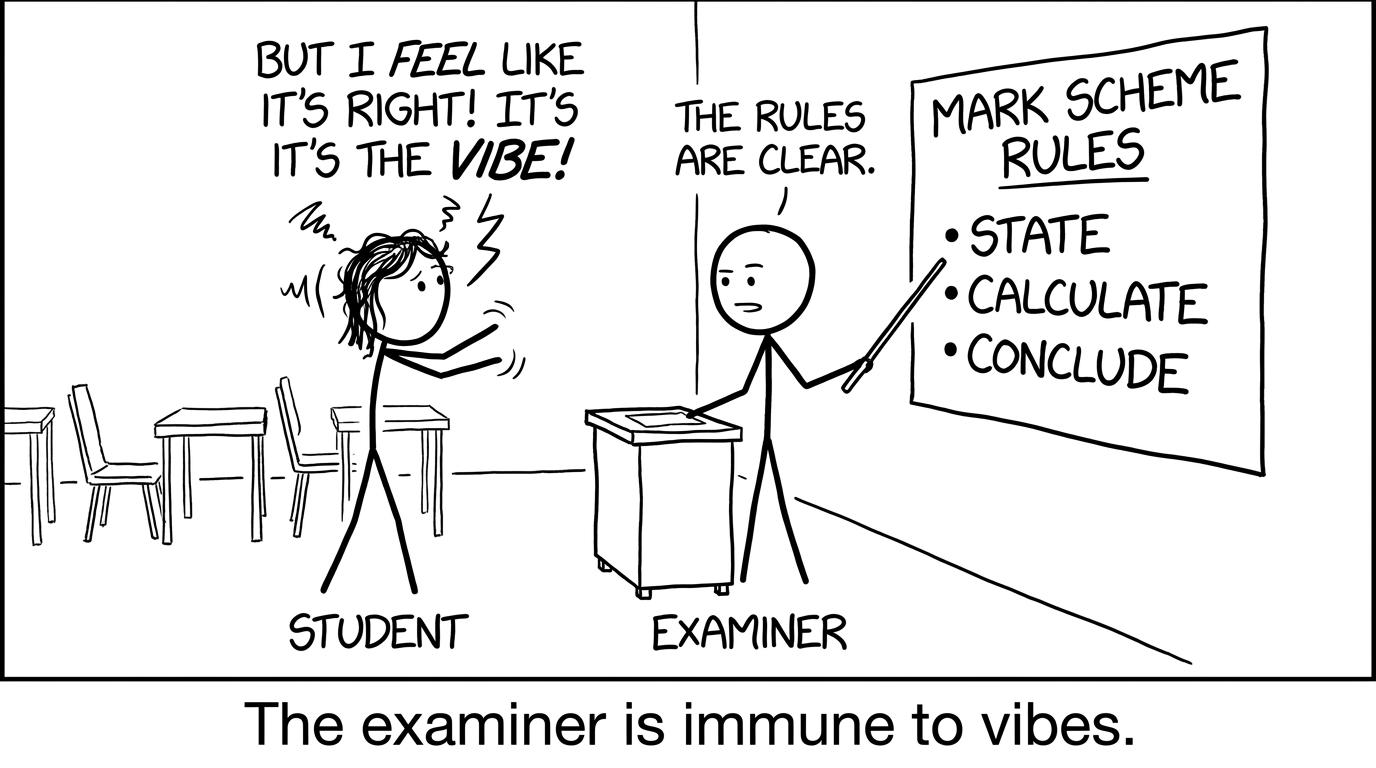 Examiner immune to vibes
How this helps you as a GCSE maths student (even if Chemistry isn’t your main worry)
If you’re revising maths, you’re revising a subject where marks are often awarded for process. That means your working is part of your answer.
The Chemistry mark scheme habit forces you to:
- write what you mean
- show what you did
- conclude with what the question asked for
That is the whole game in GCSE maths too. When you use a mark scheme properly, you stop being surprised by where marks went. You start predicting it.
And once you can predict it, you can practise it.
Closing: use the mark scheme to write what earns marks
The mark scheme is a quiet contract: write evidence and you get marks. That’s true for CCEA GCSE Chemistry, and it’s just as true for GCSE maths across Edexcel, AQA, OCR and Eduqas.
If you take one thing from this post, take this: don’t just revise content; revise the format of a mark-winning answer. Use the mark scheme to learn the language of marks, then practise until it’s automatic.
Build that loop on YesGenie today:
- revise methods with free lessons
- practise with topic questions
- sit timed papers
- mark with official mark schemes
- fix gaps using video solutions and predicted papers
Start here and keep it simple: GCSE Past papers and Resources (predicted papers and more). Your next GCSE grade is often less about “knowing more” and more about writing what the mark scheme can reward.