

GCSE Business 6 to 8: How to Raise Your Grade
GCSE Business 6 to 8: learn how sharper application, analysis, evaluation and numerical accuracy can turn solid work into top-band exam answers.

Moving from a grade 6 to a grade 8 in GCSE Business is rarely about learning twice as much content. Most grade 6 students already understand the main ideas. The difference is what happens after that knowledge reaches the page.
The GCSE Business 6 to 8 journey is usually built on four changes: applying knowledge precisely to the case study, developing longer chains of analysis, making supported judgements and protecting straightforward calculation marks. In short, you stop writing everything you know and start selecting what best answers the question.
That shift sounds small. In an exam, it changes almost everything.
The grade 6 to grade 8 checklist
A stronger GCSE Business response usually does the following:
- uses accurate business terminology without relying on memorised definitions alone;
- applies each important point to the organisation or situation in the question;
- explains consequences through a connected chain of reasoning;
- considers relevant advantages, disadvantages or competing factors;
- reaches a justified conclusion based on the circumstances;
- completes calculations accurately, showing working and including units;
- manages time according to the marks available;
- learns from mark schemes rather than merely recording a total score.
Grade boundaries vary between exam boards and examination series, so there is no permanent raw mark that guarantees a grade 8. Check the information published for your own Edexcel, AQA, OCR or Eduqas specification and examination series. Your practical target should be better answer quality and more consistent mark collection.
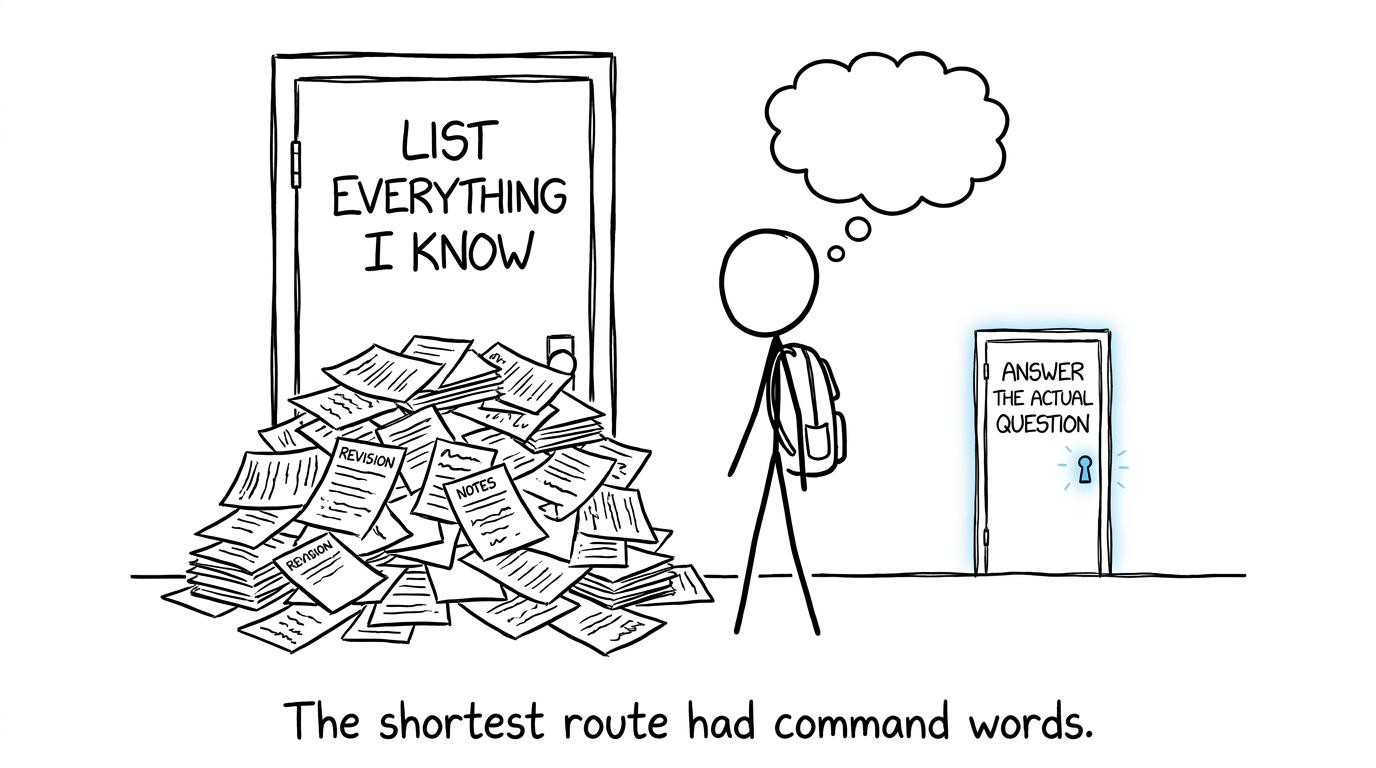 A student discovers that command words provide the shortest route through an exam
What separates a grade 6 from a grade 8?
A grade 6 answer can be correct but incomplete. It may identify a sensible benefit, mention the case study and explain one consequence. A grade 8 answer is more likely to sustain that reasoning, recognise what the answer depends on and make a decision grounded in the evidence provided.
The difference is not simply longer writing. Length without direction produces expensive paragraphs: they consume time but earn few additional marks.
Knowledge becomes selective
At grade 6, students sometimes treat an exam question as an invitation to empty a revision card onto the page. At grade 8, knowledge is selected.
If a question concerns growth, for example, not every fact about business expansion is equally useful. The strongest point depends on the business's objectives, finance, market, size and capacity. Before writing, ask:
- Which concept is being tested?
- Which case-study detail changes the answer?
- What consequence matters to this business?
Secure knowledge remains essential. But high-quality responses use knowledge as a tool, not a script.
Application becomes specific
Application means more than repeating the company's name. A copied name can be attached to an entirely generic paragraph.
Meaningful application uses information that affects the reasoning: the business's target market, pricing approach, costs, workforce, location, objective or competitive environment. The detail should help explain why an effect is likely.
A useful test is to remove the business's name from your paragraph. If the answer could apply unchanged to almost any organisation, the application is probably too thin.
Analysis becomes a chain
Analysis connects cause and consequence. Instead of stopping after the first effect, follow the commercial logic:
decision⟶immediate effect⟶business consequence⟶impact on the objective\text{decision} \longrightarrow \text{immediate effect} \longrightarrow \text{business consequence} \longrightarrow \text{impact on the objective}decision⟶immediate effect⟶business consequence⟶impact on the objectiveThe final link matters. Higher-level analysis often connects the argument to profit, cash flow, market share, customer satisfaction, productivity, survival or another objective relevant to the question.
Do not force every chain to the same destination. A decision may raise sales revenue but also increase costs or place pressure on cash flow. Business decisions involve trade-offs, and stronger answers acknowledge them.
Evaluation becomes conditional
Evaluation is not adding “however” near the end. It is deciding which factor matters most and explaining why.
A supported judgement may depend on:
- the business's objective;
- the time period;
- the scale or reliability of the evidence;
- likely competitor or customer reactions;
- the organisation's available finance and capacity;
- whether the decision's benefits outweigh its costs and risks.
Your conclusion should resolve the question, not repeat the introduction. Phrases such as “this depends on” are useful only when you explain what it depends on and how that condition changes your decision.
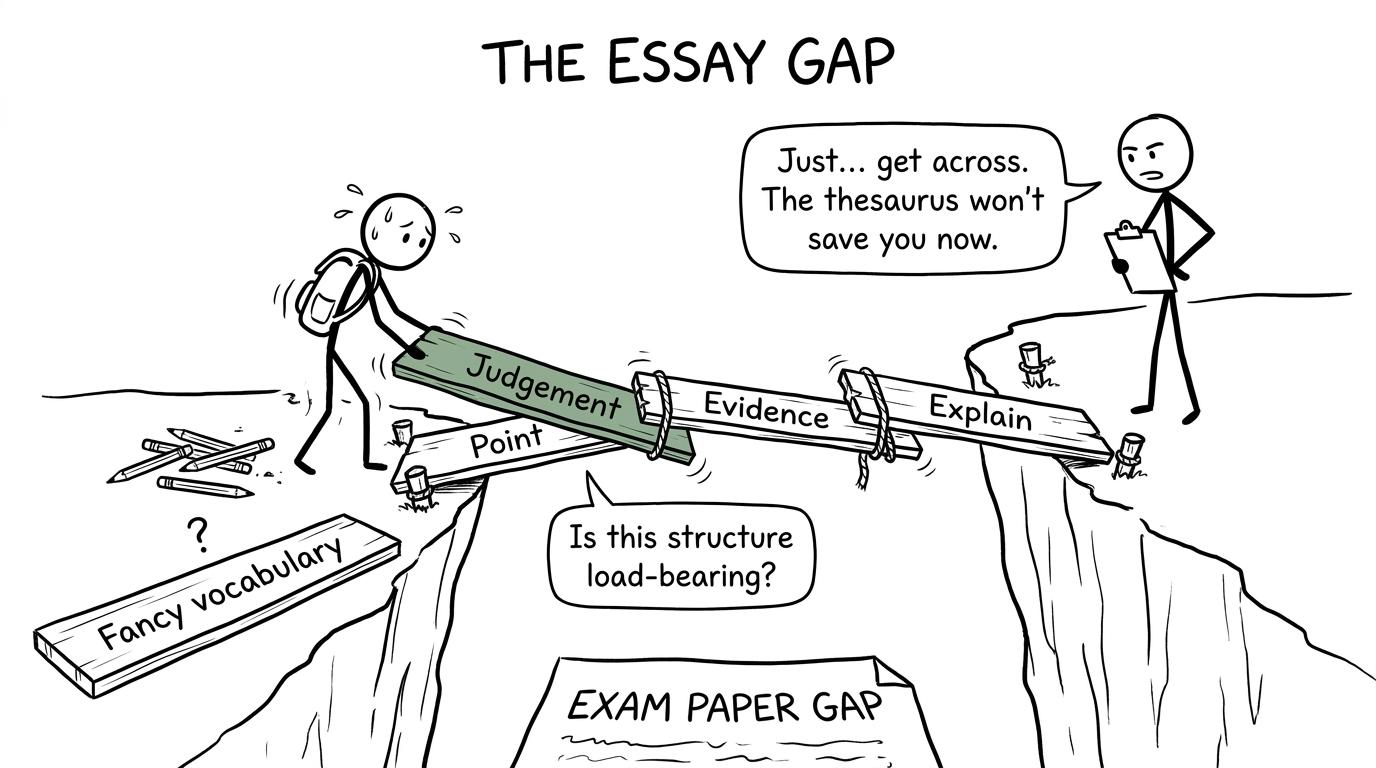 A bridge made from point, evidence, explanation and judgement carries a student across an exam gap
Change how you answer different command words
Command words define the job. Although wording and mark allocations differ between specifications, the underlying distinction is important.
Identify, state and give
These questions usually need concise, accurate information. Do not bury a short answer under an unnecessary paragraph. If the question asks for one item, give one unambiguous item.
Explain and analyse
An explanation needs a developed connection. An analytical answer normally needs a clearer chain showing how one change affects another.
Use linking language with purpose: “because”, “therefore”, “this could lead to” and “as a result”. These phrases do not earn marks by themselves, but they encourage connected reasoning.
Assess, evaluate and justify
These questions require a supported decision. Develop the strongest relevant arguments, compare their importance and finish with a contextual judgement.
A brief plan can prevent repetition. Note the main argument, the counterargument and the condition that will determine your conclusion. Then write.
Turn business calculations into dependable marks
Numerical questions can separate two otherwise similar scripts. They are also easier to improve systematically than essay style.
Formula requirements differ between specifications, so revise the calculations listed by your own exam board. Common business relationships include:
Revenue=selling price×quantity sold\text{Revenue} = \text{selling price} \times \text{quantity sold}Revenue=selling price×quantity sold Total cost=fixed costs+variable costs\text{Total cost} = \text{fixed costs} + \text{variable costs}Total cost=fixed costs+variable costs Profit=revenue−total cost\text{Profit} = \text{revenue} - \text{total cost}Profit=revenue−total cost Profit margin=profitrevenue×100\text{Profit margin} = \frac{\text{profit}}{\text{revenue}} \times 100Profit margin=revenueprofit×100For percentage change, use:
Percentage change=new value−original valueoriginal value×100\text{Percentage change} = \frac{\text{new value} - \text{original value}}{\text{original value}} \times 100Percentage change=original valuenew value−original value×100Notice that the denominator is the original value. This is a frequent source of lost marks.
Show your substitution and intermediate working, even when using a calculator. Check whether the answer needs pounds, units, a percentage or a specified degree of accuracy. A correct number with the wrong interpretation can weaken the business conclusion that follows.
MathsGenie's free lessons on percentage change, ratio and averages can strengthen the numerical skills that appear in business contexts. The scatter graphs revision lesson is also useful when revisiting correlation and data interpretation.
Use case-study evidence rather than decorating answers
Case-study details are not ornaments. They are evidence.
Before answering, annotate details that reveal the organisation's objectives, constraints and market conditions. Then ask how each detail changes the decision. A limited budget may make one option less realistic. A premium target market may alter the effect of a price change. Rapid growth may make capacity and cash flow more significant.
This is where grade 8 responses become more convincing: they recognise that the same decision can produce different outcomes in different businesses.
Do not invent evidence. If the case study does not provide a figure, customer response or competitor action, present it as a possibility rather than a fact. “This may increase demand” is more defensible than claiming that demand definitely will increase.
Build a revision loop that improves answers
Completing papers is useful. Completing them without diagnosis is mostly rehearsal.
Use a four-stage loop:
Recall
Retrieve definitions, formulae, advantages, disadvantages and relationships without looking at notes. This reveals what you can actually remember under pressure.
Apply
Answer questions using an unfamiliar business context. Application must be practised because recognising a fact in notes is different from selecting it in an exam.
Mark
Use the mark scheme and your teacher's guidance to identify where credit was earned or lost. For longer answers, compare the quality of your application, analysis and judgement rather than searching for one perfect model sentence.
Repair
Rewrite only the weak section. Extend a broken analytical chain, replace generic application or strengthen the final judgement. This is faster and more useful than copying the whole answer neatly.
Keep an error log with categories such as knowledge, application, analysis, evaluation, calculation and timing. After several papers, patterns become visible. Your revision should follow those patterns.
For numerical confidence, use the GCSE maths revision resources to target weak skills before testing them through GCSE maths past papers. Maths papers will not replace official GCSE Business papers, but they can make percentages, graphs and multi-step calculations feel more routine.
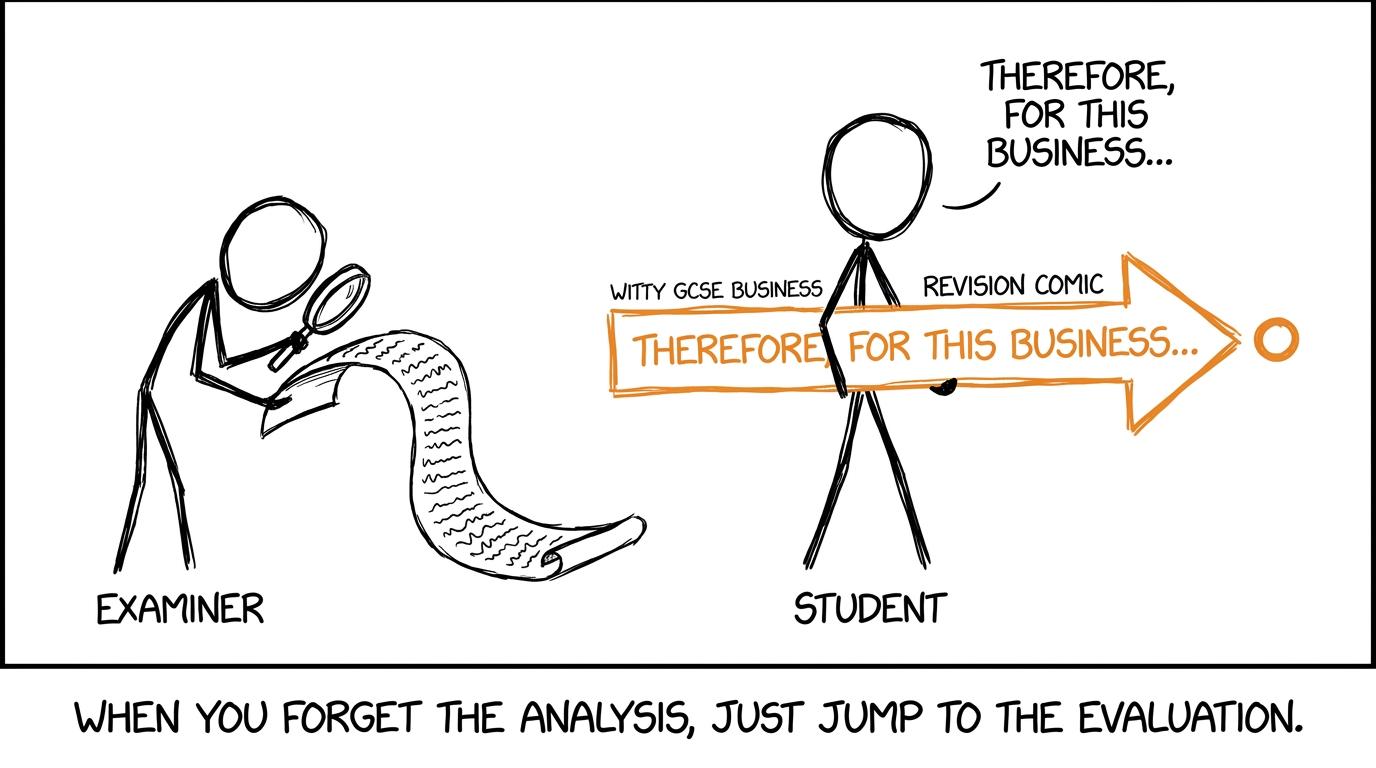 An examiner finally spots a clear judgement in a long GCSE Business answer
Common mistakes that keep students at grade 6
Writing generic paragraphs
A technically correct paragraph may earn limited credit if it ignores the case study. Use details that genuinely influence the argument rather than repeatedly inserting the business's name.
Ending analysis too early
“The business will make more profit” often needs further support. Explain what changes revenue or costs, why that change is plausible and how it affects the objective in the question.
Treating evaluation as a list
Two advantages and two disadvantages do not automatically form an evaluation. Compare their significance and decide which should influence the final decision most.
Giving an unsupported conclusion
A judgement needs a reason grounded in context. State your decision, identify the decisive factor and explain why it outweighs the alternative.
Ignoring units and working
Write the formula, substitute carefully and show intermediate steps. Then check the sign, size, unit and requested rounding of the result.
Revising only favourite topics
Comfort can look like progress. Use topic checklists and assessment evidence to spend more time on weaknesses, especially topics that connect several areas of the course.
Using predicted papers as forecasts
Predicted papers are practice resources, not guarantees of what will appear. Use them to practise timing and unfamiliar combinations of skills. MathsGenie's predicted maths papers can support general exam discipline and numerical fluency alongside your exam board's official Business materials.
Your next step from grade 6 to grade 8
The jump is not made by filling every evening with more revision. It comes from making each answer more deliberate.
Choose one recent paper and classify every lost mark. If knowledge is secure but application is weak, stop rereading and practise adapting ideas to case studies. If conclusions are vague, practise making decisions based on objectives and constraints. If calculations are unreliable, return to the underlying maths until the process feels ordinary.
That is the quiet advantage of focused revision: improvement becomes measurable. Use MathsGenie's free GCSE revision lessons, practice questions, video solutions, mini tests, past papers and predicted papers to strengthen the numerical side of your exams. Pair that work with your GCSE Business specification, official papers and mark schemes.
A grade 8 answer does not try to sound impressive. It makes a relevant point, proves why it matters and knows when the evidence is strong enough to make a decision. Start practising that process today.











