

GCSE Biology CCEA Revision When You’re Stuck at a Pass
GCSE Biology revision for CCEA students stuck at a pass grade: a practical plan, common mistakes, and how to use YesGenie maths practice to boost marks.
You can feel it in the way you underline the same sentence twice. You’re revising, you’re trying, you’re doing “a bit of everything”, and yet your GCSE Biology marks keep coming back as a pass grade that won’t budge. If you’re a CCEA student, that feeling can be even sharper because the paper style rewards precision: the right keyword, the right unit, the right step in the method.
Here’s the twist: even though this is GCSE Biology, the fastest way out of a pass grade often looks like maths revision. Not harder notes. More reps. More mark schemes. A calmer feedback loop. That’s exactly the habit YesGenie helps you build.
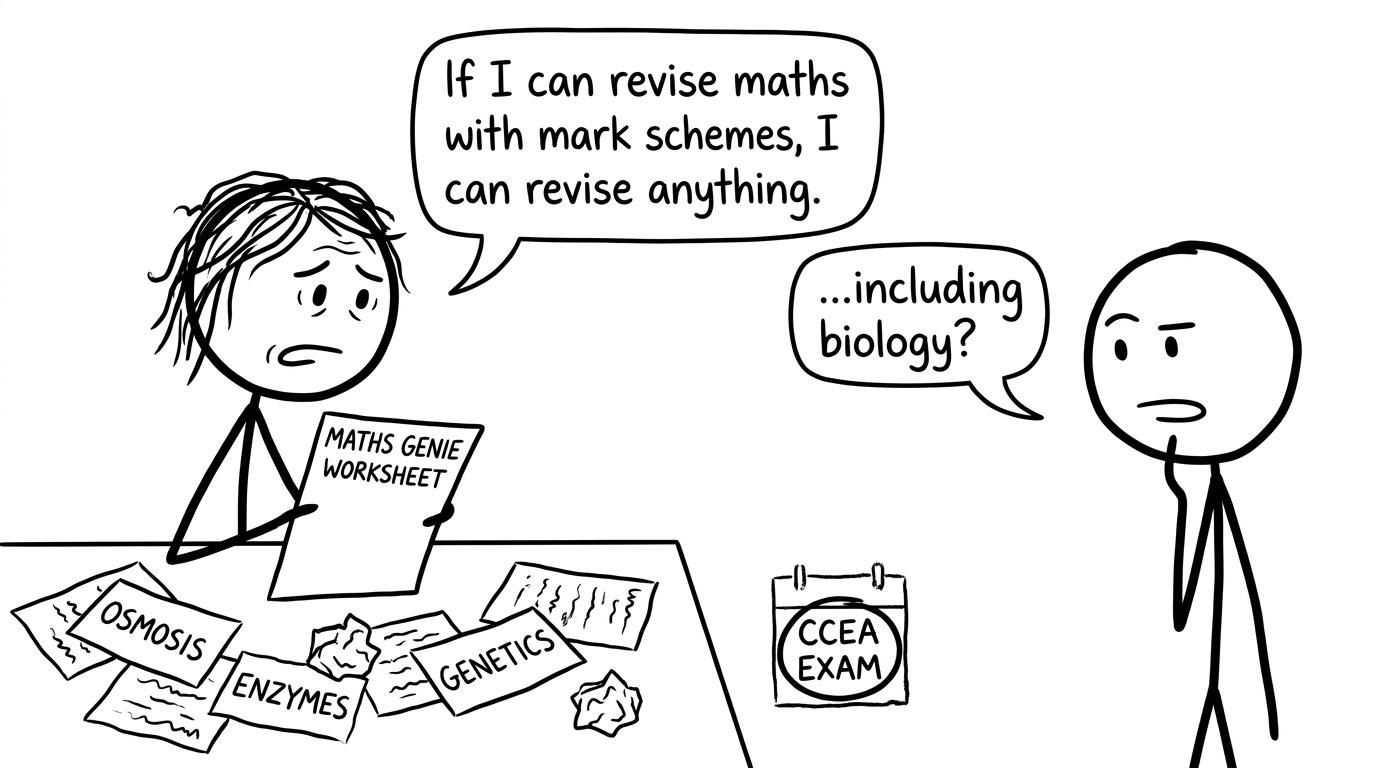 A GCSE student mixing Biology flashcards with Maths Genie practice
The “pass grade trap” (and why it happens in GCSE Biology)
Most students stuck at a pass grade aren’t missing all the knowledge. They’re missing reliable marks.
In GCSE Biology, reliable marks come from three things:
- Recall that’s specific (e.g. diffusion vs osmosis vs active transport)
- Processes explained in the correct order (so the examiner can award method marks)
- Maths-in-biology accuracy (units, rearranging, substitution, rounding)
If you’re inconsistent on any one of those, you can revise for hours and still hover around the same score.
And that’s why a maths student’s approach works: practise questions, diagnose mistakes, repeat.
A quick checklist: what to do this week (CCEA-friendly)
Use this as your GCSE reset plan:
- Pick two weak topics (not ten).
- Do one timed set of exam questions per topic.
- Mark with a mark scheme and write a mistakes log.
- Redo the same style of question 48 hours later.
- Add one maths skill that keeps costing you marks (ratios, standard form, graphs, units).
For the maths side of the plan, you can pull questions and mark schemes from YesGenie straight away: GCSE Past papers and the wider Resources page are ideal for building that repetition habit.
Revise GCSE Biology like a maths student (without making it miserable)
A lot of GCSE revision advice is basically: “make nicer notes”. Notes feel productive because they’re quiet. But marks come from performance.
A maths student improves by cycling:
- Learn the method
- Attempt questions
- Mark honestly
- Fix one error
- Repeat under time
That cycle is perfect for GCSE Biology too.
Step one: swap rewriting for retrieval
Instead of rereading, do this:
- Write the topic title (e.g. “enzymes”)
- Spend 3 minutes writing everything you can remember
- Then check your revision guide and add missing details in a different colour
You are training the act of recall, which is what the exam demands.
Step two: mark schemes are your teacher now
When you’re stuck at a pass grade, your biggest jump comes from learning how marks are awarded.
Treat each mark scheme like a miniature lesson:
- What keywords did it require?
- Did it want a cause, effect, and conclusion?
- Did it accept alternatives (e.g. “moves down a concentration gradient” vs “from high to low concentration”)?
This is exactly why students love YesGenie for maths: it’s built around practice questions, mark schemes, and clear solutions. Even if you’re revising GCSE Biology, you can build the same routine using Mini Tests for your maths confidence and then applying that discipline to science questions.
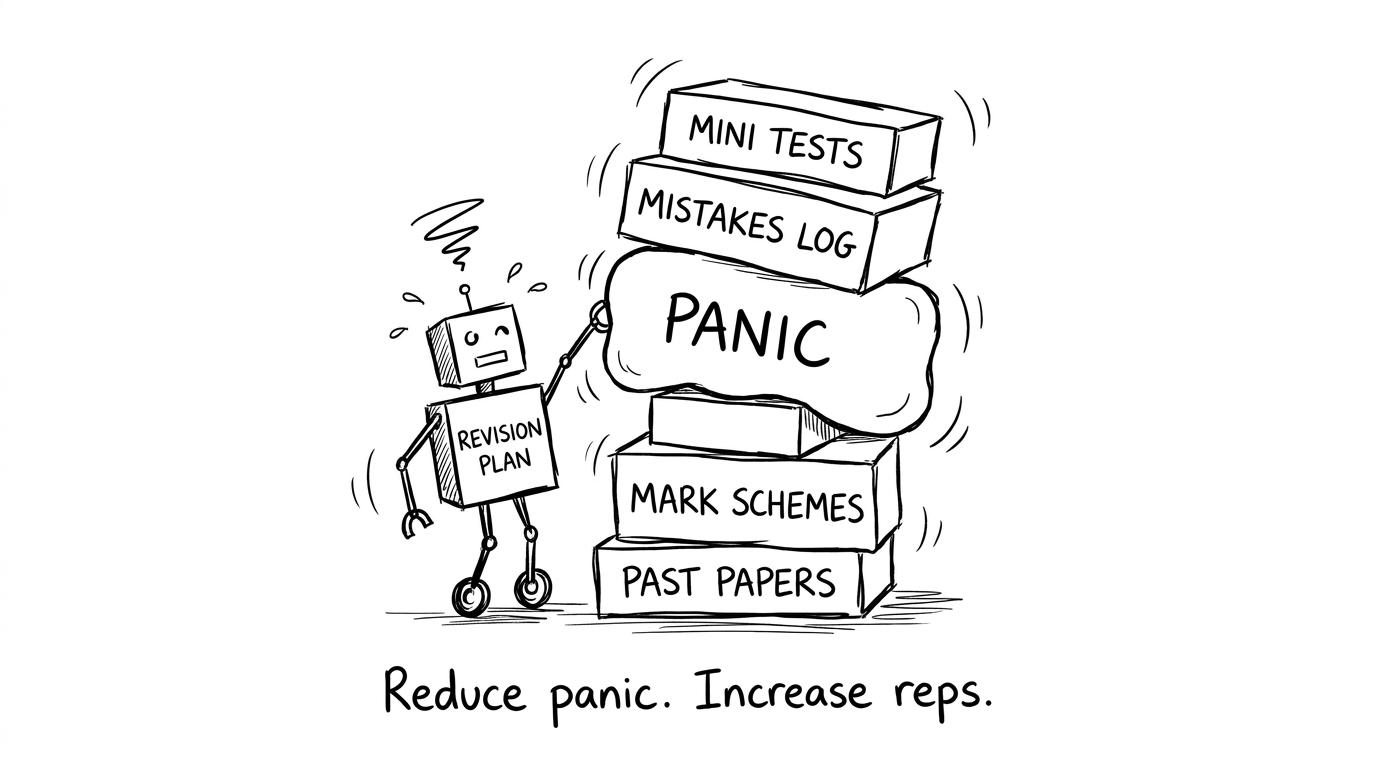 Revision plan robot stacking blocks of practice
The easiest marks you’re leaving behind: maths in GCSE Biology
CCEA GCSE Biology, like AQA, Edexcel, OCR and Eduqas, includes maths skills. If you’re stuck at a pass grade, you’re often dropping quiet marks: the ones you could earn with method and units even when the biology feels shaky.
Below are two worked examples (maths-style), because method marks are real marks.
Worked example: percentage change in a biology context
A student’s heart rate increases from 727272 bpm to 909090 bpm.
Percentage increase:
percentage increase=90−7272×100=1872×100=0.25×100=25% \text{percentage increase} = \frac{90 - 72}{72} \times 100 = \frac{18}{72} \times 100 = 0.25 \times 100 = 25\% percentage increase=7290−72×100=7218×100=0.25×100=25%What this trains (for GCSE): selecting the right numbers, subtracting in the right order, and communicating the final answer with a percent sign.
If percentages are a weak spot, build it using the YesGenie maths topic practice for foundation and higher students, then bring it back into biology calculations.
Worked example: rearranging a formula (common in required practical-style questions)
Suppose a rate is defined as:
rate=changetime \text{rate} = \frac{\text{change}}{\text{time}} rate=timechangeIf the rate is 0.80.80.8 units per second and the time is 454545 seconds, find the change.
Rearrange:
change=rate×time \text{change} = \text{rate} \times \text{time} change=rate×timeSubstitute:
change=0.8×45=36 \text{change} = 0.8 \times 45 = 36 change=0.8×45=36This is GCSE maths disguised as science. If you can reliably rearrange and substitute, you protect marks even on topics you don’t love.
For timed practice habits, many students like the idea of short papers and timed sets. YesGenie’s Resources area includes formats that suit that mindset, and you can also practise exam technique using GCSE Past papers.
Exam technique that moves you from pass to strong pass (or higher)
CCEA papers, like other UK GCSE papers, reward students who can translate the question.
Read the command word like it’s a method mark
Train yourself to spot:
- Describe: what you can see (no explanation)
- Explain: cause and effect, using biology ideas
- Compare: both sides, with a linking phrase
- Calculate: show the method and units
If you’re stuck at a pass grade, you often “explain” when it asked you to “describe”, or you write a correct idea but not the chain that earns the marks.
Collect the easy marks first
In GCSE exams, confidence is a strategy. Start by banking what you can:
- definitions you know
- graph reading
- single-mark recall
- straightforward calculations
Then return to the longer explanations. This reduces panic and improves accuracy.
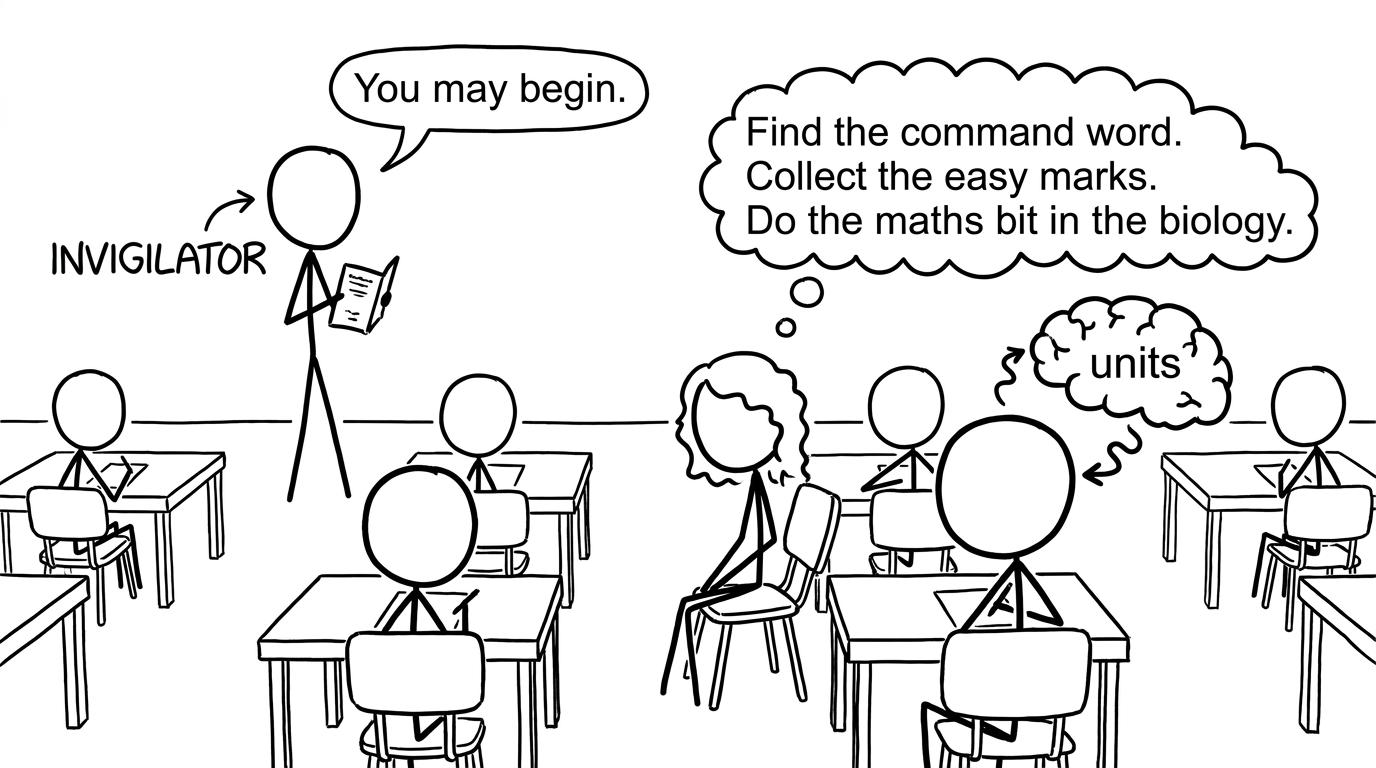 Exam hall scene focusing on command words and units
A simple two-week plan for CCEA GCSE Biology (using maths-style reps)
You don’t need a perfect timetable. You need a repeatable loop.
Week 1: build accuracy
- Day 1: Topic A retrieval + exam questions + mark scheme corrections
- Day 2: Topic B retrieval + exam questions + corrections
- Day 3: Maths skill focus (percentages, graphs, ratio) using a mini test routine
- Day 4: Topic A redo (same style questions, timed)
- Day 5: Topic B redo (timed)
- Weekend: one mixed paper section, then review
Week 2: build speed
- Repeat the loop but cut time slightly
- Prioritise questions that previously lost you marks
- Practise writing answers in the style the mark scheme rewards
To sharpen the timed element, you can use YesGenie exam practice as your “time pressure gym”: Edexcel GCSE Maths Predicted Papers and even Paper 1 - Video Solutions show what disciplined working looks like under exam conditions. The subject is maths, but the habits transfer directly into GCSE Biology.
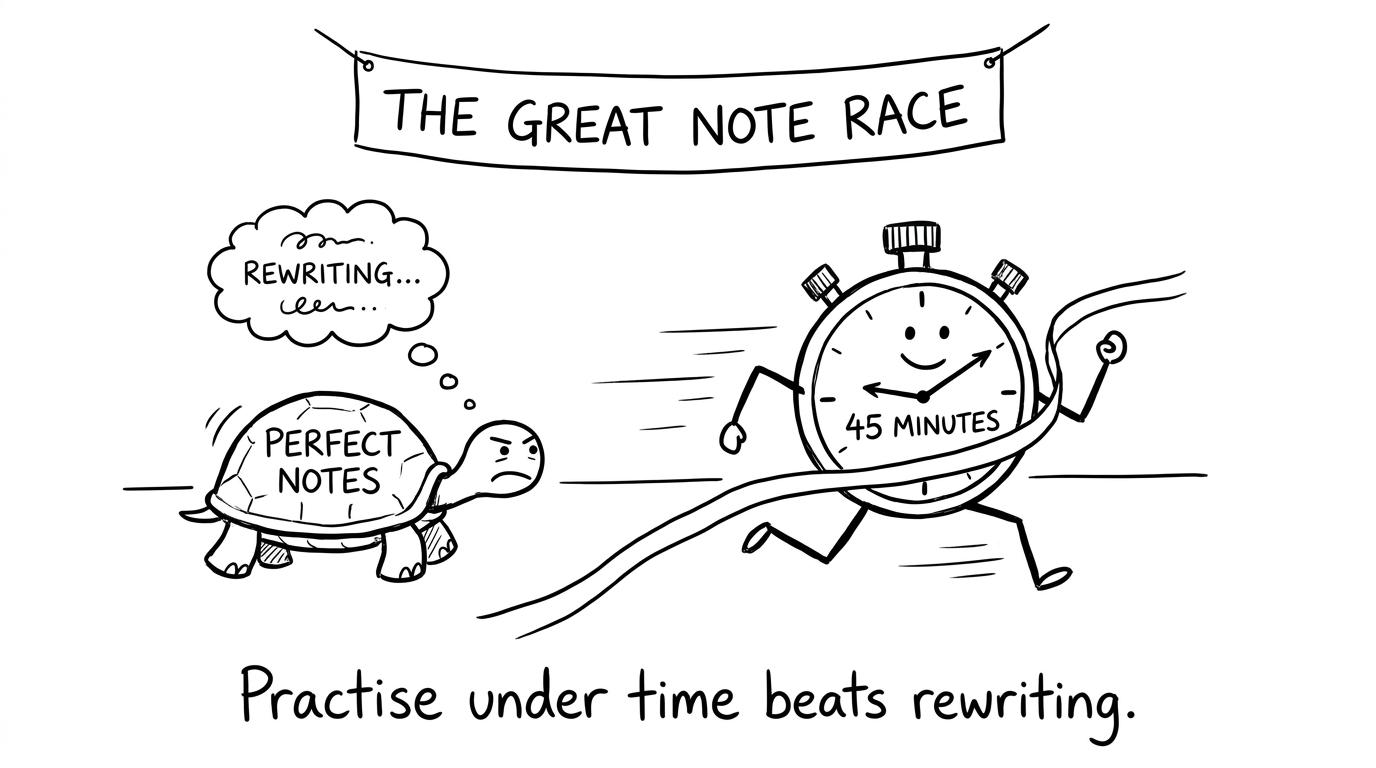 Stopwatch racing perfect notes
Common mistakes that keep CCEA students stuck at a pass grade
- Vague language: writing “it goes in” instead of “moves from high to low concentration by diffusion”.
- Missing the unit: correct number, zero credit, because the unit was required.
- Rounding too early: you lose accuracy in multi-step calculations.
- Not showing working: especially on calculation questions where method marks exist.
- Answering the wrong command word: explaining when asked to describe, or giving one side in a compare question.
- Over-revising content and under-practising questions: you feel busy, but marks don’t change.
If you recognise yourself in those, that’s good news: they’re fixable with a practice-and-feedback loop.
Bringing it home: a GCSE pass grade is not a personality trait
Being stuck at a pass grade in CCEA GCSE Biology doesn’t mean you “can’t do science”. It usually means your revision is too gentle to change your exam performance. The way out is practical and surprisingly calm: practise questions, mark schemes, a mistakes log, and timed repeats.
And if you want one simple advantage: make your maths marks automatic. Use YesGenie to build that engine with revision lessons, practice questions, mark schemes, mini tests, and exam-style papers. Start with Resources, add regular practice from GCSE Past papers, and if you like exam conditioning, try Edexcel GCSE Maths Predicted Papers as a model for timed discipline. Then take that same method back into GCSE Biology.
Your goal isn’t perfect revision. It’s repeatable revision that earns marks and gets you beyond that pass grade.










