GCSE Biblical Hebrew Grade 5 Meaning Explained
GCSE Biblical Hebrew grade 5 meaning, ability level and old-grade comparison explained clearly, with practical advice for balancing GCSE maths revision.

A results sheet can make years of learning look strangely small. One subject, one number, one line. Yet that number carries several different questions: did I pass, what can I actually do, and how will other people interpret it?
The short answer to gcse biblical hebrew grade 5 meaning is this: a grade 5 is a solid achievement above the grade 4 benchmark. It broadly sits between the old grades C and B, although there is no exact one-to-one conversion. It suggests that you have developed a secure working knowledge of Biblical Hebrew and can apply it with reasonable accuracy across translation, language and literature questions.
It does not mean that every answer was grade 5 standard, nor does it reveal a fixed percentage. Grade boundaries are set after the papers have been taken and can change from one exam series to another.
Grade 5 at a glance
Here is the practical interpretation:
- Grade 5 is higher than grade 4, the numerical grade aligned with the old grade C benchmark.
- It is commonly described as being around a high C or low B under the former letter-grade system.
- It represents competent, generally secure performance rather than complete mastery.
- It is awarded from your overall mark, so strengths in one part of the assessment may balance weaker performance elsewhere.
- Biblical Hebrew is not divided into foundation and higher tiers in the way GCSE Maths is.
- The mark needed for grade 5 is not permanently fixed and must be checked against the relevant year's official grade boundaries.
For a maths student, the most useful comparison is not that Biblical Hebrew and maths test the same abilities. They do not. It is that a grade is a summary of performance across an entire assessment, not a diagnosis of every skill you possess.
 A student searches for the instruction manual hidden behind a GCSE grade
What a grade 5 represents in Biblical Hebrew
OCR's GCSE Biblical Hebrew qualification assesses language and literature. Students need to understand vocabulary and grammar, translate Biblical Hebrew, respond to unfamiliar material and demonstrate knowledge of prescribed literary texts.
A student achieving grade 5 would normally be able to handle a meaningful range of these demands. In practical terms, that is likely to include:
- recognising a useful range of vocabulary and common grammatical forms;
- understanding the main sense of Biblical Hebrew passages;
- producing translations that are generally coherent, although not flawless;
- using contextual and textual knowledge when answering literature questions;
- supporting interpretations with relevant details from a passage;
- communicating ideas clearly enough to earn marks across different question types.
The important word is generally. Grade 5 does not require the consistency, precision or depth expected at the very highest grades. A translation might preserve the central meaning while losing some nuance. A literature response might show sound knowledge but miss opportunities for detailed analysis. Grammatical understanding may be secure in familiar constructions and less reliable in complex ones.
That is still genuine subject competence. Biblical Hebrew requires students to move between scripts, grammatical structures, translation choices and literary interpretation. A grade 5 indicates that the student can do this successfully often enough to produce a solid overall examination performance.
How grade 5 compares with the old letter grades
The numerical and letter systems cannot be converted perfectly. The newer grading structure was designed with more grades at the top, and official comparisons focus on selected benchmark grades rather than matching every number to one letter.
| Current grade | Broad old-grade comparison | Sensible interpretation |
|---|---|---|
| Grade 9 | Above the old A* threshold | Exceptional performance |
| Grade 8 | Between grades A and A* | Very strong performance |
| Grade 7 | Aligned broadly with grade A | Strong performance |
| Grade 6 | Around the upper part of grade B | Secure performance |
| Grade 5 | Around a high C or low B | Strong achievement above grade 4 |
| Grade 4 | Aligned broadly with grade C | Standard grade 4 benchmark |
| Grades 1 to 3 | Broadly cover parts of old grades D to G | Developing performance |
This table should be read as guidance, not as a conversion formula. It would be misleading to say that every grade 5 is simply an old B or that every grade 5 is an old C. The most accurate description is between the old C and B standards.
You may also hear grade 5 called a “strong pass”. That term is particularly associated with government school-performance measures for GCSE English and maths. Grade 4 is commonly described as the standard pass benchmark, while grade 5 is the higher benchmark. These labels do not change the subject knowledge represented by your Biblical Hebrew result, and schools or sixth forms can set their own entry requirements.
Why grade boundaries matter
A grade is not tied to one permanent percentage. Awarding organisations set grade boundaries for each examination series so that differences in paper difficulty can be taken into account.
Suppose one year's paper contains unusually demanding translation material. Requiring exactly the same raw mark as in a more accessible year could unfairly change the standard represented by the grade. Boundaries therefore provide the link between raw marks and comparable qualification standards.
This means you should not assume that a particular percentage always guarantees grade 5. Use the official grade boundaries for the exact exam series and specification when interpreting a result. Boundaries from previous years can guide revision targets, but they cannot predict a future boundary with certainty.
Maths works in the same broad way. When using GCSE Maths past papers, record the raw mark first and then use the boundary belonging to that paper's series. Mixing a paper from one year with another year's boundaries produces a less reliable judgement.
What grade 5 does not tell you
A single grade cannot reveal precisely where marks were gained or lost.
Two students can receive grade 5 for different reasons. One might translate accurately but give brief literature answers. Another might write thoughtful responses on prescribed texts while dropping marks through grammatical uncertainty. Their overall outcomes are similar, but their next revision steps should be different.
The grade also does not tell you how far your mark was from grade 4 or grade 6. A student could be just above the lower grade boundary or only a few marks below the next one. Your component marks, paper scripts and teacher feedback provide a more useful picture.
This is a valuable principle for maths revision too. “I am working at grade 5” is less actionable than “I lose marks on ratio, algebraic manipulation and multi-step geometry”. MathsGenie's grade 5 GCSE revision resources help turn the broad grade target into specific topics that can be practised.
Using the result to plan maths revision
Students searching for the meaning of a Biblical Hebrew grade are often trying to understand their overall GCSE position. The temptation is to treat every subject equally: the same number of hours, the same revision method and the same target. That feels organised, but it ignores where marks are easiest to recover.
Begin with evidence. In maths, complete a paper under timed conditions and mark it carefully. Separate your lost marks into three groups:
- content you did not know;
- methods you knew but could not apply;
- avoidable errors involving arithmetic, notation or reading the question.
Then use MathsGenie's GCSE revision lessons to revisit the weakest topics. Each revision session should have a clear purpose: learn the method, answer practice questions, check the mark scheme and return later to see whether the improvement lasts.
If full papers currently feel too large, GCSE Maths mini tests can make diagnosis more manageable. Short, focused practice often reveals more than rereading notes because it forces you to retrieve and apply the method.
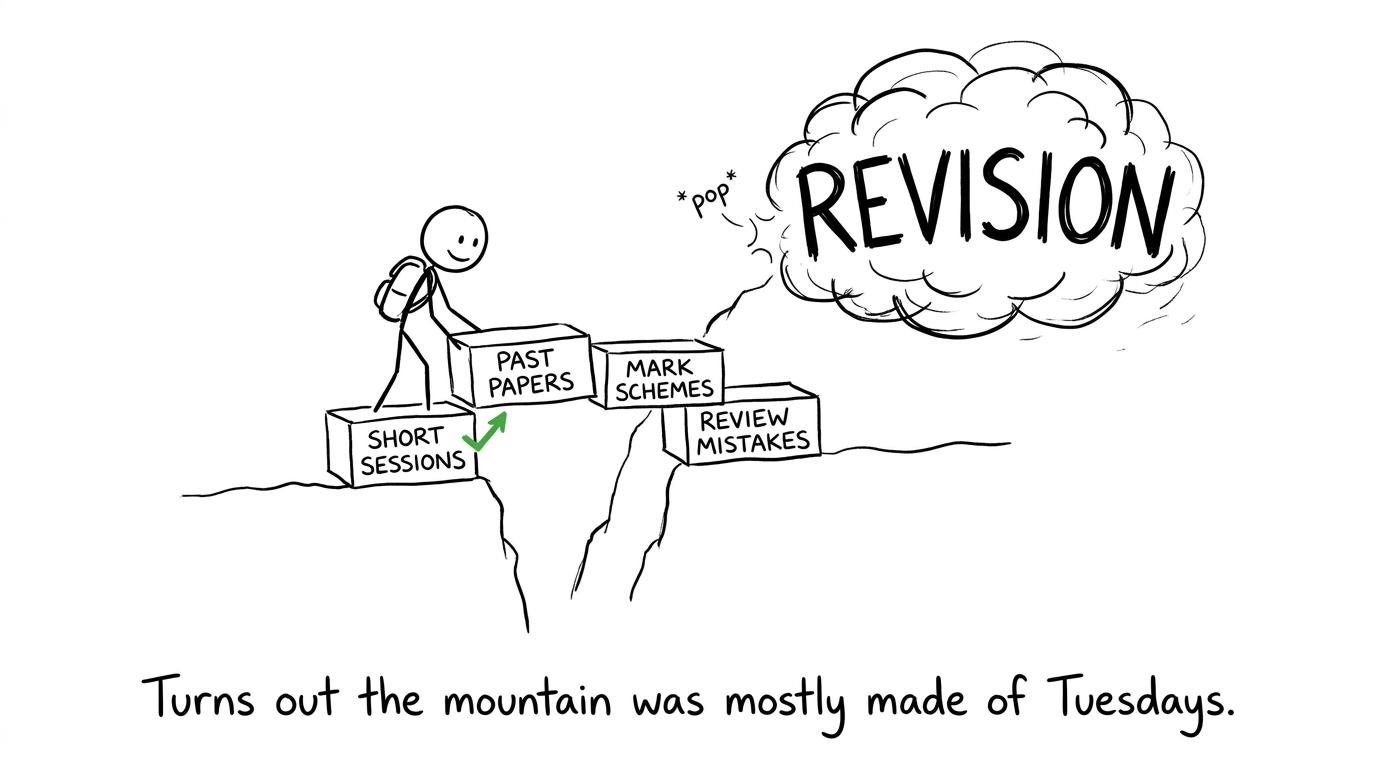 A student builds a revision bridge from small, repeatable habits
A sensible cross-subject revision strategy
Biblical Hebrew and maths reward different kinds of knowledge, but both benefit from active recall, deliberate practice and honest review.
For Biblical Hebrew, a session might focus on vocabulary retrieval, grammatical recognition, translation or prescribed literature. For maths, it might focus on one topic followed by mixed questions. The shared principle is simple: do something that produces evidence of what you can recall without support.
A balanced week might contain:
- short vocabulary or grammar retrieval sessions;
- focused maths topic practice;
- one timed section from a paper;
- careful marking using official mark schemes;
- a later attempt at questions previously answered incorrectly.
MathsGenie's GCSE predicted papers can support exam-season practice, while A Level Maths revision provides a clear next step for students continuing with maths after GCSE. Predicted papers are practice resources, not forecasts of exact examination questions, so they should supplement broad specification coverage rather than replace it.
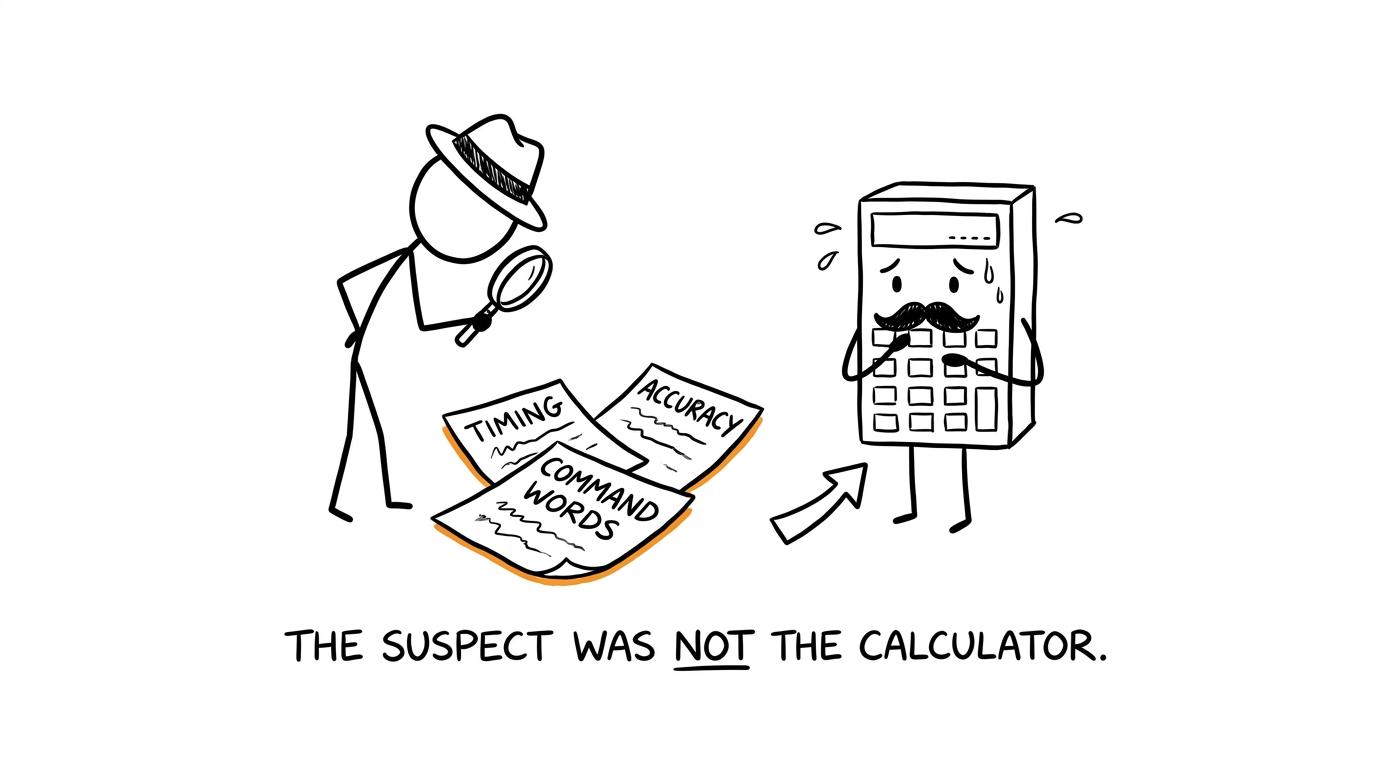 An exam-paper detective discovers that the calculator was not responsible
Common mistakes when interpreting grade 5
Treating grade 5 as an exact old letter grade
It is more accurate to describe it as sitting between the old C and B standards. The grading systems overlap at selected benchmark grades rather than matching perfectly throughout.
Assuming grade 5 always requires the same mark
Grade boundaries vary by examination series. A boundary from a previous paper is useful context, not a guaranteed target for the next examination.
Calling it a barely achieved pass
Grade 5 is above the grade 4 benchmark. It represents a solid outcome and evidence of meaningful subject knowledge, even though there remains room to develop greater precision and consistency.
Believing the grade proves every skill is equally secure
The final grade combines performance across the qualification. It can conceal important differences between translation, grammar, comprehension and literature.
Revising only questions labelled grade 5
Grades emerge from accumulated marks. In maths, securing accessible marks reliably can be as important as attempting harder material. Work through the appropriate MathsGenie revision scheme, rather than treating one grade label as a fence around what you should learn.
Turn the number into a next step
A grade 5 in GCSE Biblical Hebrew means more than “not a 4” and less than complete mastery. It represents a solid, credible level of competence, broadly between the former grades C and B. The student can understand and apply important aspects of the language and literature, although accuracy, depth and consistency can still improve.
The healthiest response to any GCSE grade is curiosity. Find out which skills produced it, which skills limited it and where the next few marks are most likely to come from.
For maths, MathsGenie gives that process a structure. Start with the free revision lessons and practice questions, measure your progress with mini tests and past papers, learn from video solutions and mark schemes, then use predicted papers as part of your final preparation. A grade summarises the last performance. Good revision decides what happens next.