Is a GCSE Bengali Revision Bootcamp Worth It?
GCSE Bengali revision bootcamp costs vary. See what courses offer, how to judge teaching quality, and when free revision is the wiser choice for exams.
Exam holidays create a peculiar kind of pressure. Every subject seems urgent, every unfinished topic feels dangerous, and a paid course can begin to look like the safest answer. A GCSE Bengali revision bootcamp may be worthwhile when it provides expert feedback, realistic speaking practice and a structure you cannot reproduce alone. It is not automatically worth paying for simply because it is intensive or scheduled close to the exam.
For students also preparing for GCSE maths, there is another cost to consider: time. A full day on Bengali is a full day unavailable for algebra, geometry or past-paper practice. The right decision depends not only on the course fee, but on what the bootcamp teaches, what support you already have and which marks you are currently missing.
The quick bootcamp value checklist
Before booking, ask the provider for clear answers to these questions:
- Is the course designed for your exact GCSE Bengali specification and tier?
- How many hours involve live teaching rather than independent worksheets?
- Does the tutor have recent experience of the relevant assessment format?
- Will you receive individual feedback on speaking and writing?
- Are groups small enough for every student to participate?
- Are materials, mock tasks and feedback included in the advertised fee?
- Is the course focused on your weakest skills rather than general revision?
- What are the cancellation, refund and safeguarding arrangements?
- How much maths revision time will the course replace?
If a provider cannot explain what happens during each session, the word “bootcamp” tells you very little. Intensity is a timetable, not a guarantee of quality.
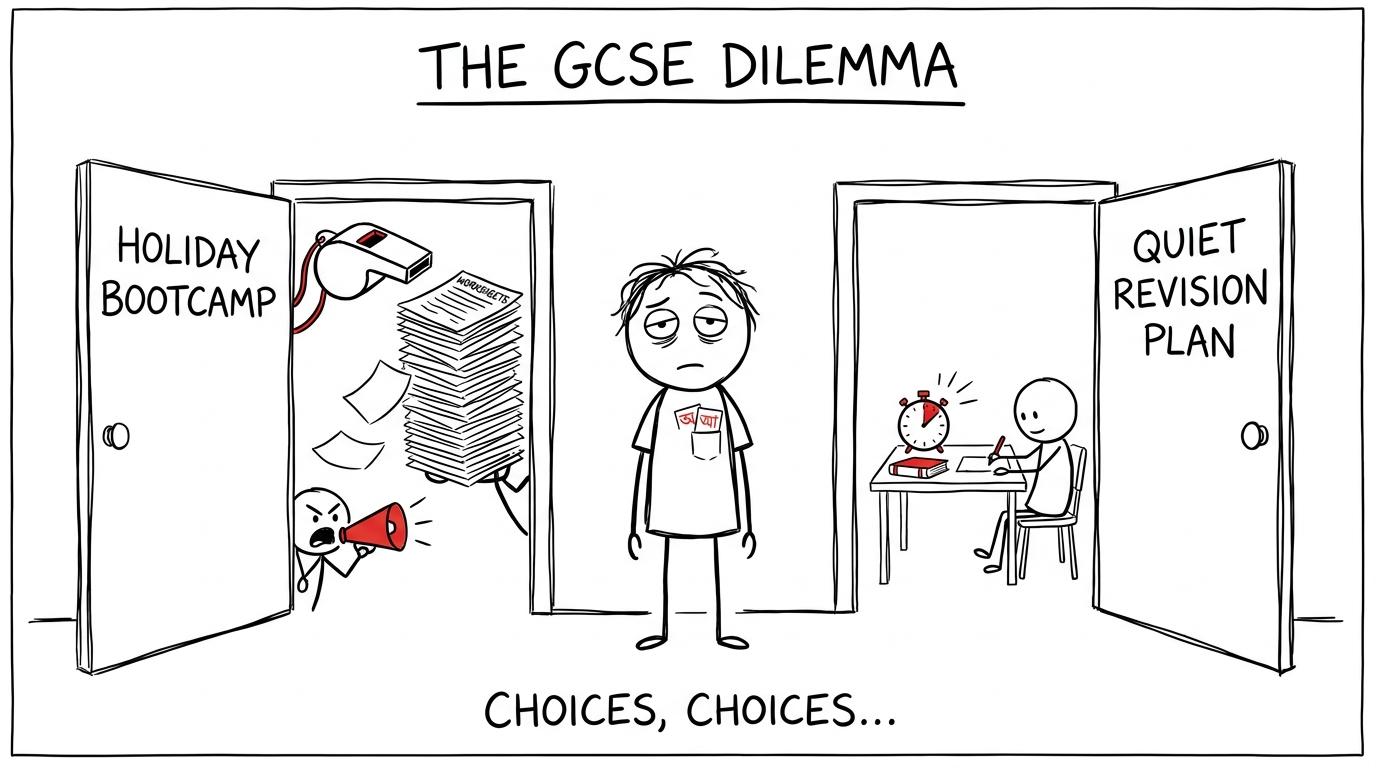 A student choosing between a holiday bootcamp and a quiet revision plan
What GCSE Bengali revision bootcamps actually offer
Holiday courses differ considerably, but useful programmes tend to combine specification coverage with timed practice and feedback. They should prepare students for the assessed skills rather than offering conversational Bengali alone.
Pearson Edexcel's GCSE Bengali qualification assesses listening, speaking, reading and writing through separate papers. Students should check the latest specification and exam arrangements with their school because qualification details can change, and the course must match the awarding body and tier for which they have been entered.
Speaking rehearsal
Speaking is one of the hardest elements to recreate through silent independent revision. A strong course may offer timed role-play preparation, picture-based discussion and general conversation practice, followed by specific feedback on pronunciation, accuracy, spontaneity and development.
This can be genuinely valuable for a student who understands Bengali at home but rarely gives extended, exam-style answers. Everyday fluency and examination performance overlap, but they are not identical. Marks depend on responding to the task under the required conditions.
Ask whether every student will speak individually and how much direct practice is included. In a large online group, a “speaking workshop” may involve more listening than speaking.
Writing feedback
A useful bootcamp should do more than distribute model answers. It should help students recognise task demands, select suitable vocabulary, communicate across time frames and check grammar methodically.
Individual marking matters here. Generic advice such as “add more detail” is less useful than feedback identifying where communication became unclear, where a verb form was inaccurate or where an answer failed to cover part of the prompt.
Check whether written work will be marked during the course, after it, or not at all. Feedback promised in an advertisement may mean whole-class commentary rather than personal assessment.
Listening and reading practice
Courses often include listening exercises, vocabulary retrieval, reading comprehension and translation. These sessions are most valuable when the tutor teaches a repeatable process: reading the question first, noticing distractors, locating evidence and moving on when one unfamiliar word appears.
Simply completing many questions is not enough. Students need time to inspect errors and decide whether each one came from vocabulary, grammar, attention or exam technique.
Structure and accountability
Sometimes the product being purchased is not secret knowledge. It is a protected block of time.
A fixed timetable can help a student who postpones language revision because maths and science feel more concrete. That structure has value, particularly when the course requires preparation and follow-up. But it should not be confused with guaranteed progress. The student still has to retrieve vocabulary, complete corrections and revisit weak material afterwards.
How to decide whether the cost is reasonable
Course fees vary by provider, delivery format, group size and duration. Rather than relying on the headline price, calculate the effective cost of what you will actually receive:
effective hourly cost=total course costlive teaching hours\text{effective hourly cost} = \frac{\text{total course cost}}{\text{live teaching hours}}effective hourly cost=live teaching hourstotal course costThe total should include compulsory materials, booking fees and travel costs where relevant. Do not count lunch breaks or unsupervised study as live teaching.
Then assess the value of the teaching itself. A cheaper course without personal feedback may offer less benefit than a shorter, focused session addressing speaking or writing. Equally, an expensive course is poor value when it mostly reproduces tasks that a school has already supplied.
Compare the course with your actual gap
A bootcamp is more likely to be worth paying for when:
- you lack anyone with whom to practise exam-style speaking;
- your teacher has identified specific weaknesses that the course addresses;
- you need informed feedback on extended writing;
- your school has limited Bengali teaching capacity;
- the group is appropriately sized and specification-specific;
- you will complete follow-up revision after the course.
It is less likely to represent good value when:
- the provider gives no detailed timetable or tutor information;
- most sessions consist of independent worksheets;
- the content does not match your specification or tier;
- you already receive regular individual feedback at school;
- you are booking mainly because the exam is close and you feel anxious;
- attendance would remove time from a subject in which your need is greater.
Urgency can make any organised solution feel valuable. The calmer question is: what will this course let me practise or learn that I cannot already access?
The hidden cost for students revising maths
Revision time is finite. Bengali may need attention, but so may fractions, equations, trigonometry or statistics. The decision should therefore sit inside a whole-exam plan rather than being made subject by subject.
Begin with your exam dates and recent evidence. Use marks from school assessments, topic tests and timed papers to identify where revision time has the greatest likely return. For maths, the free GCSE revision lessons and practice questions allow you to target individual topics instead of revising everything again.
A bootcamp taking several holiday days may still be sensible if Bengali speaking and writing are your largest gaps. If your maths paper is sooner, however, protect time for GCSE maths past papers and careful correction. Completing a paper without reviewing mistakes measures performance; correcting it develops performance.
MathsGenie's predicted GCSE maths papers can also support timed preparation closer to the exam. They should complement, not replace, official past papers and broad specification revision.
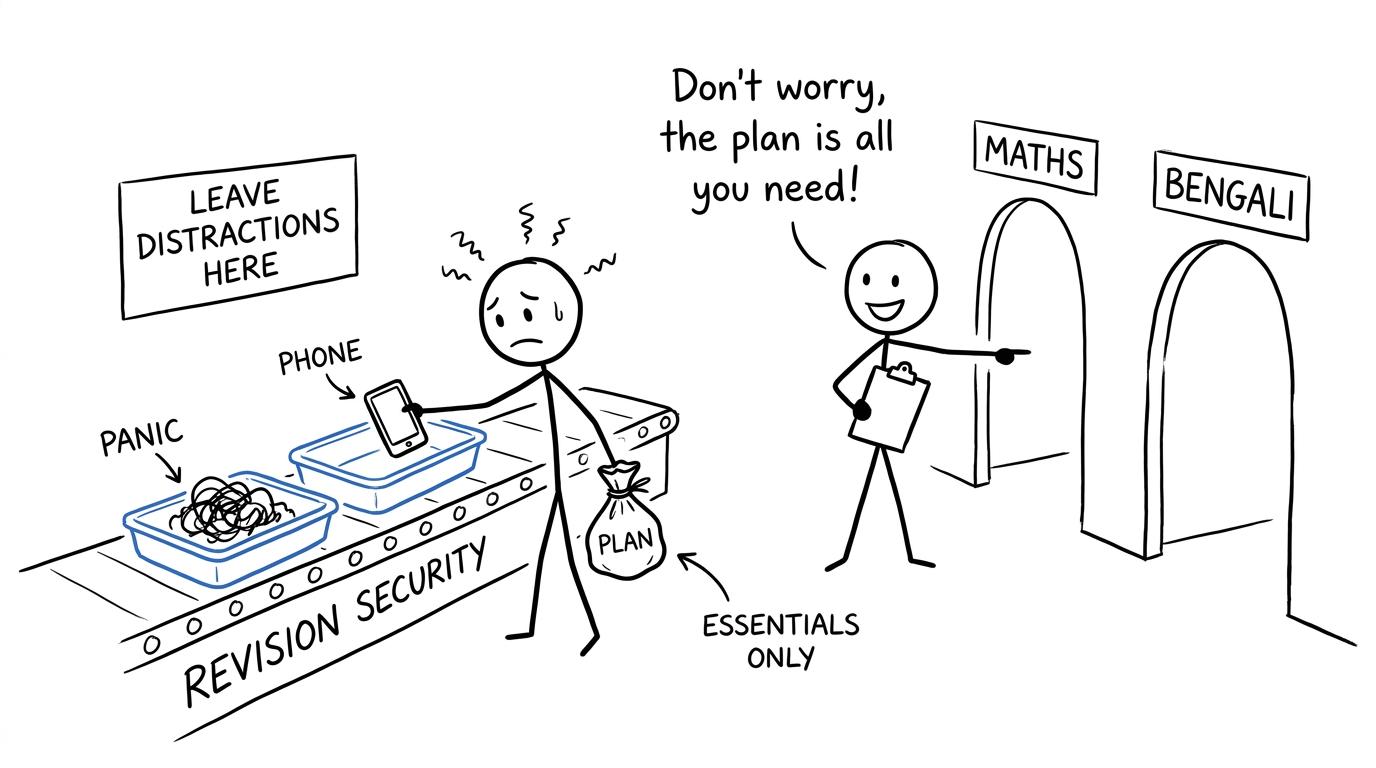 A GCSE student carrying a revision plan through revision security
A better way to plan the holiday
Think in terms of outcomes rather than hours. “Revise Bengali all morning” is vague. “Complete one timed reading task, correct it and prepare speaking responses” is observable. The same principle applies to maths.
Protect subject balance
Divide available revision sessions according to evidence, not guilt. Your plan might include Bengali speaking practice on one day and a maths paper on another, followed by targeted work using the MathsGenie GCSE topic library.
Leave space between demanding sessions. An intensive course followed immediately by several hours of maths may produce attendance without much concentration. Breaks, sleep and manageable study blocks are part of an effective plan, not rewards for finishing one.
Use free resources where they are strongest
Paid teaching is often most defensible for feedback-heavy skills such as speaking and extended writing. Independent resources are particularly effective when answers can be checked clearly.
For maths, MathsGenie combines videos, practice questions and mark schemes so that students can learn a method and test it straight away. Maths mini tests can reveal whether a topic is secure without requiring a complete paper, while the GCSE revision planner helps turn a long topic list into scheduled work.
Students considering A Level alongside GCSE planning can also explore the free A Level maths revision resources, but current GCSE preparation should remain the immediate priority.
Common mistakes when choosing a Bengali holiday course
Booking before diagnosing the problem
A student who needs speaking confidence may gain little from a course dominated by reading exercises. Use teacher feedback and marked work to identify the gap before comparing providers.
Assuming a heritage speaker needs no preparation
A student may communicate comfortably with family yet be unfamiliar with formal writing, translation, timed tasks or the exam's required response style. Confidence in conversation should not replace specification-based practice.
Confusing long hours with good teaching
A full-day course may include registration, breaks, independent work and broad presentations. Compare live teaching time, opportunities to participate and the quality of feedback.
Failing to check the tier and specification
Materials designed for a different assessment structure can create false confidence. Confirm the awarding body, qualification code where possible, tier and paper format with the provider and your school.
Ignoring the rest of the exam timetable
A course can be useful and still be badly timed. Protect preparation for nearby maths examinations, especially if recent papers reveal substantial gaps at foundation or higher tier.
Expecting one course to replace continued revision
Bootcamps compress support; they do not compress memory. Vocabulary and exam routines need repeated retrieval after the course. Ask for materials you can revisit and schedule follow-up practice before booking.
Make the decision that solves the real problem
A GCSE Bengali revision bootcamp is worth the cost when it gives you scarce, relevant support: knowledgeable teaching, individual feedback, realistic speaking practice and a structure matched to your specification. It is poor value when branding and urgency conceal generic worksheets, oversized groups or content you could cover independently.
Choose with evidence. Ask detailed questions, compare the effective teaching time and consider what the course removes from your holiday as well as what it adds.
Then make the rest of your revision plan affordable and precise. Use MathsGenie's free revision lessons to repair weak topics, practise with exam questions, check mark schemes, complete mini tests and build confidence through past and predicted papers. Start with the GCSE maths revision hub, choose the next weakness rather than the easiest topic, and give every revision session a clear purpose.