

GCSE Bengali Grade: Sixth Form Entry Guide
GCSE Bengali grade sixth form entry explained: see when Bengali counts, what admissions teams prioritise, and how to protect your future maths options.
The search phrase gcse bengali grade sixth form entry hides a simple worry: could one language result decide what happens next?
Usually, no. Sixth forms and colleges may count GCSE Bengali towards your total number of qualifications or overall grade profile, but they normally place greater weight on GCSE English, maths and the subjects connected to your chosen course. A strong Bengali grade can support an application. A lower grade is unlikely to block entry by itself unless it leaves you below a published overall requirement.
There is no single national admissions rule. Each institution sets its own criteria, so the decisive document is always the current entry policy for the sixth form or college to which you are applying.
The short admissions checklist
Before worrying about one result, check these questions in order:
- Does the institution count GCSE Bengali as one of the qualifications needed for general entry?
- Does it calculate an average GCSE score or points total?
- Must qualifications have been taken through your school’s normal timetable?
- What grades are required in GCSE English and maths?
- What is required for each A Level, T Level or vocational course you want?
- Is there a different rule for internal and external applicants?
- Are places subject to course capacity as well as grades?
This order matters. Students often focus on the most unusual grade on their results sheet. Admissions teams tend to begin with the published checklist.
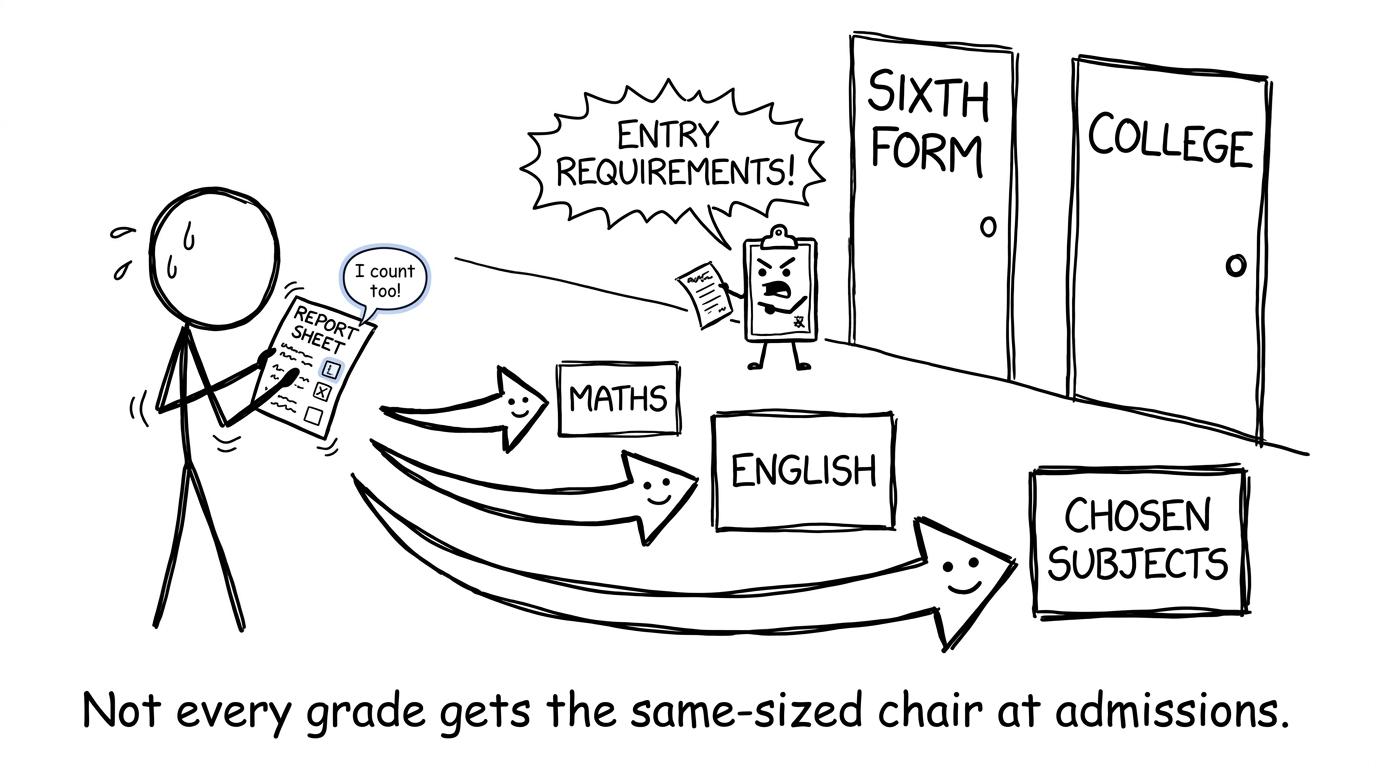 A GCSE Bengali grade finds its place in the admissions checklist
How much does a GCSE Bengali grade actually matter?
For most applicants, GCSE Bengali has supporting weight rather than decisive weight. Its importance usually falls into one of four patterns.
It may count towards your minimum number of GCSEs
Many sixth forms publish a general requirement such as five or six GCSEs at grade 444 or above, often including English and maths. Where Bengali is accepted as a full GCSE, a passing grade may help you reach that total.
For instance, if an institution asks for six qualifying GCSEs and Bengali is one of your six results at grade 444 or above, it can matter directly. This is not because Bengali is preferred over another subject. It is because the qualification helps you satisfy the numerical threshold.
Policies vary, however. Some selective schools calculate a score using particular approved subjects, the best set of results or qualifications completed within the normal school curriculum. A separately arranged language GCSE may therefore count at one institution but not at another.
It may influence an average or points score
Some sixth forms assess the overall strength of an applicant’s GCSE profile. They may use an average grade, a total based on the best results or a specified group of subjects.
In that system, a high Bengali grade can raise your profile slightly. A low grade can lower it slightly if the subject is included. The effect depends on how many results are counted and whether the institution includes Bengali in its calculation.
Do not assume that every GCSE shown on your certificate enters the calculation. Read the wording carefully and ask admissions staff if the policy does not name Bengali or other community languages.
It is rarely a substitute for a required subject grade
A grade 888 or 999 in Bengali is an achievement, but it will not usually replace a required grade in maths, English or science.
If A Level Mathematics requires grade 777 in GCSE Maths, a strong language result does not cancel a grade 666 in maths. Similarly, courses such as physics, chemistry, English literature or modern languages may have their own subject-specific thresholds.
Admissions decisions are often less like ranking every grade equally and more like checking several locks. Your overall profile opens one lock. English and maths open others. The grade linked to your chosen subject may open the final one.
It can still show genuine academic strength
A recognised language qualification demonstrates assessed knowledge across the skills included in its specification. A high grade can strengthen the wider picture of your attainment, particularly where all full-course GCSEs are considered.
But it should not be treated as a guaranteed admissions advantage. Institutions publish academic criteria so that applicants can see what will formally count. The safest approach is to value the achievement while checking its precise role in each application.
Why GCSE maths often carries more weight
In England, the national funding rules for 161616 to 191919 study programmes give English and maths a special position. Students who have not achieved grade 444 or above in the relevant GCSE or an accepted equivalent are generally required to continue working towards approved English or maths qualifications as part of their programme.
That does not mean every college refuses applicants below grade 444. Some offer courses alongside GCSE resits. It does mean that English and maths affect programme planning in a way that Bengali normally does not.
A Level subjects can demand still higher maths grades. Current sixth-form policies show that A Level Mathematics requirements commonly vary between grade 666 and grade 777, while selective courses may ask for more. Physics, computer science and economics can also include specific GCSE Maths conditions.
If maths is one of your weaker subjects, begin with the free MathsGenie GCSE and A Level revision hub. It brings revision lessons, videos and practice together, allowing you to address the grade that may control several future choices.
What matters for different post-16 routes?
A Levels
For an A Level programme, admissions teams commonly check both a general GCSE threshold and separate subject requirements. Bengali may contribute to the general threshold, but the closest related GCSEs usually matter more for individual courses.
If you want to take A Level Maths, concentrate first on the required GCSE Maths grade. You can also look ahead at the Edexcel A Level Maths revision resources or OCR A Level Maths revision resources to understand how the course develops beyond GCSE.
Vocational courses and T Levels
Colleges often offer several entry levels and pathways. Requirements can depend on the course, while English and maths grades may determine whether resits must be added to your timetable.
A Bengali grade may count as part of your overall Level 222 profile, but it is unlikely to outweigh a missing requirement for a particular programme. Check the exact course page rather than relying on a college-wide summary.
Competitive sixth forms
Selective sixth forms may use a GCSE points total, an average grade or a defined list of accepted subjects. In these applications, the treatment of Bengali can be more technical.
One institution may include it among your best GCSEs. Another may accept only languages studied within the standard timetable. A third may not include it in the scoring set but will still record it as an additional qualification. Only the published policy or a written answer from admissions can settle the question.
 A student chooses admissions priorities instead of carrying every worry
How to check whether your Bengali result counts
Start with the admissions policy for your year of entry. Requirements can change, so an older prospectus or a sibling’s experience is not enough.
Look for phrases such as:
- “full-course GCSEs”
- “best eight results”
- “average GCSE score”
- “approved subjects”
- “qualifications taken as part of the standard curriculum”
- “subject-specific entry requirements”
If Bengali is not mentioned, send a precise question to admissions: Will my GCSE Bengali qualification be included in the general entry total or average grade calculation? Include the awarding body and exact qualification title because GCSE Bengali and International GCSE Bangla are not automatically identical qualifications.
AQA’s current GCSE Bengali specification uses foundation and higher tiers, with foundation grades covering 111 to 555 and higher grades covering 444 to 999. Pearson also offers an International GCSE Bangla qualification. Your certificate or statement of entry will identify what you are taking.
A sensible revision priority order
Your Bengali preparation deserves proper attention, but revision time is limited. The calm approach is to protect the grades with the greatest admissions consequences first.
Secure essential thresholds
Prioritise GCSE English and maths, particularly if you are near grade 444. Falling below that threshold can mean continuing the subject after Year 111111, depending on your programme and circumstances.
For maths, use topic practice before relying entirely on full papers. The MathsGenie guide to revising Edexcel GCSE Maths efficiently explains how to move from a revision lesson to focused exam questions and then timed papers.
Protect grades required by your chosen subjects
If your preferred A Level has a specific requirement, treat that grade as a gateway. A student hoping to take A Level Mathematics should not sacrifice core maths revision simply to turn an already secure Bengali grade into a slightly higher one.
That is not a judgement about which subject is more valuable. It is a decision about which result changes the available routes.
Improve the wider profile
Once essential grades are secure, strengthening Bengali can help you reach a minimum GCSE count or improve an overall profile where the qualification is included. This is especially relevant if your result sits close to a grade boundary.
For maths exam preparation, introduce full papers when topic knowledge is reasonably secure. The guide to starting GCSE past papers sets out a gradual route from mini tests to timed papers. Near the examinations, GCSE predicted papers can provide an additional test of technique after you have used real past papers and mark schemes.
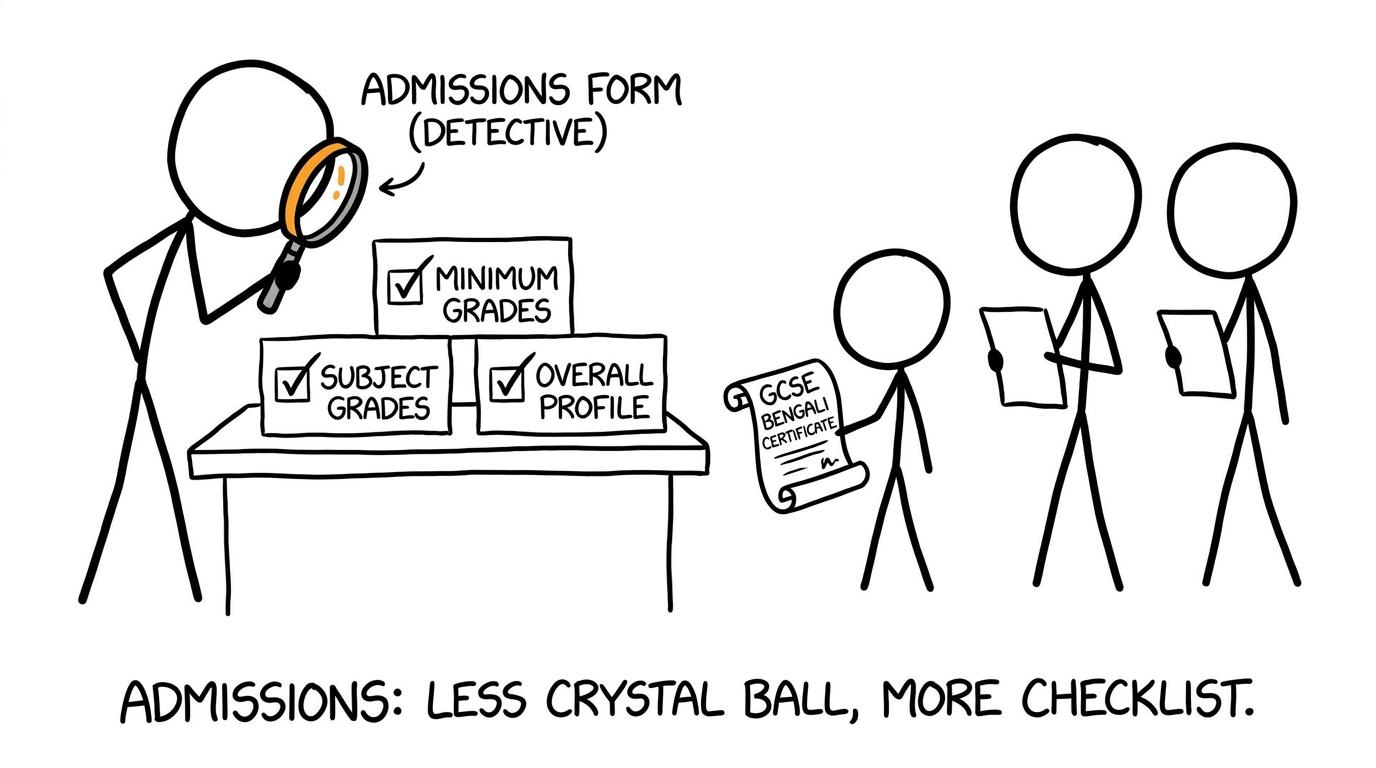 An admissions form investigates minimum grades before everything else
Common mistakes when judging your GCSE Bengali grade
Assuming every sixth form uses the same rules
There is no universal GCSE total or fixed Bengali policy. Requirements differ between institutions and courses.
Treating Bengali as irrelevant
It may count towards the minimum number of GCSE passes or an average score. Ignoring it entirely can be as misleading as assuming it is decisive.
Assuming a high Bengali grade replaces maths or English
Subject-specific thresholds remain separate. A strong result elsewhere rarely overrides a published requirement.
Looking only at general entry requirements
Meeting the overall threshold does not automatically qualify you for every A Level. Check the requirements beside each chosen subject.
Using an old prospectus
Always read the policy for your intended year of admission. Save a copy and confirm unclear wording with the institution.
Revising according to anxiety rather than consequences
The grade causing the most worry is not always the grade that matters most. Build your revision plan around essential thresholds, chosen subjects and then the wider GCSE profile.
Your next step
Your GCSE Bengali grade can matter, but its weight is usually limited and clearly defined: it may count towards your total qualifications, contribute to an average or strengthen your overall profile. English, maths and course-specific grades normally have more direct influence.
Make a shortlist of sixth forms and colleges, record their exact criteria, and ask each admissions team whether your Bengali qualification is included. Then turn that information into revision priorities.
MathsGenie can help you protect one of the grades that appears most consistently in post-16 entry requirements. Start with free revision lessons and practice questions, diagnose gaps with mini tests, and build exam confidence through past papers, mark schemes, video solutions and predicted papers. A requirement feels less intimidating once it becomes a plan.










