GCSE Bengali Grade Boundaries Year to Year
GCSE Bengali grade boundaries year to year can shift by a few marks, sometimes more. Compare recent AQA data, learn why they move, and revise wisely.
A boundary can feel strangely powerful. One mark may appear to separate relief from disappointment, so it is natural to search for patterns before results day. The short answer is that GCSE Bengali grade boundaries year to year do change, but recent AQA data shows that the movement is usually modest on higher tier and can be more noticeable on foundation tier.
Between summer 202420242024 and summer 202520252025, every overall AQA Bengali boundary moved by no more than 444 marks out of 240240240. Across the summer series from 202220222022 to 202520252025, however, some foundation boundaries moved by as many as 141414 marks in a single year. Past boundaries are therefore useful evidence, but they are not a prediction of the mark you will need.
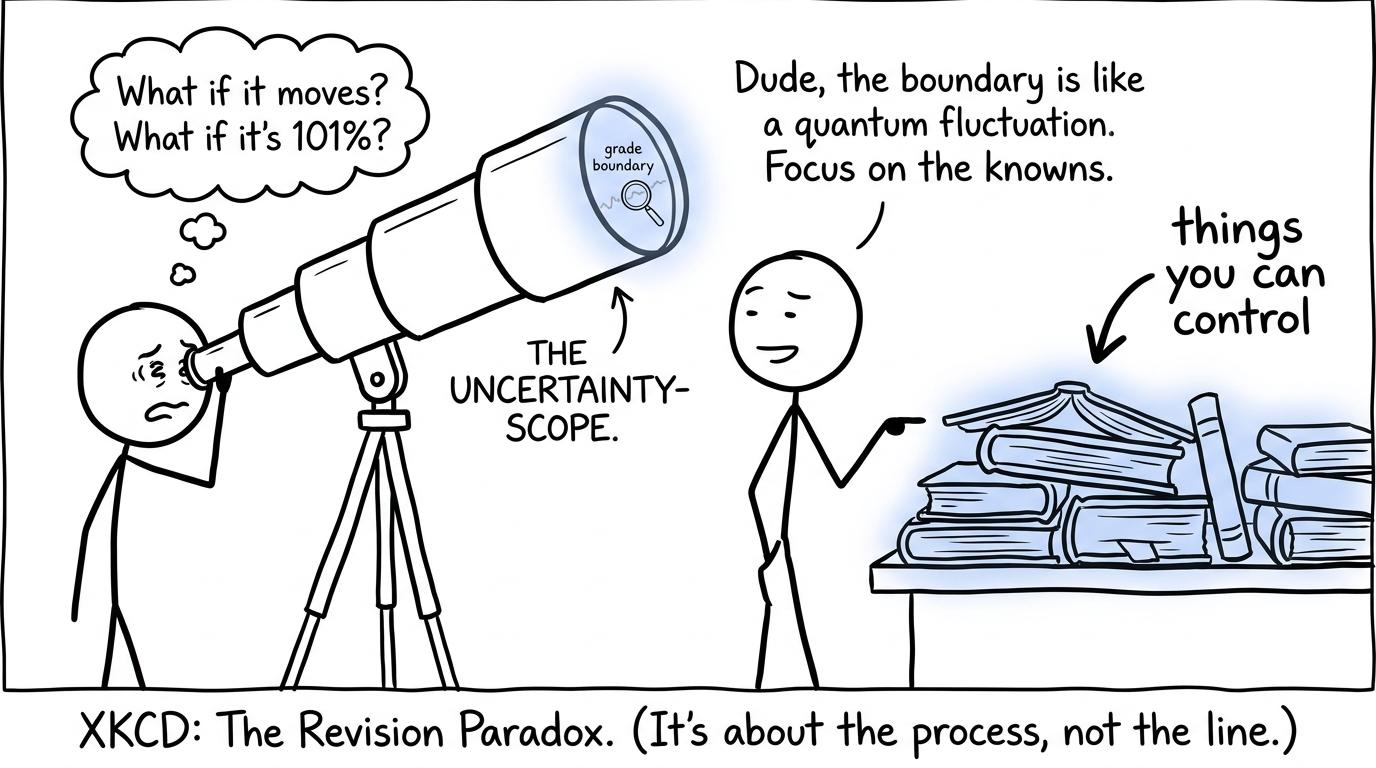 A student using a huge telescope to watch a tiny grade boundary while ignoring revision
The quick answer
Here is what matters most:
- A grade boundary is the minimum overall mark needed for a grade in a particular exam series.
- AQA sets GCSE Bengali boundaries after the assessments have been taken and marking is nearly complete.
- Boundaries move mainly to account for differences in assessment difficulty and to maintain comparable grade standards.
- Recent higher-tier Bengali boundaries have generally changed by a few marks each year.
- Foundation boundaries have sometimes shifted by around 101010 marks or more.
- The qualification has four skills, listening, speaking, reading and writing, contributing equally after scaling to an overall maximum of 240240240 marks.
- Your safest plan is to aim comfortably above an old boundary rather than treating it as a target.
You can see the complete figures on the AQA GCSE Bengali grade boundaries page.
How much have GCSE Bengali boundaries actually changed?
The clearest comparison uses summer series with the same maximum overall mark of 240240240. The table below shows the AQA subject boundaries from 202220222022 to 202520252025, the latest published summer series available at the time of writing.
Foundation-tier boundaries
| Grade | 202220222022 | 202320232023 | 202420242024 | 202520252025 | Largest annual change |
|---|---|---|---|---|---|
| 555 | 135135135 | 121121121 | 131131131 | 129129129 | 141414 marks |
| 444 | 110110110 | 969696 | 106106106 | 104104104 | 141414 marks |
| 333 | 818181 | 717171 | 818181 | 808080 | 101010 marks |
| 222 | 525252 | 464646 | 565656 | 565656 | 101010 marks |
| 111 | 242424 | 222222 | 323232 | 333333 | 101010 marks |
Foundation boundaries dropped substantially between 202220222022 and 202320232023, then rose again in 202420242024. From 202420242024 to 202520252025, the changes were much smaller: grades 555 and 444 each fell by 222 marks, grade 333 fell by 111, grade 222 stayed unchanged and grade 111 rose by 111.
This tells us two things. First, boundaries can move enough to matter when a student is very close to a threshold. Second, a large movement in one year does not establish a lasting direction. The grade 555 boundary fell, rose and then fell again.
Higher-tier boundaries
| Grade | 202220222022 | 202320232023 | 202420242024 | 202520252025 | Largest annual change |
|---|---|---|---|---|---|
| 999 | 200200200 | 206206206 | 206206206 | 202202202 | 666 marks |
| 888 | 177177177 | 182182182 | 180180180 | 177177177 | 555 marks |
| 777 | 154154154 | 158158158 | 154154154 | 152152152 | 444 marks |
| 666 | 130130130 | 131131131 | 128128128 | 127127127 | 333 marks |
| 555 | 106106106 | 104104104 | 102102102 | 102102102 | 222 marks |
| 444 | 838383 | 777777 | 767676 | 787878 | 666 marks |
| 333 | 717171 | 636363 | 636363 | 666666 | 888 marks |
Higher tier has been steadier over these four summer series. For grades 555 to 999, the largest one-year movement was 666 marks. The grade 333 boundary showed the largest higher-tier change, falling by 888 marks between 202220222022 and 202320232023.
The most recent movement was restrained. Between 202420242024 and 202520252025, the grade 999 boundary fell by 444 marks, grades 888 and 777 fell by 333 and 222, grades 666 and 555 moved by 111 and 000, while grades 444 and 333 rose by 222 and 333.
The pattern is not a staircase. It is a series of adjustments.
Why GCSE Bengali grade boundaries change
A boundary is not supposed to make one year more generous than another. Its purpose is to help keep the standard represented by each grade comparable when different papers and tasks cannot be perfectly identical in difficulty.
Ofqual explains that exam boards use statistical evidence alongside expert judgement. Data helps identify a possible range for a boundary, while senior examiners review the quality of work around that range and compare it with the standard demonstrated in previous years.
The assessment may feel easier or harder
Even when a specification and assessment objectives remain stable, students may find particular questions, recordings, texts or writing tasks more demanding than expected. If an assessment proves harder overall, a lower raw-mark boundary may be appropriate. If it proves easier, the boundary may rise.
A higher boundary therefore does not automatically mean stricter grading. It can indicate that students generally found that assessment more accessible.
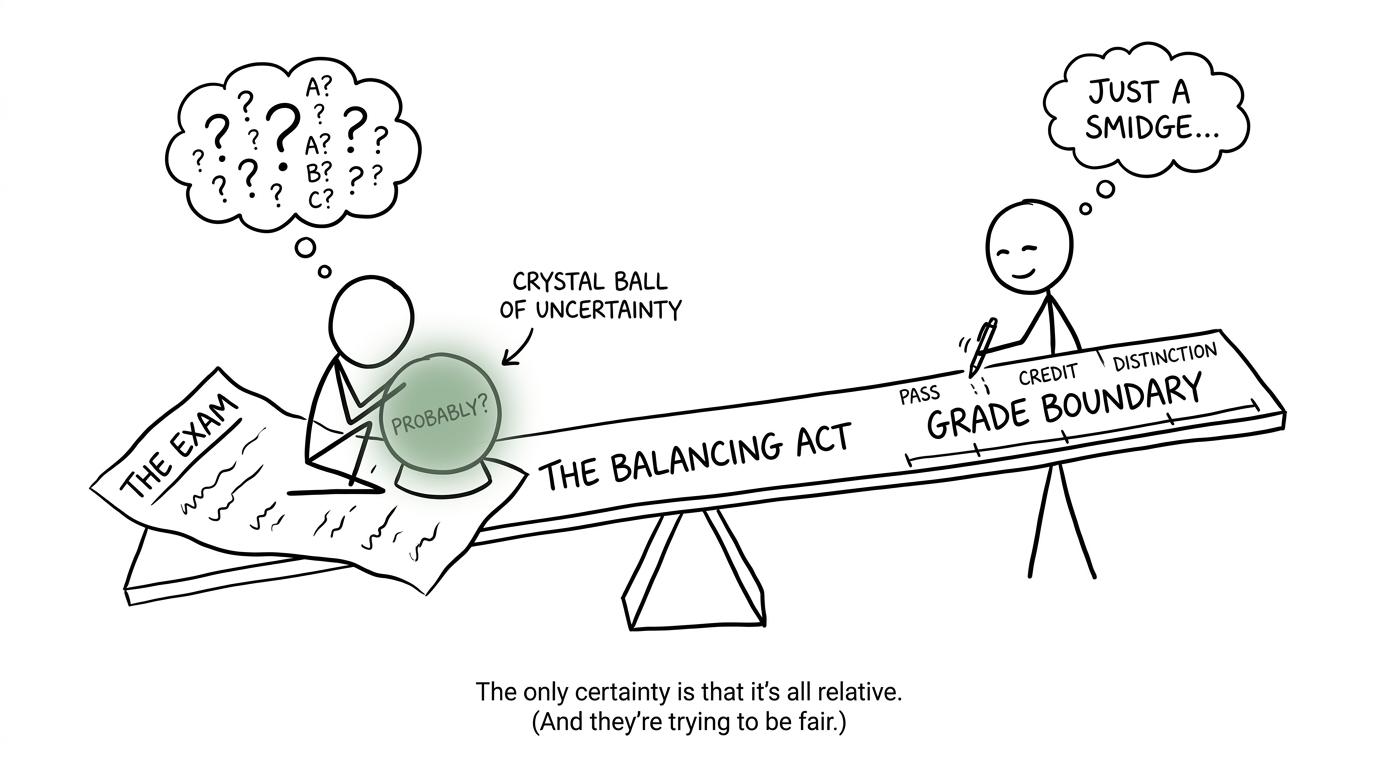 An examiner balancing an exam paper and a grade boundary while a student consults a crystal ball
The whole qualification matters
AQA GCSE Bengali assesses listening, speaking, reading and writing. Each skill contributes a maximum scaled mark of 606060, producing:
60+60+60+60=240 60 + 60 + 60 + 60 = 240 60+60+60+60=240Listening and writing raw marks are scaled because their papers do not initially carry the same raw maximum as speaking and reading. The published subject boundary applies to the combined scaled total, not simply to one isolated paper.
This is why comparing a mark on one component with the overall grade boundary can be misleading. A balanced performance across all four skills is more useful than trying to reverse-engineer a final grade from one classroom task.
Cohorts and evidence also matter
Exam boards consider information about the students taking the qualification and compare performance with previous cohorts. They do not merely choose a convenient percentage or insist that a fixed number of students must receive each grade. Ofqual states that there are no quotas or caps for GCSE grades.
That distinction matters. Boundaries are set to preserve standards, not to force every year’s results into an identical pattern.
Why old boundaries are useful but not predictive
Historical boundaries give you context. They show that a target such as exactly 152152152 marks for a higher-tier grade 777 would have worked in 202520252025, but not in every previous year shown. In 202320232023, the corresponding boundary was 158158158.
This does not mean you should ignore boundaries. It means you should use them as a range rather than a promise.
A sensible revision target includes a margin above the highest recent boundary you are considering. That margin protects you against normal movement and against optimistic self-marking. Mark schemes can be less forgiving than memory, especially in extended responses.
The same principle applies to maths. Students sometimes complete a paper, compare the total with one historical threshold and decide that their grade is secure. A better process is available through the GCSE Maths revision hub: sit several papers, mark them accurately and look for consistency across different series.
What this means for your revision
You cannot control where a future boundary lands. You can control how many secure marks you build.
For Bengali, that means practising all four language skills and using feedback to identify whether marks are being lost through vocabulary, comprehension, accuracy, task completion or communication. For maths, it means turning every dropped mark into a specific topic to revisit.
A calm weekly approach is:
- complete a timed task or paper section;
- mark it against the relevant criteria or mark scheme;
- record the reason for every lost mark;
- practise the weakest skill;
- repeat the assessment later without notes.
MathsGenie makes this feedback loop straightforward for your maths preparation. Start with AQA GCSE Maths past papers, use GCSE mini tests for shorter checks, and save GCSE predicted papers for realistic rehearsal nearer the exams.
If you are unsure how to turn a completed paper into useful revision, follow the guide to using GCSE past papers properly. The important part is not the first score. It is what you repair before the next attempt.
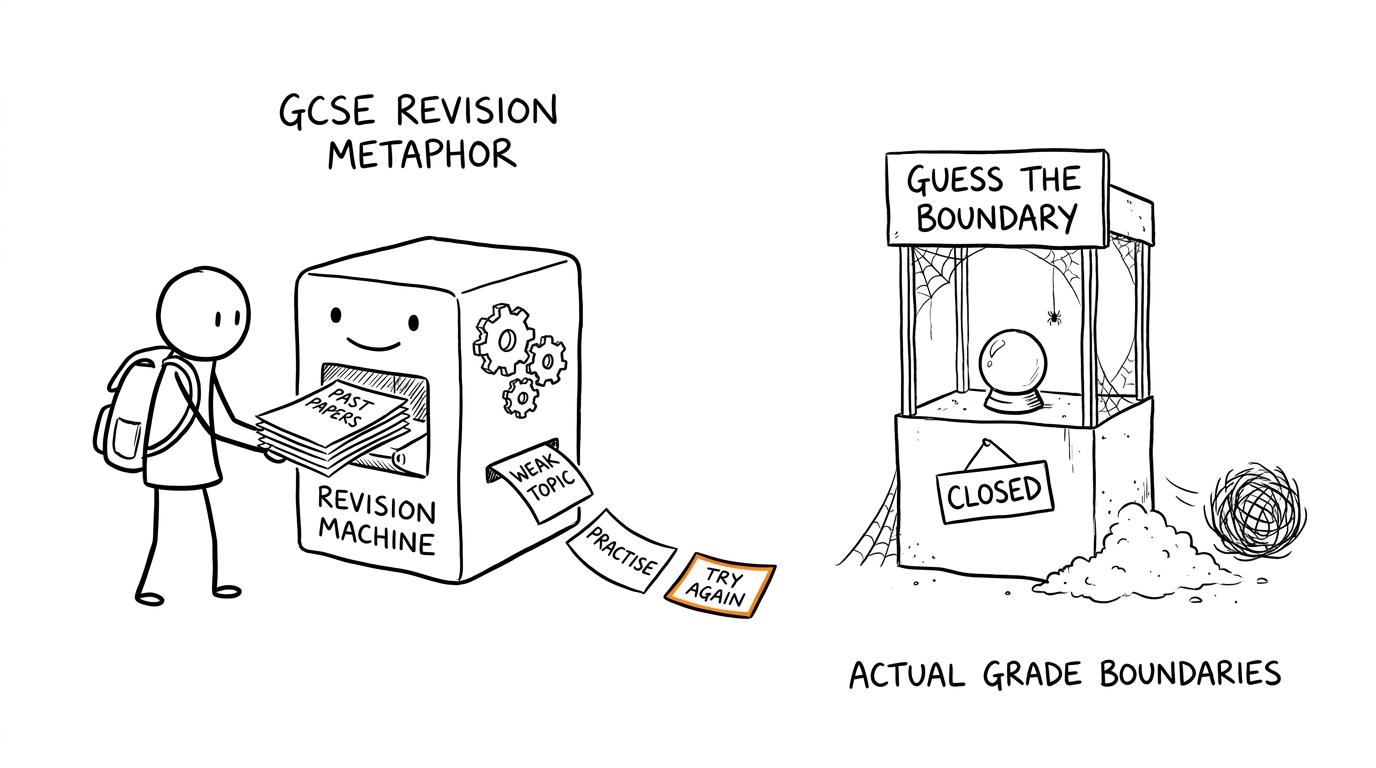 A revision machine turning past papers into useful weak-topic and practice cards
Common mistakes when reading Bengali grade boundaries
Treating the latest boundary as a guaranteed target
The 202520252025 figures describe the 202520252025 assessment. They cannot tell you the exact boundary for a future series because that boundary will be determined using evidence from the new assessment and cohort.
Comparing years with different maximum marks
The November 202020202020 and November 202120212021 higher-tier entries shown in historical data had an overall maximum of 180180180, rather than the usual 240240240. Comparing their raw boundaries directly with a 240240240-mark summer series would distort the picture unless the marks were converted to proportions. The cleaner comparison is between summer series carrying the same total.
Mixing up foundation and higher tier
Foundation and higher tier have separate boundaries and different available grade ranges. Students must be entered at the same tier for all four AQA Bengali skills. Always check the tier heading before interpreting a figure.
Confusing GCSE Bengali with International GCSE Bangla
AQA GCSE Bengali and Pearson Edexcel International GCSE Bangla are different qualifications with different specifications, assessments and boundaries. Check the qualification title, exam board and specification code before using any table.
Assuming a lower boundary means an easier grade
A lower raw boundary often reflects a more demanding assessment. The intended standard for the grade remains comparable. Looking only at the number, without considering why it moved, reverses the logic of grading.
You can compare subjects carefully through the wider AQA GCSE grade boundaries collection, but boundaries from different subjects should never be treated as measures of which subject is easiest.
Focus on the marks you can earn
GCSE Bengali boundaries do move from year to year. Recent higher-tier shifts have generally been small, while foundation tier has occasionally moved by 101010 to 141414 marks. The latest change from 202420242024 to 202520252025 was no greater than 444 marks at any published Bengali grade boundary.
That is reassuring, but it is not a reason to aim for the line itself. Boundaries are an adjustment made after the assessment; revision is the work done before it.
Use historical figures for context, then return your attention to what changes outcomes: accurate practice, honest marking and repeated work on weaknesses. For maths, make MathsGenie your free revision base: use the revision lessons and practice questions to strengthen individual topics, mini tests to check recall, and past papers, predicted papers, mark schemes and video solutions to build exam confidence. Choose your next task, mark it properly and turn every lost mark into a plan.