

GCSE Art and Design vs Media Studies: Employer View
GCSE Art and Design vs Media Studies employers compare: learn what colleges notice, which skills each subject shows and how to make the right choice.
Choosing a GCSE can feel strangely permanent. One option sounds creative and practical; another sounds analytical and connected to the digital world. Meanwhile, someone says employers prefer one, and an ordinary timetable decision begins to feel like a verdict on your future.
Here is the useful answer to GCSE Art and Design vs Media Studies employers may actually give: most employers will not prefer one automatically. Colleges usually care more about whether you meet their overall and course-specific entry requirements. Your grades in core subjects, particularly English and maths, may matter more than the difference between these two options.
The better choice is normally the subject that suits your strengths, supports your next step and leaves enough time for your wider GCSE revision.
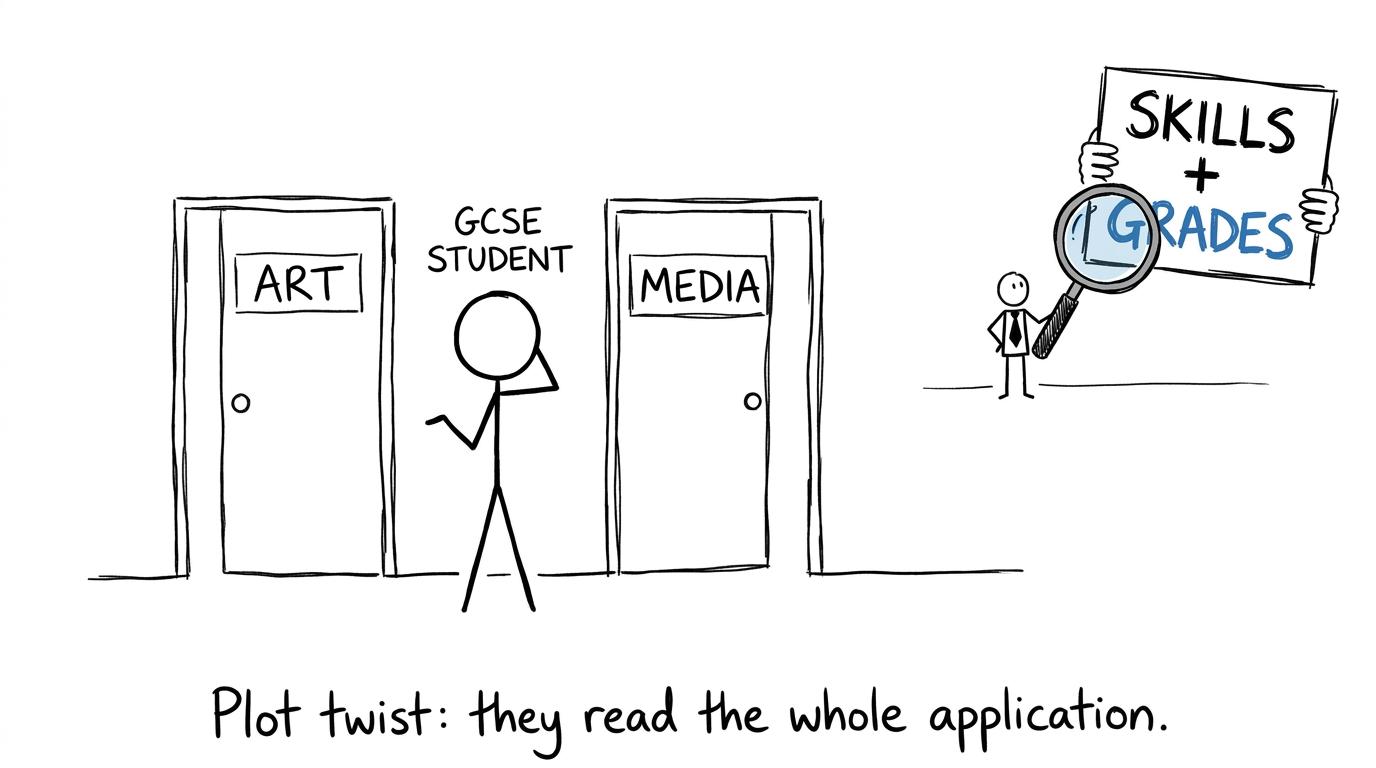 A student discovers that employers read the whole application
The short answer
Use this checklist before choosing:
- Choose Art and Design if you enjoy developing visual ideas, experimenting with materials and refining work over time.
- Choose Media Studies if you enjoy analysing films, advertising, news, social media and the way messages influence audiences.
- Check sixth-form or college requirements if you already have a particular course in mind.
- Consider the assessment style, not just the subject title.
- Protect your English and maths grades, because these are commonly specified in entry requirements for education, training and employment.
- Do not choose from reputation alone. A strong grade with convincing evidence of skills is usually more useful than a subject selected because somebody called it impressive.
Neither GCSE is a universal passport into work. Both can become valuable when you can explain what you learnt and show what you produced.
What employers are likely to notice first
For an early job, apprenticeship or work-experience application, an employer may look at your overall grade profile, English and maths results, attendance, experience and evidence that you are reliable. The name of one optional GCSE is only part of that picture.
This does not make Art and Design or Media Studies irrelevant. It changes the question. Instead of asking which title looks better, ask which subject will give you stronger evidence of useful behaviour.
Art and Design can demonstrate:
- visual communication and observation;
- creative problem-solving;
- patience and sustained project development;
- responding to feedback;
- meeting practical deadlines;
- presenting a portfolio of work.
Media Studies can demonstrate:
- critical analysis of messages and audiences;
- written communication;
- research and interpretation;
- understanding representation and media industries;
- planning creative media products;
- connecting ideas with social and cultural contexts.
These are not guaranteed outcomes. Simply taking a subject does not prove every skill associated with it. Your finished work, grade, interview answers and examples of how you handled a project provide the evidence.
Do colleges prefer Art or Media Studies?
Colleges and sixth forms set their own entry requirements. Those requirements can differ by institution and by course, so the current course page or admissions team should always be your final source.
For a general A Level programme, the college may focus mainly on your overall GCSE results and required grades in English and maths. A creative course may also request a portfolio, while another course may recommend prior experience without making the corresponding GCSE compulsory.
When Art and Design may be more directly relevant
Art and Design is likely to have the clearest connection with courses such as fine art, illustration, fashion, textiles, photography, animation, architecture or graphic design. A portfolio may matter because it reveals how you observe, experiment and improve, rather than merely recording the subject name on your application.
If a course asks for a portfolio, GCSE Art and Design can give you time and structured guidance to build one. However, you should still check what the individual provider wants. Different creative courses can expect very different kinds of work.
When Media Studies may be more directly relevant
Media Studies can connect naturally with film, television, advertising, journalism, content production, communications and related academic courses. It can be especially suitable if you enjoy combining analysis with practical production.
Yet GCSE Media Studies is not normally the only route into those fields. Strong English, creative work, wider reading and relevant experience may also contribute. Likewise, taking Media Studies does not by itself guarantee access to a media course.
When neither subject creates a major advantage
For many pathways, neither option will carry a decisive advantage. An engineering course, for example, is more likely to focus on its stated requirements in maths and sciences. Other routes may prioritise English, particular GCSE grades or an overall profile.
That is why checking requirements early is so useful. It turns a vague fear about what colleges might value into a list of facts you can act upon.
Assessment style can decide which grade you achieve
The subject that sounds most interesting is not always the subject whose assessment suits you best.
GCSE Art and Design commonly involves a portfolio or sustained body of work alongside an externally set task. GCSE Media Studies commonly combines written examinations with non-exam assessment. The precise structure and weighting depend on the current specification used by your school, whether that is from AQA, Edexcel, OCR, Eduqas or another awarding organisation.
Before choosing, ask your teacher:
- Which exam board and specification will we follow?
- How much work is completed during lessons?
- What form does the non-exam assessment take?
- How often are projects reviewed?
- What does a successful piece of work actually involve?
- Which deadlines fall near mocks and final GCSE exams?
Art often rewards steady development. Leaving everything until the final days can make the workload difficult to recover. Media Studies still requires organisation, but its mixture of analytical writing, subject knowledge and production may feel more familiar to students who prefer structured revision and examinations.
Neither is inherently easier. Difficulty depends partly on your strengths and partly on whether you keep pace with the work.
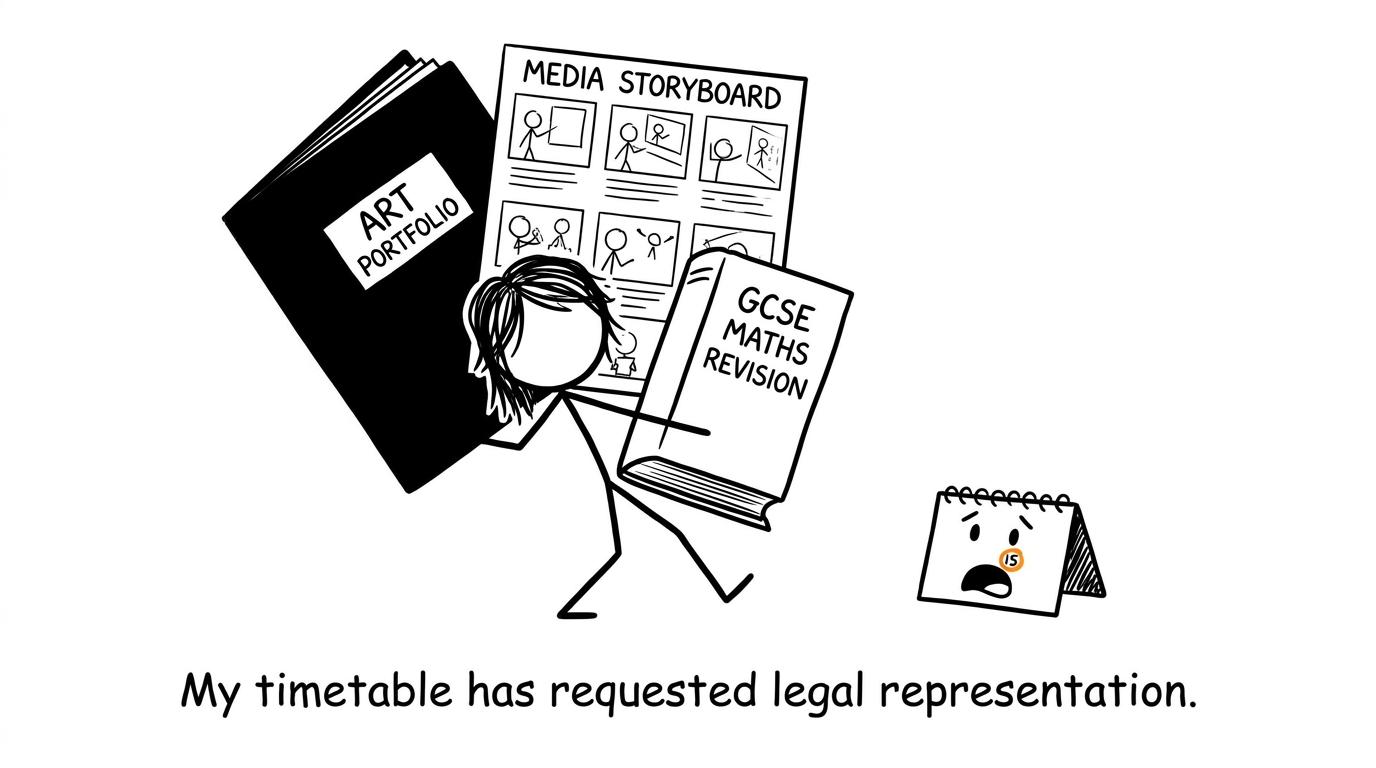 A revision timetable attempts to cope with three competing priorities
Think about the effect on maths revision
An optional GCSE should not quietly consume the time needed for core subjects. This matters because English and maths are frequently named explicitly in college, apprenticeship and employment requirements.
Art can demand sustained practical work and careful refinement. Media Studies can require substantial reading, analytical writing and preparation for examinations. The relevant question is not which subject has less work. It is which kind of work you are more likely to complete consistently.
Imagine that you enjoy drawing but regularly postpone long projects. Art may still be right for you, but you will need a dependable weekly routine. If you enjoy discussing films but dislike supporting interpretations with precise evidence, Media Studies may require more analytical writing than you expect.
Build your choice around realistic habits. Then protect regular time for GCSE maths revision lessons, rather than waiting until creative deadlines and mock exams collide.
If your foundations need strengthening, begin with the skills collected in Grade 1 GCSE maths revision and move forward systematically. Students working towards a standard pass can organise practice through Grade 4 maths topics, while those targeting stronger higher-tier results can use Grade 7 maths revision.
The principle is simple: the best option is one you can manage without allowing another important grade to drift.
How to make either GCSE useful to an employer
Employers cannot infer everything from a qualification title. You need to translate your experience into evidence.
Instead of saying, “I took Art”, you might explain that you developed several initial ideas, acted on feedback and completed a final outcome by a fixed deadline. A Media Studies student might describe researching an audience, making production decisions and evaluating whether the result achieved its purpose.
Keep a record of projects while the details are fresh. Note:
- the task or brief;
- your individual responsibility;
- a difficulty you encountered;
- the decision you made;
- how you used feedback;
- what improved in the final outcome.
This gives you material for applications and interviews without exaggeration. It also makes the subject more than a line in a qualifications section.
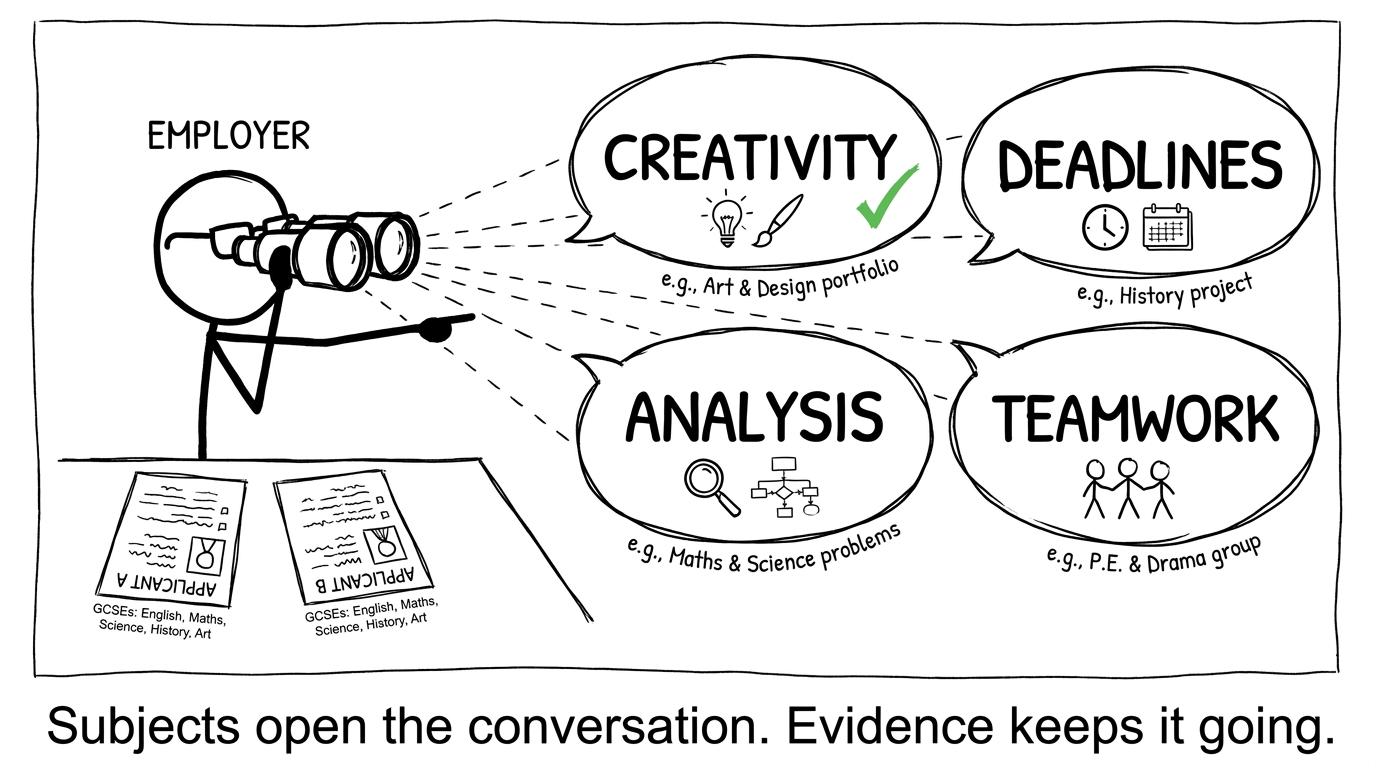 An employer focuses on evidence of skills rather than subject labels
A practical decision process
Start with enjoyment, but do not end there. Ask yourself which activities you would still tolerate when the work becomes demanding.
Art and Design may suit you if you prefer making, observing and revising visual work. Media Studies may suit you if you prefer interpreting texts, discussing audiences and combining written analysis with production. Look at real course materials from your school and speak to current teachers before deciding.
Then check three things:
- Relevance: Does either subject support a course you may apply for?
- Assessment fit: Which combination of practical work, writing and examinations suits you?
- Workload fit: Which option can you manage alongside English, maths, sciences and your other subjects?
You do not need a perfect career plan at fourteen. You need a sensible choice based on the information available now, with enough flexibility to change direction later.
Common mistakes when comparing the subjects
Assuming one subject is respected everywhere
There is no single employer preference covering every industry, job and apprenticeship. Relevance depends on the opportunity and the evidence you provide.
Ignoring specific college requirements
General advice cannot replace the published entry requirements for a particular course. Check them before relying on assumptions from friends or social media.
Treating creative subjects as an escape from revision
Art and Media Studies both require disciplined work. Creative freedom does not remove deadlines, assessment objectives or the need to respond to feedback.
Choosing only because a friend is taking it
Your friend may have different strengths, career interests and working habits. Shared lessons are temporary; your workload and result belong to you.
Sacrificing core-subject preparation
A demanding project can expand to fill every available evening. Set boundaries and continue practising maths through GCSE maths past papers. Use mark schemes and video solutions to identify why marks were lost, then return to focused practice questions.
Which choice will look better on your application?
The honest answer is that the stronger application usually comes from the stronger fit.
Art and Design may stand out when a portfolio is relevant and your work shows visual development. Media Studies may stand out when an application benefits from critical analysis, communication or production experience. For many other applications, the distinction will be modest compared with your grades, core qualifications, experience and ability to explain what you learnt.
Choose the subject in which you can produce credible evidence of effort and growth. Then give the rest of your GCSEs the same attention. Use MathsGenie predicted papers when preparing for the style and timing of an upcoming maths exam, alongside full past papers rather than as a replacement for them.
Make the choice, then build the grade profile
Subject choices matter, but rarely in the dramatic way rumours suggest. A GCSE option is one piece of a larger application. Employers and colleges can also notice your core grades, relevant work, reliability and the way you communicate what you have done.
Check the requirements for any pathway already on your radar. Compare the actual assessment methods. Choose the work you are willing to practise when it stops feeling effortless.
Then turn your attention back to what you can control. MathsGenie provides free revision lessons, practice questions, mini tests, mark schemes, video solutions, past papers and predicted papers. Start with the GCSE maths revision hub, identify the topics costing you marks and build a routine you can sustain. If you are already thinking beyond GCSE, the A Level maths revision resources show where stronger mathematical foundations can lead.










