GCSE Arabic Role-Play Marking Explained
GCSE Arabic role play marking explained: learn what earns each mark, what examiners hear and how to prepare clear, relevant Edexcel speaking answers.
A role-play can feel strangely unforgiving. You may know plenty of Arabic, yet the examiner asks something brief and suddenly every possible answer competes for space in your mind. The good news is that GCSE Arabic role play marking is simpler than many students imagine: for the current Pearson Edexcel GCSE Arabic specification, each of the five prompts is marked for communication, with up to 222 marks available per response.
The examiner is not waiting for a perfect accent or an impressive speech. They are listening for a clear, relevant and unambiguous message that fits the situation. Your task is not to say everything you know. It is to communicate exactly what the prompt requires.
The marking checklist at a glance
For Pearson Edexcel GCSE Arabic, specification code 1AA0:
- The role-play contains five prompts.
- Each prompt is marked separately out of 222.
- The maximum role-play mark is 101010.
- Role-play responses are marked for communication only.
- A clear, appropriate and unambiguous response earns 222 marks.
- A partially clear, ambiguous or only partly appropriate response earns 111 mark.
- A response with no rewardable communication earns 000 marks.
- Pronunciation matters when it affects whether the message can be understood.
- Short, relevant answers can earn full marks.
- Foundation students ask one question; Higher students ask two.
- Both tiers include one unpredictable prompt.
The role-play is only one part of Paper 2. The complete speaking assessment also contains a picture-based task and a conversation, which use different marking grids. Do not apply conversation advice about long, developed answers to the role-play.
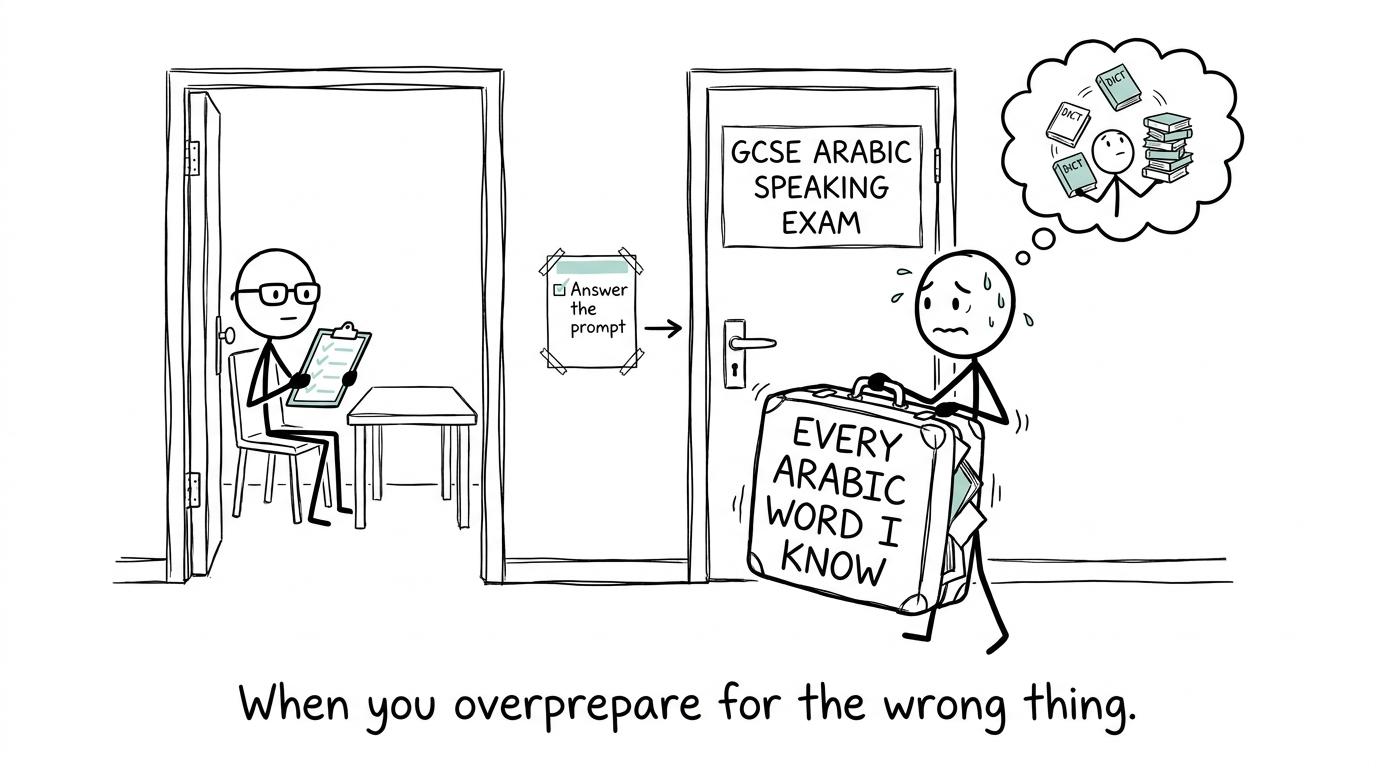 A student arrives at the speaking exam with far more vocabulary than the task requires
How GCSE Arabic role play marking works
The examiner applies the same small mark grid to each response:
| Mark | What the examiner hears |
|---|---|
| 222 | The required message is clearly communicated, appropriate to the scenario and unambiguous. Pronunciation supports understanding. |
| 111 | The message is only partially clear, contains ambiguity or is only partly appropriate in context. Pronunciation may reduce clarity. |
| 000 | There is no rewardable communication, the message is highly ambiguous or pronunciation prevents understanding. |
This creates an important strategic point. Your total is built prompt by prompt:
2+2+2+2+2=10 2 + 2 + 2 + 2 + 2 = 10 2+2+2+2+2=10One weak answer does not automatically ruin the entire task. If a response earns 000 or 111, the next prompt is a fresh opportunity. Treat the task as five small communication decisions rather than one flawless performance.
That is similar to sensible maths exam technique. A difficult question should not be allowed to consume the marks available later in the paper. MathsGenie's guide to using GCSE past papers properly develops the same habit: attempt, assess, correct and move forward.
What examiners are actually listening for
The requested information
The first question in an examiner's mind is simple: did the student communicate what the bullet point required?
If the prompt asks for a preference, a place, a time, a reason or a question, that element must be audible and understandable. Related vocabulary does not compensate for missing the central message. A polished answer about the general topic can still lose marks if it does not perform the function requested.
During preparation, identify the job of every bullet point. Reduce each one mentally to a function such as:
- give information;
- state a preference;
- explain a reason;
- refer to a past event;
- ask for information;
- respond to something unprepared.
This keeps your attention on communication rather than memorised content.
Clarity rather than complexity
The official role-play grid does not contain a separate category for grammatical range, sophisticated vocabulary or extended speech. Those qualities matter elsewhere in the speaking assessment, but they do not generate bonus marks here.
A short response can therefore earn 222 marks if it completes the prompt clearly. A longer response may become risky if it introduces contradictions, unclear references or an incorrect detail. Pearson examiner reports repeatedly advise students to keep role-play answers relevant and focused because overlong responses can make communication less clear.
This does not mean careless Arabic is harmless. Grammar and word choice still carry meaning. An error that changes who did something, when it happened or what was requested may create ambiguity. The distinction is that accuracy is not scored separately in this task; it matters through its effect on communication.
An answer that fits the situation
The response should make sense within the role-play scenario. Before preparing individual phrases, establish:
- where the conversation takes place;
- who you are speaking to;
- what you are trying to achieve;
- whether the interaction is formal or informal.
The candidate card tells you which register is expected. Register is not awarded through a separate pile of marks, and official marking principles indicate that an incorrect register is generally disregarded unless it obstructs communication. Even so, following the stated register helps your answer remain appropriate and reduces the risk of sounding confusing or out of place.
Pronunciation that protects meaning
You do not need native-like pronunciation. Pearson's specification makes clear that students can access the highest marks without a perfect command of Arabic.
However, the examiner must be able to identify the intended words. Pronunciation becomes a marking issue when it makes a response partially clear or prevents communication. Focus particularly on words carrying the essential information: the action, time, person, place, preference or question word.
Practise at a calm speaking speed. Rushing does not prove fluency if it blurs the message. A brief pause followed by an intelligible response is usually safer than a fast answer that cannot be decoded.
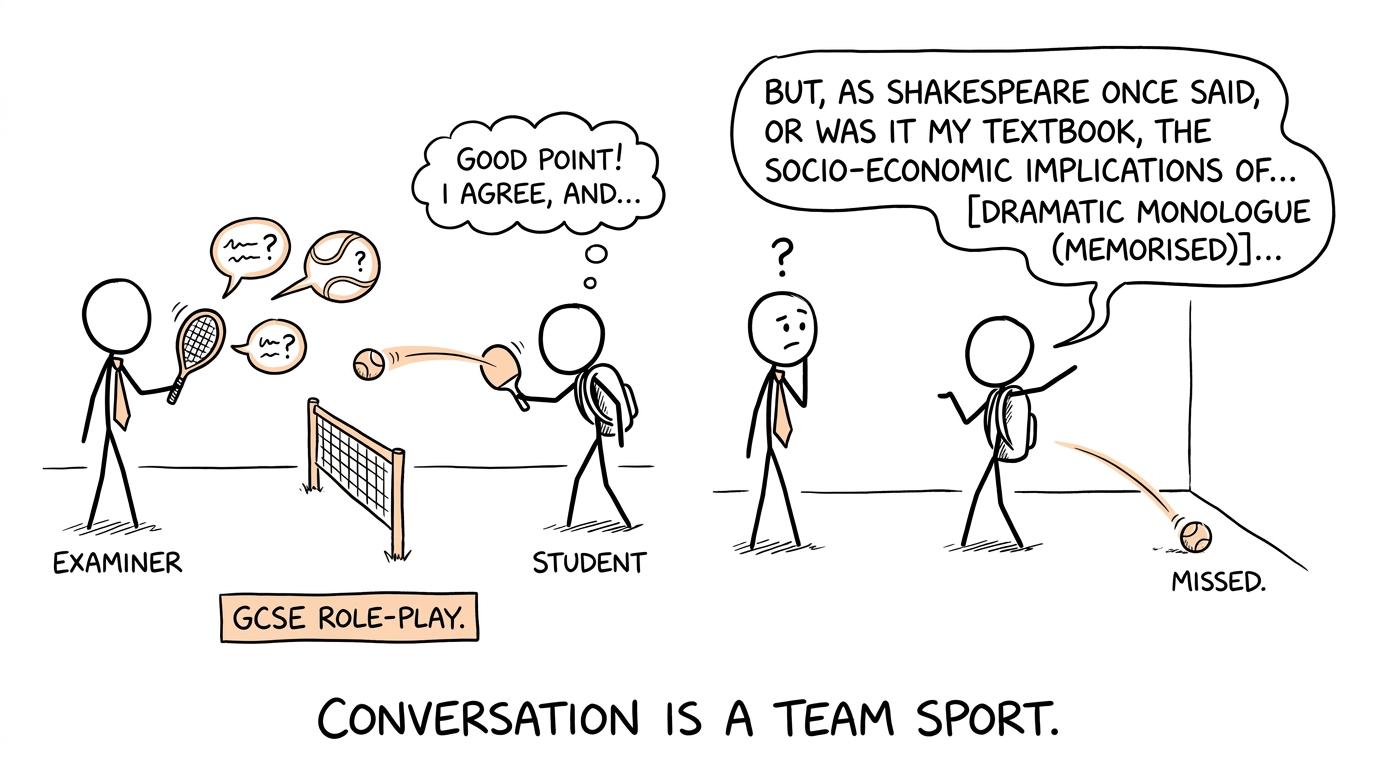 A role-play works best when both speakers keep the conversational ball moving
Foundation and Higher tier differences
Both tiers contain five prompts and offer the same maximum of 101010 marks. The individual responses are judged using the same communication principles.
At Foundation tier, students must ask one question and respond to one unpredictable question. Four prompts require present-time communication, although a familiar conditional form may be natural in some situations.
At Higher tier, students must ask two questions and answer one unpredictable question set in a past tense. The remaining prompts generally use present-time communication, with a conditional form possible where appropriate.
The unpredictable symbol does not mean the topic is completely random. It means you do not see the exact question during preparation. Listen to the teacher-examiner rather than forcing a prepared response into the gap.
The complete speaking assessment provides 121212 minutes of preparation time for both tiers. The Foundation role-play is recommended to last approximately one to one-and-a-half minutes, while the Higher role-play is recommended to last approximately two to two-and-a-half minutes. These are short tasks, which reinforces the value of direct responses.
Always confirm your tier and current arrangements with your teacher. This article concerns Pearson Edexcel GCSE Arabic 1AA0, not International GCSE Arabic or a different qualification.
How to use the preparation time
You prepare the role-play and picture-based task within the same 121212-minute period, so spending all your time scripting the first task is a poor trade.
A practical role-play preparation routine is:
- Read the scenario before translating individual prompts.
- Mark whether the conversation is formal or informal.
- Identify all five communication functions.
- Locate the question prompt or prompts.
- Locate the unpredictable prompt.
- At Higher tier, identify the prompt requiring a past response.
- Note essential vocabulary rather than writing an elaborate script.
- Check that every planned response directly covers its bullet point.
- Say difficult key words quietly in your head to test pronunciation.
Notes should support listening, not replace it. If you become dependent on reading a prepared sentence, an unexpected question can feel more disruptive than it really is.
The broader lesson is useful across GCSE revision. Good preparation reduces decisions under pressure. MathsGenie's free revision planner can organise your maths workload so speaking practice does not get crowded out by last-minute paper practice. For focused maths sessions, the GCSE Maths revision hub brings together lessons, exam questions and board-specific resources.
How to practise the role-play effectively
The best practice should resemble the marking process. Record five-prompt tasks and assess each response separately using 000, 111 or 222. Do not give yourself credit because you know what you intended. Ask whether someone listening to the recording could recover the required message without guessing.
Use this cycle:
- attempt a complete role-play without stopping;
- score each prompt for communication;
- label the reason for every lost mark;
- repair only the unclear part;
- repeat the task with the prompts in a fresh order;
- return to it several days later.
Useful error labels include missing information, wrong question form, unclear tense, out of context, pronunciation and did not understand the prompt. Specific labels produce specific improvements.
This is the same feedback loop that makes maths revision productive. Edexcel GCSE Maths mini tests provide quick evidence of weak skills, while GCSE past papers develop performance under sustained exam conditions. The subject changes, but the principle survives: practise the assessed behaviour, mark honestly and revisit the weakness.
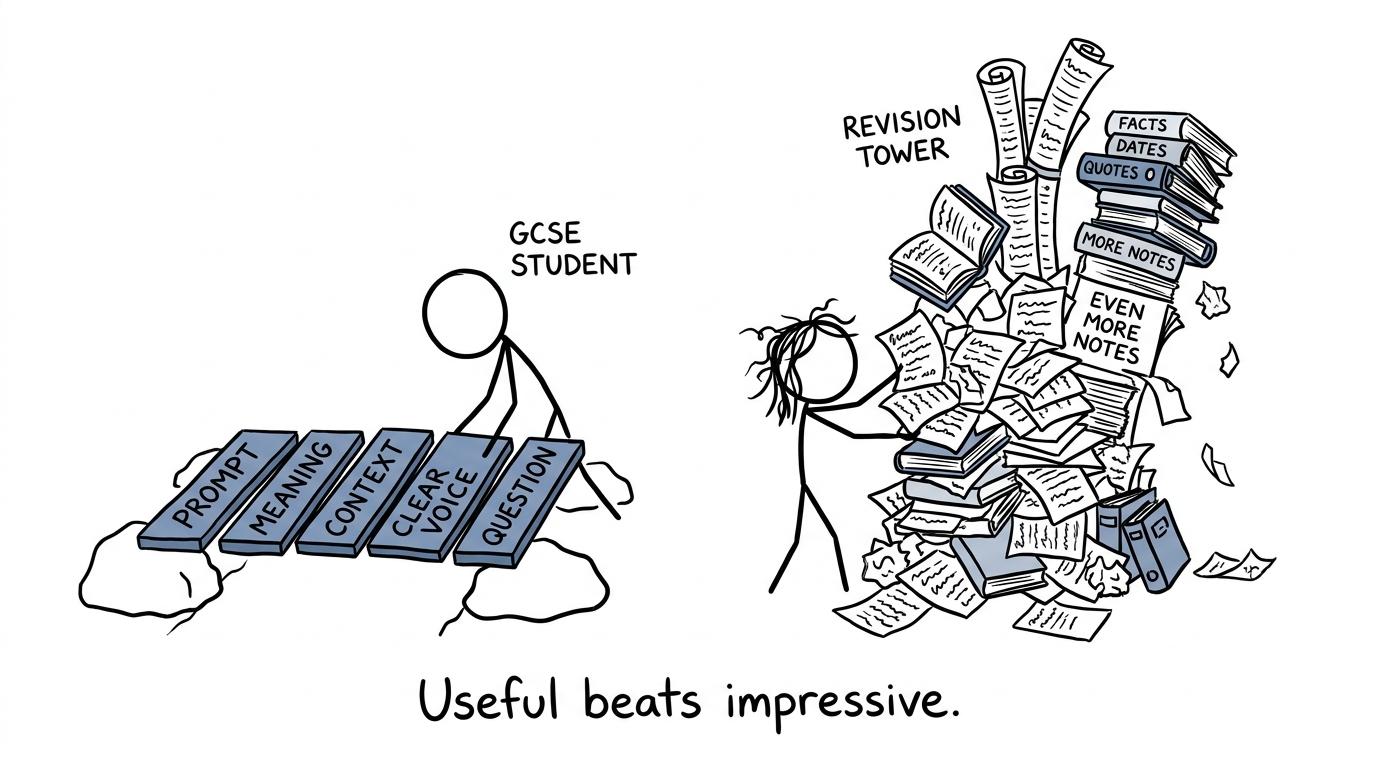 A simple response builds a safer bridge than an unnecessarily elaborate answer
Common mistakes that cost role-play marks
Giving a rehearsed answer to a different question
A familiar phrase can feel reassuring, especially under pressure. But relevance comes before fluency. Listen for the exact information requested and adapt your answer accordingly.
Missing the question prompt
Where the card requires you to ask a question, a statement cannot complete the same job. Prepare reliable question structures and make the interrogative meaning clear through wording and intonation.
Saying too much
Extra content creates more opportunities for contradiction and ambiguity. Once the prompt has been answered clearly, stop. The role-play is not the section in which to demonstrate everything you can say about the theme.
Using the wrong time reference
This is particularly important for the Higher unpredictable question in the past tense. If the examiner asks about a completed event but the response only communicates a present habit, the intended answer may not be clear.
Ignoring the scenario
Words can be linguistically possible but contextually inappropriate. Read the setting and relationship before planning your response.
Letting one mistake affect the next prompt
Each response receives its own mark. If an answer goes badly, release it. Staying mentally attached to it can cost marks on the remaining prompts.
Expecting the teacher to rephrase the question
The teacher-examiner follows a fixed script. Questions may be repeated within the permitted rules, but they must not be rephrased or supplemented. Practise listening for key information in the original wording rather than relying on an explanation.
A calm way to think about the task
Students often imagine that an examiner is measuring how impressive they sound. In the role-play, the examiner is doing something narrower: checking whether each required message arrived intact.
That should change how you revise. Build dependable language for common functions, strengthen listening, practise forming questions and protect the pronunciation of essential words. Then test those skills in short, recorded role-plays instead of endlessly rereading vocabulary lists.
Keep your wider GCSE preparation equally evidence-led. Use MathsGenie's GCSE Maths past papers, free revision lessons, practice questions, mark schemes and video solutions to find where maths marks are leaking. Add mini tests for focused repair and predicted papers when you are ready for unseen exam-style practice.
The goal in both subjects is not to know everything at once. It is to understand what earns the mark, practise that behaviour and make the next response clearer than the last.