

GCSE Active Recall: Turn WJEC Chemistry Notes into Marks
GCSE active recall for WJEC: turn Chemistry notes into daily self-tests using maths-style practice loops, flashcards, blurting and past papers.
You can spend an hour rewriting Chemistry notes and still feel blank when a WJEC GCSE question asks you to explain a trend, justify a method, or calculate a yield. That panic is not a character flaw. It is a revision method mismatch. GCSE success is less about how neat your notes look and more about how often your brain has to retrieve the idea under mild pressure.
Maths students learn this early: you do questions, you get it wrong, you fix it, you do another. Chemistry can work the same way. If you can turn your WJEC notes into active recall, you stop revising by recognition ("I’ve seen this") and start revising by performance ("I can answer this").
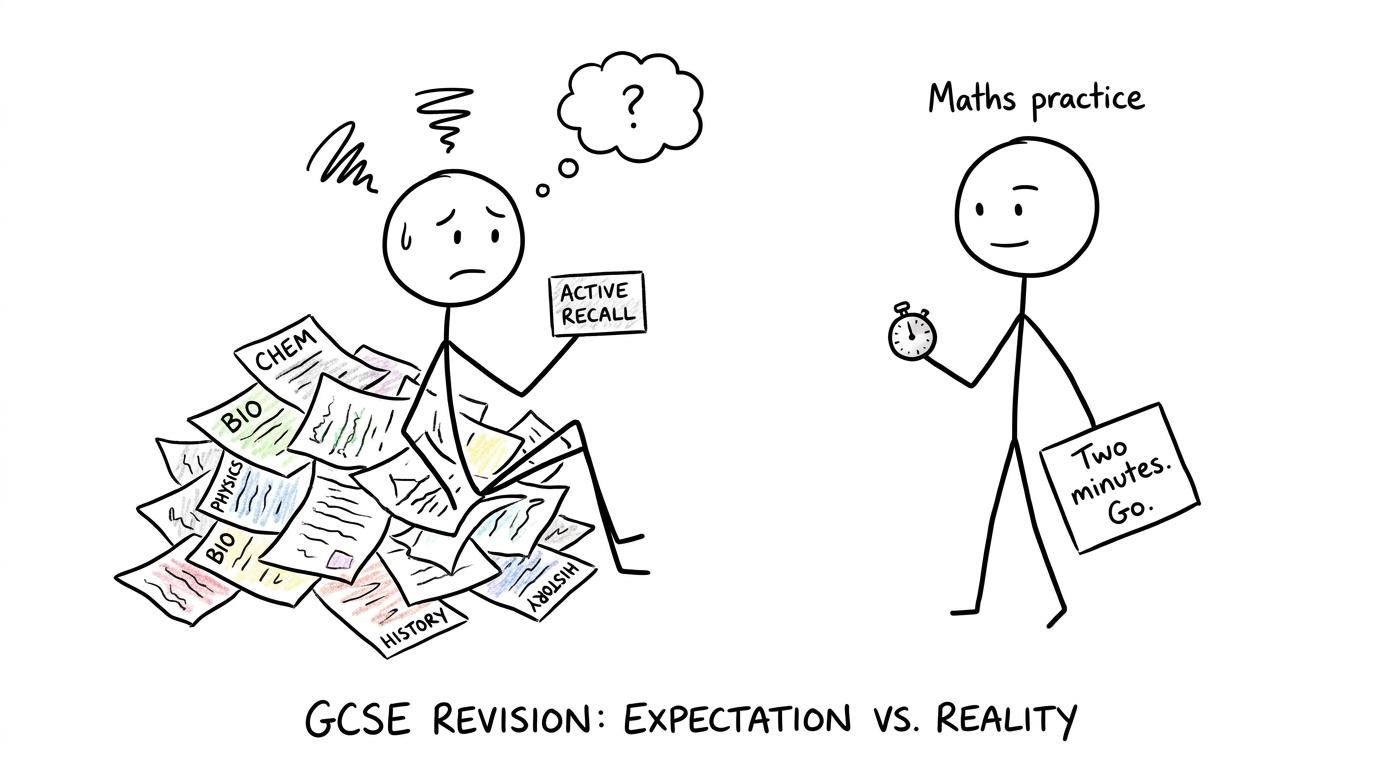 A stressed student with notes vs a tiny flashcard labelled Active Recall
The GCSE active recall shift (and why it feels hard)
There is a quiet trap in note-based revision: you re-read, you highlight, you rewrite, and it feels productive because the page is busy. But exam questions do not ask you to recognise your own handwriting. They ask you to recall, connect, and apply. That is why GCSE active recall often feels uncomfortable at first: it exposes gaps.
A useful story: a student once told me they “knew” electrolysis because their notes were six pages long. Then they tried a single six-mark question and could not structure an answer. Nothing was wrong with their effort. The effort was just pointed at the wrong target.
Maths revision has a built-in truth serum: you either get the answer or you do not. That is why modelling Chemistry revision on maths-style practice is so effective, even if you are a WJEC student and even if you are aiming for grades 999 to 111 across different subjects.
A quick checklist: turning notes into active recall
Use this as your simple loop for GCSE active recall. It works for WJEC Chemistry, and it mirrors how strong maths revision works too.
- Convert each page of notes into questions (not summaries).
- Practise retrieval before you “re-learn”.
- Mark brutally honestly, then fix one thing at a time.
- Space it out: revisit after 111 day, 333 days, 777 days.
- Mix topics (interleaving), like maths papers do.
If you want a maths-based model for this loop, YesGenie is essentially built around it: lessons, practice, solutions, and repetition. Start with your board hub like WJEC GCSE Maths Revision and notice how everything pushes you towards retrieval.
Make your Chemistry notes behave like GCSE maths practice
Chemistry and maths look different, but your brain learns them through the same mechanism: repeated recall with feedback.
On YesGenie, even a single topic page nudges you into this: learn, then answer, then check solutions. For example, topics such as Proof (Edexcel GCSE Maths) or Probability (OCR GCSE Maths) only really “stick” once you retrieve methods repeatedly.
So for WJEC Chemistry, your job is to turn a passive object (notes) into a practice engine (questions). Here are three conversion methods that work.
Method 1: Blurting, but with exam structure
Blurting is simple: close your notes and write everything you can remember. The upgrade is making it exam-shaped.
Pick a subtopic (say, “rates of reaction” or “acids and alkalis”). On a blank page, write headings that match how WJEC mark schemes reward answers: definition, key equation, practical method, variables, common graphs, required explanation phrases.
Then blurt under each heading for 333 to 555 minutes. Only after that do you open your notes and mark what you missed. The marking step is where learning happens.
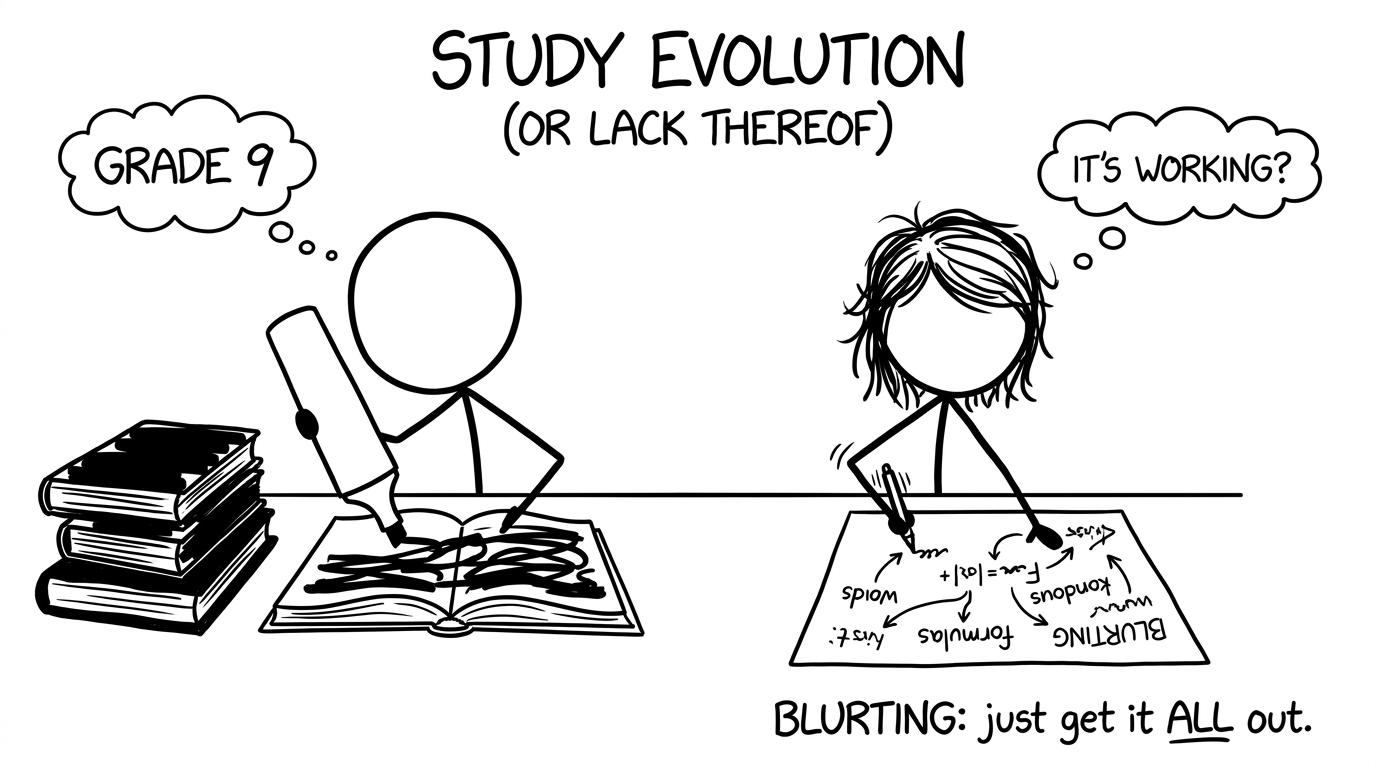 Highlighting vs blurting in a library
Method 2: Flashcards that force retrieval (not recognition)
A weak flashcard is “Define electrolysis” with the definition on the back. You can half-recognise it and feel confident.
A strong GCSE active recall flashcard forces a decision or an application:
- “In electrolysis of molten lead bromide, what forms at the cathode and why?”
- “State the test for hydrogen AND write the word equation it links to.”
- “A reaction rate doubles when concentration doubles. What does that suggest about collision frequency?”
If you want to see what good flashcards look like in a subject that is brutally method-driven, explore YesGenie flashcards such as Fractions, Decimals and Percentages Flashcards or Rearranging Harder Formulae Flashcards. The prompts are designed to make you retrieve steps, not just reread.
Method 3: “One page of notes” becomes “ten micro-questions”
Take one Chemistry page and rewrite it as ten micro-questions. Example transforms:
- Notes say: “Catalyst increases rate by providing alternative pathway with lower activation energy.”
- Questions become: “What does a catalyst do?” “What happens to activation energy?” “Does the catalyst get used up?” “How does the energy profile diagram change?”
This is exactly how maths revision guides work: they break a big topic into small retrieval chunks. If you like that style for maths, browse Eduqas GCSE Maths Revision Guides and borrow the same chunking mindset for Chemistry.
Worked examples: make Chemistry calculations feel like GCSE maths
WJEC Chemistry has calculations, and they are often where students either gain calm marks or lose easy ones. Treat them like maths: write a method, then practise it.
Worked example 1: Percentage yield
A student expects 12.0 g12.0\text{ g}12.0 g of product but actually makes 9.0 g9.0\text{ g}9.0 g. Find the percentage yield.
Use the method:
percentage yield=actual yieldtheoretical yield×100 \text{percentage yield} = \frac{\text{actual yield}}{\text{theoretical yield}} \times 100 percentage yield=theoretical yieldactual yield×100Substitute:
percentage yield=9.012.0×100=0.75×100=75% \text{percentage yield} = \frac{9.0}{12.0} \times 100 = 0.75 \times 100 = 75\% percentage yield=12.09.0×100=0.75×100=75%To make this GCSE active recall, your flashcard should not be “What is the formula?” It should be “Actual =9.0 g=9.0\text{ g}=9.0 g, theoretical =12.0 g=12.0\text{ g}=12.0 g. Show the calculation and give the final answer with units/percentage.”
Worked example 2: Concentration (simple) and rearranging
A solution has concentration 0.40 mol dm−30.40\text{ mol dm}^{-3}0.40 mol dm−3 and volume 0.50 dm30.50\text{ dm}^30.50 dm3. Find moles.
Use:
n=cV n = cV n=cVSo:
n=0.40×0.50=0.20 mol n = 0.40 \times 0.50 = 0.20\text{ mol} n=0.40×0.50=0.20 molNow reverse it (because exams do). If n=0.20 moln=0.20\text{ mol}n=0.20 mol and V=0.50 dm3V=0.50\text{ dm}^3V=0.50 dm3, find ccc:
c=nV=0.200.50=0.40 mol dm−3 c = \frac{n}{V} = \frac{0.20}{0.50} = 0.40\text{ mol dm}^{-3} c=Vn=0.500.20=0.40 mol dm−3This is why maths students get good at rearranging: you practise both directions until it is automatic. If rearranging is a weak spot in maths, use a topic like Rearranging Harder Formulae Flashcards as your training ground and then bring that confidence back into Chemistry.
Build a WJEC-friendly active recall timetable (without burning out)
WJEC students often revise multiple subjects at once, and Chemistry can balloon because notes are long. The trick is to think in “recall reps”, not “hours”.
Try this weekly pattern:
- Day 1: Convert notes to questions (only 202020 to 303030 minutes). Then do a short recall session.
- Day 2: Quick recall review (flashcards or blurting) for 101010 minutes.
- Day 4: Mixed recall (interleave two topics) for 151515 minutes.
- Day 7: Exam-style questions, then mark.
For maths, anchor your week with real exam practice using GCSE Past papers or board-specific pages like Edexcel GCSE Maths Past Papers. The habit of “attempt, mark, fix” is the same habit you want for Chemistry.
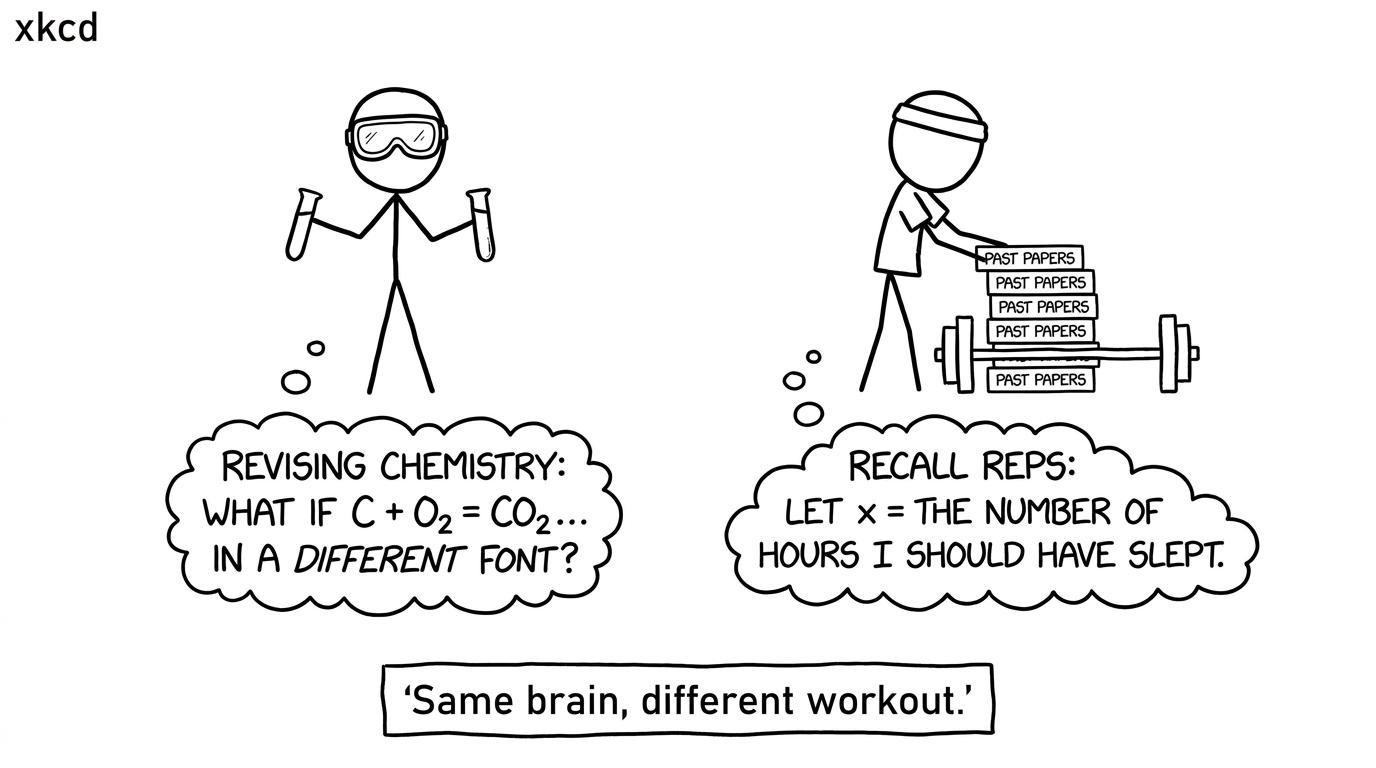 Science vs maths revision as a workout metaphor
Common mistakes when trying GCSE active recall from notes
- Making flashcards that copy sentences: if the back of the card is a paragraph, you will recognise it rather than retrieve it. Force short answers, steps, or “because” explanations.
- Checking notes too early: the struggle is the point. Give yourself at least 606060 to 909090 seconds to try before you peek.
- Never marking: GCSE active recall needs feedback. If you do not check, you will practise mistakes.
- Only revising what you like: interleave. Mix “easy” and “hard” topics so you stop relying on comfort.
- Confusing time spent with marks gained: ten minutes of retrieval can beat an hour of rewriting.
Bringing it back to YesGenie: practise retrieval every day
If you are a WJEC student trying to turn Chemistry notes into GCSE active recall, the big idea is simple: stop revising to see information and start revising to produce it.
And if you want the cleanest model of how this works, use your maths revision as the daily proof. YesGenie is built for retrieval: bite-sized lessons, topic practice, active-recall flashcards, and exam practice through GCSE Past papers. If you are on WJEC for maths too, begin with WJEC GCSE Maths Revision and make “attempt, mark, fix, repeat” your default.
Do that, and your Chemistry notes stop being a pile of paper you carry around. They become a set of questions you can answer. That is what GCSE active recall looks like in real life, quiet, repeatable, and surprisingly powerful.










