

GCSE Active Recall: Turn WJEC Biology Notes into Marks
GCSE active recall for WJEC Biology: turn notes into flashcards, questions and timed practice. A maths-first method to remember more, faster.
If you’re a WJEC student, you probably know this feeling: your GCSE Biology notes look impressive, colour-coded, and complete… yet the moment you try a past-paper question, your mind goes blank. That’s not laziness. It’s physics. Notes are storage, but exams reward retrieval. The shift you need is GCSE active recall: turning what you wrote into questions you can answer without looking.
And because you’re also revising maths, you’ve already met the same truth in another outfit: reading the method for solving simultaneous equations is not the same as solving them. Marks come from doing.
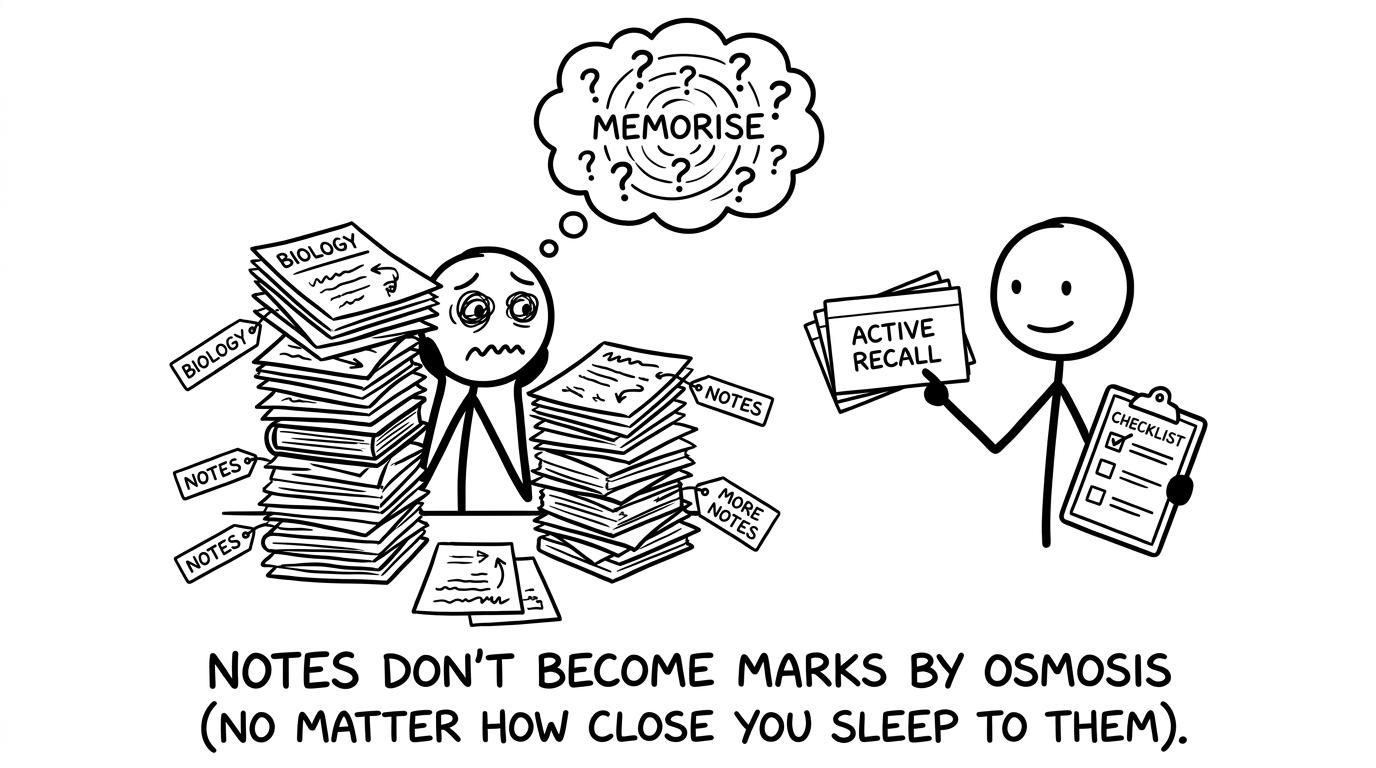 A student realises notes don't become marks by osmosis
GCSE active recall in one sentence (and why it works)
GCSE active recall means you force your brain to fetch information from memory, then you check and correct it.
It works because exams are a retrieval event. Whether it’s WJEC Biology or Edexcel Maths, you’re judged on what you can produce on demand, under time pressure, with no prompts. Your notes are prompts. Your exam paper isn’t.
A helpful mental model from maths is the difference between recognising and generating.
- Recognition is: “Yes, I remember that formula.”
- Generation is: “Here’s the formula and here’s how I use it.”
In maths, you can “recognise” a2+b2=c2a^2+b^2=c^2a2+b2=c2 all day. But until you can generate a solution in a new context, the topic isn’t secure. Biology is the same, just with different symbols.
A quick checklist to turn WJEC Biology notes into active recall
Use this as your simple conversion pipeline from “nice notes” to “exam-ready memory”:
- Convert each page of notes into questions (not summaries)
- Practise retrieval closed-book and timed
- Mark using a mark scheme style checklist (keywords, sequences, units)
- Fix gaps immediately, then space the topic out and revisit it
- Mix topics (interleave) so your brain learns to choose the right idea
YesGenie is built around this exact loop in maths: learn the idea, attempt questions, check solutions, and repeat. If you want the maths equivalent of active recall, start with the GCSE Past papers and the Edexcel GCSE Maths Mini Tests so you’re retrieving, not re-reading.
How to convert notes into GCSE active recall questions
Most students convert notes the way they organise a bedroom: they make it look tidy. But active recall is more like packing for a hike: every item has to earn its weight.
The “one heading, five questions” rule
Take one subheading from your WJEC Biology notes and force it into five question types:
- Define: What is it?
- List: What are the key steps/parts?
- Explain: Why does it happen?
- Compare: How is it different from something similar?
- Apply: What would happen if something changed?
Example (photosynthesis):
- Define photosynthesis.
- State the word equation.
- Explain the role of chlorophyll.
- Compare limiting factors: light vs carbon dioxide.
- Predict what happens to rate if temperature increases beyond optimum.
Each question becomes a flashcard prompt or a mini test item. This is GCSE active recall because the question is now doing the work, not the highlighting.
Make mark scheme-style answer bullets
WJEC Biology mark schemes reward specific points, often in a sequence. So convert your answer side into bullet marks you can self-check.
For example, an “explain” question might need:
- correct keyword
- correct cause
- correct consequence
That’s exactly how you mark maths too: method mark then accuracy mark. On YesGenie you can see this mindset in worked solutions, like the step-by-step approach across Edexcel GCSE Maths Past Papers.
GCSE active recall for science students who are also revising maths
You’re a maths student. That’s an advantage, not a distraction. Maths has already taught you three exam habits that transfer perfectly to Biology.
Habit one: retrieval beats rereading
In maths, if you only reread a topic, you get the warm feeling of familiarity. But the first time you try a question, you discover the truth.
The same applies to Biology notes. You need to produce answers.
A practical routine:
- 888 minutes: closed-book recall from flashcards
- 222 minutes: check answers, correct in a different colour
- 555 minutes: re-test the cards you missed
That 151515 minutes is more powerful than an hour of rewriting notes.
Habit two: interleaving prevents “topic shock” in the exam
Most GCSE students revise in blocks. It feels clean: respiration today, ecology tomorrow.
But exams aren’t polite. They mix.
Maths students already train for this using mixed papers and mini tests. Try doing the same with your revision: mix two Biology topics and one maths topic in a short session, like:
- 101010 minutes WJEC Biology active recall (flashcards)
- 151515 minutes maths mini test
- 101010 minutes WJEC Biology past-paper short answers
On the maths side, you can use the Resources hub to find mini tests and predicted papers when you want mixed practice.
Habit three: check the method, not just the final line
In maths, you can get the final answer wrong even with mostly-correct method. That’s why you review working.
In Biology, the “working” is your sequence and keywords. When you self-mark, don’t ask “Was I close?” Ask “Did I hit the exact points?” That’s GCSE active recall done properly.
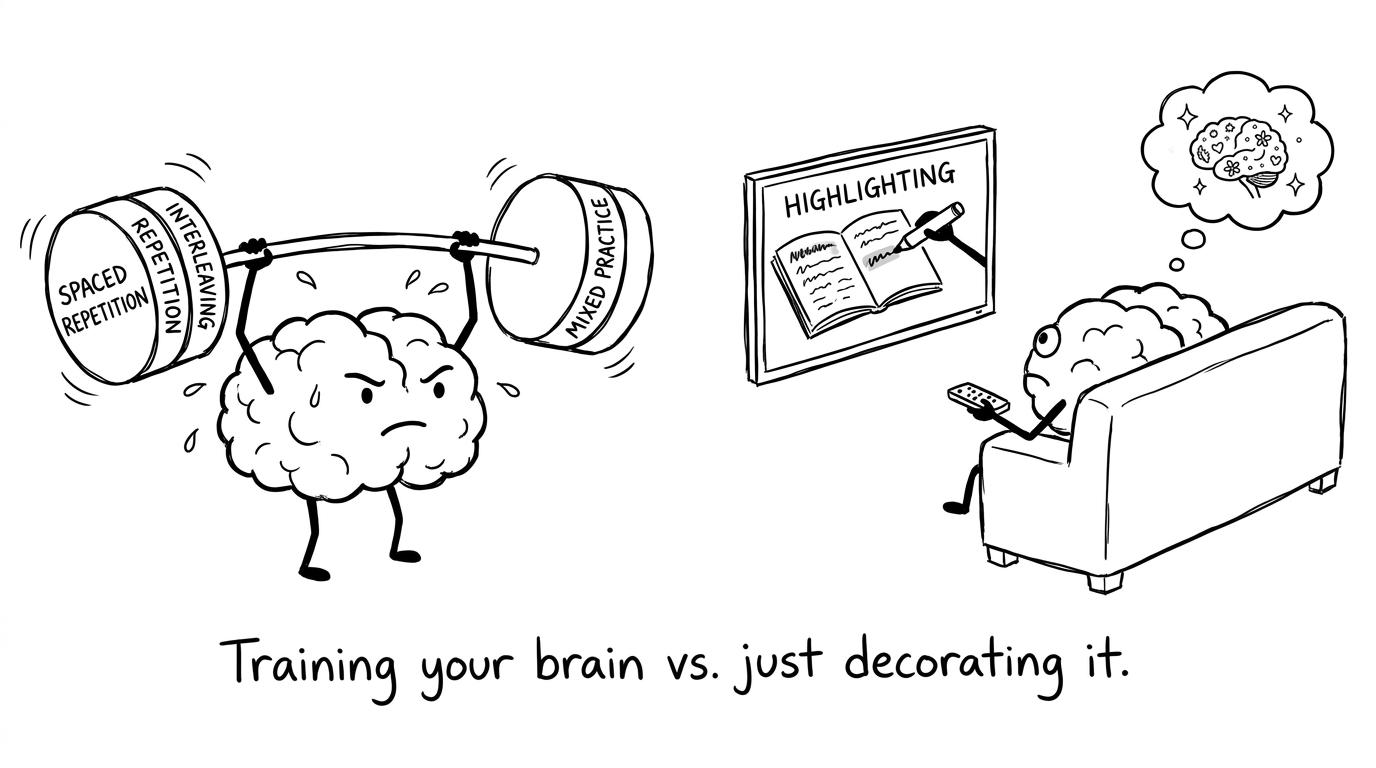 Training vs decorating your brain
Worked examples: using maths thinking to sharpen Biology recall
These are maths-style worked examples, because your brain likes methods.
Worked example 1: turning a messy fact list into a recall algorithm
Suppose your Biology notes say:
- diffusion depends on concentration gradient
- rate increases with temperature
- larger surface area increases rate
- diffusion distance matters
Convert into a “decision method” you can recall.
Create a single prompt card:
Prompt: “What affects diffusion rate? Give four factors and explain each in one line.”
Answer bullets (mark-scheme style):
- Concentration gradient: bigger gradient $ ightarrow$ more net movement per second.
- Temperature: higher temperature $ ightarrow$ particles have more kinetic energy, move faster.
- Surface area: larger area $ ightarrow$ more particles can cross at once.
- Diffusion distance: shorter distance $ ightarrow$ quicker overall transfer.
Now practise retrieval. If you miss one bullet, that’s a clear gap. The point is you’re training the shape of an exam answer.
Worked example 2: using a simple equation to practise recall and accuracy
GCSE Biology sometimes involves straightforward calculations (for example, magnification). Use maths discipline: write the formula, substitute, simplify, include units.
If you’re given an image length of 35 mm35\text{ mm}35 mm and an actual length of 5 mm5\text{ mm}5 mm, magnification is:
magnification=image sizeactual size=355=7 \text{magnification}=\frac{\text{image size}}{\text{actual size}}=\frac{35}{5}=7 magnification=actual sizeimage size=535=7Active recall practice:
- Can you state the formula without looking?
- Can you substitute accurately?
- Can you write a final answer cleanly?
That is GCSE active recall because you’re retrieving a formula and applying it, not copying it.
Worked example 3: timing and checking like a maths paper
Take a six-mark Biology question. Give yourself 666 minutes. Write your answer. Then self-mark with a checklist.
This is the same skill you build when you do timed sections from maths papers, such as splitting practice into manageable chunks using 45 Minute GCSE Papers (available in the resources area).
The shared lesson is simple: speed comes from familiarity under pressure, not from rereading.
Common mistakes students make with GCSE active recall
These are the traps that make students think they’re doing GCSE active recall when they’re not.
Making flashcards that are just copied notes
If the “question” side is a title like “Respiration”, that’s not a prompt, it’s a chapter heading. A real prompt forces an output: “State the word equation for aerobic respiration.”
Peeking too early
If you look after two seconds, you’ve trained yourself to quit at the first sign of difficulty. Leave a gap. Try again. Then check.
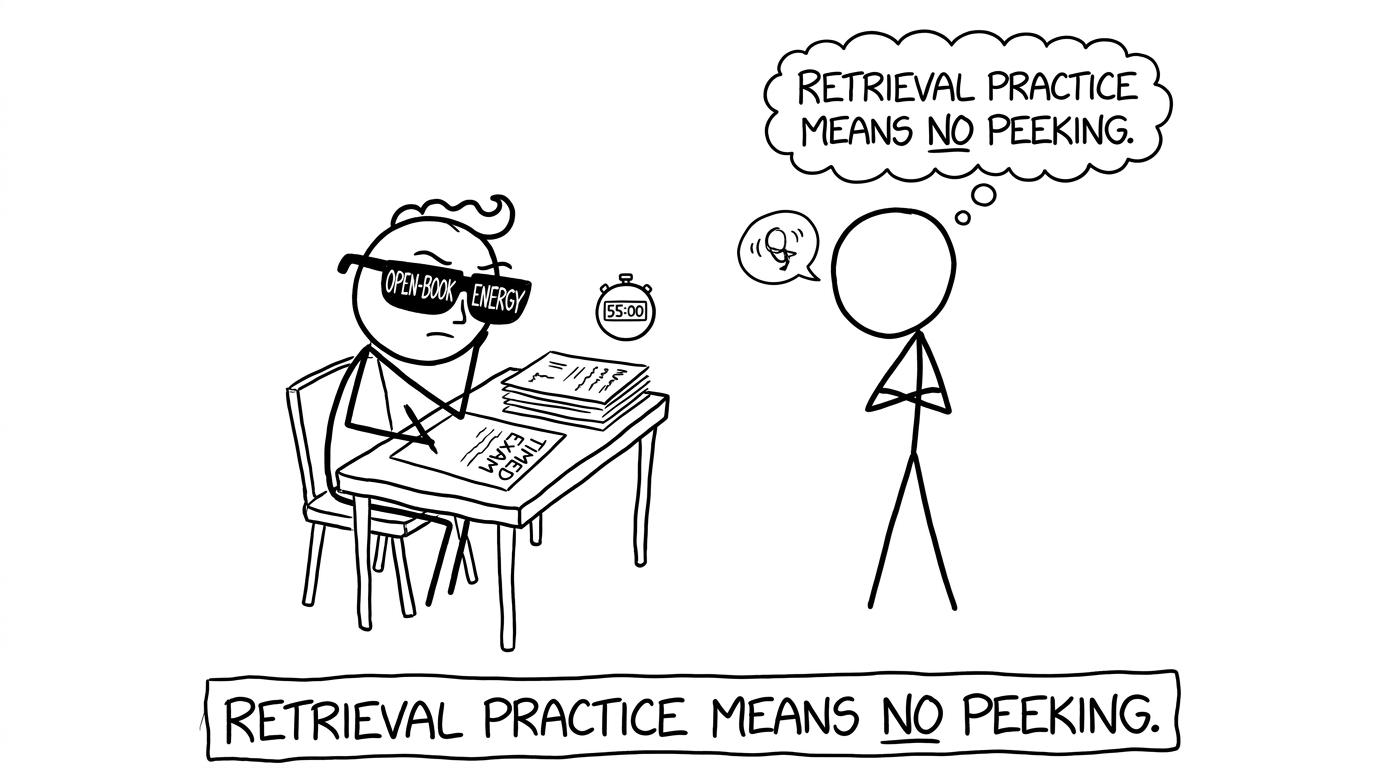 Retrieval practice means no peeking
Not correcting with precision
Writing “revise this” is not correction. Correction is: add the missing keyword, rewrite one sentence, then re-test.
Never upgrading to exam questions
Flashcards build recall. Exam questions build selection, structure, and timing. You need both.
For maths, this is exactly why students move from topic practice to GCSE Past papers and then to full paper runs.
A simple weekly plan: WJEC Biology active recall plus maths revision
A plan matters because panic is a terrible strategist.
- Mon: Biology flashcards (2 topics, 202020 minutes) + maths mini test (202020 minutes)
- Tue: Biology exam questions (252525 minutes timed) + maths weak-topic lesson (151515 minutes)
- Wed: Biology flashcards (spaced revisit, 151515 minutes) + maths past-paper section (303030 minutes)
- Thu: Biology six-mark answers (222 questions timed) + maths mixed questions (202020 minutes)
- Fri: Light review: biology “missed cards” + maths “fix list”
- Weekend: One longer session: half a maths paper + a biology past-paper section
Use YesGenie as your maths engine room: start with revision lessons and practice cards from a WJEC topic page such as 3d Pythagoras and Trigonometry (WJEC GCSE Maths), then move to mini tests and past papers.
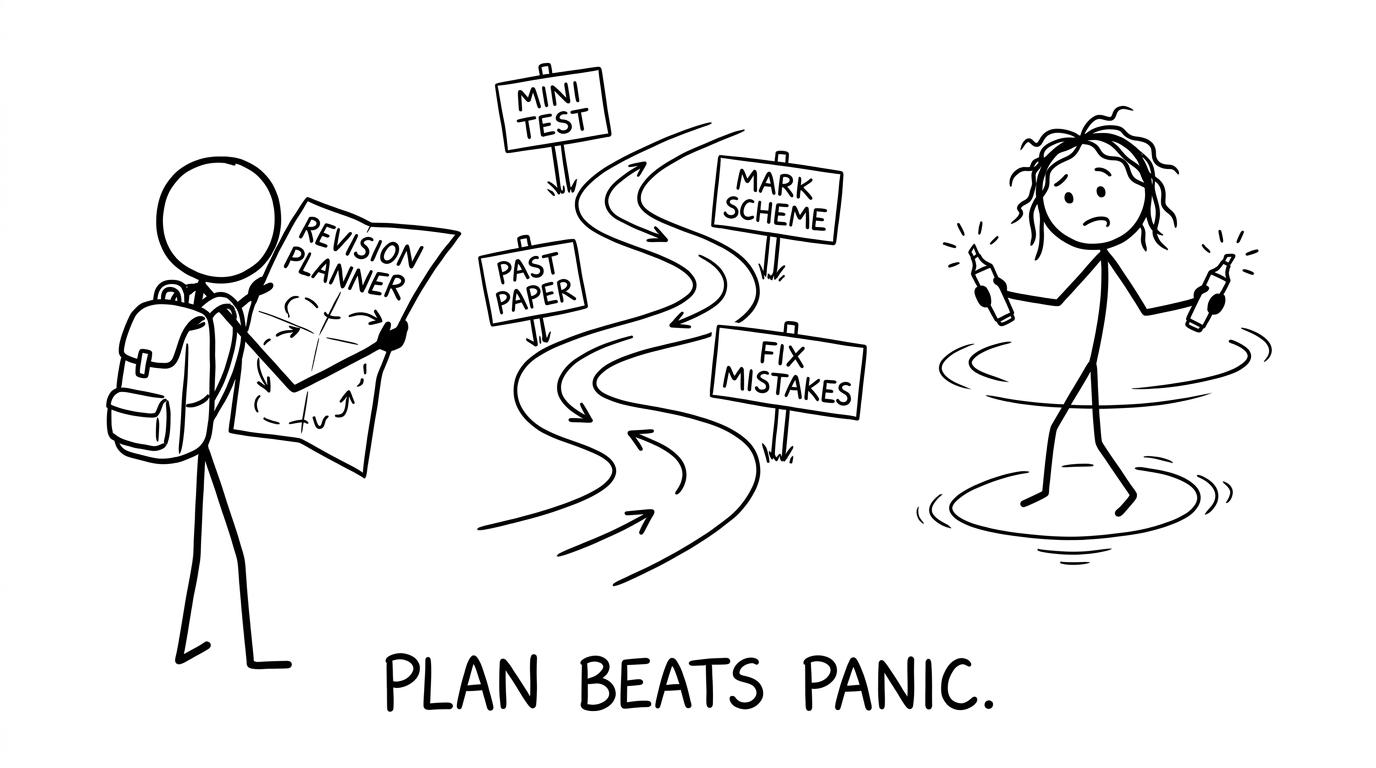 Plan beats panic
Closing: turn notes into marks, not just pages
There’s a quiet moment most GCSE students reach, usually late in revision season, where they realise their notebook is not a scoreboard. It’s just evidence that time passed. What changes grades is what you can retrieve under pressure.
For WJEC Biology, that means converting notes into prompts, practising closed-book, and marking like an examiner. For maths, it’s the same story written in numbers: learn the idea, practise questions, check the method, and repeat until it feels inevitable.
If you want that loop to be simple, consistent, and free, use YesGenie as your daily maths revision home: revision lessons, mini tests, practice questions, mark schemes, video solutions, and full GCSE Past papers when you’re ready to prove it to yourself. Then bring the same GCSE active recall mindset back to Biology, and watch your notes finally start paying rent.










