Functions GCSE Maths: A Clear Guide
Functions GCSE maths explained with simple rules, step-by-step worked examples, common mistakes and exam-style questions for confident revision.
Functions can feel harder than they really are. A letter appears inside brackets, one rule seems to sit inside another, and suddenly substitution looks like a new language. But the central idea behind functions GCSE maths questions is simple: a function takes an input, follows a fixed rule and produces an output.
Imagine a student called Sam. At first, Sam treats f(x)f(x)f(x) as though it means f×xf \times xf×x. Every functions question begins with uncertainty. Then one detail clicks: f(x)f(x)f(x) is the name of an output, not a multiplication. From that point, the topic becomes a sequence of instructions rather than a collection of strange symbols.
This guide follows the same path, from basic function notation to composite and inverse functions, with worked examples and exam-style practice.
The functions checklist
For GCSE functions questions, you should be able to:
- understand function notation such as f(x)f(x)f(x);
- substitute numbers, negatives and algebraic expressions;
- work backwards from an output;
- combine two functions in the correct order;
- find the inverse of a simple function;
- check an inverse using the original rule.
Inverse and composite functions are commonly assessed in higher-tier material, although the exact coverage depends on your exam board and specification. Maths Genie places them within its Edexcel Grade 7-9 resources.
The complete Inverse and Composite Functions lesson brings the explanations, questions and supporting resources together in one place.
What is a function?
A function is a rule that assigns an output to an input. If the rule is
f(x)=3x−5,f(x)=3x-5,f(x)=3x−5,then the function tells you to multiply the input by 333 and subtract 555.
The letter fff is simply the name of the function. Another function might be called ggg, hhh or ppp. The value inside the brackets is the input.
So f(4)f(4)f(4) means: use 444 as the input in the rule for fff.
Worked example: evaluating a function
Given
f(x)=3x−5,f(x)=3x-5,f(x)=3x−5,find f(4)f(4)f(4).
Replace every xxx in the rule with 444:
f(4)=3(4)−5.f(4)=3(4)-5.f(4)=3(4)−5.Calculate in the usual order:
f(4)=12−5=7.f(4)=12-5=7.f(4)=12−5=7.Therefore,
f(4)=7.f(4)=7.f(4)=7.Sam's early mistake was to see f(4)f(4)f(4) and search for something called fff to multiply by 444. The useful habit is simpler: locate the function rule, then substitute the input wherever xxx appears.
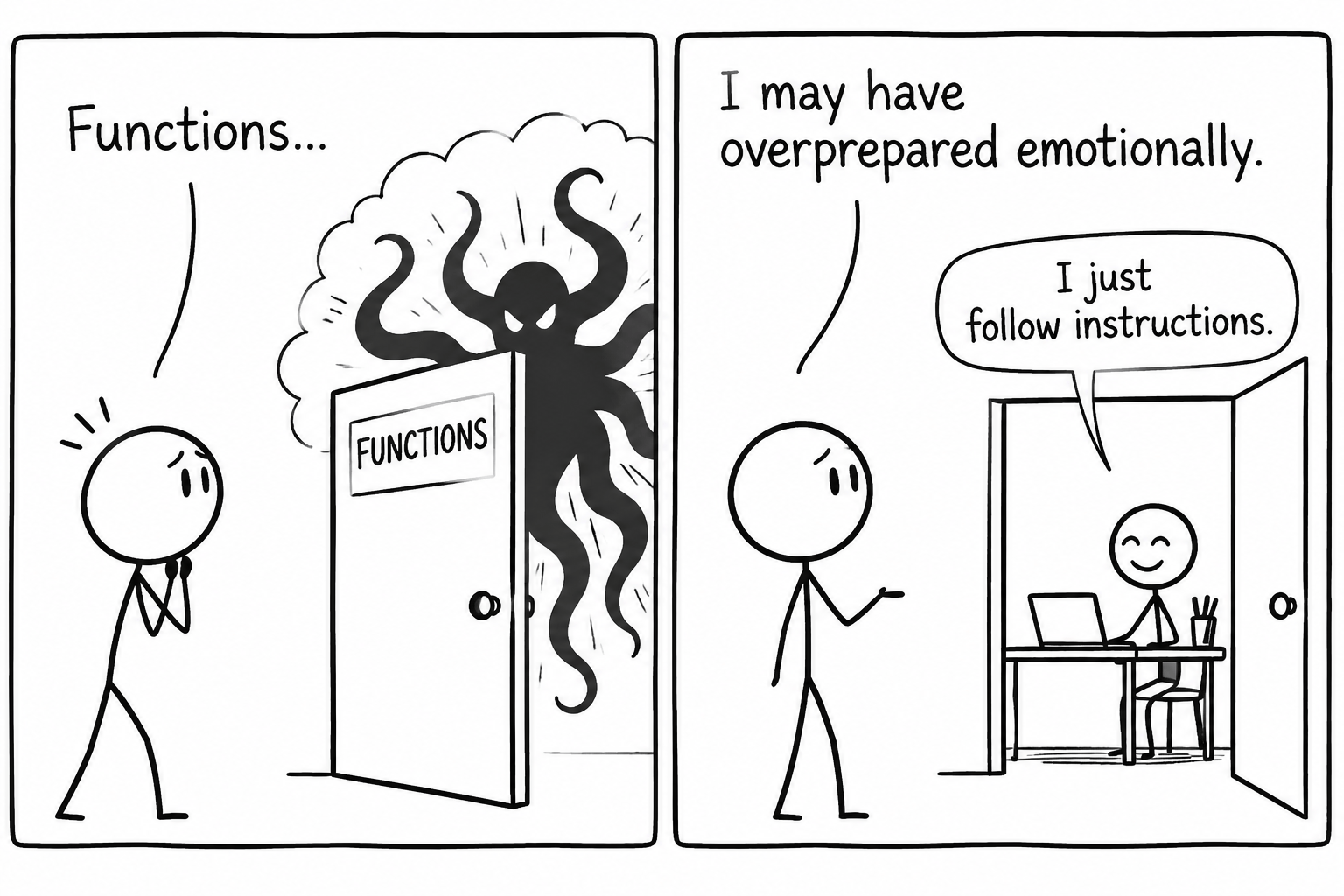 A pupil discovers that functions are instructions rather than monsters
Substituting negative numbers
Negative inputs deserve care because powers and signs can change the answer.
Suppose
h(x)=x2+2x.h(x)=x^2+2x.h(x)=x2+2x.Find h(−3)h(-3)h(−3).
Substitute −3-3−3 using brackets:
h(−3)=(−3)2+2(−3).h(-3)=(-3)^2+2(-3).h(−3)=(−3)2+2(−3).Now simplify:
h(−3)=9−6=3.h(-3)=9-6=3.h(−3)=9−6=3.Writing brackets around a negative input makes the calculation clearer. In particular,
(−3)2=9,(-3)^2=9,(−3)2=9,because the negative number itself is being squared.
You can reinforce this substitution process with the functions practice worksheet after completing the examples here.
Working backwards from an output
Some functions questions give you the output and ask for the original input. Treat the missing input as an unknown and form an equation.
Worked example: finding the input
Given
f(x)=2x+7f(x)=2x+7f(x)=2x+7and
f(a)=19,f(a)=19,f(a)=19,find aaa.
Because aaa is the input, substitute it into the rule:
2a+7=19.2a+7=19.2a+7=19.Subtract 777 from both sides:
2a=12.2a=12.2a=12.Divide both sides by 222:
a=6.a=6.a=6.You can check by substituting 666 into the original function:
f(6)=2(6)+7=19.f(6)=2(6)+7=19.f(6)=2(6)+7=19.This is where the topic began to click for Sam. A function was no longer a mysterious object. It was a rule that could be followed forwards or reversed carefully.
Once this method makes sense, use the Maths Genie functions video solutions to see it applied to further exam-style questions.
Composite functions explained
A composite function applies one function and then another. If you see
fg(x),fg(x),fg(x),this normally means
f(g(x)).f(g(x)).f(g(x)).Work from the inside out. Apply ggg first, followed by fff.
Worked example: finding a composite function
Let
f(x)=2x−3f(x)=2x-3f(x)=2x−3and
g(x)=x2+1.g(x)=x^2+1.g(x)=x2+1.Find fg(x)fg(x)fg(x).
Start with the inside function:
g(x)=x2+1.g(x)=x^2+1.g(x)=x2+1.This entire expression becomes the input of fff. Since fff doubles its input and subtracts 333,
f(g(x))=2(x2+1)−3.f(g(x))=2(x^2+1)-3.f(g(x))=2(x2+1)−3.Expand and simplify:
fg(x)=2x2−1.fg(x)=2x^2-1.fg(x)=2x2−1.Order matters. Finding gf(x)gf(x)gf(x) gives a different calculation:
g(f(x))=(2x−3)2+1.g(f(x))=(2x-3)^2+1.g(f(x))=(2x−3)2+1.Expanding gives
gf(x)=4x2−12x+10.gf(x)=4x^2-12x+10.gf(x)=4x2−12x+10.The two answers differ because the functions were applied in a different order. A reliable note beside the question is: inside first.
If setting up the order still feels demanding, work through the composite functions Question Bank while keeping that two-word reminder beside each calculation.
Inverse functions explained
An inverse function reverses the original function. Its notation is
f−1(x).f^{-1}(x).f−1(x).This does not mean 111 divided by f(x)f(x)f(x). It means the inverse of fff.
Worked example: finding an inverse
Let
f(x)=3x+6.f(x)=3x+6.f(x)=3x+6.To find the inverse, begin by writing
y=3x+6.y=3x+6.y=3x+6.Swap xxx and yyy:
x=3y+6.x=3y+6.x=3y+6.Rearrange to make yyy the subject:
x−6=3y,x-6=3y,x−6=3y,so
y=x−63.y=\frac{x-6}{3}.y=3x−6.Therefore,
f−1(x)=x−63.f^{-1}(x)=\frac{x-6}{3}.f−1(x)=3x−6.A quick check is to choose an input. Since
f(3)=15,f(3)=15,f(3)=15,the inverse should take 151515 back to 333:
f−1(15)=15−63=3.f^{-1}(15)=\frac{15-6}{3}=3.f−1(15)=315−6=3.That check catches many rearranging errors. The inverse functions revision resources provide further opportunities to practise the same process.
Common mistakes with functions
Treating f(x)f(x)f(x) as multiplication
The notation f(x)f(x)f(x) names the output of function fff when the input is xxx. It does not mean f×xf \times xf×x.
Forgetting brackets around negative inputs
If p(x)=x2−4p(x)=x^2-4p(x)=x2−4, then
p(−2)=(−2)2−4=0.p(-2)=(-2)^2-4=0.p(−2)=(−2)2−4=0.Use brackets whenever you substitute a negative number.
Applying composite functions in the wrong order
For fg(x)=f(g(x))fg(x)=f(g(x))fg(x)=f(g(x)), calculate g(x)g(x)g(x) first. Starting with fff changes the question.
Squaring only part of an expression
If
g(f(x))=(2x−3)2+1,g(f(x))=(2x-3)^2+1,g(f(x))=(2x−3)2+1,the whole bracket must be squared. Expanding correctly gives
(2x−3)2=4x2−12x+9.(2x-3)^2=4x^2-12x+9.(2x−3)2=4x2−12x+9.Confusing an inverse with a reciprocal
The notation f−1(x)f^{-1}(x)f−1(x) means the inverse function. It is not generally equal to
1f(x).\frac{1}{f(x)}.f(x)1.Skipping the check
For an inverse function, test one input through the original rule and then the inverse. You should return to your starting value.
Exam-style functions questions
Try these without looking at the answers first.
Question 1
Given f(x)=4x−7f(x)=4x-7f(x)=4x−7, find f(5)f(5)f(5).
Question 2
Given h(x)=x2−3h(x)=x^2-3h(x)=x2−3, find h(−4)h(-4)h(−4).
Question 3
Let f(x)=2x+1f(x)=2x+1f(x)=2x+1 and g(x)=x−5g(x)=x-5g(x)=x−5. Find fg(x)fg(x)fg(x).
Question 4
Find the inverse of
p(x)=5x−10.p(x)=5x-10.p(x)=5x−10.Question 5
Given f(x)=3x+2f(x)=3x+2f(x)=3x+2 and f(a)=20f(a)=20f(a)=20, find aaa.
Answers
- f(5)=13f(5)=13f(5)=13
- h(−4)=13h(-4)=13h(−4)=13
- fg(x)=2x−9fg(x)=2x-9fg(x)=2x−9
- p−1(x)=x+105p^{-1}(x)=\frac{x+10}{5}p−1(x)=5x+10
- a=6a=6a=6
Check any errors by identifying the precise step that went wrong: substitution, order, expansion or rearranging. That diagnosis is more useful than simply copying the correct answer.
Turn understanding into reliable marks
Sam's progress did not come from memorising more symbols. It came from following one dependable routine: identify the input, substitute carefully, simplify, and check. Knowing that routine is the first step; applying it often enough to feel automatic is the next.
Your turn. Start the Functions lesson and Question Bank.