Feeling Behind in GCSE Economics? How to Catch Up
Feeling behind GCSE Economics? Learn why it is common, identify your gaps and build a calm catch-up plan covering knowledge, maths and exam skills.
Feeling behind can begin with something small. A classmate recalls a definition instantly. Someone else finishes a data question before you have read the axis. Suddenly, a difficult lesson feels like evidence that everyone understands GCSE Economics except you.
If you are feeling behind GCSE Economics, the short answer is yes: that feeling is understandable, and it does not prove that you cannot catch up. Economics combines unfamiliar terminology, connected chains of reasoning, quantitative skills and extended writing. Students rarely master all four at the same speed.
The useful question is not, “How far ahead is everyone else?” It is, “Which part should I improve next?” Once you replace a vague fear with a specific task, catching up becomes much more manageable.
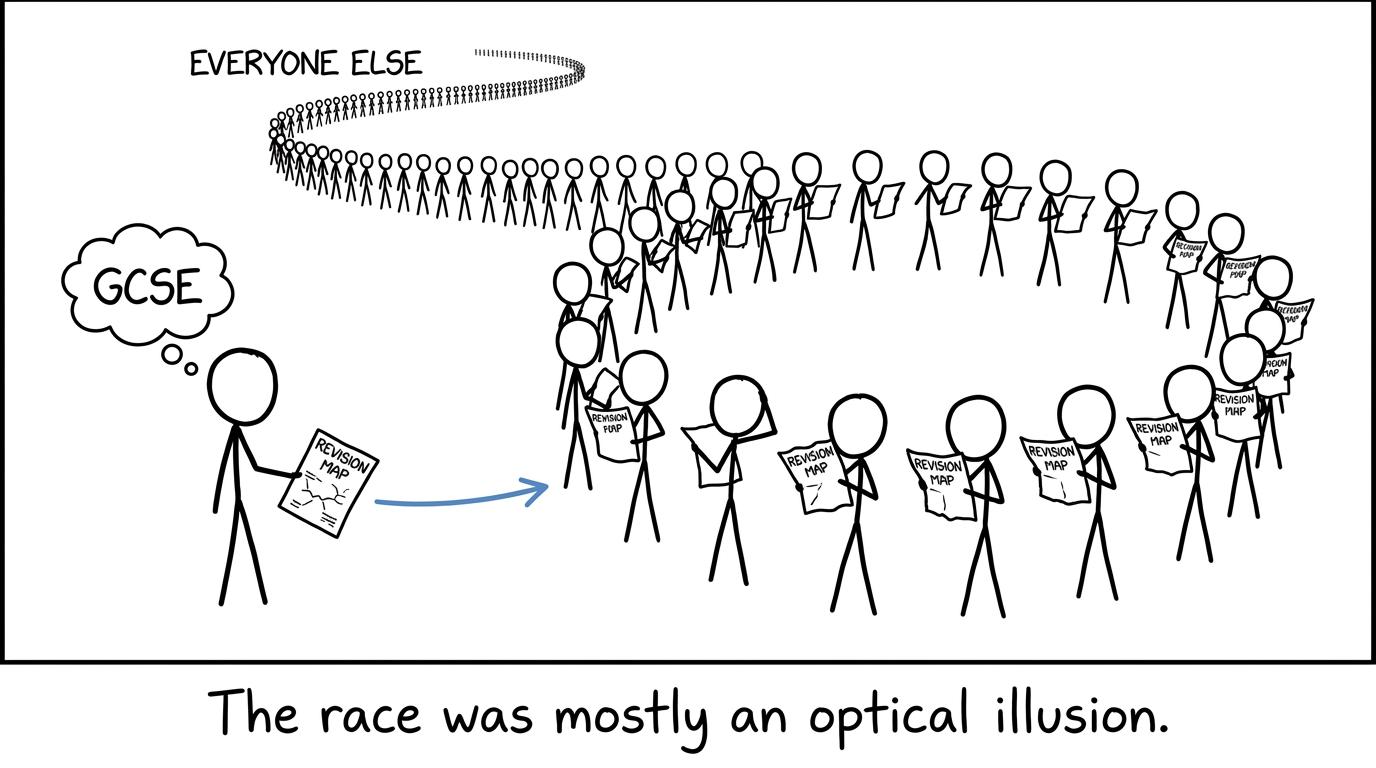 A revision race that turns out to be an optical illusion
A quick GCSE Economics catch-up checklist
Start by checking these areas separately:
- Core knowledge: Can you define the essential terms in your current topics?
- Connections: Can you explain how one economic change may cause another?
- Quantitative skills: Are percentages, ratios, averages and graphs secure?
- Application: Can you use information from a case study rather than giving a generic answer?
- Evaluation: Can you explain why an outcome may depend on circumstances?
- Exam technique: Do you understand what each command word requires?
Do not label the whole subject as a weakness if only two items need attention. A student who knows the content but struggles to organise longer answers has a different problem from a student who has missed several topics. Both can feel equally “behind”, but they need different plans.
Why feeling behind is more common than it looks
Economics is cumulative. Ideas such as scarcity, incentives, markets, costs, revenue and government intervention do not remain in separate boxes. Later topics often assume that earlier vocabulary and relationships are already familiar.
This creates an awkward effect. One missing idea can make several lessons feel confusing, even when the underlying gap is small. If you are uncertain about percentage change, for instance, questions involving inflation, costs or economic data may all appear harder than they really are.
There is also a visibility problem. You hear the student who answers confidently, but not the private uncertainty of everyone who stays quiet. Fast recall is noticeable; slow improvement is not. Comparing your internal doubts with somebody else's most visible moment is rarely a fair measurement.
Finally, familiarity can resemble understanding. A page of highlighted notes may look reassuring because the words are recognisable. An exam question asks for something more demanding: retrieval, selection, application and explanation. Discovering that gap can feel like falling behind when it is actually useful feedback about how to revise.
Work out what “behind” means for you
Before building a timetable, diagnose the gap. Take a recent assessment, practice paper or topic checklist and sort each weakness into one of four categories.
Missing knowledge
You cannot accurately define a term, identify a concept or recall the relevant content. The solution is focused learning followed by closed-book retrieval. Keep definitions precise and connect each one to its role in the wider topic.
Weak chains of reasoning
You know individual facts but cannot explain the route from cause to consequence. Practise building short verbal chains using prompts such as “because”, “therefore” and “this may lead to”. Each link should explain the mechanism rather than simply repeat the previous sentence.
Insecure quantitative skills
Economic questions may include tables, charts, percentages, ratios, averages and changes over time. These skills are also part of GCSE Maths, so strengthening them can support both subjects.
Useful starting points include MathsGenie's free lessons on percentages, percentage change, ratio and averages.
For example, the underlying percentage-change relationship is:
percentage change=changeoriginal value×100\text{percentage change}=\frac{\text{change}}{\text{original value}}\times 100percentage change=original valuechange×100Knowing the relationship is only the beginning. You must also identify the original value correctly, use the units given and interpret what the result means in context.
Weak exam technique
You understand the topic but lose marks because the response does not meet the command word, use the case-study evidence or develop evaluation. Compare your answers with the official mark scheme for your exam board and look for a repeated pattern. “Needs more evaluation” is still broad; “does not explain what the outcome depends on” is actionable.
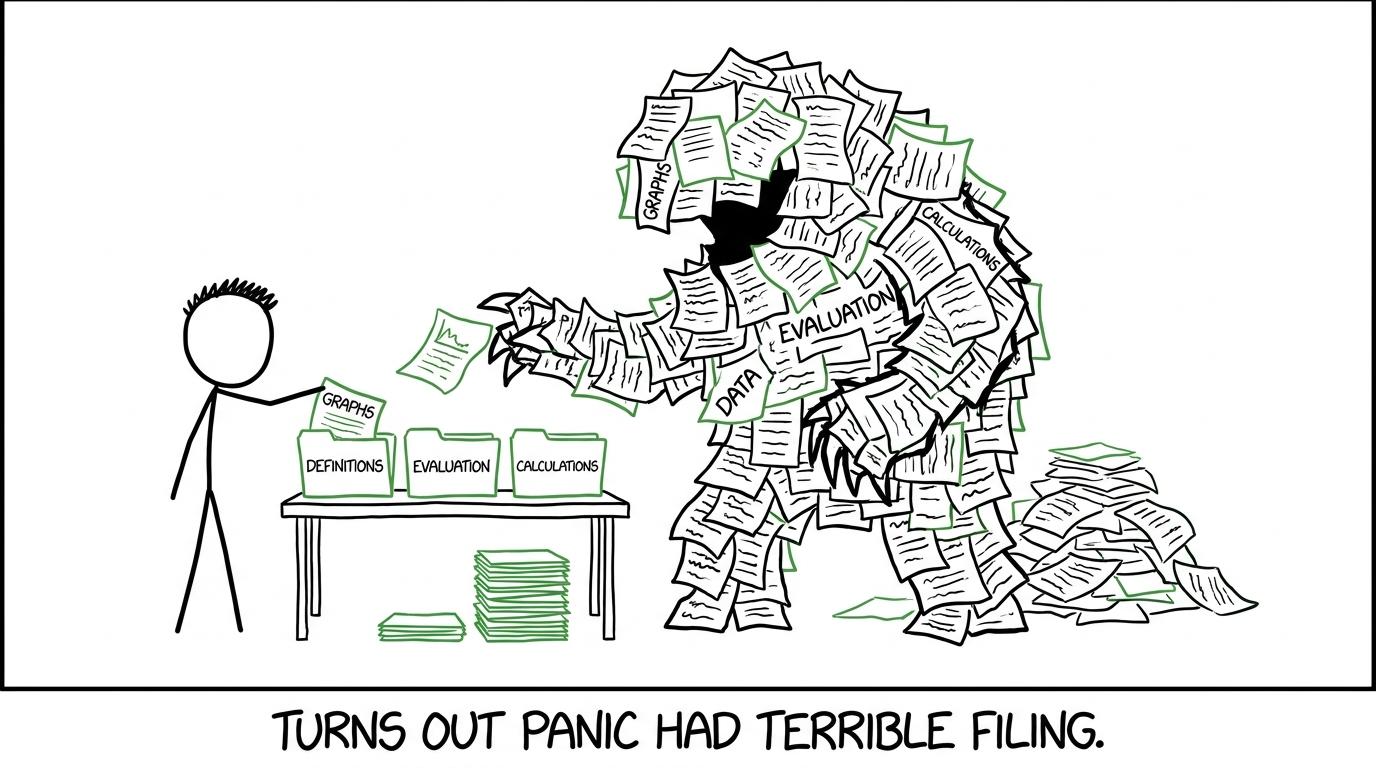 A panic monster shrinking as revision gaps are sorted
How to catch up without panicking
Panic encourages dramatic plans: revise the entire course this weekend, rewrite every note and complete several papers immediately. These plans often fail because they ignore attention, feedback and the order in which knowledge develops.
A calmer plan is smaller and more specific.
Prioritise foundational gaps
Begin with ideas that unlock other topics. If graphs are causing difficulty, revise scales, coordinates and interpreting trends before attempting increasingly complicated data questions. MathsGenie's GCSE maths revision topics are arranged by grade, making it easier to locate the underlying skill rather than revising randomly.
Then list your Economics topics using three labels:
- Secure: you can answer questions without notes;
- Developing: you understand the idea but need practice;
- Priority: the topic is missing or regularly costs marks.
Spend most of your catch-up time on priority and developing areas. Secure topics still need occasional retrieval, but they should not consume the session simply because they feel comfortable.
Use short cycles of learning and testing
A productive catch-up session can follow this sequence:
- retrieve what you already know without notes;
- review one small section of content;
- answer focused questions;
- check the answers or mark scheme;
- record one correction to revisit later.
The final step matters. A mistake becomes useful only when you identify why it occurred. Your correction log might classify errors as missing knowledge, misunderstood wording, weak calculation, incomplete application or undeveloped evaluation.
Keep Economics and maths revision connected
Do not treat every calculation error as an Economics problem. If you repeatedly misread graphs or calculate percentage change incorrectly, repair the underlying maths skill directly.
MathsGenie provides GCSE Maths past papers alongside topic-based revision, practice questions, mini tests, mark schemes and video solutions. This lets you move between learning a skill and seeing it under exam conditions.
When reading economic data, use a consistent routine:
- read the title and source;
- check both axes or column headings;
- identify units and time periods;
- distinguish actual values from percentage changes;
- support conclusions with precise evidence.
That routine reduces avoidable errors without requiring you to rush.
Build a realistic weekly catch-up plan
A useful plan should tell you what to do, not merely when to sit at a desk. “Revise Economics” is too vague. “Retrieve market-failure definitions, answer two application questions and correct yesterday's graph errors” gives the session a clear finish line.
Across a week, balance four activities:
- Knowledge retrieval for terminology and concepts;
- Quantitative practice for calculations and data interpretation;
- Written responses for analysis, application and evaluation;
- Review of earlier errors so they do not return.
Alternate demanding and lighter tasks. A long written response may be followed by a short definition test rather than another extended answer. This keeps the plan sustainable while ensuring that revision remains active.
If maths is competing for attention too, use the MathsGenie GCSE revision resources to select one precise topic at a time. Progress is easier to see when the task has boundaries.
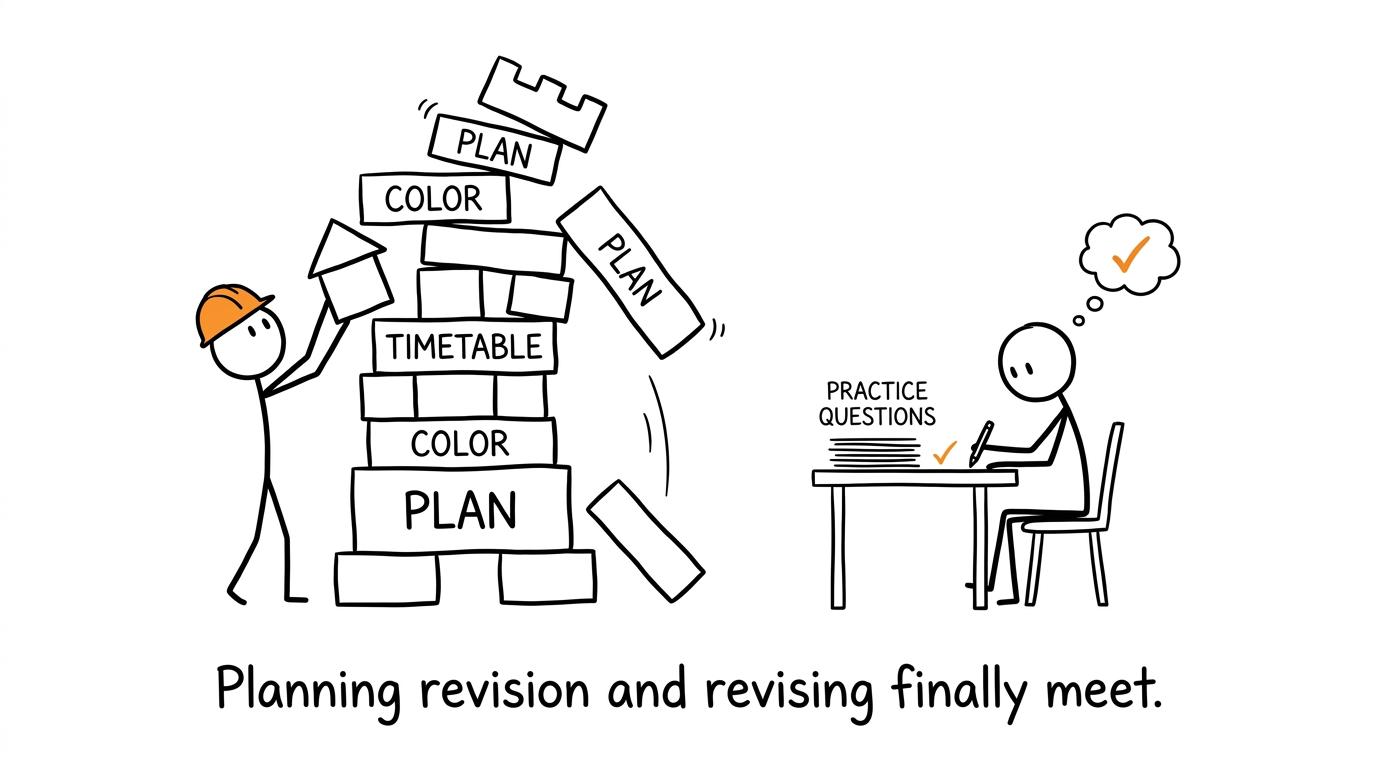 The difference between building a timetable and doing revision
Practise exam questions at the right time
Past papers are valuable, but completing full papers is not always the best first move. If several topics are missing, a full paper may repeatedly confirm what you already know: you have gaps.
Start with targeted questions on one topic or skill. Once your knowledge is more stable, combine topics under timed conditions. Later, use full papers and predicted papers to practise selecting methods, managing time and moving between short calculations and longer written responses.
Always use materials for your own specification. GCSE Economics assessment structures and wording can differ between exam boards such as AQA and OCR. Check your board, qualification code and current specification rather than assuming that any Economics paper matches your course.
For GCSE Maths, MathsGenie's past paper collection includes papers, mark schemes and worked video solutions. Predicted papers can then provide additional practice near the examination period, but they should complement specification coverage and past papers rather than replace them.
Common mistakes when trying to catch up
Rewriting everything
Neat notes can support learning, but copying an entire textbook is slow and provides little evidence that you can retrieve or apply the content. Summarise selectively, then test yourself.
Revising only comfortable topics
Familiar work feels productive because it goes smoothly. Use your priority list to make sure weaker areas receive more attention while there is still time to improve them.
Doing calculations without interpreting them
In Economics, a correct value may be only part of the task. Check whether the question also asks you to compare, explain or use the result in context.
Jumping straight to full papers
Full papers are most informative once you have enough topic knowledge to attempt them meaningfully. Use focused practice first when the underlying content is insecure.
Reading mark schemes passively
A mark scheme is not just an answer to look at. Compare it with your response, identify the missing feature and rewrite the weak part. Notice whether marks were lost through knowledge, application, analysis, evaluation or quantitative accuracy.
Treating classmates as a progress measure
Someone else's speed tells you little about your own gaps or the quality of their understanding. Measure progress through improved retrieval, fewer repeated errors and stronger answers to questions you previously found difficult.
Feeling behind does not mean staying behind
The feeling is broad, but the solution should be precise. Identify whether you need knowledge, reasoning, quantitative confidence or exam technique. Repair one important gap, test it, review the feedback and return to it later.
That process is less dramatic than attempting to transform everything overnight. It is also far more useful. Confidence usually follows evidence: a definition recalled accurately, a graph read correctly, a percentage question completed without guessing, or an answer improved after using a mark scheme.
Start today with one Economics priority and one supporting maths skill. Use MathsGenie's free GCSE revision lessons and practice questions, then build towards past papers and mark schemes, predicted papers, mini tests and video solutions. The aim is not to catch an imaginary crowd. It is to make your next piece of work better than the last one.