Factorising Quadratics GCSE Maths: Examples and Practice
Factorising quadratics GCSE maths made clear with step-by-step worked examples, sign checks, common mistakes and exam-style questions to build confidence.

Imagine a student who keeps finding two numbers that multiply correctly, puts them into brackets, and still gets the answer wrong. If that sounds familiar, factorising quadratics GCSE maths becomes clearer when you give those numbers two jobs: multiply to the constant term and add to the coefficient of xxx.
That second check is often where the method clicks. Factorising stops feeling like guessing when you know exactly what each pair must do.
We will follow this hypothetical student's turning point through worked examples, then give you questions to try independently.
The method at a glance
For a quadratic of the form x2+bx+cx^2+bx+cx2+bx+c:
- Check whether all the terms have a common factor first.
- Find two numbers that multiply to ccc.
- Check that those same numbers add to bbb.
- Put them into two brackets.
- Expand your answer to check it.
Quadratics with a leading coefficient of 111 appear within foundation tier content. Higher tier also includes harder expressions of the form ax2+bx+cax^2+bx+cax2+bx+c, where the leading coefficient is not 111.
What does factorising a quadratic mean?
Factorising means rewriting an expression as a product of factors. It reverses expanding brackets.
The reason the method works is visible here:
(x+p)(x+q)=x2+(p+q)x+pq(x+p)(x+q)=x^2+(p+q)x+pq(x+p)(x+q)=x2+(p+q)x+pqThe numbers inside the brackets produce the constant term by multiplication. They produce the coefficient of xxx by addition.
Our imagined student had been checking only the multiplication. Once they start writing down both conditions, they have a reliable way to choose between possible pairs.
If expanding brackets still feels uncertain, use the expanding and factorising quadratics revision guide to strengthen that connection.
Factorising quadratics worked examples
Positive numbers in both brackets
Factorise:
x2+7x+12x^2+7x+12x2+7x+12We need two numbers whose product is 121212 and whose sum is 777.
The positive factor pairs are 111 and 121212, 222 and 666, and 333 and 444. Only the last pair adds to 777.
Therefore:
x2+7x+12=(x+3)(x+4)x^2+7x+12=(x+3)(x+4)x2+7x+12=(x+3)(x+4)Check by expanding:
(x+3)(x+4)=x2+4x+3x+12=x2+7x+12(x+3)(x+4)=x^2+4x+3x+12=x^2+7x+12(x+3)(x+4)=x2+4x+3x+12=x2+7x+12Notice how the middle term comes from two separate multiplications. That explains why checking the constant alone is insufficient.
A negative constant term
Factorise:
x2−x−12x^2-x-12x2−x−12The product must be −12-12−12, so the numbers must have opposite signs. Their sum must be −1-1−1.
Our student might initially choose −3-3−3 and 444. The product is correct, but the sum is 111. Writing down the sum catches the mistake immediately.
The correct pair is 333 and −4-4−4:
3×(−4)=−12,3+(−4)=−13\times(-4)=-12,\qquad 3+(-4)=-13×(−4)=−12,3+(−4)=−1Therefore:
x2−x−12=(x+3)(x−4)x^2-x-12=(x+3)(x-4)x2−x−12=(x+3)(x−4)A useful sign rule follows: when the constant is negative, the number with the greater absolute value determines the sign of the sum.
Build confidence with this product-and-sum check in the MathsGenie Lessons on expanding and factorising quadratics, then apply it to the Question Bank linked below.
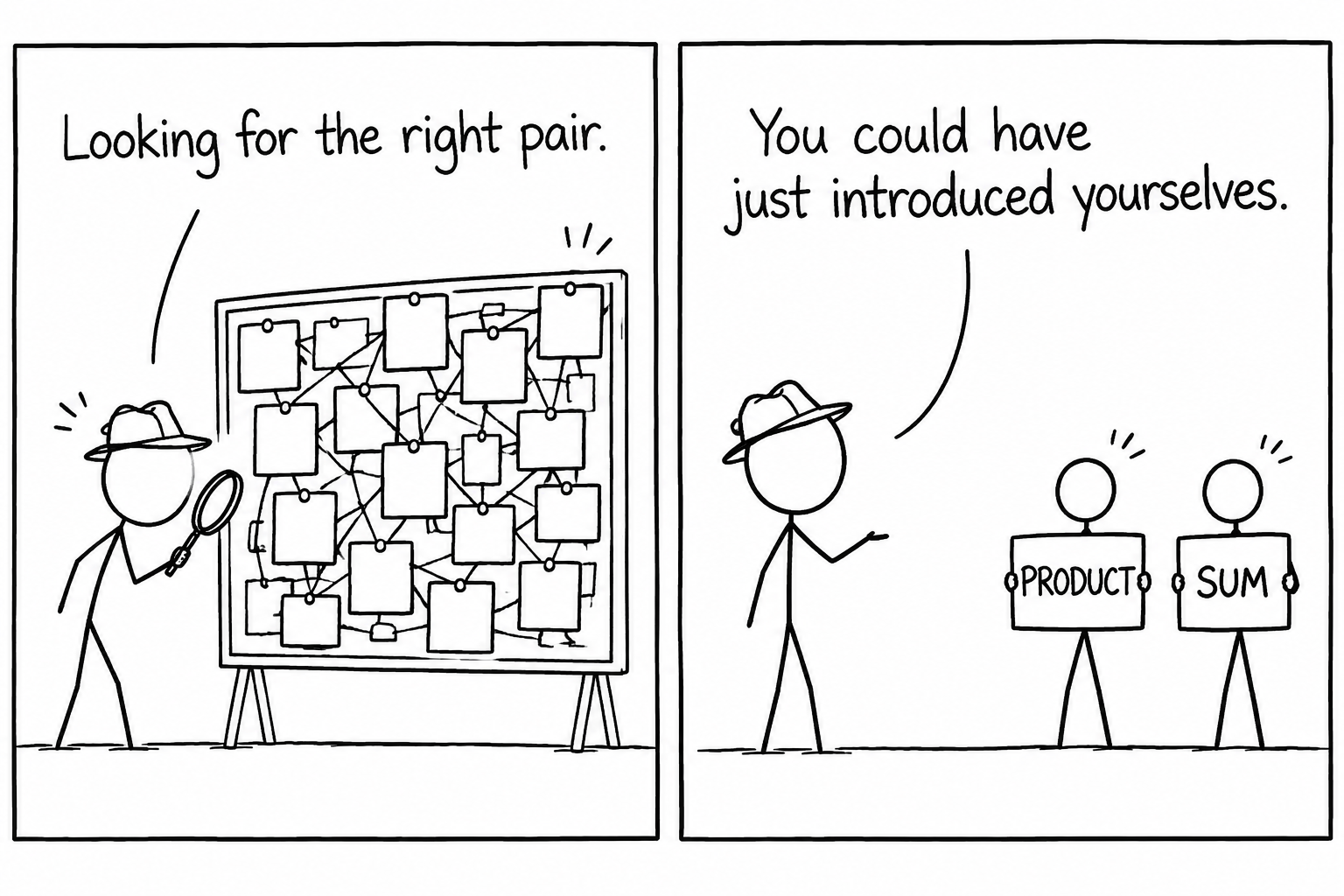 A stick-figure student detective discovers that product and sum are the two clues needed for factorising.
A coefficient before the squared term
For higher tier, factorise:
2x2+7x+32x^2+7x+32x2+7x+3Use splitting the middle term. Multiply the leading coefficient by the constant:
2×3=62\times3=62×3=6Find two numbers that multiply to 666 and add to 777: they are 666 and 111.
Split the middle term, then factorise each group:
2x2+7x+3=2x2+6x+x+3=2x(x+3)+1(x+3)=(2x+1)(x+3)\begin{aligned} 2x^2+7x+3&=2x^2+6x+x+3\\ &=2x(x+3)+1(x+3)\\ &=(2x+1)(x+3) \end{aligned}2x2+7x+3=2x2+6x+x+3=2x(x+3)+1(x+3)=(2x+1)(x+3)The matching bracket, (x+3)(x+3)(x+3), becomes a common factor. Expand the final answer to confirm that the middle terms combine to 7x7x7x.
For more practice at this level, use the factorising harder quadratics topic page.
When no pair seems to work
Work systematically rather than trying random numbers. List the positive factor pairs of the constant, then use its sign to decide which combinations need checking. Compare each sum with the middle coefficient. This gives you a clear stopping point: you have either found a suitable pair or checked every possible integer pair without finding one that satisfies both conditions.
For harder quadratics, remember that the product used when splitting the middle term is acacac, not simply ccc. If your grouped brackets do not match, revisit the split and any common factors you extracted. Matching brackets are a consequence of correct working, not something to force by changing signs or dropping terms.
Common mistakes and how to catch them
Choosing a pair that only multiplies correctly
Several factor pairs can give the same product. Write “product” and “sum” beside your working until checking both becomes automatic. A correct product with an incorrect sum gives the wrong middle term.
Getting both negative signs wrong
When the constant is positive, the two numbers have the same sign. If the middle coefficient is negative, both numbers must be negative.
When the constant is negative, the numbers have opposite signs. Decide which sign belongs to which number by checking their sum.
Forgetting to factorise fully
Before searching for pairs, look for a common factor:
2x2+10x+12=2(x2+5x+6)=2(x+2)(x+3)2x^2+10x+12=2(x^2+5x+6)=2(x+2)(x+3)2x2+10x+12=2(x2+5x+6)=2(x+2)(x+3)Stopping after taking out the common factor leaves a quadratic that can still be factorised.
Confusing factorising with solving
“Factorise” asks for a product, usually involving brackets. “Solve” asks for values of the unknown.
Do not set each bracket equal to zero unless you are solving an equation whose other side is zero. The expanding and factorising quadratics topic overview provides a focused place to practise the expression skills first.
Factorising quadratics questions
Try these exam-style practice questions without looking at the answers. Factorise each expression fully, and expand your brackets to check.
| Question | Expression |
|---|---|
| A | x2+9x+20x^2+9x+20x2+9x+20 |
| B | x2−8x+15x^2-8x+15x2−8x+15 |
| C | x2+2x−15x^2+2x-15x2+2x−15 |
| D | 3x2+12x+93x^2+12x+93x2+12x+9 |
| E, higher tier | 3x2+11x+63x^2+11x+63x2+11x+6 |
Answers and checks
- A: (x+4)(x+5)(x+4)(x+5)(x+4)(x+5), because 4+5=94+5=94+5=9 and 4×5=204\times5=204×5=20.
- B: (x−3)(x−5)(x-3)(x-5)(x−3)(x−5), because −3+(−5)=−8-3+(-5)=-8−3+(−5)=−8 and (−3)×(−5)=15(-3)\times(-5)=15(−3)×(−5)=15.
- C: (x+5)(x−3)(x+5)(x-3)(x+5)(x−3), because 5+(−3)=25+(-3)=25+(−3)=2 and 5×(−3)=−155\times(-3)=-155×(−3)=−15.
- D: 3(x+1)(x+3)3(x+1)(x+3)3(x+1)(x+3). Take out the common factor first.
- E: (3x+2)(x+3)(3x+2)(x+3)(3x+2)(x+3). Expanding gives middle terms 9x+2x=11x9x+2x=11x9x+2x=11x.
If an answer differs, locate the first incorrect decision: the common factor, the pair, the signs or the brackets. Our imagined student's breakthrough comes from identifying that decision and correcting it before attempting another question.
After checking your answers, cover the solutions and redo any question you missed on a fresh line. Explain the correction in a short sentence, such as “I checked the product but forgot the sum”. In your next revision session, try the question again before reading your notes. The aim is to make the decision independently, not just recognise a familiar answer.
Turn the method into a habit
You now have a way to choose the numbers and check every answer. The next step is using it independently until the product-and-sum check becomes familiar. Your turn: start with MathsGenie's factorising Lessons, then practise the same technique in the factorising quadratics Question Bank.