Factorising Quadratics Exam Questions: GCSE Guide
Factorising quadratics exam questions made clearer. Follow three GCSE worked examples, understand method marks, check answers and avoid common mistakes.
Factorising can feel strangely uncertain in an exam. You may know that two brackets are needed, yet the numbers seem to depend on guesswork. Under time pressure, that uncertainty grows.
The reliable way to answer factorising quadratics exam questions is to work from the constant term and middle coefficient, record enough working to show your method, then expand the brackets to check. For harder quadratics, multiply the first and last coefficients before splitting the middle term.
We will follow a hypothetical student, Sam, through three GCSE questions of rising difficulty. The marks shown are illustrative because exact allocations depend on the paper and its mark scheme, but they demonstrate the working examiners commonly reward.
The factorising quadratics checklist
Before looking at the questions, here is the complete method.
- Check whether there is a common factor to take out first.
- If the coefficient of x2x^2x2 is 111, find two numbers that multiply to give the constant and add to give the coefficient of xxx.
- If the coefficient of x2x^2x2 is not 111, multiply the coefficient of x2x^2x2 by the constant.
- Find two numbers with that product and the required sum.
- Split the middle term and factorise by grouping.
- Expand your brackets to check the answer.
That final check matters. Factorising and expanding are reverse processes, so expansion gives you a quick way to catch a sign error before moving on.
Once this checklist makes sense, the matching Expanding and Factorising Quadratics lesson and its Question Bank let you repeat the same method across exam-style questions.
Question one: a positive quadratic
Sam begins with a familiar-looking question.
Factorise fully x2+7x+12x^2+7x+12x2+7x+12.
Because the coefficient of x2x^2x2 is 111, the brackets will begin with xxx:
(x+□)(x+□)(x+\square)(x+\square)(x+□)(x+□)Sam needs two numbers that multiply to give 121212 and add to give 777.
The factor pairs of 121212 include 111 and 121212, 222 and 666, and 333 and 444. The useful pair is:
3×4=123\times4=123×4=12and
3+4=73+4=73+4=7Therefore:
x2+7x+12=(x+3)(x+4)x^2+7x+12=(x+3)(x+4)x2+7x+12=(x+3)(x+4)Where the marks may come from
On a typical two-mark question, one method mark may be available for identifying the correct pair of values or forming brackets with the right structure. The accuracy mark would then be awarded for the fully correct factorisation.
Sam checks by expanding:
(x+3)(x+4)=x2+4x+3x+12=x2+7x+12(x+3)(x+4)=x^2+4x+3x+12=x^2+7x+12(x+3)(x+4)=x2+4x+3x+12=x2+7x+12The check returns the original quadratic, so the answer is correct.
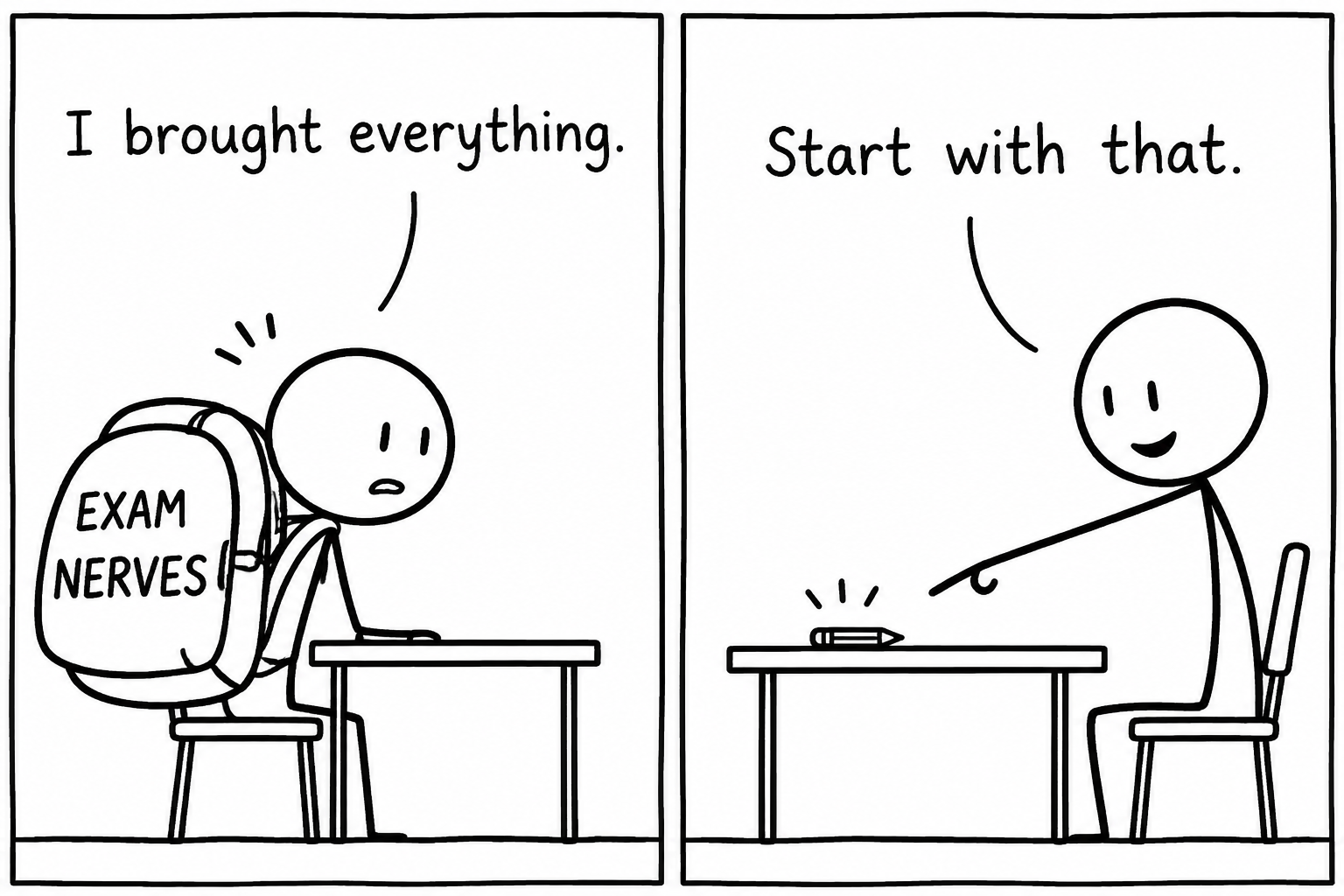 A student discovers that starting calmly beats carrying a backpack full of exam nerves
Question two: handling negative signs
The next question changes only one detail, but it is the detail that causes many errors.
Factorise fully x2−x−12x^2-x-12x2−x−12.
Sam needs two numbers that multiply to give −12-12−12 and add to give −1-1−1.
A negative product means one number must be positive and the other negative. Sam tests 444 and 333. Their difference is 111, but the larger number must be negative to produce a total of −1-1−1:
−4×3=−12-4\times3=-12−4×3=−12and
−4+3=−1-4+3=-1−4+3=−1Therefore:
x2−x−12=(x−4)(x+3)x^2-x-12=(x-4)(x+3)x2−x−12=(x−4)(x+3)Protecting the method mark
Writing the multiplication and addition conditions makes Sam's reasoning visible. If the final brackets contain a small copying error, clear intermediate work may still support a method mark, depending on the mark scheme.
The expansion check is:
(x−4)(x+3)=x2+3x−4x−12=x2−x−12(x-4)(x+3)=x^2+3x-4x-12=x^2-x-12(x−4)(x+3)=x2+3x−4x−12=x2−x−12When practising factorising quadratics GCSE exam questions, Sam learns not to decide both signs from the constant alone. The constant controls their product; the middle coefficient controls their sum.
For more questions at this level, students can use the AQA Expanding and Factorising Quadratics revision lesson or begin with an Eduqas factorising quadratics question.
Question three: a harder quadratic
Sam now reaches a quadratic in which the coefficient of x2x^2x2 is greater than 111.
Factorise fully 6x2+11x+36x^2+11x+36x2+11x+3.
Guessing two brackets is possible, but splitting the middle term gives Sam a systematic route.
First, multiply the coefficient of x2x^2x2 by the constant:
6×3=186\times3=186×3=18Sam needs two numbers that multiply to give 181818 and add to give 111111:
9×2=189\times2=189×2=18and
9+2=119+2=119+2=11The middle term 11x11x11x can therefore be split into 9x+2x9x+2x9x+2x:
6x2+9x+2x+36x^2+9x+2x+36x2+9x+2x+3Sam factorises the first pair and then the second pair:
3x(2x+3)+1(2x+3)3x(2x+3)+1(2x+3)3x(2x+3)+1(2x+3)Both terms now contain the same bracket, so:
6x2+11x+3=(3x+1)(2x+3)6x^2+11x+3=(3x+1)(2x+3)6x2+11x+3=(3x+1)(2x+3)Where the method marks may come from
A longer question may reward more than the final answer. Marks could recognise a valid split of the middle term, correct factorisation by grouping and the accurate final brackets. The exact structure varies, so Sam writes every important stage rather than jumping directly to an answer.
The check confirms the result:
(3x+1)(2x+3)=6x2+9x+2x+3=6x2+11x+3(3x+1)(2x+3)=6x^2+9x+2x+3=6x^2+11x+3(3x+1)(2x+3)=6x2+9x+2x+3=6x2+11x+3Students ready to consolidate this method can work through Factorising Harder Quadratics. The OCR harder quadratics revision resources provide another board-specific route through the topic.
Common mistakes in factorising quadratics exams
Using numbers with the right product but the wrong sum
For x2+7x+12x^2+7x+12x2+7x+12, the numbers 222 and 666 have the correct product but add to 888, not 777. Always test both conditions.
Losing a negative sign
For x2−x−12x^2-x-12x2−x−12, the pair 444 and −3-3−3 multiplies to −12-12−12 but adds to 111. The correct order of signs is −4-4−4 and 333.
Forgetting a common factor
If asked to factorise fully, first check whether every term shares a factor. For example:
2x2+10x+12=2(x2+5x+6)=2(x+2)(x+3)2x^2+10x+12=2(x^2+5x+6)=2(x+2)(x+3)2x2+10x+12=2(x2+5x+6)=2(x+2)(x+3)Stopping at 2(x2+5x+6)2(x^2+5x+6)2(x2+5x+6) would not be fully factorised.
Splitting the middle term without grouping correctly
After splitting 11x11x11x into 9x+2x9x+2x9x+2x, each pair must produce an identical bracket. If the brackets do not match, either the grouping or the chosen pair needs checking.
Solving when the question only asks for factorising
Factorising an expression is not the same as solving an equation. If there is no equals sign and the instruction is simply “factorise”, finish with brackets. For related equation practice, use the Solving Quadratics exam booklet.
How to practise with past paper questions
Factorising quadratics past paper questions become useful when you review the working, not merely the final score. For each question:
- attempt it without notes;
- show the product and sum you need;
- keep every algebraic stage visible;
- expand your final brackets;
- compare your method with the worked solution and mark scheme.
Sam's improvement is modest but important: the questions no longer begin with guessing. They begin with a decision. Product, sum, brackets, check.
The Maths Genie factorising Question Bank provides exam-style practice with worked solutions and mark schemes, making it easier to see which line of working earns credit.
Turn the method into exam confidence
Knowing the steps is different from recalling them quickly in an exam. Your goal is to make the product-and-sum check automatic, then recognise when the harder splitting method is needed. Start the Maths Genie Lessons and Question Bank, work through factorising quadratics exam questions in increasing difficulty, and check each solution against the mark scheme.