Factorising Harder Quadratics GCSE Maths
Factorising harder quadratics GCSE maths made clear with a reliable method, worked examples, common mistakes and focused exam-style practice.
Factorising harder quadratics GCSE maths questions becomes much more manageable when you stop guessing brackets and use a repeatable method. Multiply the first and last coefficients, find a suitable pair of numbers, split the middle term, then factorise by grouping.
Imagine a student called Sam. This is a hypothetical story, but the mistake will feel familiar. Sam can factorise x2+7x+12x^2+7x+12x2+7x+12 quickly, yet freezes when the question becomes 6x2+11x+36x^2+11x+36x2+11x+3. There seem to be too many possible brackets. After several wrong attempts, Sam assumes the topic requires unusual intuition.
It does not. What finally makes it click is treating factorisation as a sequence of small decisions rather than one inspired guess.
The harder quadratics checklist
For a quadratic in the form
ax2+bx+c,ax^2+bx+c,ax2+bx+c,where a≠1a\neq1a=1, use this checklist:
- Take out any highest common factor first.
- Calculate a×ca\times ca×c.
- Find two numbers that multiply to acacac and add to bbb.
- Split the middle term using those numbers.
- Factorise the first pair and the second pair.
- Take out the repeated bracket.
- Expand your answer to check it.
This is often called splitting the middle term. It turns one unfamiliar quadratic into two familiar factorising problems.
The skill is generally associated with Higher tier GCSE Maths. The precise wording and context can differ across Edexcel, AQA, OCR and Eduqas papers, but the underlying algebra remains the same. MathsGenie's Factorising Harder Quadratics revision page brings the relevant resources together.
Why ordinary bracket guessing becomes unreliable
For an easier quadratic such as
x2+7x+12,x^2+7x+12,x2+7x+12,you need two numbers with a product of 121212 and a sum of 777. That gives
(x+3)(x+4).(x+3)(x+4).(x+3)(x+4).When the coefficient of x2x^2x2 is not 111, both the first terms and the constant terms must be considered. For example,
(3x+1)(2x+3)(3x+1)(2x+3)(3x+1)(2x+3)contains several interacting products. Expanding gives
6x2+9x+2x+3=6x2+11x+3.6x^2+9x+2x+3=6x^2+11x+3.6x2+9x+2x+3=6x2+11x+3.The middle coefficient comes from two cross-products, not simply from adding the constants. That is where Sam's guessing kept going wrong.
Factorising harder quadratics worked examples
Example with positive terms
Factorise
6x2+11x+3.6x^2+11x+3.6x2+11x+3.First identify
a=6,b=11,c=3.a=6,\qquad b=11,\qquad c=3.a=6,b=11,c=3.Multiply the first and last coefficients:
ac=6×3=18.ac=6\times3=18.ac=6×3=18.Now find two numbers that multiply to 181818 and add to 111111. The numbers are 999 and 222 because
9×2=189\times2=189×2=18and
9+2=11.9+2=11.9+2=11.Split 11x11x11x into 9x+2x9x+2x9x+2x:
6x2+9x+2x+3.6x^2+9x+2x+3.6x2+9x+2x+3.Factorise each pair:
3x(2x+3)+1(2x+3).3x(2x+3)+1(2x+3).3x(2x+3)+1(2x+3).The repeated bracket is (2x+3)(2x+3)(2x+3), so
6x2+11x+3=(3x+1)(2x+3).6x^2+11x+3=(3x+1)(2x+3).6x2+11x+3=(3x+1)(2x+3).This was Sam's turning point. The brackets were not guessed. They emerged from the structure of the calculation.
Start the matching Factorising Harder Quadratics lesson when you want guided practice applying this checklist one step at a time.
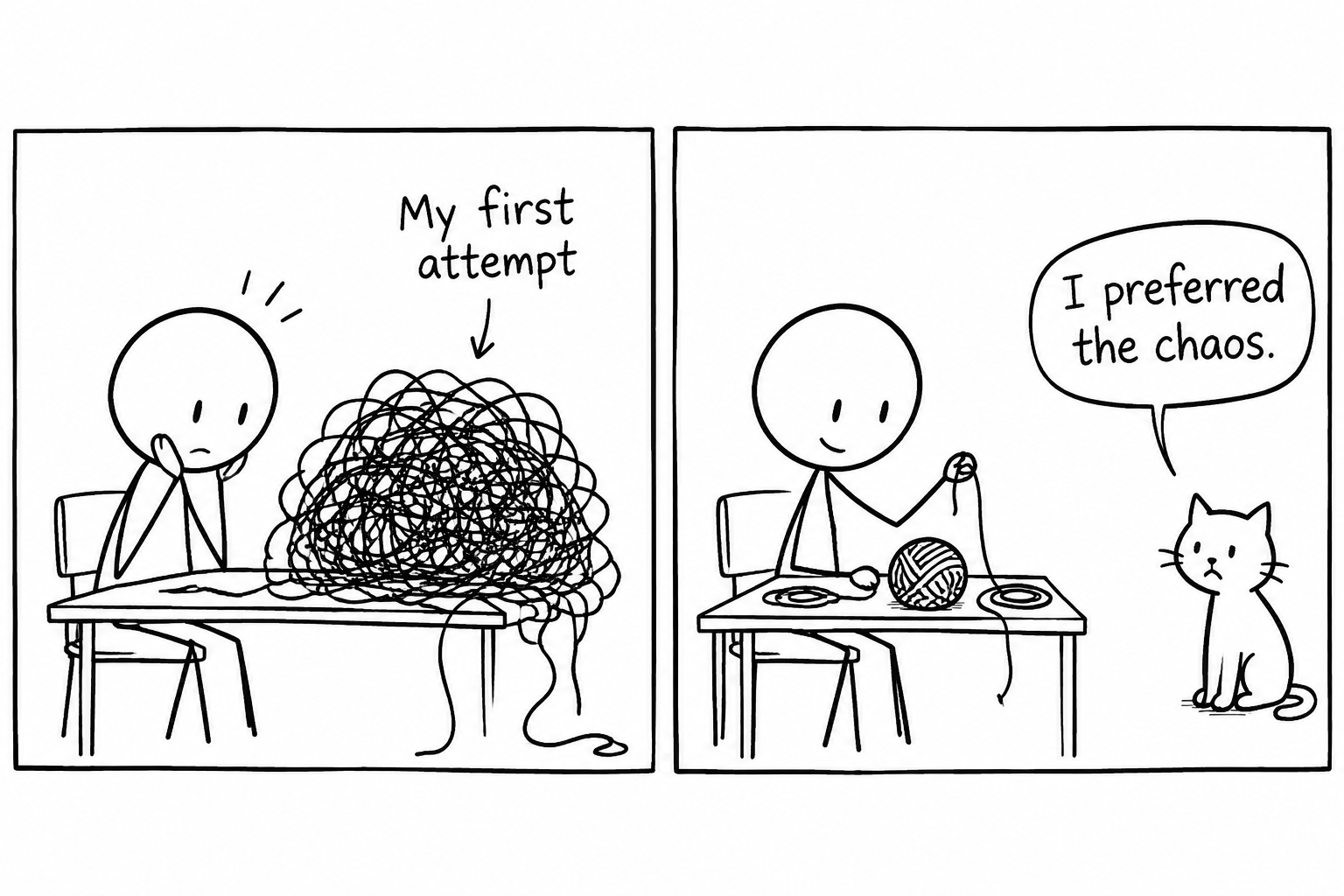 A student replaces a tangled first attempt with a calm method while a cat misses the chaos
Example involving negative numbers
Factorise
6x2−x−2.6x^2-x-2.6x2−x−2.Calculate the product:
ac=6×(−2)=−12.ac=6\times(-2)=-12.ac=6×(−2)=−12.We need two numbers with a product of −12-12−12 and a sum of −1-1−1. These are 333 and −4-4−4:
3×(−4)=−12,3\times(-4)=-12,3×(−4)=−12, 3+(−4)=−1.3+(-4)=-1.3+(−4)=−1.Split the middle term:
6x2+3x−4x−2.6x^2+3x-4x-2.6x2+3x−4x−2.Factorise by grouping:
3x(2x+1)−2(2x+1).3x(2x+1)-2(2x+1).3x(2x+1)−2(2x+1).Take out the repeated bracket:
6x2−x−2=(3x−2)(2x+1).6x^2-x-2=(3x-2)(2x+1).6x2−x−2=(3x−2)(2x+1).The signs are easier to manage if you decide what the pair must do before listing possibilities. A negative product means one number is positive and the other is negative. Their sum tells you which number needs the greater magnitude.
Example where the common factor comes first
Factorise fully:
4x2−20x+24.4x^2-20x+24.4x2−20x+24.Every term has a common factor of 444, so begin with
4(x2−5x+6).4(x^2-5x+6).4(x2−5x+6).Now find two numbers that multiply to 666 and add to −5-5−5. They are −2-2−2 and −3-3−3:
4(x−2)(x−3).4(x-2)(x-3).4(x−2)(x−3).Therefore,
4x2−20x+24=4(x−2)(x−3).4x^2-20x+24=4(x-2)(x-3).4x2−20x+24=4(x−2)(x−3).Taking out the common factor first reduces the size of the numbers and helps ensure that the final answer is fully factorised. If this earlier skill needs attention, revisit the Expanding and Factorising exam booklet.
How to check a factorised answer
Expansion reverses factorisation, so it provides a dependable check. For
(3x−2)(2x+1),(3x-2)(2x+1),(3x−2)(2x+1),expand every term:
6x2+3x−4x−2.6x^2+3x-4x-2.6x2+3x−4x−2.Collect the middle terms:
6x2−x−2.6x^2-x-2.6x2−x−2.This matches the original expression. The check takes only a few lines and catches misplaced signs, incorrect coefficients and incomplete factorisation.
Notice that factorising an expression is not the same as solving an equation. If asked only to factorise, your answer should remain in brackets. If the question includes an equation such as
6x2−x−2=0,6x^2-x-2=0,6x2−x−2=0,factorisation can then be used to find the values of xxx.
Common mistakes that lose marks
Using numbers that only multiply correctly
The pair must satisfy two conditions. For ac=18ac=18ac=18 and b=11b=11b=11, the numbers 666 and 333 multiply to 181818, but their sum is 999, not 111111.
Write both checks before splitting the middle term:
pq=ac,p+q=b.pq=ac,\qquad p+q=b.pq=ac,p+q=b.Losing a negative sign while grouping
From
6x2+3x−4x−2,6x^2+3x-4x-2,6x2+3x−4x−2,the second pair factorises as
−2(2x+1),-2(2x+1),−2(2x+1),not 2(2x−1)2(2x-1)2(2x−1). Expand the pair immediately if you are unsure.
Forgetting the highest common factor
An answer such as
(2x−4)(2x−6)(2x-4)(2x-6)(2x−4)(2x−6)may expand correctly, but it is not fully factorised because each bracket contains a factor of 222. The complete factorisation is
4(x−2)(x−3).4(x-2)(x-3).4(x−2)(x−3).Stopping after splitting the middle term
Rewriting a quadratic as four terms is working, not the final answer. Continue until the expression is written as a product of factors.
Expanding only part of the answer when checking
Both terms in one bracket must multiply both terms in the other. The Expanding and Factorising Quadratics questions can help strengthen this reverse process.
Factorising harder quadratics questions
Try these without looking at the answers. Show the product acacac, your number pair and the split middle term.
- Factorise 2x2+7x+32x^2+7x+32x2+7x+3.
- Factorise 3x2−5x−23x^2-5x-23x2−5x−2.
- Factorise 5x2+13x+65x^2+13x+65x2+13x+6.
- Factorise fully 6x2−24x+186x^2-24x+186x2−24x+18.
- Factorise 8x2−2x−38x^2-2x-38x2−2x−3.
The answers are:
- (2x+1)(x+3)(2x+1)(x+3)(2x+1)(x+3)
- (3x+1)(x−2)(3x+1)(x-2)(3x+1)(x−2)
- (5x+3)(x+2)(5x+3)(x+2)(5x+3)(x+2)
- 6(x−1)(x−3)6(x-1)(x-3)6(x−1)(x−3)
- (4x−3)(2x+1)(4x-3)(2x+1)(4x−3)(2x+1)
If an answer differs only because the brackets are reversed, it is still equivalent. Check each result by expansion rather than relying on appearance.
For a larger set, use the Factorising Harder Quadratics Question Bank, where exam-style questions are paired with worked solutions and mark schemes. Once the process feels secure, the Factorising Harder Quadratics Question Rush provides focused fluency practice.
Turn the method into exam confidence
Sam's problem was not a lack of ability. It was trying to hold every possible bracket in mind at once. A written method replaced guesswork with evidence, but lasting confidence still depends on following that method across varied questions.
Your turn: start the Factorising Harder Quadratics Lessons, then apply the same checklist in the MathsGenie Question Bank.