Expressions vs Equations vs Formulae vs Identities
Expressions vs equations vs formulas vs identities exam questions explained with GCSE definitions, worked solutions, mark tips and practice advice.
A student can know how to expand brackets, collect like terms and solve for xxx, yet still hesitate when an exam question asks whether something is an expression, equation, formula or identity. The algebra looks familiar. The labels do not.
Students searching for expressions vs equations vs formulas vs identities exam questions usually need two things: a reliable way to tell the four apart and a clear method for answering the questions that follow. In British GCSE Maths, the plural of formula is normally written as formulae, but the underlying distinction is simple: look at the symbols, then ask what the algebra is doing.
This guide follows a student through three exam-style questions of rising difficulty. It also shows where method marks may be available. Exact mark allocations vary between exam boards and papers, so the breakdowns below are illustrative rather than fixed mark schemes.
The four algebraic statements at a glance
Before answering anything, use this checklist.
| Type | What to look for | Example |
|---|---|---|
| Expression | Terms and operations, but no equals sign | 5x−75x-75x−7 |
| Equation | An equals sign and an unknown that can be solved | 3x+4=193x+4=193x+4=19 |
| Formula | A rule connecting two or more variables | v=u+atv=u+atv=u+at |
| Identity | A statement true for every permitted value | 2(x+3)≡2x+62(x+3)\equiv 2x+62(x+3)≡2x+6 |
An expression is something you simplify, expand, factorise or evaluate. It does not make a claim that one side equals another.
An equation is true for particular value or values of an unknown. For example, 3x+4=193x+4=193x+4=19 is true when x=5x=5x=5.
A formula describes a general relationship between quantities. In a broad mathematical sense, a formula containing an equals sign is also an equation. In GCSE classification questions, however, its purpose matters: A=πr2A=\pi r^2A=πr2 gives a rule connecting the area and radius of a circle, so it is called a formula.
An identity is true for every value for which both sides are defined. The identity symbol ≡\equiv≡ communicates this, although some questions use an ordinary equals sign and ask you to prove that the statement is an identity.
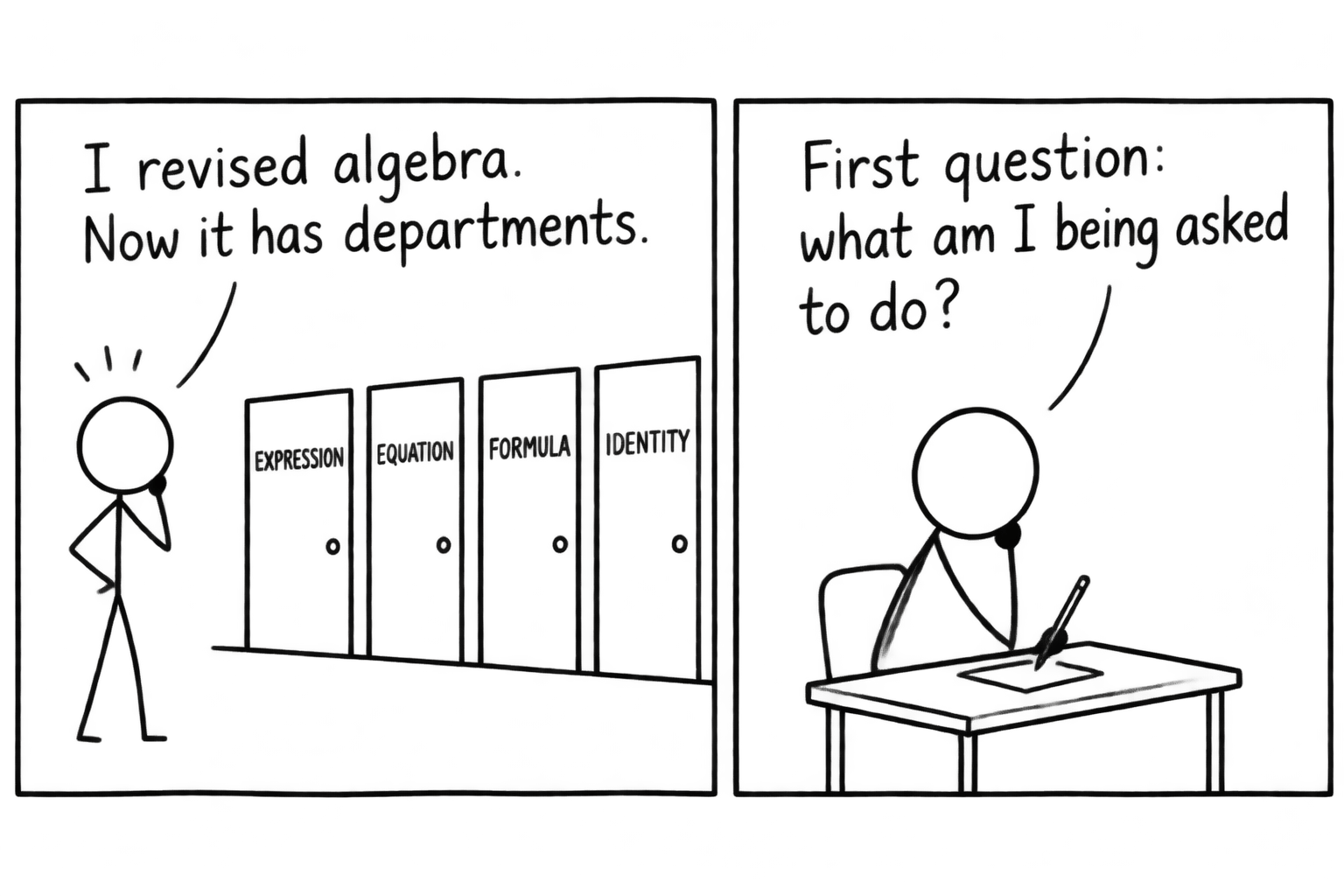 A student discovers that algebra has departments
A dependable exam method
When the student in our example meets an unfamiliar algebra statement, they follow the same order each time:
- Look for an equals or identity sign.
- Count the variables.
- Decide whether the statement is a rule, a condition to solve or something always true.
- Read the command word: simplify, solve, use, rearrange, show or prove.
- Write enough working for the examiner to follow the method.
The command word is often more useful than the appearance of the algebra. You normally simplify an expression, solve an equation, substitute into or rearrange a formula, and prove an identity.
If setting up these distinctions feels slow, use the GCSE Maths lessons and then test the same method in the GCSE Question Bank.
Exam-style question one: classify each statement
The student begins with a direct classification question.
Question: State whether each item is an expression, equation, formula or identity.
5x−75x-75x−7 3x+4=193x+4=193x+4=19 v=u+atv=u+atv=u+at 2(x+3)≡2x+62(x+3)\equiv 2x+62(x+3)≡2x+6Step-by-step answer
The first statement, 5x−75x-75x−7, has no equals sign. It is an expression.
The second, 3x+4=193x+4=193x+4=19, is true only for a particular value of xxx. It is an equation.
The third, v=u+atv=u+atv=u+at, connects several variables through a general rule. It is a formula.
The fourth is true for every value of xxx because expanding the left side gives 2x+62x+62x+6. It is an identity.
A question like this may award one accuracy mark for each correct classification. There may be no separate method mark, which is why precise vocabulary matters. If a reason is requested, include one: writing “it has an equals sign” is not enough to distinguish an equation from a formula or identity.
Exam-style question two: form and solve an equation
The next question hides the equation inside a context.
Question: A rectangle has length x+3x+3x+3 centimetres and width x−1x-1x−1 centimetres. Its perimeter is 282828 centimetres. Find xxx.
Step one: form the equation
The perimeter is twice the length plus twice the width:
2(x+3)+2(x−1)=282(x+3)+2(x-1)=282(x+3)+2(x−1)=28This line is important. Even if the student later makes an arithmetic error, a correct equation may earn a method mark.
Step two: expand and simplify
2x+6+2x−2=282x+6+2x-2=282x+6+2x−2=28 4x+4=284x+4=284x+4=28Step three: solve
4x=244x=244x=24 x=6x=6x=6The student checks the result. The length is 999 centimetres and the width is 555 centimetres, giving a perimeter of 282828 centimetres.
A typical mark scheme might recognise the correct equation, a valid solving process and the correct final answer separately. That is why jumping straight to x=6x=6x=6 is risky. Visible working protects method marks.
The core technique is covered on the Forming and Solving Equations lesson page. You can also work through the Solving Equations exam booklet for focused practice.
Exam-style question three: prove an identity
The final question looks like an equation, but the command word changes the task.
Question: Prove that
(2x+3)(x−4)+x(x+1)≡3x2−4x−12(2x+3)(x-4)+x(x+1)\equiv 3x^2-4x-12(2x+3)(x−4)+x(x+1)≡3x2−4x−12The student does not try to solve for xxx. An identity must work for every value, so the aim is to transform one side into the other.
Step one: expand the first pair of brackets
(2x+3)(x−4)=2x2−8x+3x−12(2x+3)(x-4)=2x^2-8x+3x-12(2x+3)(x−4)=2x2−8x+3x−12 (2x+3)(x−4)=2x2−5x−12(2x+3)(x-4)=2x^2-5x-12(2x+3)(x−4)=2x2−5x−12Step two: expand the remaining product
x(x+1)=x2+xx(x+1)=x^2+xx(x+1)=x2+xStep three: combine like terms
2x2−5x−12+x2+x2x^2-5x-12+x^2+x2x2−5x−12+x2+x =3x2−4x−12=3x^2-4x-12=3x2−4x−12This matches the right-hand side, so the identity has been proved.
Method marks could come from a correct bracket expansion and a valid attempt to collect like terms. The final accuracy mark would normally require the fully simplified expression. Substituting one value of xxx is not a proof: it checks only one case, while an identity must hold for every permitted value.
For extra fluency, practise the underlying skill with the Expanding and Factorising exam booklet.
How these questions change across GCSE papers
Expressions, equations, formulae and identities appear across foundation and higher tier. The definitions remain the same, but the surrounding algebra becomes more demanding.
A foundation question might ask you to classify statements, substitute into a formula or form a linear equation. A higher-tier question may involve quadratic identities, algebraic fractions, rearranging a harder formula or proving that two expressions are equivalent.
The exam board also matters less than the method. Edexcel, AQA, OCR and Eduqas specifications all expect accurate algebraic vocabulary and manipulation, although question wording and mark schemes differ. Use your board's papers when preparing for the final exam. MathsGenie's GCSE Maths revision hub lets you choose the relevant exam board and find revision resources, past papers and mark schemes.
Common mistakes in these exam questions
Calling everything with an equals sign an equation
An equals sign alone does not settle the classification. Ask whether the statement gives a rule, identifies a particular solution or remains true for all values.
Trying to solve an identity
An identity has no single solution to find. Expand, factorise or simplify one side until it matches the other.
Checking one value instead of proving
If both sides give the same result when x=2x=2x=2, you have checked one case. You have not proved the identity.
Losing method marks by showing no working
Write the equation before solving it. Show bracket expansions. Keep each rearrangement on a separate line. A correct method can still receive credit when a later arithmetic slip occurs, depending on the mark scheme.
Treating an expression as a complete statement
An expression such as 4x+74x+74x+7 has no truth value by itself. Do not write that it is “true” or “false”. It is an algebraic quantity that can be simplified, evaluated or used within an equation.
Turn recognition into reliable exam marks
The student’s progress came from replacing a vague question, “What kind of algebra is this?”, with a short routine: inspect the sign, identify the purpose and obey the command word. Knowing the distinctions is the first step; applying them quickly under exam conditions requires deliberate practice.
Start the matching Maths Genie Lessons, then answer expressions, equations, formulae and identities questions in the Maths Genie Question Bank.