Expanding Double Brackets GCSE Maths Guide
Expanding double brackets GCSE maths made clear with a four-product method, worked examples, common mistakes and exam-style questions for confident revision.

Expanding brackets can feel easy right up to the moment there are two of them. Then signs disappear, terms are missed and a short algebra question becomes a page of crossed-out arrows.
For expanding double brackets GCSE maths, the reliable method is simple: multiply every term in the first bracket by every term in the second bracket, then collect like terms. There are four multiplications. If all four are present and their signs are correct, the rest is usually straightforward. (pearson.com)
Imagine a student called Sam. Sam understands single brackets, but double brackets keep going wrong. Sometimes only three products appear. Sometimes a negative sign vanishes. What finally helps is not a cleverer shortcut. It is a small routine that makes every multiplication visible.
The method at a glance
When expanding two brackets:
- multiply the first term in the first bracket by both terms in the second bracket;
- multiply the second term in the first bracket by both terms in the second bracket;
- write all four products before simplifying;
- collect the two middle terms if they are like terms;
- check every negative sign.
For example, the structure of (a+b)(c+d)(a+b)(c+d)(a+b)(c+d) is:
(a+b)(c+d)=ac+ad+bc+bd (a+b)(c+d)=ac+ad+bc+bd (a+b)(c+d)=ac+ad+bc+bdYou may hear this described as FOIL, meaning first, outside, inside and last. That can help, but the deeper rule is more useful: everything in one bracket multiplies everything in the other. (isaacscience.org)
The skill appears within quadratic algebra and supports later work on factorising and solving quadratic equations. You can review the full topic through the Expanding and Factorising Quadratics lesson. (mathsgenie.co.uk)
Expanding double brackets worked examples
Example with two positive brackets
Expand and simplify (x+3)(x+5)(x+3)(x+5)(x+3)(x+5).
Write the four products separately:
x×5=5x x \times 5=5x x×5=5x x×x=x2 x \times x=x^2 x×x=x2 3×x=3x 3 \times x=3x 3×x=3x 3×5=15 3 \times 5=15 3×5=15Put them together:
(x+3)(x+5)=x2+5x+3x+15 (x+3)(x+5)=x^2+5x+3x+15 (x+3)(x+5)=x2+5x+3x+15Collect the like terms 5x5x5x and 3x3x3x:
(x+3)(x+5)=x2+8x+15 (x+3)(x+5)=x^2+8x+15 (x+3)(x+5)=x2+8x+15This is the point where Sam's work begins to improve. Instead of trying to see the final answer immediately, Sam writes four products first. Accuracy comes before speed.
Example with one negative term
Expand and simplify (2x−3)(x+4)(2x-3)(x+4)(2x−3)(x+4).
Multiply each pair:
2x×x=2x2 2x \times x=2x^2 2x×x=2x2 2x×4=8x 2x \times 4=8x 2x×4=8x −3×x=−3x -3 \times x=-3x −3×x=−3x −3×4=−12 -3 \times 4=-12 −3×4=−12Now combine the results:
(2x−3)(x+4)=2x2+8x−3x−12 (2x-3)(x+4)=2x^2+8x-3x-12 (2x−3)(x+4)=2x2+8x−3x−12Collect the middle terms:
(2x−3)(x+4)=2x2+5x−12 (2x-3)(x+4)=2x^2+5x-12 (2x−3)(x+4)=2x2+5x−12A useful habit is to attach the negative sign to the number before multiplying. Think of the term as −3-3−3, not merely 333 with a subtraction sign nearby.
Once the four-product method makes sense, use the Maths Genie expanding quadratics lesson and practice resources to repeat it until the routine feels automatic.
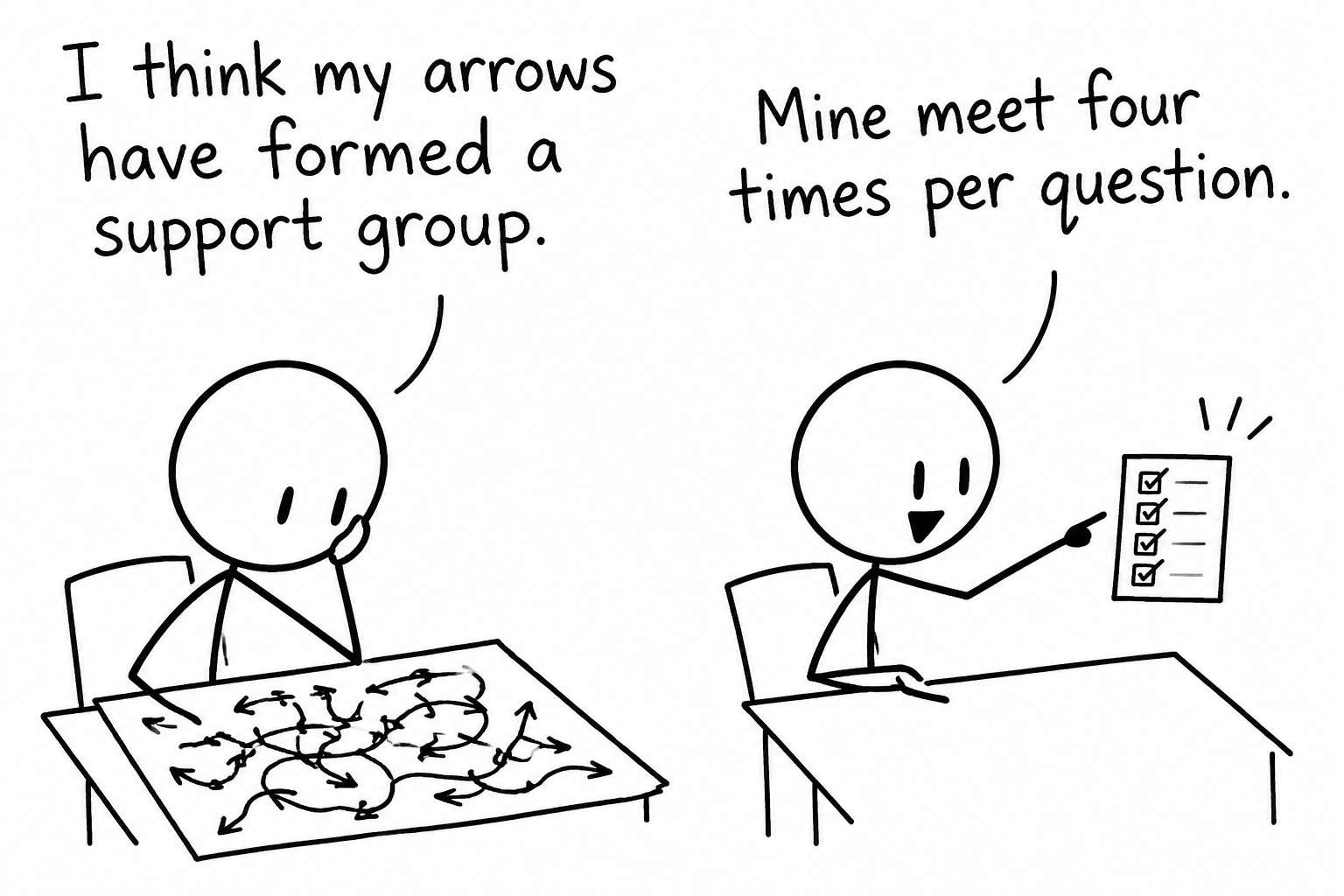 Stick figures joke about tangled arrows while revising double brackets
Example with two negative terms
Expand and simplify (3x−2)(2x−5)(3x-2)(2x-5)(3x−2)(2x−5).
The four products are:
3x×2x=6x2 3x \times 2x=6x^2 3x×2x=6x2 3x×−5=−15x 3x \times -5=-15x 3x×−5=−15x −2×2x=−4x -2 \times 2x=-4x −2×2x=−4x −2×−5=10 -2 \times -5=10 −2×−5=10Therefore:
(3x−2)(2x−5)=6x2−15x−4x+10 (3x-2)(2x-5)=6x^2-15x-4x+10 (3x−2)(2x−5)=6x2−15x−4x+10Collecting like terms gives:
(3x−2)(2x−5)=6x2−19x+10 (3x-2)(2x-5)=6x^2-19x+10 (3x−2)(2x−5)=6x2−19x+10The final constant is positive because multiplying two negative numbers gives a positive result.
Expanding a squared bracket
A squared bracket means that the bracket is multiplied by itself:
(x−6)2=(x−6)(x−6) (x-6)^2=(x-6)(x-6) (x−6)2=(x−6)(x−6)Now apply the same method:
(x−6)(x−6)=x2−6x−6x+36 (x-6)(x-6)=x^2-6x-6x+36 (x−6)(x−6)=x2−6x−6x+36Therefore:
(x−6)2=x2−12x+36 (x-6)^2=x^2-12x+36 (x−6)2=x2−12x+36A common trap is to write (x−6)2=x2+36(x-6)^2=x^2+36(x−6)2=x2+36. This misses both middle products. Squaring a bracket does not mean squaring each term separately.
Why the middle term matters
After expansion, the answer usually has the quadratic form:
ax2+bx+c ax^2+bx+c ax2+bx+cThe x2x^2x2 term comes from multiplying the variable terms. The constant comes from multiplying the numbers. The middle xxx term comes from adding the two cross-products.
For (x+p)(x+q)(x+p)(x+q)(x+p)(x+q):
(x+p)(x+q)=x2+qx+px+pq (x+p)(x+q)=x^2+qx+px+pq (x+p)(x+q)=x2+qx+px+pqSo:
(x+p)(x+q)=x2+(p+q)x+pq (x+p)(x+q)=x^2+(p+q)x+pq (x+p)(x+q)=x2+(p+q)x+pqThis pattern is useful for checking an answer, but it should not replace careful multiplication when coefficients or negative signs become more complicated. Students following AQA can use the equivalent AQA Expanding and Factorising Quadratics lesson, while Eduqas students can revise through the Eduqas quadratic expansion lesson. (mathsgenie.co.uk)
Choose a layout you can check
Arrows are useful until they become difficult to follow. If your working looks tangled, try a multiplication grid instead. Put the terms from one bracket across the top and the terms from the other down the side. Fill each cell with its row term multiplied by its column term. Then collect the results below the grid. This is the same mathematics, organised differently. (pearson.com)
Whichever layout you choose, separate multiplying from simplifying. Trying to combine terms while you are still generating products makes it harder to spot an omission. Give each stage its own line so you can inspect the arithmetic without having to reconstruct your thinking.
During revision, compare two attempts at the same question: one completed slowly with full working, then another completed later without looking back. If the same sign error returns, practise that multiplication rule before tackling more brackets. The aim is not prettier working. It is a method you can trust under exam pressure.
Common mistakes when expanding double brackets
Missing one multiplication
Two terms multiplied by two terms produce four products. If your working contains only three, something has been missed.
Losing a negative sign
In (x−4)(x+2)(x-4)(x+2)(x−4)(x+2), the term is −4-4−4. It produces both −4x-4x−4x and −8-8−8. Carry the sign with the term during every multiplication.
Combining terms that are not alike
Terms such as x2x^2x2 and xxx cannot be combined. Only terms with exactly the same variable and power are like terms.
For example:
2x2+7x−3x=2x2+4x 2x^2+7x-3x=2x^2+4x 2x2+7x−3x=2x2+4xThe x2x^2x2 term remains separate.
Multiplying powers incorrectly
When multiplying 2x2x2x by 3x3x3x, multiply the coefficients and the variables:
2x×3x=6x2 2x \times 3x=6x^2 2x×3x=6x2It is not 6x6x6x because x×x=x2x \times x=x^2x×x=x2.
Stopping before simplifying
An expansion such as x2+7x+2x+14x^2+7x+2x+14x2+7x+2x+14 is mathematically equivalent to the final expression, but an instruction to expand and simplify expects:
x2+9x+14 x^2+9x+14 x2+9x+14Expanding double brackets questions
Try these without looking at the answers. Show the four products for each one.
- Expand and simplify (x+2)(x+7)(x+2)(x+7)(x+2)(x+7).
- Expand and simplify (x−4)(x+3)(x-4)(x+3)(x−4)(x+3).
- Expand and simplify (2x+1)(x−5)(2x+1)(x-5)(2x+1)(x−5).
- Expand and simplify (3x−2)(2x+7)(3x-2)(2x+7)(3x−2)(2x+7).
- Expand and simplify (2x−3)2(2x-3)^2(2x−3)2.
Answers
- x2+9x+14x^2+9x+14x2+9x+14
- x2−x−12x^2-x-12x2−x−12
- 2x2−9x−52x^2-9x-52x2−9x−5
- 6x2+17x−146x^2+17x-146x2+17x−14
- 4x2−12x+94x^2-12x+94x2−12x+9
If an answer is wrong, do not simply copy the correct expression. Return to your four products and identify the exact multiplication where the error began. That is how Sam turns each mistake into something useful.
For more exam-style practice, work through the Expanding and Factorising Quadratics Question Bank, where worked solutions and mark schemes help you compare your method as well as your answer. If double brackets still feel like too large a jump, revisit the Expanding and Factorising foundations lesson first. (mathsgenie.co.uk)
Make the method stick
Sam's turning point is modest but important: four products are written every time, signs are checked before terms are collected, and incorrect answers are traced back to one multiplication. Knowing the method takes a few minutes. Following it consistently takes purposeful practice.
Your turn. Start the Expanding and Factorising Quadratics Lessons and Question Bank and practise the four-product method until every term has somewhere to go.