Exam Countdown: GCSE English Language and Literature
Exam countdown GCSE English Language and Literature: see when a timer motivates, when it adds pressure, and how to build a calmer GCSE revision plan.
A countdown can make an exam feel real. That can be useful when revision has remained something you will start “soon”. It can also make every passing day feel like evidence that you are falling behind.
So, does an exam countdown for GCSE English Language and Literature help? The short answer is: it helps when it turns time into clear, manageable actions. It adds pressure when it simply displays a shrinking number without showing you what to do next.
For students also preparing for GCSE maths, the distinction matters. English Language, English Literature and maths each demand different kinds of practice. A good countdown helps you distribute attention across them. A bad one encourages panic, comparison and last-minute revision marathons.
A quick countdown checklist
A countdown is probably helping if it:
- reminds you to begin a specific task;
- supports a realistic weekly plan;
- includes rest, school commitments and other subjects;
- measures completed practice, not just remaining days;
- can be hidden when you need to concentrate;
- leaves room to adjust after illness or a difficult week.
It may be adding pressure if you:
- check it repeatedly without revising;
- feel guilty whenever the number changes;
- sacrifice sleep to “catch up”;
- compare your timetable with somebody else’s;
- revise only the nearest exam and neglect later papers;
- treat one missed session as proof that the whole plan has failed.
The countdown itself is neutral. What matters is the behaviour it creates.
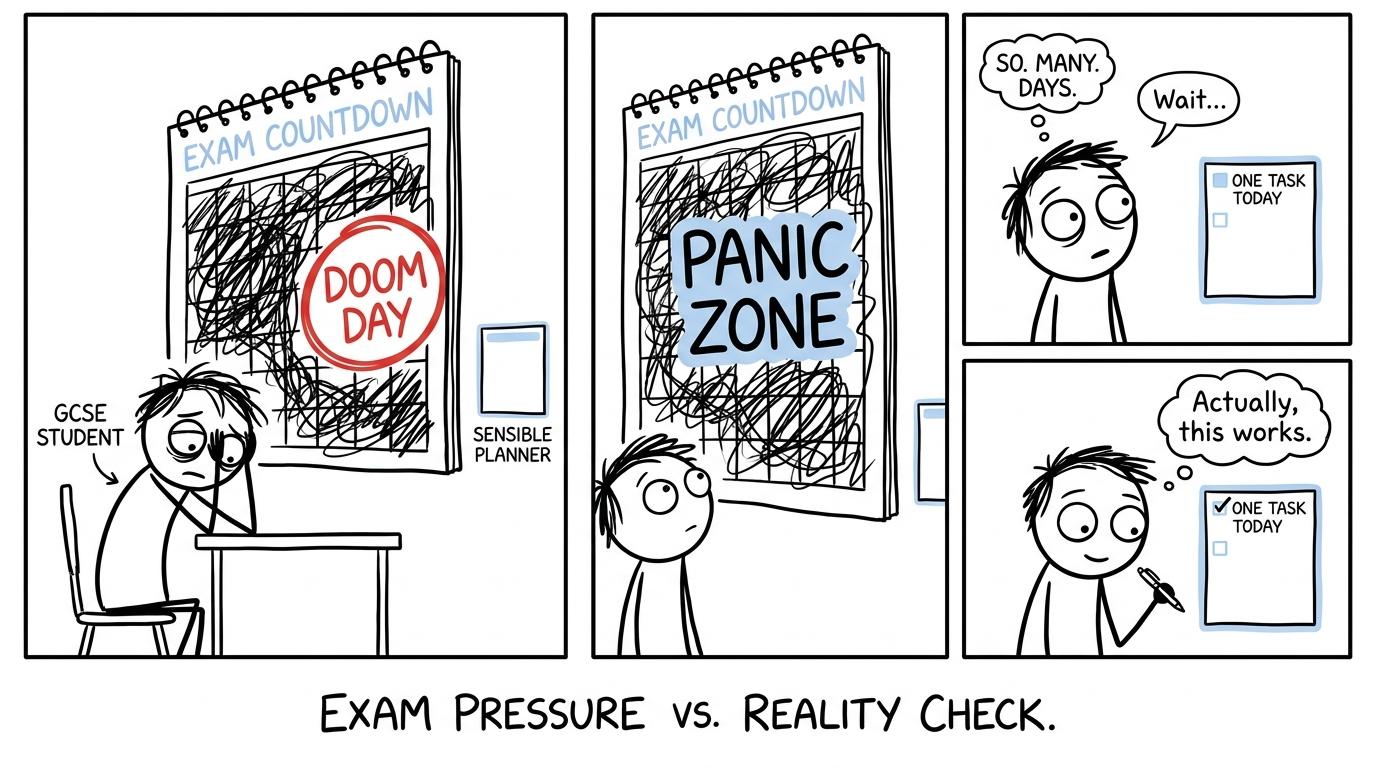 A student chooses one useful task over an enormous dramatic exam countdown
Why an exam countdown can improve revision
Deadlines give vague intentions an edge. “I should revise English” asks little of you. “I will plan one Literature response after school” gives you somewhere to begin.
A visible exam date can also help you work backwards. English Literature may require knowledge of set texts, themes, characters and relevant quotations. English Language revision tends to involve reading unfamiliar material, analysing writers’ methods, comparing texts and practising extended writing. These cannot all be completed effectively in one final weekend.
Maths creates a similar planning problem. You need time to revisit knowledge, answer questions without support, mark the work and return to errors. MathsGenie’s GCSE maths revision resources organise topics by grade, making it easier to turn a distant maths exam into a sequence of smaller decisions.
A useful countdown therefore does not say only, “Time is running out.” It says, “This is the next piece of work.”
It can protect time for every subject
The nearest exam often feels like the only exam. That is understandable, but it can distort a revision plan. Spending every evening on English because its paper comes first may leave large gaps in maths preparation.
Instead, look at the whole exam period. Your school’s individual timetable should be your main reference because entries and dates depend on your qualifications and exam boards. English Language and English Literature are separate GCSEs, while GCSE maths has foundation and higher tiers. English does not use the same foundation and higher tier structure.
Once the dates are confirmed, assign revision sessions across all subjects. A short English Language task and a focused maths topic can coexist in the same week. Balance is usually more sustainable than allowing one subject to consume every available evening.
It encourages earlier exam practice
Knowing the date can create a sensible point at which to move from learning content towards timed practice. For maths, Edexcel GCSE past papers, AQA GCSE past papers and OCR GCSE past papers allow you to practise the format relevant to your entry.
Past papers are most useful when they produce information. Marking a paper reveals whether marks were lost through missing knowledge, an incorrect method, weak notation, poor timing or a misread question. The next revision session can then respond to that evidence.
The same principle applies to English. Completing an answer is only the first step. You also need to consider whether it addressed the exact question, used evidence effectively and maintained a clear line of argument.
When a countdown starts adding pressure
A countdown becomes unhelpful when it measures threat rather than progress. A large number may initially feel harmless. As it falls, it can begin to represent every topic not revised, every quotation not remembered and every practice paper not attempted.
That feeling is not a reliable measure of preparation. A student can feel nervous and still be working effectively. Another can feel calm because they are avoiding the task. Emotions matter, but they are not a mark scheme.
The number is too visible
A countdown on a phone’s home screen can be checked dozens of times without prompting useful action. If each glance creates tension, move it into your planner and check it only during a weekly review.
You do not need to remain constantly aware of the exam date. During a revision session, your attention belongs on the current task. The deadline has already done its job by helping you choose that task.
The plan assumes perfect weeks
Revision plans often fail on paper before they fail in real life. They account for school and homework but ignore travel, meals, tiredness, family commitments and rest. One disruption then pushes every later task out of place.
Build spare capacity into the week. If everything goes to plan, use that space for retrieval practice, a mini test or rest. If something changes, the plan can absorb it without turning one missed session into a crisis.
It encourages quantity over quality
A countdown can make students chase visible volume: more hours, more pages and more highlighted notes. Yet revision is valuable only when it improves what you can understand, recall or do.
For maths, answering questions is generally more revealing than rereading a method. MathsGenie’s topic pages combine revision lessons, practice questions and video support so that you can move from explanation to independent practice. If you are rebuilding essential knowledge, the Grade 4 GCSE maths topics provide a structured starting point. Students aiming to strengthen higher-grade content can use the Grade 5 topic collection before moving further through the grade sections.
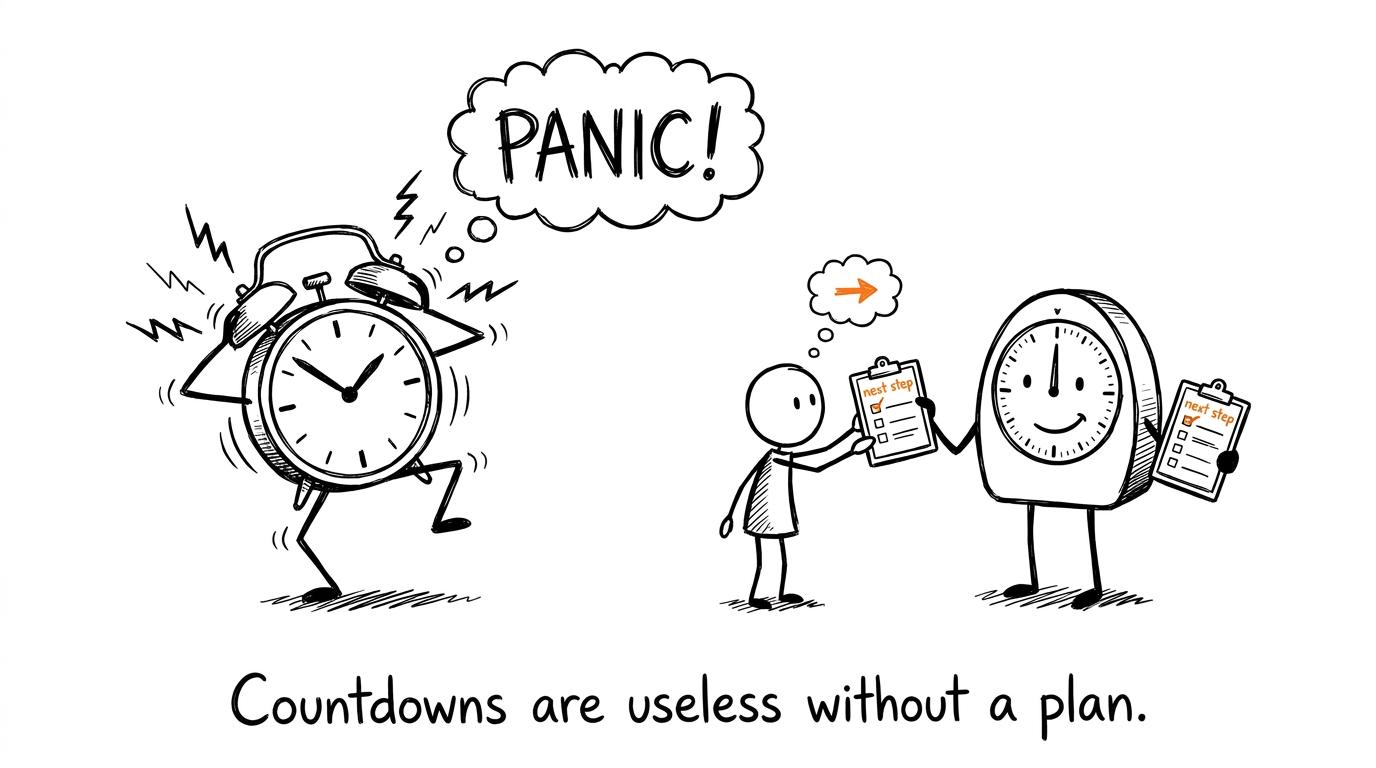 A student chooses a calm checklist while an alarm clock shouts about panic
How to make a GCSE exam countdown useful
The most effective countdown has two layers: the date and the next action. The date provides direction. The action produces progress.
Start with confirmed information
Do not rely on a social-media graphic or a friend’s countdown. Check the timetable supplied by your school and confirm the exam board and paper. Edexcel, AQA, OCR and Eduqas specifications and timetables are not interchangeable.
Record every paper, not merely the first English or maths exam. Literature papers may cover different set texts or components, while Language papers test different combinations of reading and writing. Maths is normally assessed across several papers, and your revision should continue after the first one.
Official arrangements can change, so follow information from your school and awarding body rather than an old online calendar.
Convert weeks into outcomes
Give each week a small set of priorities. These might include:
- revisiting one English Literature theme;
- planning an English Language writing response;
- completing one maths topic mini test;
- marking a section of a past paper;
- correcting errors without looking at the original solution;
- revisiting a weak topic later in the week.
Keep the list short enough to complete. An ambitious plan that is repeatedly abandoned teaches you to distrust your timetable. A modest plan completed consistently creates useful momentum.
Use traffic-light decisions carefully
You can label topics green, amber or red, but base the colour on evidence. A topic is not green because the notes look familiar. It is green when you can answer suitable questions independently and explain the method clearly.
Red topics require attention, but not all deserve equal time. Prioritise content that appears in your specification, supports several other skills or is currently preventing access to exam questions. MathsGenie’s free GCSE revision hub can help you locate an explanation and relevant questions without searching across unrelated resources.
Schedule full papers at the right stage
Full papers are helpful, but beginning with them too early can be discouraging if several topics have not yet been covered. Start with targeted questions, then mixed sections, and finally complete papers under timed conditions.
Closer to the exams, MathsGenie predicted papers can provide additional practice alongside official past papers. Predicted papers are practice resources, not promises about the questions that will appear. Use them to rehearse methods, timing and decision-making rather than trying to guess the exam.
Keep English and maths revision in balance
English and maths can compete for time because progress looks different in each subject. In maths, a completed question has a visible answer. In English, improvement may appear through a more precise interpretation, stronger paragraph structure or better-controlled writing.
Do not force both subjects into the same revision method. English may need quotation retrieval, essay planning, close reading and timed writing. Maths needs frequent problem solving, correction and repetition across different question forms.
A practical weekly plan might alternate demanding tasks rather than stacking them. After extended English writing, a short set of focused maths questions may be more manageable than another essay. After a full maths paper, retrieving Literature quotations could provide a useful change of pace.
The goal is not to make every day identical. It is to keep both subjects moving.
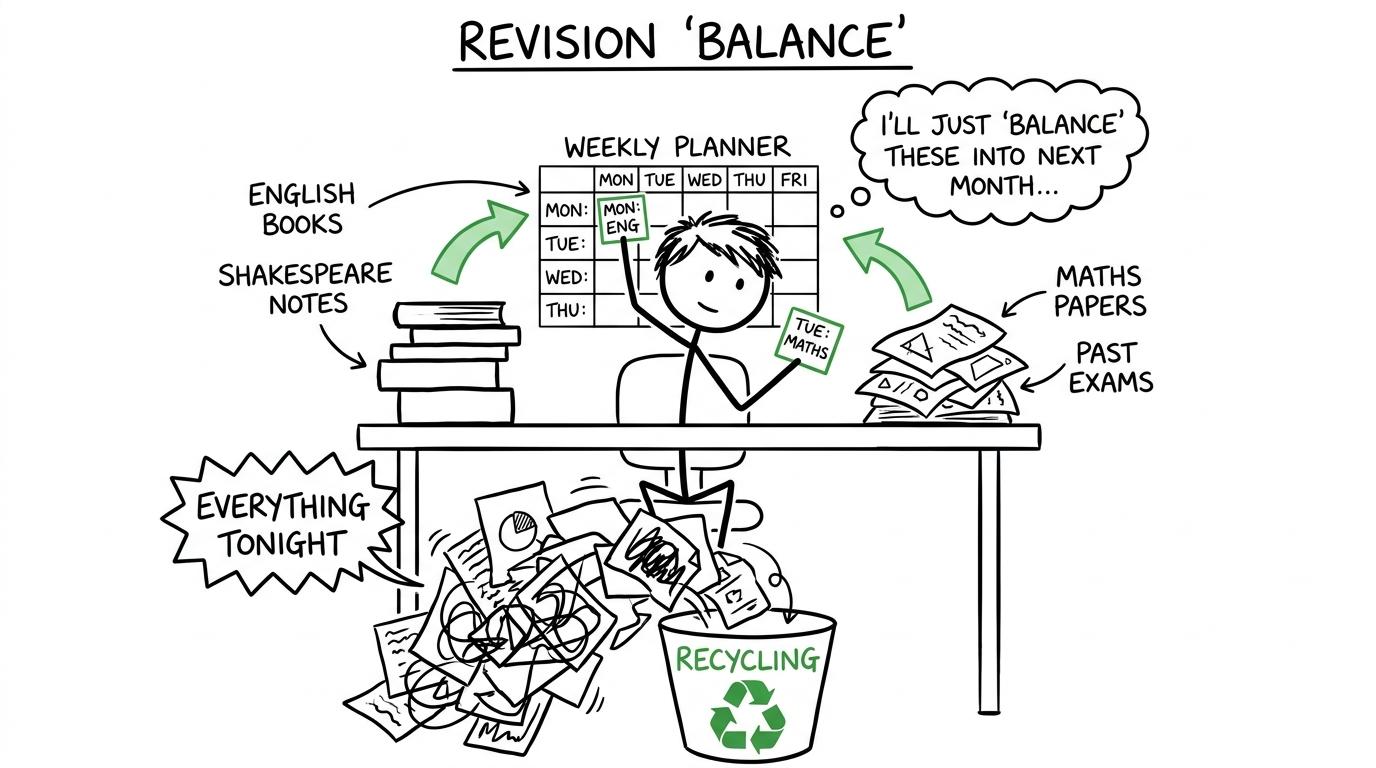 A student calmly balances English books and maths papers in a weekly planner
Common countdown mistakes
Counting days instead of sessions
Not every day contains the same available time. Count realistic revision opportunities and decide what belongs in them. This produces a more honest plan than treating every calendar day as fully available.
Planning every minute
A timetable with no flexibility breaks easily. Leave gaps for unfinished work, unexpected commitments and recovery. Rest is part of a sustainable revision plan, not a reward for reaching exhaustion.
Restarting after one missed task
Do not redraw the entire timetable each time something slips. Move the most important task, remove a low-priority one and continue. Revision plans should adapt rather than demand perfection.
Using the countdown as a comparison tool
Another student may have different subjects, texts, tiers, responsibilities and areas of confidence. Their number of completed papers tells you little about what your next step should be.
Ignoring rising anxiety
If the countdown is affecting sleep, concentration, eating or day-to-day life, remove it and speak to a trusted adult, teacher or pastoral member of staff. Seeking support is a practical response, not a failure of discipline. Urgent or persistent concerns should be discussed with an appropriate health professional.
Turn the countdown into a next step
A countdown cannot revise for you. Its only useful role is to make the next decision clearer.
Confirm your timetable. Choose a small number of weekly outcomes. Practise actively. Mark what you complete, return to mistakes and adjust the plan without treating every disruption as a disaster. If the countdown creates more fear than action, hide it. The exam date will remain the same, but your attention can return to the work in front of you.
For maths, begin with MathsGenie’s free revision lessons and practice questions, then build towards mini tests, past papers, mark schemes, video solutions and predicted papers. Use the revision structure to identify one weak area today rather than worrying about every possible question at once.
The number of days remaining is not your grade. What matters is how calmly and deliberately you use the next one.